Showing posts with label As a Driven Leaf. Show all posts

Friday, January 8, 2021

The Joy-Drenched Essence of All Things


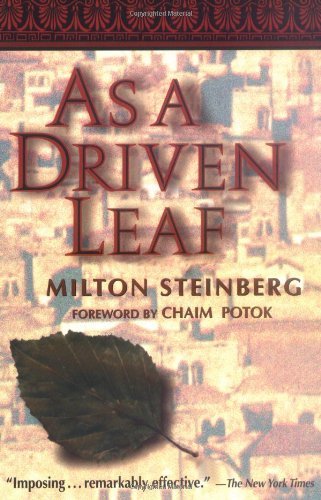
Milton Steinberg's powerful novel about the rabbinic heretic, Elisha ben Abuyah, contains this remarkable description of the biblical--and rabbinic--worldview:
"Inevitably, contrasts suggested themselves between this [Greek] literature and that Scripture to which so many years of Elisha's life had been dedicated. It was a sternly earnest book, that of the Jews, and yet animated for all its dour austerity by a confident serenity which the Greeks seemed never to experience. For, given its presuppositions, all things were good by virtue of the God who pervaded them. There was for men no burning urgency in the quest for the fugitive experience. Love and laughter were but transient manifestations of the joy-drenched essence of all things." - Milton Steinberg, As a Driven Leaf (Behrman House, 1939), 354.
I first finished reading As a Driven Leaf ten years ago today, and blogged about it here, here, and here. (I see that I was struck by this passage the first time through as well.) 

Tuesday, February 9, 2010

As a Driven Leaf - The Ending

This is the last in a series of three posts with excerpts from Milton Steinberg's brilliant novel, As a Driven Leaf. (See here and here for the first two.) In the end, Elisha confesses to his former student, Rabbi Meir, that his quest was "vanity and a striving after wind:
Do you remember, Meir, that epigram quoted in the name of Rabbi Johanan ben Zaccai: "There is no truth unless there be a faith on which it may rest"? Ironically enough the only sure principle I have achieved is this which I have known almost all my life. And it is so. For all truth rests ultimately on some act of faith, geometry on axioms, the sciences on the assumptions of the objective existence and orderliness of the world of nature. In every realm one must lay down postulates or he shall have nothing at all. So with morality and religion. Faith and reason are not antagonists. On the contrary, salvation is through the commingling of the two, the former to establish first premises, the latter to purify them of confusion and to draw the fulness of their implications. It is not certainty which one acquires so, only plausibility, but that is the best we can hope for. (473)
The book celebrates the value of Jewish tradition, but also laments a social context that made no room for questions or for those who asked them:
That is the fantastic intolerable paradox of my life, that I have gone questing for what I possessed initially--a belief to invest my days with dignity and meaning, a pattern of behavior through which man might most articulately express his devotion to his fellows. In a sense it has all been a long arduous journey in a circle, whereby I have returned to my point of departure. And yet I may not enter. For those who live there insist, at least in our generation, on the total acceptance without reservation of their revealed religion. And I cannot surrender the liberty of my mind to any authority. Free reason, my son, is a heady wine. It has failed to sustain my heart, but having drunk of it, I can never be content with a less fiery draught. (474)
The book concludes with Rabbi Meir weeping on his master's grave:
Thunder rolled in the misty vault of the heavens. From the cemetery down the hill, from the grave at his feet and from out dead yesterdays ghosts came stealing. And he wept not alone for his master, but for himself as well, for a woman who rarely smiled, for sweet children who slept near by, for a people crushed and persecuted, for all the sons of men, their aches of the body and soul, and their dreams that die. (477)

Monday, February 8, 2010

As a Driven Leaf - Comparing Traditions

The last post on Milton Steinberg's As a Driven Leaf described his protagonist's Cartesian quest for certainty. Years later, well into his grand project, Elisha compares the Greek classics with Hebrew Scripture:
And yet for all its blitheness, the verse of the Greeks saddened him too. There was in it, he came to feel, stark fear, artfully concealed. It had about it an aura of yearning and regret. Beneath its gaiety, melancholy stirred, the more desperate because unspoken. And with time he came to understand the great hopelessness that breathed through these polished cadences. The poet loved life so ardently because in the end he despised it for its meaninglessness and futility. . . . Inevitably, contrasts suggested themselves between this literature and that Scripture to which so many years of Elisha's life had been dedicated. It was a sternly earnest book, that of the Jews, and yet animated for all its dour austerity by a confident serenity which the Greeks seemed never to experience. For, given its presuppositions, all things were good by virtue of the God who pervaded them. There was for men no burning urgency in the quest for the fugitive experience. Love and laughter were but transient manifestations of the joy-drenched essence of all things. Wistfully Elisha admitted that, so regarded, the world he had elected was less happy and buoyant and . . . less merciful than that which he had rejected. (354)

Sunday, February 7, 2010

As a Driven Leaf Revisited - The Quest

As I mentioned earlier, Milton Steinberg's novel, As a Driven Leaf (Behrman House, 1939), offers a sympathetic portrayal of 2nd century rabbinic Judaism. Even more remarkable is its sympathetic portrayal of the Roman world: Steinberg was a Conservative Jewish Rabbi writing during the Shoah, but he makes his readers care about his main character, an apostate Jew who abandoned his belief in God and betrayed his people.

But therein lies its brilliance. Because we like Elisha ben Abuyah and sympathize with his quest for certainty, we are moved more profoundly by his tragic failure. As one reviewer put it: "Perhaps so completely frustrated a life has never before been presented in fiction. Sheer beauty!"

Elisha claims Euclid's geometry as the inspiration for his quest, but Steinberg is thinking of Descartes and the European Enlightenment:
I am seeking a theology, a morality, a ritual, confirmed by logic in the fashion of geometry so that one need not forever wonder whether what he believes is true. . . . Of course, the price is high. But that makes no difference. According to our sacred literature there once was a man called Job who stood before the inscrutable universe and demanded an answer to its mystery. It did not reply. Therefore he repeated his question, hurling it again and again into its unresponsive face. And when his friends protested that he was destroying himself by his obduracy, he turned and challenged the Presence behind things--"Wherefore," he demanded, "hidest Thou Thyself from me? Wilt Thou harass a driven leaf?" I know how he felt. The great curiosity is like that. It is not a matter of volition. It is stark inner compulsion, dire necessity. And he against whom it moves has no more choice than a leaf driven in a gale. No, there is no retreat. Forward is the only way. . . . My procedure has been ever to try to demonstrate predetermined conclusions, the doctrines of Tradition. I have spoken glibly about the method of Euclid without ever applying it seriously. If I am driven to it, I shall do exactly as does the geometry book. I shall lay away all beliefs, principles and affirmations, and set out afresh accepting only what is as thoroughly self-evident as the axioms and postulates of mathematics . . . (201-3).
To be continued...since if you are like me you tend to skim or skip long posts, and the quotations to come deserve individual attention.