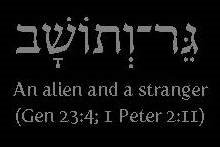
I've been using Unicode when I work with Greek and Hebrew since the turn of the millenium. Unicode is great for all the reasons stated here. It is especially nice for Hebrew, because it keeps the correct right-to-left word order when there is a line break in the middle of a string of Hebrew text.
The problem--in my limited experience--is that most publishers remain wedded to legacy fonts. Until publishers and editors get on board, it is not true that "Unicode Fonts Unite Biblical Studies."
Wednesday, November 5, 2008


Monday, November 3, 2008
John Goldingay on Evangelicals and Scripture
I was preparing a rant--a, uh, pep talk--to deliver to my Gospels students as feedback on their first essays, when I read this, which says it for me:
If there are no aspects of scripture that they do not like and do not have to wrestle with, then they are kidding themselves. It means that they have bracketed them out or reinterpreted them. That is what as evangelicals we have to do. We know we have to accept all of scripture, so we make it mean something else so we can accept it. As a Bible teacher one of my basic concerns has become simply to get people to read the Bible with open eyes. Some people learn to, others do not. I want people to read the Bible, to be open to finding there things that they had not realized were there, to be enthralled and dazzled and appalled and infuriated and puzzled and worried and stimulated and kept awake at night by these extraordinary words from God, to let their mind and heart and imagination and will be provoked and astonished by them.- John Goldingay, To the Usual Suspects: One Word Questions (Paternoster, 1998), 153-4.
Sunday, November 2, 2008
Calling for a Moratorium on New Commentary Series
I recently checked the list of forthcoming commentaries on Jeremy Pierce's Parableman blog, and discovered 13 on Acts, 4 of which are due out this fall:
A few of the forthcoming commentaries will join my old friends Gaventa, Fitzmyer, Johnson, Cadbury and Lake, Haenchen, Bruce, and especially Barrett, whose dry wit never fails to make me chuckle. Since I am teaching Acts next semester, I expect to purchase Pervo's and Walton's commentaries at SBL, perhaps Parsons' too, and I can't wait until Loveday Alexander's commentary in the reasonable-length Black's series comes out.
But why, friends, do we need a Zondervan Exegetical Commentary to go along with the Baker Exegetical Commentary and the Eerdmans Exegetical Commentary, etc.? Why do we need the 40 or so NT different commentary series on Jeremy's list if not to provide publishing opportunities for scholars and $ for publishers? As Max Weber observed long ago (and I read recently on Ben Myer's blog):
I wish more commentators would begin their writing with the customary apology for writing yet another commentary on this or that book, convince themselves that another commentary is not, in fact, needed and go on to something more productive for scholarship in general, and for the church in particular. What we need from a scholarly angle is more detailed long-term projects that actually make a contribution to knowledge--the kind that don't make money or advance careers in the short term. What we need from a pastoral angle is scholars who are in touch with the needs of the church, who are able to write well. The occasional popular level commentary by a fine scholar is okay, but we don't need 40 on each book.
Loveday Alexander (Black's)When you add in the 2007 contributions by Richard N. Longenecker (Expositor's) and Darrell Bock (Baker Exegetical), that makes 6 commentaries all coming out at more-or-less the same time--as if scholars wanted to be spared the burden of reading each other's work. These commentaries are in addition to the 50+ selected English language commentaries on Acts I included on my Acts syllabus for next semester.
J. Bradley Chance (Smyth & Helwys)
Youngmo Cho (New Covenant)
Joel B. Green (NICNT, to replace F.F. Bruce)
Carl R. Holladay (New Testament Library)
Craig Keener (Eerdmans, not in a series)
Todd Penner (Rhetoric of Religious Antiquity)
Richard Pervo (Hermeneia, Nov 2008)
David Peterson (Pillar, probably late 2008 or early 2009)
Stanley Porter (NIGTC)
Mikeal C. Parsons (Paidaia, Nov 2008)
Eckhard J. Schnabel (Zondervan Exegetical)
Steve Walton, Acts 1-14 (Word, Nov 2008)
Steve Walton, Acts 15-28 (Word, Aug 2009)
J. Weatherley (Two Horizon's)
A few of the forthcoming commentaries will join my old friends Gaventa, Fitzmyer, Johnson, Cadbury and Lake, Haenchen, Bruce, and especially Barrett, whose dry wit never fails to make me chuckle. Since I am teaching Acts next semester, I expect to purchase Pervo's and Walton's commentaries at SBL, perhaps Parsons' too, and I can't wait until Loveday Alexander's commentary in the reasonable-length Black's series comes out.
But why, friends, do we need a Zondervan Exegetical Commentary to go along with the Baker Exegetical Commentary and the Eerdmans Exegetical Commentary, etc.? Why do we need the 40 or so NT different commentary series on Jeremy's list if not to provide publishing opportunities for scholars and $ for publishers? As Max Weber observed long ago (and I read recently on Ben Myer's blog):
“Many elements conspire to render unlikely any serious possibility of a new communal religion borne by intellectuals…. Nor can a religious renascence be generated by the need of authors to compose books, or by the far more effective need of clever publishers to sell such books. No matter how much the appearance of a widespread religious interest may be simulated, no new religion has ever resulted from the needs of intellectuals or from their chatter. The whirligig of fashion will presently remove this subject of conversation and journalism, which fashion has made popular.”Weber's prediction was wrong, but his diagnosis was, I think, correct in this case: Publishers sponsor commentary series because they can be counted on to sell consistently. Most of the commentaries will repeat the tired old comments that everyone else has made already. The result: Whoever wants to research a passage thoroughly has to wade through the sludge of similar material or ignore it altogether. It doesn't help scholarship. It doesn't really serve the church.
I wish more commentators would begin their writing with the customary apology for writing yet another commentary on this or that book, convince themselves that another commentary is not, in fact, needed and go on to something more productive for scholarship in general, and for the church in particular. What we need from a scholarly angle is more detailed long-term projects that actually make a contribution to knowledge--the kind that don't make money or advance careers in the short term. What we need from a pastoral angle is scholars who are in touch with the needs of the church, who are able to write well. The occasional popular level commentary by a fine scholar is okay, but we don't need 40 on each book.
Friday, October 31, 2008
John Goldingay on Worship and Theology
'Know then that Yahweh your God is God,' says Moses, and adds some further theological facts about Yahweh that the people are to know. It sounds like the essence of doing theology, and it is. But the NRSV rightly translates it as 'acknowledging' these facts about Yahweh, not just knowing them. It assumes that theology and commitment are one thing, not two things....When theological students are in the classroom they are not playing academic games. They are worshipping. And when they are in chapel, they are not playing religious games. They are knowing.
- John Goldingay, To the Usual Suspects: One Word Questions (Paternoster, 1998), 152.
- John Goldingay, To the Usual Suspects: One Word Questions (Paternoster, 1998), 152.
Tuesday, October 28, 2008
George Eliot on the Hermeneutical Circle
This quotation from George Eliot's Middlemarch sounds a lot like Schleiermacher's (1768-1834) concept of the "hermeneutical circle":
Here's another dialogue that reminds me of romantic hermeneutics if not Schleiermacher in particular:
Lydgate talked persistently when they were in his work-room, putting arguments for and against the probability of certain biological views; but he had none of those definite things to say or to show which give the way-marks of a patient uninterrupted pursuit, such as he used himself to insist on, saying that 'there must be a systole and diastole in all inquiry,' and that 'a man's mind must be continually expanding and shrinking between the whole human horizon and the horizon of an object-glass' (Penguin Classics edition, 640).I assumed at first that she got it from Schleiermacher himself. Since Eliot translated David Freidrich Strauss's Das Leben Jesu, and Strauss was influenced by Schleiermacher, it makes sense that she read Schleiermacher too. But I can't find any positive evidence that she did. However, we do know that Eliot read Spinoza, and if these two websites are correct it is Spinoza rather than Schleiermacher who first came up with the "hermeneutical circle."
Here's another dialogue that reminds me of romantic hermeneutics if not Schleiermacher in particular:
"I daresay not,' said Dorothea.... 'If you knew how it came about, it would not seem wonderful to you.'
'Can't you tell me?' said Celia, settling her arms cozily.
'No, dear, you would have to feel with me, else you would never know" (822).
Monday, October 27, 2008
John Goldingay on Clergy
"The clergy are simply paid functionaries whose position puts them in greater spiritual danger than anyone else in the church." - John Goldingay, To the Usual Suspects: One Word Questions (Paternoster, 1998), 149.
__________________
Semi-regular blogging will resume eventually.
Semi-regular blogging will resume eventually.
Thursday, October 16, 2008
Briercrest Faculty Blogs
To get my weekly Barth fix, I have subscribed to the new blogs by my theologian colleagues David Guretzki (Theommentary) and Dustin Resch ("...A Resch Like Me").
I've mentioned Old Testament prof Eric Ortlund's blog, Scatterings, before. The only other current faculty blogger I'm aware of is Danny Gamache, our business professor. Danny has been posting to his eponymous blog since the end of 2006. Are there others?
I've mentioned Old Testament prof Eric Ortlund's blog, Scatterings, before. The only other current faculty blogger I'm aware of is Danny Gamache, our business professor. Danny has been posting to his eponymous blog since the end of 2006. Are there others?
Subscribe to:
Posts (Atom)