Showing posts with label Hermeneutics. Show all posts

Saturday, July 30, 2022

Midsummer Reading: Oliver O'Donovan and Ephraim Radner

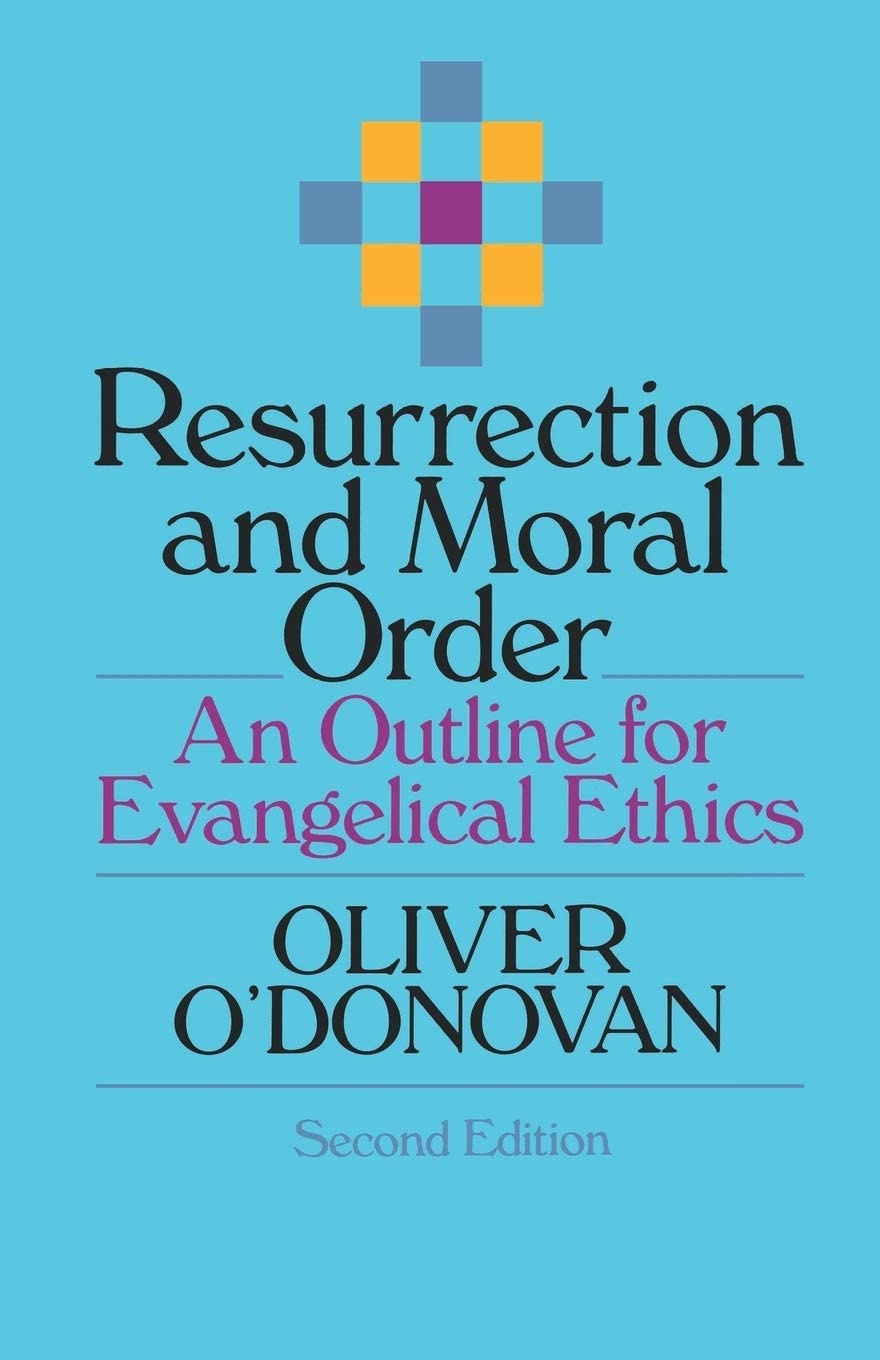
I checked out a copy of Oliver O'Donovan's Resurrection and Moral Order 18 or so years ago on my PhD supervisor's recommendation. As I recall, I got a few dozen pages in before returning it to the library. The book was dense with lengthy excurses in fine print, and I was in my first year of teaching. Maybe also: the book was by a theologian, while I was a freshly-minted Biblical scholar. To be honest, I suspect I was not ready for it.

This summer I checked out the library's copy a second time. Even though I typically only manage a few pages every now and then before bed, I am now about halfway through and find it mesmerizing. Humbling too. It is remarkable how the thirty-one year old O'Donovan was able to range so widely and so authoritatively over such a vast theological, philosophical and biblical terrain, and to do it in such a short compass with such clarity.* 

* A note on clarity: Resurrection and Moral Order is still an academic book with occasional sentences like this one: The value of the voluntarist emphasis lay in its perception that the dialectic between reason and revelation rests not on an accidental deficiency of human reason but on the aboriginal metaphysical fact that human reason is not transcendent. Clarity, I suppose, is in the ear of the listener.

Again and again one encounters convincing explanations of the implications of the death and resurrection of Jesus for Christian behaviour alongside compelling mini-exegeses of biblical passages. I keep telling myself I need to go back and add it to my course notes for several different classes. If this is what theology means, sign me up.
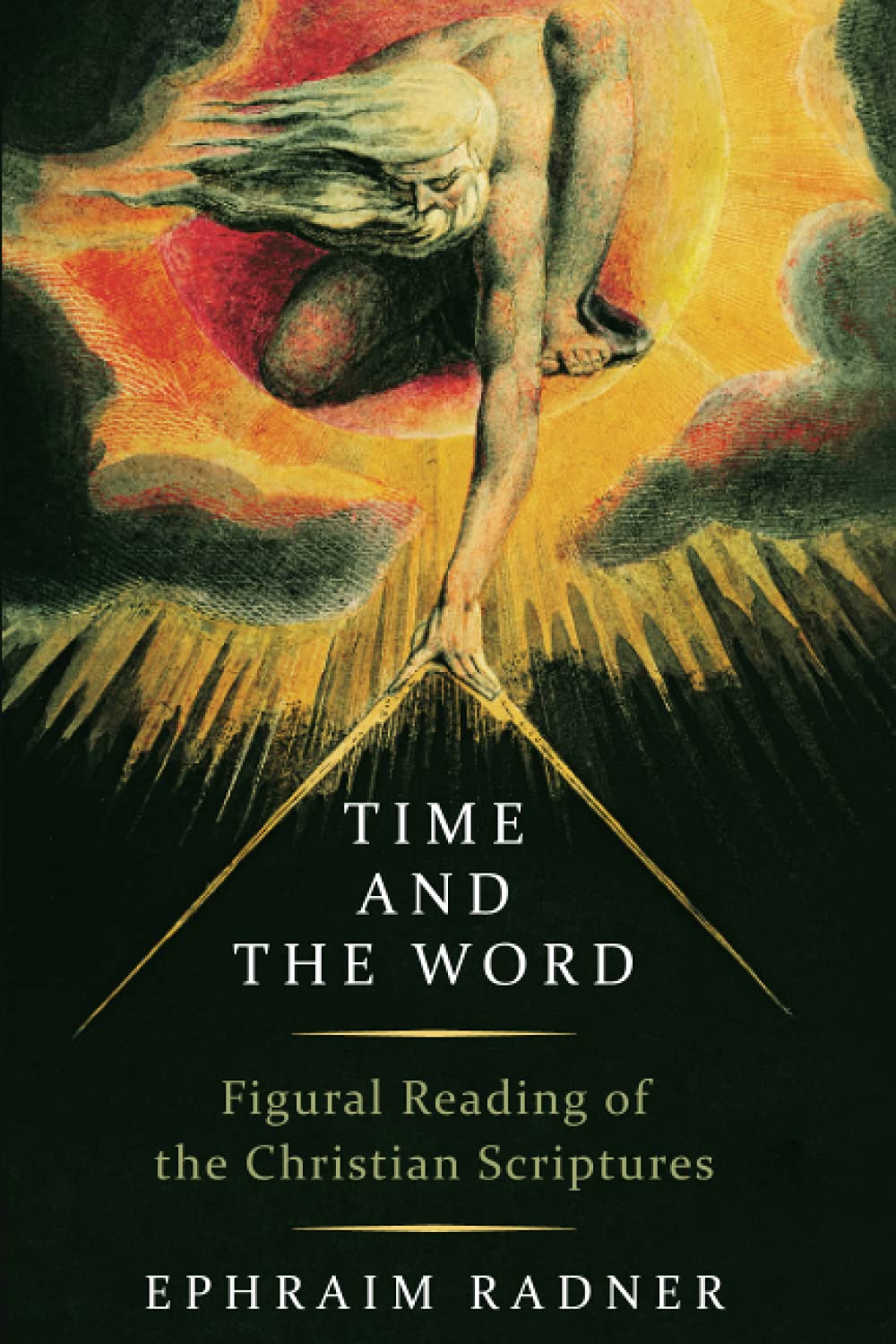
Ephraim Radner's Time and the Word is still beyond me. I purchased an e-copy on sale after a former colleague, who had studied under Radner, enthused about it. Critics complain that Radner's prose is needlessly dense. Time and the Word is a difficult book and, it must be said, it is not a model of clarity. But, as Paul J. Griffiths put it in his review:

“It's a real book, by which I mean that it's the written deposit of concentrated thought about a set of questions as if it were important to approach and answer them rightly. It's something more than journeyman academic work, and something more, too, than the work of someone who cares for the church and wishes to serve her. It has the unusual virtue of combining wide learning, intellectual passion, and devotion to Christ and his church. In reading it, it seemed to me that I was faced with a mind at work on something that matters.” 

Kevin Vanhoozer describes it this way:

“Time and the World is a demanding book: ambitious in scope, theological in substance, counter-cultural in spirit, at turns breath-taking and headscratching in style, yet always urgent and important in its moral and spiritual summons to acknowledge our status as creatures of God’s word.”

The first time I tried, I made it through the first chapter and put it down. I am making another attempt this summer because I really like Radner's two short blog posts (here and here) on “Reading Scripture Well”; I now assign them in my college and seminary hermeneutics classes, and I thought I should learn more about the kind of theological reading he gestures toward in these two popular-level essays. I also wanted to consider the possibility that I might be missing something important.

As a NT scholar by trade and a wanna-be historian, I am not predisposed to allegorical interpretation—what Radner calls 'figural reading'—or to a reclamation of Augustine's neoplatonic speculations about time and eternity, which is what Radner seems to be offering. Yet Radner's historical arguments about how the Bible was read through the early modern period (chap 2) make a lot of sense to this outsider, and his insistence on the present reality of God raises questions about the extent to which my fundamental hermeneutical axiom—reading the Bible historically on its own terms in its own historical and literary contexts—defaults to a human-centred approach that brackets God out of the equation. In short, three chapters in, I feel the force of Radner's attempt to dislodge history as the arbiter of meaning, but the ideas are so mind-blowingly different I'm not sure what to do with them. Still, I can get behind a reading approach that claims:

“Good reading takes us further into, not out of, of Scripture. ... The more our reading has us talking about ourselves, and the less about the Scriptures, the less good it is. ... Good reading, by contrast, leads us to put down stakes in the text. The text itself, after all, is God’s self-presentation. It is not us, not our family, our church, our politics, our situation, nor our intellectual or emotional interests. Good reading, therefore, will lead us to linger over words and phrases, to pause on and circle around events, to wonder about figures, to dwell on questions raised in the text, or on its oddities, amazements, even leaden and intolerable normalcies. ... “[R]eal life,” if Scripture is what I have suggested it is, is to be found in, not outside, of the text. If we must provide a homiletic application of a scriptural text – out of pastoral and circumstantial concern – we must rein it in proportionately. No more than one fifth of a sermon, perhaps, should be applicatory; and we should never leave it to the end, as if it were the sermon’s “point.” It isn’t, at least not if one is preaching on the Bible. Any such applicative “message” is a disappointment in the face of God’s Word! Sermons should begin, stay with, and end with Scripture itself. There’s nothing to worry about at that point: God is acting in his Word, say what we will.” - Ephraim Radner, “Reading Scripture Well (Part 1)

I may not get through either book before the fall semester closes in, but these are, so far, the reading highlights of my summer. 


Friday, July 17, 2020

Introduction to Biblical Interpretation

I'm not big on personal mission statements--unless the quote from Robert Frost in my sidebar counts: 
"My object in living is to unite / My avocation and my vocation / As my two eyes make one in sight."   
But if I were forced to articulate what makes me tick, what gets me up in the morning, it would have something to do with helping students read the Bible carefully and profitably, and helping students experience why it matters. That's why I'm committed to teaching Greek and Hebrew as effectively as I can, and that's why I'm looking forward to teaching a one-week Introduction to Biblical Interpretation modular course at Briercrest Seminary at the end of August. The full syllabus is here, if anyone is interested. 

The course will be offered over Zoom, so you can take it from the comfort of your living room. All you'd need is an internet connection. No travel required.  

Tuesday, May 12, 2020

Iain Provan on Serious Christian Education

“[T]hose who care greatly about the Bible's authority must necessarily care greatly about the Bible's proper meaning, and the elucidation of that meaning requires literary competence at various levels of Bible reading …. It is not by accident that the churches arising out of the Reformation, with their emphasis on sola scriptura, have historically been primary advocates and organizers of education for everyone. The Reformers understood that reading the Bible well required education—not least because the ability to read itself was the necessary prerequisite of Bible reading. We now live in a world, on the other hand, in which many factors currently conspire against literacy in general, even where people are technically capable of reading words on pages. Literary competence certainly cannot be taken for granted, even in general terms; and if people cannot read well in general, it stands to reason that they will not be able to read the Bible well in particular. In such a situation there is a need for the revival of serious Christian education—education that will not so much tell people what to think about the Bible, but will rather enable them to reengage with the Bible …. If, for example, Old Testament narrative is exhausting but also engaging, it is surely no part of the minister's task to try to intervene between the Bible and the congregation in order to make it less so. The task is surely to facilitate the exhaustion and the engagement, so that God may speak to people through the Scriptures as they experience both realities. The task is to teach literary competence with respect to the Bible as much as it is to preach the Bible's message, so that the sheep in our various flocks are not only hearing the word but also themselves reading it with understanding.” - Iain W. Provan,  “Literary Competence and Biblical Authority.” Word & World 26.4 (2006): 375–82, here 382.

Monday, July 16, 2018

Biblical Leadership according to Josephus

In the first half of Flavius Josephus’s twenty-volume Jewish Antiquities, composed in the 90’s CE for a non-Jewish audience, the Jewish historian rewrites the narrative parts of the Hebrew Bible / Old Testament in his own words. Although he claims not to have added or omitted anything, much has changed in the telling. There are entirely new episodes, like Moses’ conquest of Ethiopia at the head of an Egyptian army—the back story, if you will, of the strange biblical reference to Moses’ marriage to a Cushite woman in Numbers 12. There are also major omissions. The golden calf, for instance, has entirely vanished from Josephus’s account. As a Greco-Roman historian, Josephus also follows convention by inventing speeches and attributing them to characters in his narrative.

One such speech that may at first appear to be entirely Josephus’s own creation is Moses’ final address to the Israelites on the eve of their entry into the promised land. In the Bible, Moses’ final speech consists primarily of a review of the wilderness wanderings and a series of laws that take up most of the book of Deuteronomy. Josephus omits the review of events because it duplicates what he has already described; much of the legal material appears in a separate summary of the Jewish national “constitution” that, according to Josephus, Moses presented to the people in a book. This gives Josephus freedom to innovate with the speech itself. The result is a shorter, punchier version that focuses on leadership—a topic that would have resonated with his Roman audience. Here is my slightly paraphrastic attempt at an idiomatic translation of part of the speech:
Now I am leaving you, rejoicing in your good things and entrusting you to the temperance of the laws, to the order of the constitution, and to the virtues of the governors who will take thought for what is profitable for you. And God who has been your ruler until now—and, really, it is a result of his decision that I have been of any use to you—God, I say, will not at this point stop providentially caring for you. No, you will continue to benefit from his thoughtful care as long as you wish to have a benefactor in the ways of virtue—provided, that is, that you remain in the ways of virtue. And the high priest Eleazar, Joshua, and the council of elders, as well as the tribal leaders, will propose the best counsels to you. If you follow their direction, you will experience true happiness (eudaimonia). Listen to them without causing trouble, knowing that all who know well how to be ruled will also know how to rule if they ever come to a position of authority. (Jewish Antiquities 4.184-6)
One might object that Josephus’s focus on human leaders obscures Deuteronomy’s overwhelming emphasis on God, that Josephus’s Moses resembles a Stoic philosopher, and, of course, that the words Josephus attributes to Moses never actually appear in the Bible in this form. Nevertheless, the speech deserves consideration as an interpretation of Deuteronomy, not just as an invention inserted to appeal to Josephus’s first-century audience.

Josephus rarely simply makes stuff up. His rewriting of his biblical source is a thoughtful interpretation that attempts to explain the text (or texts) he had in front of him, often in a surprisingly conservative way. With a few exceptions, Josephus’s imaginative conclusions about what biblical figures must have done and said are matched, I suspect, by popular contemporary interpretations of the Bible. If his revisions to the Bible seem strange, it is because his assumptions are foreign enough for us to notice them, while we tend to ignore the ways our own cultural assumptions influence what we think the Bible says. Indeed, the value of reading Josephus lies in part in his attention to details our own cultural blinders keep us from seeing. As a first-century interpreter, Josephus can also help us understand the basic assumptions and worldview of his contemporaries, including the writers of the New Testament.

I would suggest that the passage I quoted actually distills much of what Deuteronomy says about leadership. In Josephus, as in Deuteronomy, God is presented as the supreme ruler. And Deuteronomy does, after all, have quite a bit to say about human leadership, both directly in instructions about tribal leaders, judges, kings and prophets (Deut 1:9-18; 13; 16:18-20; 17; 18:14-22), and indirectly in its depiction of Moses as a model for other leaders, like Joshua, who will follow him (Deut 3:28; 4:22; 31:23; 34:5-12).
  • Good leaders are characterized by virtue. 
  • Virtue comes from fearing God and following the “temperance of the laws.” 
  • Good leaders, therefore, are those who have learned to follow.
Note that Moses does not encourage the Israelites to become leaders; he exhorts them to follow. As the speech continues, Moses reminds the people of their previous leadership conflicts in the wilderness. Examples of this conflict—including Korah’s revolt, jealousy about the choice of Aaron as high priest (Num 16-17), and the opposition of Zambrias (based on Num 25)—would be fresh in Josephus’s readers’ minds because Josephus has just described them in detail. Leaders are necessary, but in Josephus’s world, too many aspiring leaders results in civil strife.

While the language of “virtue” is obviously influenced by popular Greek philosophical thought, it is well-suited to what Deuteronomy says about the character qualities of leaders. In Deut 16:18-20, for instance, the cardinal Greek virtue of “justice” is given pride of place. Although the term is rare, the same concern for virtue emerges even more clearly in the New Testament, for example in the list of the fruit of the spirit in Galatians 5:22-23, in Phil 4:8 where the word “virtue” (aretê) actually appears, and in the qualifications for church leaders in 1 Timothy and Titus. In the Bible as well as Josephus, leaders are known by their virtue—not their mission, vision, and values. (For an example of why virtue—or “goodness”—is relevant in today’s context, consider Scot McKnight’s reflections on the recent problems at Willow Creek Community Church, which is known to many as the home of the Global Leadership Summit.)

Monday, June 25, 2018

Perspicuity 4: Suspended Reading and Wilful Misunderstanding

I once tried to dignify my typical reaction to reading the Old Testament as “The Spiritual Discipline of Bewilderment.” If I were called upon to teach or preach regularly from the Old Testament, the time and effort expended in careful study would doubtless clarify much of what at first seems confusing. I will gladly grant that specialists in Jeremiah might regard this Old Testament book as more understandable than Romans. But while no real discipline is required to be baffled by an initial encounter with an unfamiliar text, I was trying to get at something important about the posture of faithful reading.

A belief in the “verbal plenary” clarity of Scripture may generate an unhelpful anxiety that leads readers to move too quickly from questions to a premature conclusion about the one definitive right answer. After all, if the whole text is clear, I am at fault for not understanding, right?

I am not denying that correct interpretation is a valid goal and that better understanding is, in most cases, possible. I know from experience that puzzling out difficult texts is both arduous and richly rewarding. Still, there is something to be said for practicing a kind of reading that remains suspended between the question and the answer.

According to Augustine, this is the place to begin:
“In all these books those who fear God and are of a meek and pious disposition seek the will of God. And in pursuing this search the first rule to be observed is, as I said, to know these books, if not yet with the understanding, still to read them so as to commit them to memory, or at least so as not to remain wholly ignorant of them.” - Augustine, On Christian Doctrine, 2.9.14
What I am calling “suspended reading,” N.T. Wright refers to as living uncomfortably with the text:
“I take it as a method in my biblical studies that if I turn a corner and find myself saying, ‘Well, in that case, that verse is wrong’ that I must have turned a wrong corner somewhere. But this does not mean that I impose what I think is right on to that bit of the Bible. It means, instead, that I am forced to live with that text uncomfortably, sometimes literally for years . . ., until suddenly I come round a different corner and that verse makes a lot of sense.” - N.T. Wright, “How Can the Bible Be Authoritative?” 30
Scripture is a multi-faceted splendour that, as Gregory the Great said, is a river where a lamb may wade, and an elephant swim. The pressure to understand may, paradoxically, impoverish reading by leaving no place for wonder, and by making of interpretation an individual pursuit when, to comprehend the text more fully, we need each other’s varied perspectives.

But while it is okay not to understand, and it is important not to rush to easy answers, complaints about the Bible’s complexity are not always innocent. According to Erasmus,
“This doctrine [i.e., the teaching of Scripture] in an equal degree accommodates itself to all . . . . not only does it serve the lowliest, but it is also an object of wonder to those at the top. . . . It keeps no one at a distance, unless a person, begrudging himself, keeps himself away.” - Erasmus, Paraclesis, 96. 

No one put the danger of willful misunderstanding as forcefully as Søren Kierkegaard, and with these two quotes I conclude:
“[I]t is regarded in the world as definitely settled that people would like to know the truth if only they had the capacity and the time for it and if it could be made clear to them. What a superfluous concern, what an ingeniously fabricated evasion! Every human being truly has capacity enough to know the truth …. The one who has any knowledge of himself at all knows from his own experience that it is rather that one has in one’s innermost being a secret anxiety about and wariness of the truth, a fear of getting to know too much.” – Kierkegaard, Christian Discourses, 170 in Westerholm & Westerholm, 340-1.
“Suppose that it was said in the New Testament – we can surely suppose it – that it is God’s will that every man should have 100,000 dollars: do you think there would be any question of a commentary? … But what is found in the New Testament (about the narrow way, dying to the world, and so on) is not at all more difficult to understand than this matter of the 100,000 dollars. The difficulty lies elsewhere, in that it does not please us – and so we must have commentaries and professors and commentaries. … We really wish it to be doubtful, and we have a tiny hope that the commentaries may make it so. … We have invented learning in order to escape from God’s will.” - Kierkegaard, The Last Years: Journals 1853-1855, 334-35 in Westerholm & Westerholm, 347.
Other Posts in This Series:
Perspicuity 1: Is the Bible Understandable?
Perspicuity 2: The NET Bible on Old Testament Obscurities
Perspicuity 3: Limited Clarity, Perspicuous Theology and the Importance of Historical Context 

Works Cited
Augustine, Saint. On Christian Doctrine. Translated by D. W. Robertson. Upper Saddle River, N.J.: Prentice Hall, 1997.

Erasmus. “The Paraclesis.” Pages 97–108 in Christian Humanism and the Reformation: Selected Writings of Erasmus with the Life of Erasmus by Beatus Rhenanus. Translated by John C. Olin. 3rd ed. New York: Fordham University Press, 1987.

Naselli, Andy.  “On Swimming Elephants.” http://andynaselli.com/on-swimming-elephants. (For the Gregory the Great citation and the photo of a swimming elephant.)
Westerholm, Stephen, and Martin Westerholm. Reading Sacred Scripture: Voices from the History of Biblical Interpretation. Grand Rapids: Eerdmans, 2016.

Wright, Nicholas Thomas. “How Can the Bible Be Authoritative?Vox Evangelica 21 (1991): 7–32.

Monday, June 18, 2018

Perspicuity 3: Limited Clarity, Perspicuous Theology and the Importance of Historical Context

In his essay on “The Perspicuity of Scripture,” Wayne Grudem explains that his theological method is an expression of his understanding of the clarity of Scripture:
“The clarity of scripture tells me that its doctrines can be taught in a way that ordinary people are able to understand. ... Neither Jesus nor Paul nor even the writer to the Hebrews felt compelled to make their teaching of doctrine so inaccessible to ordinary Christians, and I wondered if it might be possible to imitate the clarity of Scripture rather than the opacity of [Louis] Berkhof in writing about theology.”
By all accounts Grudem’s Systematic Theology is admirably clear, but there are problems with the analogy:
  1. Conflating Understandability and Clarity: I am convinced that Paul’s letter to the Romans is understandable both in its overall message and in detailed points of argumentation, but that the letter is far from clear to the general reader is apparent from the history of interpretation—and the testimony of my students. 2 Peter 3:15-16 says of the letters of “our beloved brother Paul,” “that there are some things in them hard to understand.” Indeed. Erasmus wrote that “The difficulty of this letter equals and almost surpasses its utility!” This is an overstatement, but my students sympathize. Although Paul no doubt wrote to be understood, Romans does not approach the clarity that Grudem attributes to his own Systematic Theology. Understandability is not the same as clarity.
  2. Confusing Clarity and Accessibility: The little I have read of Berkhof’s Systematic Theology I find very clear indeed, but that does not mean Berkhof’s tome is accessible to those with no academic training. This is because clarity is not the same as accessibility. What is clear to one reader may be opaque to another.
To be fair, Grudem cites 2 Peter 3:15-16 later in the article, he acknowledges that some texts are more difficult to understand than others, and he explains that, in his view, “The clarity of scripture is a doctrine about its understandability, not about how various people actually understand it.” Still, it seems to me that the Systematic Theology analogy is telling. Although Grudem grants that understanding is a process and that it deepens over time, his commitment to the Bible’s complete accessibility leads him to minimize difficulties inherent in reading the Bible.

In my last post, I discussed one way Grudem minimizes difficulties in understanding the Bible. Here I want to respond to Grudem’s suggestion that “historical background information” is unnecessary “for getting a proper sense of a text” by relating this claim to Grudem’s common-sense approach to theology.

Grudem allows that “[s]ome awareness of the wisdom contained in the church’s history of interpretation” is “useful.” His essay interacts with the 1646 Westminster Confession of Faith and cites Mark Thompson’s book on the Clarity of Scripture, which comments on the history of the debate. Nevertheless, Grudem’s discussion of the clarity of Scripture pays insufficient attention to the historical framework within which the doctrine was first articulated. The result, I think, is a case of perspicuity “mission creep” that leads to a new and unhelpful expanded meaning of the term.

In 1516 Desiderius Erasmus expressed his wish for the “Gospels and the Pauline Epistles” to be “translated into all languages so that they could be read and understood,” adding a line that would be taken up by William Tyndale:
“Would that, as a result, the farmer sing some portion of them at the plow, the weaver hum some parts of them to the movement of his shuttle, the traveler lighten the weariness of the journey with stories of this kind!” (Erasmus, "The Paraclesis")
For Erasmus, this does not mean that the meaning of the Bible is completely clear. In a 1524 response to Martin Luther, Erasmus wrote:
“[T]here are some secret places in the Holy Scriptures into which God has not wished us to penetrate more deeply and, if we try to do so, then the deeper we go, the darker and darker it becomes, by which means we are led to acknowledge the unsearchable majesty of the divine wisdom, and the weakness of the human mind. ... [T]here are many passages in the sacred volumes about which many commentators have made guesses, but no one has finally cleared up their obscurity ... yet there are other things which God has willed to be most plainly evident, and such are the precepts for the good life” (Erasmus, “On the Freedom of the Will,” quoted in Thompson 144).
A year later, Luther replied:
“[I]n opposition to you I say with respect to the whole Scripture, I will not have any part of it called obscure. ... Christ has not so enlightened us as deliberately to leave some part of his word obscure while commanding us to give heed to it, for he commands us in vain to give heed if it does not give light” (Luther, “The Bondage of the Will,” quoted in Thompson 147).
By the time the dust had settled at the end of the 16th century, William Whitaker, Regius Professor of Divinity at the University of Cambridge, explained:
“[O]ur fundamental principles are these: First, that the Scriptures are sufficiently clear to admit of their being read by the people and the unlearned with some fruit and utility. Secondly, that all things necessary to salvation are propounded in plain words in the Scriptures. Meanwhile, we concede that there are many obscure places, and that the Scriptures need explication; and that, on this account, God’s ministers are to be listened to when they expound the word of God, and the men best skilled in Scripture are to be consulted.” (Whittaker 1588, quoted in Thompson 153)

According to Thompson, “Whitaker explicitly argued that this was in all respects the same argument as that published by Luther sixty years earlier” (153). Whitaker also anticipated the Westminster Confession, which limits the clarity of Scripture to things that are necessary for salvation. For what it’s worth, Louis Berkhof, writing in 1938, said much the same thing.
Thanks to the historical context, we learn that the classic Protestant formulation of the perspicuity of Scripture was, in effect, a statement about the value of reading Scripture, and a claim that everyone should be allowed to read the Bible for themselves. If Whitaker and Berkhof are correct, affirmations of the clarity of Scripture were always limited and never absolute.

To be sure, the traditional limited view of the Bible’s perspicuity may be mistaken, but it should at least give us pause when we encounter a contemporary theologian who advances what appears to be a new understanding of the term. In this case, I think there are good reasons for retaining the traditional view. Instead of affirming Scripture’s “understandability,” why not simply quote Whitaker or the Westminster Confession?

Believers who regard the Bible as authoritative must not let hermeneutical challenges keep them from saying anything at all. But it won’t do to paper over the complexity within which understanding takes place, and it won’t do to neglect historical context.

Other Posts in This Series:
Perspicuity 1: Is the Bible Understandable?
Perspicuity 2: The NET Bible on Old Testament Obscurities
Perspicuity 4: Suspended Reading and Wilful Misunderstanding   

Works Cited
Berkhof, Louis. Systematic Theology. Grand Rapids: Eerdmans, 1938.
Erasmus, Desiderius. “The Paraclesis.” Pages 97–108 in Christian Humanism and the Reformation: Selected Writings of Erasmus with the Life of Erasmus by Beatus Rhenanus. Translated by John C. Olin. 3rd ed. New York: Fordham University Press, 1987.
Grudem, Wayne. “The Perspicuity of Scripture.” Themelios 34, no. 3 (2009): 288–308.
Grudem, Wayne. Systematic Theology: An Introduction to Biblical Doctrine. Leicester: IVP, 1994.
Thompson, Mark D. A Clear and Present Word: The Clarity of Scripture. Downers Grove: InterVarsity Press, 2006.

Sunday, June 10, 2018

Perspicuity 2: The NET Bible on Old Testament Obscurities

The NET Bible makes up for its overly paraphrastic translation by providing detailed notes that are more helpful for original language work than most commentaries. As I make my way through Old Testament books that I have not read in Hebrew before, I have found I can count on the NET Bible notes to comment on matters of Hebrew grammar, word meanings, and text criticism. Often the notes will include a literal translation and explain the rationale, typically stylistic, for the much smoother NET Bible translation. They also justify textual emendations, and identify when the translation follows the Greek or Syriac, for instance, instead of the Masoretic Hebrew text. In Jeremiah, which I have been reading recently, comments such as the following are not unusual:

(1) Explaining the NET Bible’s substitution of “Zedekiah” for “Jehoiakim” in Jeremiah 27:1:
The reading here is based on a few Hebrew MSS and the Syriac and Arabic versions. The majority of Hebrew MSS and most of the versions read “At the beginning of the reign of Josiah's son, Jehoiakim king of Judah” as in Jer 26:1. The LXX does not have this whole verse. It has long been recognized that the text of Jer 27:1 is textually corrupt. The date formula in the majority of Hebrew MSS at Jer 27:1 is contradictory both with the context of the passage which deals with an event in the reign of Zedekiah ... and the date formula in Jer 28:1 which refers to an event “in that same year” and then qualifies it with “Early in the reign of Zedekiah.” Hence it is preferable to read “Zedekiah” here in place of “Jehoiakim” and explain the error in the Hebrew manuscripts as an erroneous copying of Jer 26:1.
(2) The NET Bible offers this smooth translation of Jeremiah 28:1: “The following events occurred in that same year, early in the reign of King Zedekiah of Judah. To be more precise, it was the fifth month of the fourth year of his reign.” The note explains:
The original text is unusually full here and deemed by many scholars to be corrupt: Heb “And it happened in that year in the beginning of the reign of Zedekiah king of Judah, in the fourth year, in the fifth month Hananiah…said to…” Many scholars see a contradiction between “in the fourth year” and “in the beginning of the reign.” … However, it is just as likely that there is really no contradiction here. I.e., the term “beginning of the reign” can include the fourth year.
(3) The fourth note on Jeremiah 33:5 is just under 600 words long. It provides a literal translation of the Hebrew and Greek texts of Jeremiah 33:4-5, comments on the Hebrew syntax, and evaluates a proposed textual emendation. Here is a sample from the beginning and end of the note:
The translation and precise meaning of vv. Jer 33:4-5 are uncertain at a number of points due to some difficult syntactical constructions and some debate about the text and meaning of several words. … Until a more acceptable explanation of how the difficult Hebrew text could have arisen from the Greek, the Hebrew should be retained, though it is admittedly awkward.
(4) After translating Jeremiah 39:8 as “The Babylonians burned down the royal palace, the temple of the LORD, and the people’s homes…,” the NET Bible notes explain:
The reading here is based on an emendation following the parallels in Jer 52:13 and 2Ki 25:9. The Hebrew text here does not have “the temple of the LORD” and reads merely “house of the people.” The text here is probably corrupt.
In this case, the NET Bible’s reading is harmonized out of thin air because there is no manuscript evidence that supports a reference to the “house of the LORD.” Most English translations stick with a minor shift from a singular house to plural houses, and translate “the king’s house and the houses of the people.”

Since we do not have the ‘original’ text of the Old Testament, it should not trouble us that scholars sometimes declare words or phrases in our surviving Hebrew copies to be corrupt, and defend a reading preserved in another language as more likely to be original. Everyone agrees that the great medieval manuscripts printed in modern editions of the Hebrew Bible have errors. Often the copyists’ mistakes are obvious. Sometimes, as in the examples cited above, there is no consensus, but it is still possible to offer reasons in support of a particular conclusion. All modern translations depart from the Masoretic Hebrew text from time to time, but they often do it silently. The NET Bible is more conscientious than most about letting readers know where and why they have done so.

My point here is not so much to commend the NET Bible notes—although they are a fantastic resource and are freely available online—as to put Wayne Grudem’s comments about the clarity of Scripture in perspective.

In his article on “The Perspicuity of Scripture,” Grudem admits that “There are some places in Scripture where we still are not sure what a certain Hebrew or Aramaic or Greek word means.” So he adds this qualification:
“Scripture is able to be understood everywhere where we are able to translate it accurately; moreover, that the yet-unknown words are relatively few in comparison to the whole scope of scripture, and that even where the meaning of a word is unknown, the sense of the passage as a whole is usually quite understandable.”

As my examples above demonstrate, this is a significant oversimplification. I agree that the general gist of a larger passage is “usually quite understandable,” but uncertainty about the meaning of the Bible often extends beyond individual words, to matters of grammar and the text itself. In most cases, careful readers can still make up their own minds and come to an understanding about the meaning of the text. But decisions are required. If clarity means absence of uncertainty or scholarly consensus, we must conclude that not all the Bible is “clear” in the way Grudem defines it.

And sometimes we have lost the clue entirely. No one reading the NET Bible translation of Jer 40:5 would have any questions about the meaning of “Before Jeremiah could turn to leave, the captain of the guard added, ‘Go back to Gedaliah.’” The note, however, acknowledges that this is not what the Hebrew text says:
The meaning of the first part of v. Jer 40:5 is uncertain. The text is either very cryptic here or is corrupt, perhaps beyond restoration. The Hebrew text reads, “and he was not yet turning and return to Gedaliah” … which is very cryptic.
After working through various possible solutions, the translator concludes, “[I]t is perhaps best to retain the Hebrew and make the best sense possible out of it,” and then adds: “All of this shows that the meaning of the text at this point is very uncertain.”

In other words, not all the parts of the Bible are currently “understandable” in any meaningful sense of the term.

Incidentally, the NET Bible’s evangelical pedigree can be traced back to the faculty at Dallas Theological Seminary. Based on the notes, it appears that the translators would agree with the Westminster Confession’s statement that “All things in Scripture are not alike plain in themselves, nor alike clear unto all.”

Other Posts in This Series:
Perspicuity 1: Is the Bible Understandable?
Perspicuity 3: Limited Clarity, Perspicuous Theology and the Importance of Historical Context
Perspicuity 4: Suspended Reading and Wilful Misunderstanding  

Tuesday, June 5, 2018

Is the Bible Understandable?

If you are like me, the answer to this question seems so obvious your initial reaction is to wonder why anyone would think to ask it. Nevertheless, the question was posed recently, and I want to take some time to reflect on it here.

The obvious answer is “yes.” What motivates my work as a college professor is the conviction that ordinary readers can learn to read and apply the Bible for themselves. I would not have welcomed the opportunity to teach an introductory course on hermeneutics regularly over the last fourteen years if I did not think the Bible was understandable.

But what do we mean when we affirm that the Bible is understandable? I take for granted that the Bible is not always easy to understand, and that reading well requires effort and skill. In my classes I explain that I want my students to develop confidence in their ability to interpret the Bible and at the same time grow in humility as they come to appreciate the complexity of the task and their own human limitations. We see through a glass darkly. Scripture is understandable the way God is understandable, and the self-revealing God is beyond our comprehension.

Does “understandable” allow for this complexity? Can those who affirm the Bible’s “understandability” admit that no one knows what this or that or that Hebrew word means, or confess to being unable to resolve a particular interpretive issue? Must we always arrive at answers, or are we allowed to live with questions from time to time?

I gather that the Protestant doctrine of the Bible’s perspicuity or clarity lies behind the question and the answer it invites. Indeed, in a 2009 article Wayne Grudem proposed using “understandability” as an alternative way of describing the Bible’s clarity.

I am going to argue that this substitution is problematic. “Clarity” and “understandability” mean different things, and conflating them leads to confusion. But if we assume for the moment that when we discuss the Bible’s “understandability” we really mean its “perspicuity,” the natural place to turn is the classic statement in the 17th-century Westminster Confession of Faith:
“All things in Scripture are not alike plain in themselves, nor alike clear unto all: yet those things which are necessary to be known, believed, and observed for salvation are so clearly propounded, and opened in some place of Scripture or other, that not only the learned, but the unlearned, in a due use of the ordinary means, may attain unto a sufficient understanding of them.” (WCF 1.7; online here)
Grudem, however, explicitly rejects the Westminster Confession’s limitation of the Bible’s clarity to “those things which are necessary … for salvation,” and attempts to apply the doctrine in as expansive a way as possible. Grudem grants that understanding the Bible requires effort and time, that other people contribute to understanding, and that our understanding is never complete; he also allows that “there are still today a few words that we are not sure how to translate.” But he insists that if the Bible is authoritative, “clarity” must be affirmed “as a characteristic of Scripture as a whole” and not limited to things that are necessary for salvation: “[T]he meaning of the whole of scripture on many topics is able to be understood by God’s people.” In other words, Grudem defends something like a verbal plenary understandability that extends to (almost) every part of the text.

As a corollary to Scripture’s clarity, Grudem suggests, on the one hand, that “translations should be encouraged,” but he denies, on the other hand, that knowledge of the Bible’s historical context is necessary for understanding—that would put the meaning of the Bible out of the reach of ordinary people.

I share Grudem’s desire to help ordinary people read and understand the Bible. Nevertheless, there are major problems with Grudem’s broad interpretation of the clarity of Scripture. In the next few posts I want to consider weaknesses of Grudem’s approach, explaining why “clarity” and “understandability” should be distinguished, and why the original limited sense of “clarity” as it is presented in the Westminster Confession should be preferred.

Bibliography: Grudem, Wayne. “The Perspicuity of Scripture.” Themelios 34, no. 3 (2009): 288–308.

This is the first post in a series on the perspicuity of Scripture:
Perspicuity 2: The NET Bible on Old Testament Obscurities
Perspicuity 3: Limited Clarity, Perspicuous Theology and the Importance of Historical Context
Perspicuity 4: Suspended Reading and Wilful Misunderstanding 

Sunday, April 29, 2018

Amos Oz and Fania Oz-Salzburger on Hermeneutics

Not surprisingly, Jews and Words, the short collection of essays by the Israeli novelist, Amos Oz, and his historian daughter, Fania Oz-Salzburger, is replete with insightful comments about the process of interpretation:
"We do not oppose the rabbinical habit, old and new, of playing around with the meaning of ancient verses. How can we? In this book we are doing much the same. But there are some differences. Unlike ultra-Orthodoxy, we are not trying to denounce, confine, or silence anyone. More to the point, our approach to the very act of interpretation is different from the traditional rabbis'. For us, the rules are something like this: Read in growing circles around your quotation rather than pluck it out of context. Cherish discovery and surprise more than your own agenda. Acknowledge the shortcomings of texts and authors you love, and the merits of those you dislike. Look hard to see the inner logic of a paragraph, a page, and a chapter." (60-61)

"Reading the words in their contexts, many times over, can reward the reader with an increasing sense of familiarity. Despite recent theoretical skepticism, we do believe that an experienced and sensitive nose can sniff out a trace of the original meaning even of very ancient texts. The original meaning! 'What the author had in mind'! One can smile at a simile, mouth a metaphor, or taste a turn of phrase, getting a sense of what their earliest listeners or readers experienced. We probably miss a great part of the tenor and 'feel' of ancient usage, and often enough we are bound to misunderstand completely, but at times we can grasp it. The careful reader can follow subtle shifts of meaning, trace transformations of a word's role." (158-9).
~ Amos Oz and Fania Oz-Salzberger, Jews and Words (New Haven: Yale University Press, 2012).
On a related note, I am now listening to Amos Oz's memoir, A Tale of Love and Darkness, on my ride to and from the library where I spend my week-days. It is by turns laugh-out-loud funny--which feels a bit strange when I'm cycling along a busy Cambridge street--and heartbreakingly sad. I can't recommend it highly enough.

Friday, March 30, 2018

A Gadamer Cake

I began Hans-Georg Gadamer's Truth and Method in 2008, read a little over 100 pages, and stopped (evidence: here, here and here). The tome languished in my personal library graveyard for unfinished books until this January, when I picked it up again. Completing the final 450 pages almost a decade later feels like an accomplishment worth celebrating. t. suggested a cake, and the conversation quickly turned to what a Gadamer Cake would be like: Dense, I said, and layered. No, not a fruit-cake. It's more substantial than that. It has to be taken in small servings, and it really does a number on your system.

The translator's preface puts it this way: "The book is powerful, exciting, but undeniably difficult. Published when Gadamer was sixty, it gathers the ripe fruit of a lifetime's reading, teaching and thinking."

The book must have been healthy too--Gadamer was born in 1900 and died in 2002. What follows is an excerpt from the 25-page Afterward, first published in 1986 with Gadamer's collected works. This dessert course warns of the dangers of a "scientific" over-reach that forgets its and humanity's own epistemic limits:
"In a time when science penetrates further and further into social practice, science can fulfill its social function only when it acknowledges its own limits and the conditions placed on its freedom to maneuver. Philosophy must make this clear to an age credulous about science to the point of superstition." (556)
The same goes for the social sciences:
"However uncertain are the factual bases on which rational management of social life might be possible, a will to believe impels the social sciences onward and drives them far beyond their limits." (557)
I recall an atheist Canadian New Testament scholar who, rather too conveniently, dismissed hermeneutics as in effect a cover for "theological obscurantism." I expect a similar approach is common to the scientism of the new atheists. Gadamer responds that such a dogmatic refusal to consider the limits of the scientific method is irrational:
"A philosophy of the sciences that understands itself as a theory of scientific method and dismisses any inquiry that cannot be meaningfully characterized as a process of trial and error does not recognize that by this very criterion it is itself outside science. ... By raising 'critical rationality' to the status of an absolute measure of truth, empirical theory of science regards hermeneutic reflection as theological obscurantism. ... What is remarkable is that, for the sake of rationality, theory of science here abandons itself to complete irrationality .... It fails to recognize that it is itself complicit with a much more fatal immunization against experience--for example, against that of common sense and the experience one gains in living. It always does so when it promotes the uncritical expansion of scientific management beyond specific contexts--for example, when it assigns responsibility for political decisions to experts." (558-9)
Quotations are from the second revised edition: Hans-Georg Gadamer, Truth and Method (London: Continuum, 2004).

Tuesday, January 9, 2018

Nonpartisan Evangelical Scholarship Part 4: Donald J. Verseput

Before his untimely death of a brain tumour at age 51, Donald J. Verseput was a professor of New Testament at Bethel Seminary. In addition to the personal loss experienced by his family, the world of biblical studies lost a fine scholar who was "about half-way through" a major commentary on the book of James.

I had the good fortune of having Don as a faculty advisor during his year as a visiting professor at TEDS in 1997-1998. Although I never took a course from Don, he had an extraordinary impact on my education. As I recall, students at TEDS were to meet in “advisee groups” with a faculty member every two weeks. Don took the idea a step further by inviting us to join him for dinner once a week before an evening class. As a relatively unknown visiting professor, Don’s group was small, and I ended up being the only one who was able to accept his invitation. I was surprised that a faculty member would want to spend time with a mere MA student, and impressed to discover a scholar so committed to his family, so down-to-earth, and so candid. A few years later, I met up with Don at my first SBL in Denver 2001, and had to smile when I learned that he had his family—and skis—in tow, and planned to hit the slopes after delivering his paper. What else would you expect from someone who chose to do a PhD at the University of Basel because his family enjoyed skiing?

When in 2004 I heard that Don had passed away, I made a point of reading through some of his published articles. This had the effect of reinforcing what he had said about exemplary scholarship with a series of exemplary models.

To get a sense for the difference between partisan and non-partisan evangelical scholarship, one need only read Don’s response to Craig Blomberg in the 2001 issue of the Bulletin for Biblical Research.

Blomberg’s essay responded to the question, “Where Should Twenty-First-Century Evangelical Biblical Scholarship Be Heading?”, with a laundry list of academic topics that merit more attention by evangelical scholars. For example, work on the historical Jesus needs to be expanded to include the historicity of John’s Gospel and the historicity of the Old Testament; the historical context of the Bible needs to be examined “from an evangelical perspective”; we need an evangelical Hebrew grammar. And so on. These are not necessarily bad ideas, and those who work in the areas Blomberg recommends are not thereby “partisan” as long as they are willing to follow the evidence where it leads. (See F.F. Bruce’s comments in part 1 of this series).

What does strikes me as partisan is the location from which Blomberg surveys the field. Although Blomberg decries closet fundamentalists who are “committ[ed] to sociological separatism” and encourages his fellow evangelicals to “engag[e] the larger, scholarly world,” his comments presuppose and thus reinforce an insider-outsider divide between “us” evangelicals and “the scholarly world in general.”

Unlike Blomberg, Verseput’s reply is marked by a persistent refusal to make distinctions along tribal lines:
  • Where Blomberg called for “a thoroughgoing evangelical study” of Christian ethics to correct the work of Richard Hays, Verseput remarked that Hays, along with the German scholars, Wolfgang Schrage and Rudolf Schnackenburg, “need some help,” and then explained why, and why it matters for the church today. 
  • Wayne Meeks’s sociological study of the earliest Christian churches does not need to be redone “from an evangelical perspective,” it needs to be “updated” with attention to the theological convictions that Meeks overlooked, so that Christians in a post-Christian age can learn from the example of the early church.
Instead of evangelical bona fides, Verseput emphasized quality. Where Blomberg referred repeatedly to “evangelical scholars,” Verseput preferred different adjectives—“rigorous scholarship,” “leading biblical scholars,” “the latest research.” In fact, the word “evangelical” only appears in Verseput’s essay once, as part of a summary of Blomberg’s article. This is not, I take it, because Verseput rejected the label, but because he believed evangelical scholars need to do good scholarly work, and good scholars will necessarily engage and learn from the best contributions of the guild, irrespective of party affiliation.

What should distinguish evangelicals who are biblical scholars, Verseput implies, is not in-house conversations, or footnotes that cite only evangelical publishers, but scholarship that addresses “the needs of the church”: 
"Blomberg himself remarks that our scholarly efforts must "self-consciously serve the most crucial needs of the church of Jesus Christ at home and abroad." But if this is indeed the case, would it not be profitable to pause for a moment to ask what questions the church might have for us?" - Verseput (p. 173) 

Because the church’s needs are vital, Verseput urged Christian scholars to address them with all the academic resources at their disposal. Verseput’s footnotes, as much as the main text of his response, illustrate how he thought this sort of nonpartisan evangelical scholarship should be done.

Bibliography:
Blomberg, Craig L. “Where Should Twenty-First-Century Evangelical Biblical Scholarship Be Heading?” Bulletin for Biblical Research 11.2 (2001): 161–72. (Online here)

Verseput, Donald J. “Considering the Needs of the Church: A Response to Craig Blomberg.” Bulletin for Biblical Research 11.2 (2001): 173–77. (Online here)

Other posts in this series:
Part 1: F.F. Bruce 
Part 2: John Goldingay 
Part 3: N.T. Wright

Monday, January 1, 2018

Nonpartisan Evangelical Scholarship Part 3: N.T. Wright

If John Goldingay's Models for Scripture provided emergency roadside assistance partway through my PhD during my own little crisis of authority (see part 2 in this series), N.T. Wright's “How Can the Bible Be Authoritative?” (Vox Evangelica 21 [1991]: 7–32), has been more of a familiar traveling companion.

I first read Wright's essay shortly after Models for Scripture, and found it to reaffirm in more general terms what Goldingay had said. I have had occasion to reread it often since then because I assign it as a required reading when I teach Hermeneutics.

Whether or not N.T. Wright has succeeded in practice at being nonpartisan (in the sense I am using it), in this essay he defends nonpartisan evangelical scholarship:
"[E]vangelicals often use the phrase 'authority of scripture' when they mean the authority of evangelical, or Protestant, theology, since the assumption is made that we (evangelicals, or Protestants) are the ones who know and believe what the Bible is saying." (9)

"How can we handle this extraordinary treasure, responsibly? First, we have to let the Bible be the Bible in all its historical oddness and otherness. ... God forgive us that we have taken the Bible and have made it ordinary--that we have cut it down to our size. We have reduced it, so that whatever text we preach on it will say basically the same things. ... What we are seeing in such preaching is not the authority of scripture at work, but the authority of a tradition, or even a mere convention masquerading as the authority of scripture--which is much worse, because it has thereby lost the possibility of a critique or inbuilt self-correction coming to it from scripture itself." (23-24)

"If we really engage with the Bible in this serious way we will find, I believe, that we will be set free from (among other things) some of the small-scale evangelical paranoia which goes on about scripture. ... Of course the Bible is inspired, and if you're using it like this there won't be any question in your mind that the Bible is inspired. But, you will be set free to explore ways of articulating that belief which do not fall into the old rationalist traps of [the] 18th or 19th or 20th century. ... Of course you will discover that the Bible will not let you down. You will be paying attention to it; you won't be sitting in judgement over it. But you won't come with a preconceived notion of what this or that passage has to mean if it is to be true. ... I take it as a method in my biblical studies that if I turn a corner and find myself saying, 'Well, in that case, that verse is wrong' that I must have turned a wrong corner somewhere. But that does not mean that I impose what I think is right on to that bit of the Bible. It means, instead, that I am forced to live with that text uncomfortably, sometimes literally for years (this is sober autobiography), until suddenly I come round a different corner and that verse makes a lot of sense; sense that I wouldn't have got if I had insisted on imposing my initial view on it from day one." (29-30)

The substance of Wright's essay reappeared as part of Wright's The Last Word (HarperSanFrancisco, 2005), but the original shorter version is freely available online here.

This is part 2 in a 4-part series:
Part 1: F.F. Bruce 
Part 2: John Goldingay 
Part 3: N.T. Wright
Part 4: Donald J. Verseput  

Sunday, December 31, 2017

Nonpartisan Evangelical Scholarship Part 2: John Goldingay

The single most helpful book I have read on approaching the Bible honestly as a Christian is John Goldingay's Models for Scripture (Eerdmans / Paternoster, 1994). Although it left a lasting impression and I eventually acquired--and then lost and found--my own copy, I have seldom referred to it since I first read it in 2001 or 2002. At the time, however, Goldingay was a good Samaritan who stopped to help a broken-down stranger on a lonely road.

I don't have my copy of Models for Scripture with me to review, reassess, and excerpt. But the gist of Goldingay's nonpartisan approach to the Bible is incapsulated in this reflection on his students: 

If there are no aspects of scripture that they do not like and do not have to wrestle with, then they are kidding themselves. It means that they have bracketed them out or reinterpreted them. That is what as evangelicals we have to do. We know we have to accept all of scripture, so we make it mean something else so we can accept it. As a Bible teacher one of my basic concerns has become simply to get people to read the Bible with open eyes. Some people learn to, others do not. I want people to read the Bible, to be open to finding there things that they had not realized were there, to be enthralled and dazzled and appalled and infuriated and puzzled and worried and stimulated and kept awake at night by these extraordinary words from God, to let their mind and heart and imagination and will be provoked and astonished by them. - John Goldingay, To the Usual Suspects: One Word Questions (Paternoster, 1998), 153-4.
Long-time readers of this blog may recall encountering the same quote back in 2008. My students may recognize the quote from class (where I usually add that I'm not anxious for them to be appalled or infuriated by the Bible). Other references to Goldingay on this blog are collected here.

This is part 2 in a 4-part series:
Part 1: F.F. Bruce 
Part 2: John Goldingay 
Part 3: N.T. Wright
Part 4: Donald J. Verseput 


Thursday, December 28, 2017

Nonpartisan Evangelical Scholarship Part 1: F.F. Bruce

"Nonpartisan," "evangelical," and "scholarship" are, it would seem, three words that do not belong together. In today's political climate when the term "evangelical" appears to be joined at the hip with the Republican party, Scot McKnight advocates abandoning the label, and even Tim Keller wonders if it may have no "ongoing usefulness." (If evangelical means support for Donald Trump, I want no part in it either.)

Evangelical biblical scholarship is alive and well, but it is often regarded as--and dismissed by outsiders for being--partisan. While there is a place for apologetics, I share a distaste for the variety of evangelicalism that reflects a siege mentality, an us-them divide between evangelicals and "secular" critical scholars, and a drive to defend the authenticity of Scripture and certain doctrinal positions that we know to be true.


Rather than being defined by a defensive ethos or by political affiliation, evangelicalism has historically been characterized by four commitments:
 "[A]n evangelical is committed to these four elements: the Bible, the cross as the place of atonement, the necessity of personal conversion, and an active Christian life both in missions/evangelism as well as justice, peace and reconciliation." (Scot McKnight summarizing David Bebbington's quadrilateral)
It is probably safe to say that the term has always been contested by insiders, and viewed with suspicion, if not contempt, by outsiders. And it may be the case that "evangelical" should now be discarded because it no longer conveys anything like Bebbington's quadrilateral.

Nevertheless, in this series I want to show that nonpartisan evangelical scholarship need not be a contradiction in terms, by quoting from scholars who have in the past been willing to identify as evangelical, and who defend a nonpartisan approach to biblical scholarship.

I begin with Frederick Fyvie Bruce, the doyen of an earlier generation of evangelical scholars, who adopted a scholarly posture marked not so much by vigilant defense as by attention—listening carefully to the text and to other people both inside and outside his tradition.


On being an (unqualified) evangelical:
"I am always happy to be called an evangelical, although I insist on being an unqualified evangelical. I do not willingly answer, for example, to such a designation as ‘conservative evangelical’. (Many of my positions are indeed conservative; but I hold them not because they are conservative – still less because I myself am conservative – but because I believe they are the positions to which the evidence leads.)” - F.F. Bruce, In Retrospect: Remembrance of Things Past (Grand Rapids: Eerdmans, 1980), 309.
On the posture of an evangelical scholar:
"A sense of security with regard to the foundations of faith and life encourages a spirit of relaxation with regard to many other matters. I am sure that an inner insecurity is often responsible for the dogmatism with which some people defend positions which are by their nature incapable of conclusive proof: there may be a feeling that, if those positions are given up, the foundations are in danger. I am sure, too, that a similar insecurity is responsible for the reluctance which some people show to acknowledge a change of mind on matters about which they once expressed themselves publicly: they may fear that their reputation for consistency is imperilled if they do . . . . Ultimately, the Christian’s faith is in a Person: his confession is ‘I know whom I have believed’, not ‘…what I have believed’ . . . . With this sense of liberty one can write freely – which is not the same thing as writing irresponsibly. A Christian will consider the probable effect of his words, whether spoken or written. (In Retrospect, 172-3)
On avoiding simplistic harmonization:
“I suppose much depends on the cast of one’s mind, but I have never been bothered by ‘apparent discrepancies’, nor have I been greatly concerned to harmonize them. My faith can accommodate such ‘discrepancies’ much more easily than it could swallow harmonizations that place an unnatural sense on the text or give an impression of special pleading. If the ‘discrepancies’ are left unharmonized, they may help to a better appreciation of the progress of revelation or of the distinctive outlooks of individual writers” (In Retrospect, 312).

 On unfettered evangelical scholarship:
"No such conclusions [he is referring to pre-Vatican II Roman Catholic biblical scholarship] are prescribed for members of the Tyndale Fellowship. In such critical cruces, for example, as the codification of the Pentateuch, the composition of Isaiah, the date of Daniel, the sources of the Gospels, or the authenticity of the Pastoral Epistles, each of us is free to hold and proclaim the conclusion to which all the available evidence points. Any research worthy of the name, we take it for granted, must necessarily be unfettered." (F. F. Bruce, “The Tyndale Fellowship for Biblical Research,” The Evangelical Quarterly 19 (1947) 52-61) (HT: Michael Bird, who got it from Dan Reid)
I should note that I am not sure how representative Bruce was in his day, or how many of his fellow evangelicals supported his manifesto for the Tyndale Fellowship. (Some apparently did not.) But of Bruce's positive influence on evangelical scholarship there can be no doubt.


The above quotes from F. F. Bruce appeared earlier on this blog in 2007 and 2008.

This is part 1 in a 4-part series:
Part 1: F.F. Bruce 
Part 2: John Goldingay 
Part 3: N.T. Wright
Part 4: Donald J. Verseput 

Thursday, May 25, 2017

The Book of Common Prayer and Bible Literacy

I recently stumbled across a 450-year-old "Through the Bible in a Year" reading plan in the 1662 edition of the Book of Common Prayer
"The Psalter shall be read through once every Month, as it is there appointed, both for Morning and Evening Prayer. ... The Old Testament is appointed for the first Lessons at Morning and Evening Prayer, so as the most part thereof will be read every year once, as in the Kalendar is appointed. The New Testament is appointed for the second Lessons at Morning and Evening Prayer, and shall be read over orderly every year thrice, besides the Epistles and Gospels; except the Apocalyps, out of which there are only certain proper Lessons appointed upon divers Feasts."  (pp. 23-24)

The list of daily lectionary readings in the 1662 Book of Common Prayer was taken over more-or-less unchanged from the first 1549 edition. The plan omits the book of Revelation, the subject of controversy in post-Reformation England, and parts of the Old Testament, but makes up for it by reading through the Psalter once every 30-day month and the rest of the New Testament three times in the year. The result is a schedule that is more rigorous than most contemporary Bible reading plans, and, I suspect, significantly more than is expected of churchgoers in most evangelical churches today.

How widely this plan was adopted is another question. For most people in 17th-century England, church consisted of the morning and evening prayer services--Matins and Evensong--but only on Sundays. Most people would not have owned a copy of the prayer book, and most churches did not offer daily services. John Spur notes that "the rector of Clayworth in Nottinghamshire thought himself conspicuously pious when he resolved to read prayers on Wednesdays and Fridays during Lent."*

Nevertheless, the plan had an impact. To take one famous example, the community established by Nicholas Ferrar at Little Gidding "read the regular daily offices of the Book of Common Prayer, including the recital every day of the complete Psalter."** According to Hannibal Hamlin's fine Oxford Handbook article on "Reading the Bible in Tudor England," "apparently many did follow the Prayer Book's 'order howe the Psalter is appointed to be read'" each month. If the BCP's annual reading plan for the whole Bible did not catch on as widely, that may have been because there were other more popular alternatives: "Daily reading of the rest of the Bible was a common practice, but readers could either decide on their own reading plan or follow one of the many available in print."***

Indeed, the BCP's daily lectionary is in many respects characteristic of the dedication to lay Bible reading that both contributed to and resulted from the Protestant Reformation. As a result, as Hamlin puts it, "the Bible permeated almost every nook and cranny of sixteenth-century culture."***

Perhaps there is something to be learned here by Protestant churches today who lay claim to the heritage of the Reformation. Why not take a lead from a 16th-century church willing to instruct its members to read through the Bible every year? I submit that the practice of Bible reading says more about the authority of Scripture than any doctrinal statement.

Saturday, June 25, 2016

Reflections on Hermeneutics and the Purpose of Acts

Recent scholarship on the purpose of the book of Acts is in disarray. I will explain below why I think this matters and then suggest two factors that need to be taken into account in any discussion, but first a sketch of the current situation:
  • Although some 20th-century scholars dated Acts before Paul's death in the mid-60's and a few others dated it to the 2nd century, it is fair to say that most scholars during the 20th century were content to locate Acts in the mid-80's CE. I still think a mid-80's date is preferable, but the current trend is to date Luke's second volume to 115 or beyond.
  • Dating is only one relatively minor introductory issue: Was Luke Jewish or Gentile? Was his church composed primarily of Jewish or Gentile Christians? To what extent can we read between the lines of Luke's narrative and recover the issues facing the church in Luke's own day? When does Luke idealize the past and when does he anachronistically impose his own context onto the past? On all these questions scholars remain divided. (For one example, see this post.)

These questions are important because construing the meaning of a text normally (always?) involves reconstructing its purpose. And when you ask why a text was written, you are soon asking when it was written and to whom.  

Before I go on, a few caveats and clarifications are in order:
  1. Reading a text in light of its overall purpose is more important for some texts--and some parts of some texts--than for others. You don't need a specific Sitz im Leben to read much of Genesis well because individual narrative cycles and thematic elements help explain the meaning. In the same way, Acts can be read with profit and insight from the general orientation provided by Luke's preface--Luke writes both volumes to confirm the Gospel (so R. Maddox)--and through attention to major themes.
  2. There is a hermeneutical circle, though not a vicious one. You get at the overall purpose in the first place by considering the details within the text, not primarily from larger models drawn from external evidence about, say, the structure of early Christian communities.
  3. Scholarly reconstructions can be overdone. The 20th century is littered with the remains of ever more elaborate, hypothetical, speculative settings constructed by historical critics to account for the purpose of a book. In such cases, the payoff tends to be limited.  Better to leave questions of setting and purpose unanswered than to impose a model that ignores or results in forced readings of specific details in the text.
  4. Some authors may not be able to articulate why they write, and may only have a general sense of their work's purpose. To take one example, I have been wondering why I am writing this blog post, and I am not at all sure who it is for. Perhaps it is only my attempt to work out for myself what I referred to recently as the great puzzle of the setting and purpose of Acts. Returning to Acts, it is possible that Luke included some episodes in Acts simply because they were interesting--they made a good story.
Nevertheless, I am persuaded by recurring emphases in the text itself that Luke wrote to address specific issues or, to put it another way, as he was writing Acts, he was preoccupied with specific questions. If it is true that "We can understand a text only when we have understood the question to which it is an answer" (Collingwood/Gadamer), what was Luke's question? 

I suggest that any construal of the purpose of Acts needs to take seriously the prominence of the Jews and Judaism at the beginning and end of Acts. The first 7 chapters of Acts announce the fulfillment of God's promises to Israel in the Jewish community of Jesus followers, a community that by chapter 6 has emerged as a separate Jewish sect. The final 8 chapters insist that in extending salvation to the Gentiles Paul (representing Jewish Christianity as a whole) has not violated the law.

Identifying Luke's emphasis on the Jewish beginning and Jewish ending of Acts is not yet an articulation of his question, but it provides a means of evaluating other attempts to summarize the purpose of Acts.

No promises, but I hope to return to the topic in another post or--don't hold your breath--a series of posts.

Wednesday, March 9, 2016

Stephen Westerholm on (not) reading the Bible like any other book

Stephen Westerholm's new book arrived in the mail a couple weeks ago, just in time for my Hermeneutics class discussion on the question, "Should we read the Bible like any other book?"

Stephen begins the volume with his own answer:
"Among the slogans that set the agenda for much modern study of the Bible, the prescription that it should be read 'like any other book' seems to me singularly unhelpful. We do not read Stiff Upper Lip, Jeeves or Have It Your Way, Charlie Brown the same way we read Hamlet or King Lear. Critique of Pure Reason and The House at Pooh Corner are both, I believe, eminently worth reading (though, in the one instance, I am relying on others' assurances), but they call for rather different approaches. Textbook of Medical Oncology requires yet another. To cut short a game becoming more fun by the minute, we may well ask: Like which other book are we supposed to read the Bible?
"To be sure, these and other books can all be read the same way if we approach each with a particular question in mind: How frequently does the author split infinitives, dangle participles, or quote Russian proverbs? Or, what do Romeo and Juliet, Concluding Unscientific Postscript, and Pippi Longstocking tell us about eating habits at the time of their composition? (This game, too, could be fun.) These are, I suppose, legitimate questions--doctoral dissertations have certainly been written on stranger topics--but they seem somewhat limiting. Classic literature--William Shakespeare, Søren Kierkegaard, Astrid Lindgren--has more to offer its readers; those open to experiencing the 'more' soon learn that different books make different demands on their readers.
"Unless, then, we are reading the Bible merely to carry out our own limiting agendas, the notion that it should be read 'like any other book' will be true only in the sense that the Bible, like any other book, calls for a particular kind of reading. Sensitive readers of the Bible, like sensitive readers of any text, will be alert to what is being asked of them, given the nature of the text before them." (pp. 1-2)
The first chapter takes soundings in New and Old Testaments to establish that the kind of reading the biblical writings call for is one that responds to the text as the word of God: 
"[T]he New Testament documents were written by people who believed that ... their writings ... were vehicles by which the word of God, uniquely and climactically spoken through Jesus Christ, could now address those who never encountered him in the flesh." (23)
In the same way, the words of the prophets were collected because they transcended their historical contexts:
"The 'word of the Lord' was thus seen, not simply as divinely given knowledge-before-the-fact of some future event, but as a divine force that, once spoken by the prophet, was 'released' into the world where it might shape any number of events: as the word of God, it remained living and active and could not fail to have effect." (24).
This means that "the actual force of the requirement to read the Bible 'like any other book' is to deny--at the outset, and as a matter of principle--the Bible a reading in tune with its peculiar nature, to close one's ears to its call, and to preclude for oneself the possibility of experiencing the transformative impact that the biblical texts have always had within communities of faith" (27).

After a chapter on the formation of the Christian canon of Scripture, successive chapters explore the reading of Scripture by Irenaeus, Origen, Chrysostom, Augustine, Aquinas, Luther, Calvin, Wesley, Schleiermacher, Kierkegaard, Barth and Bonhoeffer. (The chapters on Schleiermacher and Barth were written by Stephen's son, Martin.)

Instead of trying to justify this choice of authors--why no women writers, for example--Stephen acknowledges frankly that his is not an exclusive canon:
"No dozen figures, however significant, can adequately represent the history of biblical interpretation or exhaust the approaches that have been taken to reading the sacred text; nor would any two informed readers think the same twelve figures most worthy of consideration. But selections have to be made, and no informed reader will doubt the importance of each of the interpreters treated here." (ix)
Indeed. Tolle lege

Bibliography:

Westerholm, Stephen, and Martin Westerholm. Reading Sacred Scripture: Voices from the History of Biblical Interpretation. Grand Rapids: Eerdmans, 2016.