Showing posts with label Scholarship. Show all posts

Saturday, May 16, 2026

Josephus and Jewish Ethnonyms

I am pleased to report that a pre-print version of my long article, “Josephus and Jewish Ethnonyms: Restoration Eschatology or Jewish Antiquity?” has appeared online at the Journal for the Study of Judaism website.

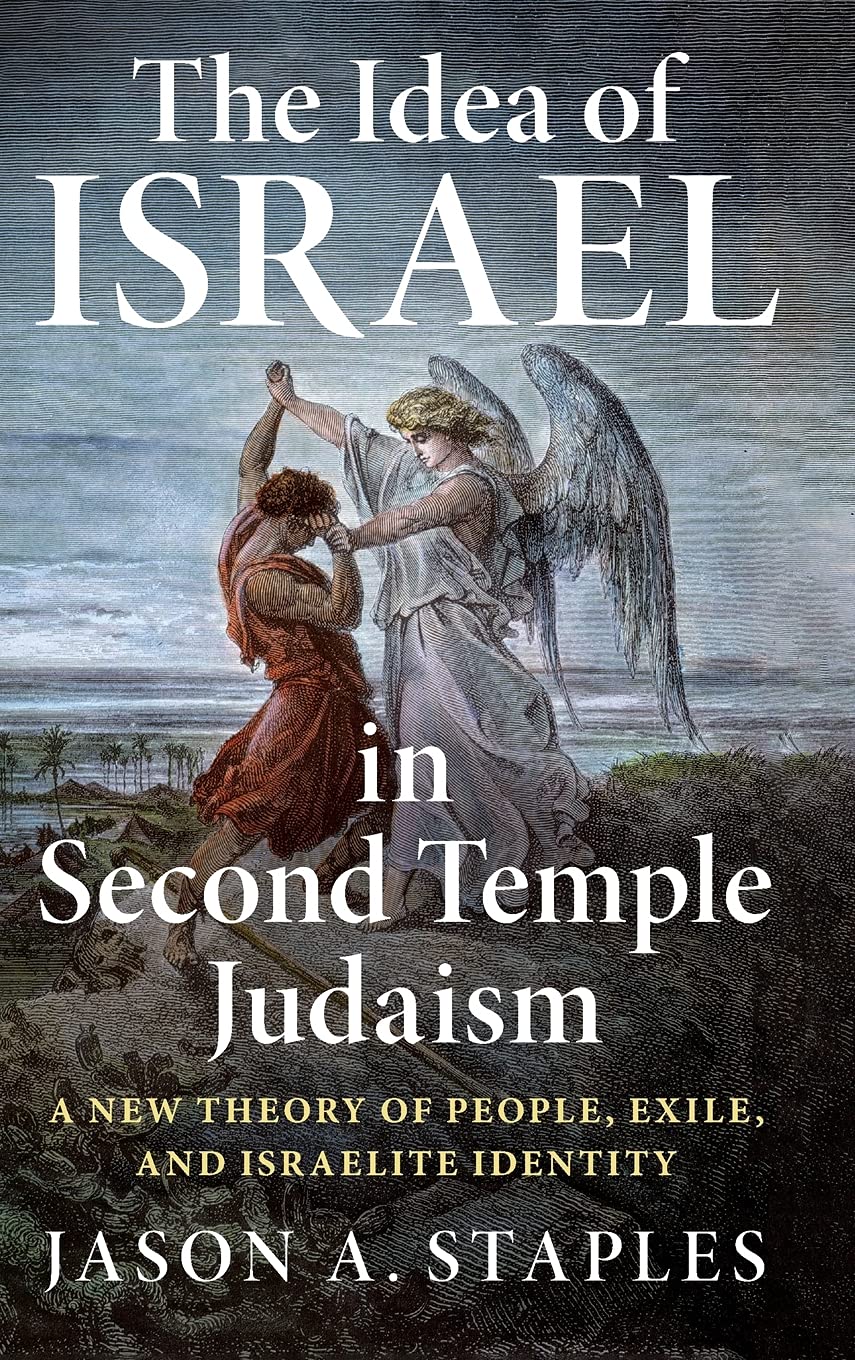
The article is framed as a response to the use Jason Staples makes of the ancient Jewish historian, Josephus, in his book, The Idea of Israel in Second Temple Judaism: A New Theory of People, Exile, and Israelite Identity (Cambridge University Press, 2021). In a nutshell, I agree with Staples that Josephus links the term Ioudaios (usually translated ‘Jew’ or ‘Judean’) to the tribe of Judah, but disagree that Josephus’ adoption of Ioudaios as the standard term for his people at the midpoint of his massive Jewish Antiquities has anything to do with a sense of ongoing exile or a hope for the restoration of the northern tribes of Israel.

In addition to responding to parts of Staples’ important monograph, I’d like to think the article makes its own contribution to our understanding of Josephus, in the first place by defending one of Staples’ main points about Josephus, which might otherwise be neglected; second, by critiquing Staples’ case for restoration eschatology in Josephus; and, finally, by highlighting how Josephus’ introduction of Ioudaios as a new name contributes to his defense of the Ioudaioi by way of a polemical opposition to the Samaritans. (There is also a close reading of sections of Antiquities book 11 and an exploration of Josephus’ ‘geography of exile’—his understanding of the boundaries of Babylon, Media and Persia—and what it implies about where Josephus thought the inhabitants of the northern and southern kingdoms of Israel and Judah were exiled.)

The article has had a long gestation period and has incurred debts along the way. I would like to acknowledge some of them here: I presented an early version of the essay at the Canadian Society of Biblical Studies in May of 2023, and a revised version at a faculty colloquium at my home institution in January 2024. I thank Briercrest for a semester sabbatical in 2025 that gave me time to finish the essay, and the other Dr. Miller for reading and talking about it more than she wanted to. Incisive, detailed and critical feedback from two anonymous reviewers for JSJ resulted in a much better, clearer (and longer) final product. I am also grateful to Staples himself: I learned a great deal from interacting with his work.

For anyone interested in more detail, here are the thesis and outline paragraphs:

The re-examination of Josephus’ ethnic terminology in this article confirms and reinforces one of Staples’ major points. When in Antiquities 11 Ioudaios first begins to be used as a common label, the term is in fact closely associated with the southern kingdom of Judah. I am not persuaded, however, by Staples’ additional claims that Ioudaios consistently refers to a subset of “all Israel” or that the shift from “Hebrews” and “Israelites” to Ioudaioi in Antiquities 11 reflects Josephus’ restoration eschatology. The point of introducing the label, Ioudaios, at the return from exile in Babylon is not to contrast southern kingdom Ioudaioi, on the one hand, and northern kingdom “Israelites” still in exile beyond the Euphrates, on the other. Nor is it to express hope for a still future restoration of the twelve tribes of Israel. When Josephus adopts Ioudaios as his preferred ethnonym and explains its connection to the tribe of Judah, his goal is to establish continuity between contemporary Ioudaioi and the past history of his people in the context of a wider polemical contrast with the Samaritans, whose claim to Israelite ancestry he regards as illegitimate. Once the antiquity of the label and the people it designates is validated, its meaning expands to encompass the whole people regardless of current location or tribal ancestry.

I begin by tracing the use of ethnonyms in Josephus’ paraphrase of the preexilic period (Ant. 1-10), noting that his preferred term for the people as a whole before the exile is “Hebrews,” that Ioudaios seldom appears, and that “Israelites” can designate the people as a whole or the northern tribes, as “Israel” does in his biblical source texts. The two established meanings of “Israelite” complicate attempts to determine whether Josephus presents the Ioudaioi as opposed to the Israelites, a subset of the Israelites, or synonymous with the Israelites. This ambiguity is the subject of sections two and three. Section two examines Josephus’ own explanation of the postexilic origins of Ioudaios and its links to the “tribe of Judah” (Ant. 11.173), and then explores his understanding of the regions where the northern and southern tribes were relocated by the Assyrians and Babylonians. Section three employs what Josephus says about Babylonia, Media and Persia as a diagnostic tool to help determine the meaning of “Israelite” and its relationship to Ioudaios in the first half of Antiquities 11. Although it is not always possible to identify the referent of “Israelite” in book 11, Josephus’ use of “Israelite” and Ioudaios does not point to a separation between Ioudaioi and “all Israel” when the southern tribes return from exile. Instead, the continued use of “Israelite” during the return narrative connects the Ioudaioi to their preexilic past. The next two sections challenge Staples’ claim that Josephus’ adoption of Ioudaios implicitly draws attention to the absence of the northern tribes. Section four argues that Josephus identified the end of exile with possession of the land and temple, not the return of all twelve tribes. References to “Israelites” or members of the “ten tribes” beyond the Euphrates do not, therefore, reflect Josephus’ restoration hope; nor does a sense of ongoing exile explain the shift to Ioudaios. Section five shows that, despite its initial connections to the southern kingdom of Judah, the term Ioudaios expands in scope in Antiquities 12-20, becoming, in effect, a postexilic replacement for “Israelite” and “Hebrew.” A concluding section attributes Josephus’ decision to switch to Ioudaios to his own reading of his biblical source texts, and suggests that he attempted to introduce the name into his narrative in a way that confirmed his people’s antiquity.

You can view the abstract here.

Finally, I tried to present Staples’ position accurately. Staples evidently thinks I failed to do so. So … if you wish to pursue the topic further, I recommend reading Staples’ book as well as my own essay. Let the conversation continue. 


Tuesday, May 23, 2023

Josephus and Jewish Ethnonyms: Evaluating Jason Staples's Idea of Israel in Second Temple Judaism

I'm on to present a paper at the Canadian Society of Biblical Studies annual meeting at Congress in Toronto next Monday. I put the abstract together in January on a hunch, in the hopes that a deadline would force me to finish a book I wanted to read, and prime the writing pump. Since I didn't make nearly as much progress as I wanted over the semester, it also made a gauntlet of a winter-spring that much more demanding. Right now, however, I'm grateful because at least in a few moments over the last intense week of research and writing, the chance to concentrate on a single intellectual puzzle long enough to make headway has felt strangely like a mental vacation. 

The abstract is not quite what I would say now that I have a more-or-less complete rough draft in hand, but it is close enough to what the paper is still trying to do that I will post it here in case anyone is interested:

In The Idea of Israel in Second Temple Judaism (CUP, 2021), Jason Staples argues that instead of being mutually interchangeable terms for the same group, “Israel” referred to the “tribes of the biblical northern kingdom” or to “the twelve-tribe covenantal people,” while Ioudaios (and cognates) designated a “subset” of this larger group associated with the southern tribes and the biblical kingdom of Judah. This paper will test Staples’s proposal against the evidence in Josephus. I will consider Josephus’s explanation for his own shift in terminology within the narrative context of the Antiquities; reevaluate the dueling claims of Ioudaioi and Samaritans in Antiquities books 9 and 11; and examine the labels Josephus uses to designate both those who returned from exile and those who remained “beyond the Euphrates.” We will see that within Josephus Ioudaios could still serve as a label for the people as a whole, including descendants of the northern tribes.

I may have more to say once the draft is revised and the paper is presented.

Thursday, December 29, 2022

Luke Timothy Johnson Shoots the Moon

In the final two chapters of his memoir, Luke Timothy Johnson describes what it takes to be an excellent (and productive) scholar, someone with the requisite raw-material—intelligence, rapid reading fluency, memory—who is increasingly characterized by the intellectual virtues of curiosity, respect for evidence, mastery, wide and critical reading, imagination, clarity and cogency, and by the moral virtues of courage, ambition, discipline, persistence, detachment, contentment, and (surprisingly) multitasking. 

Mastery for mature scholars of "New Testament and Christian origins" begins with "comprehensive knowledge of the content and rhetorical character of each OT and NT writing" as well as "a firsthand grasp of all the critical questions concerning those compositions." Mastery also entails "appropriate interaction with all of Greco- Roman literature, Jewish literature, and early Christian literature at least to the time of Constantine":

"The mature scholar ought to be as comfortable with the Sentences of Sextus as with the Sentences of Pseudo-Phocylides, with the Pirqe Avot and the Avot of Rabbi Nathan as with the Sifre on Deuteronomy, with the varieties of Jewish mysticism as with the hermetic literature, with Epictetus as with Plutarch, with the Didache as with Dionysius the Areopagite."

Nor is it sufficient to know the text themselves. The evidence that a scholar must respect includes "the entire history of interpretation."

Among the moral virtues, ambition—"not in the competitive sense of seeking to outdo others but in the sense of desiring excellence"—is "the 'motor' that pushes the scholar to significant accomplishment."

Also essential is contentment, the "freedom from a scholarly possessiveness manifested by obsessiveness, compulsiveness, and perfectionism":

"[I]f my identity and worth are not to be identified with my scholarship, then what I research and write can freely and generously be shared with others. As in other areas of life, so in scholarship: liberality and even prodigality reveal a freedom that is the opposite of a cramped perfectionism driven by anxiety, that only with great reluctance shares with others what I have discovered or crafted."

Few contemporary New Testament scholars can match Johnson's scholarly productivity. His autobiography makes it clear that his was no charmed ivory-tower existence: he wrote 35 books and 75 scholarly articles while being actively involved in university life and supporting family through significant personal adversity. Although Johnson peppers his account of the scholarly virtues with examples from his own life, he is at pains to insist that the final two chapters are not a self-portrait but an ideal to which he aspired in his "long career as a scholar." Besides, his abilities and the opportunities that came his way are in fact gifts from God.

For those with ears to hear, the memoir as a whole can serve as motivation for those just starting out, or a kick in the pants for academics mid-career.

Still, I came away with a few questions:

  • First, what if the pursuit of scholarly excellence conflicts with the ultimate goal—the goal Johnson identifies as his own—of becoming a saint? For ordinary mortals who don't possess Johnson's natural ability and rigorous training, and who perhaps lack his ambition, enormous industry and audacity, life may be more of a zero sum game where energy expended in scholarly production comes at the expense of other important things—one's family, for instance. At the very least, there is a temptation to cheat, to sacrifice those other important things instead of making room for both.
  • Second, there are other competing models of life before God and of scholarship that emphasize the virtue of moderation. (See, for example, the slow work movement, and its application to the academy in Berg and Seeber's The Slow Professor.) Is the only option for real scholars such enormous effort? Perhaps.
  • Third, middle-aged me questions Johnson's definition of scholarship as "an intellectual life that is both focused and productive" because productivity tends to be defined in terms of scholarly publications. Is productivity in this sense really the mark of a scholar? To be fair, Johnson does not simply equate the two:

"By productive, I mean that such learning gained by the mind is communicated to others, or is applied to the solution of other problems, with an eye to eventual communication, through teaching, writing, or other medium."

Insofar as productivity is reduced to publication (by Johnson's readers if not by Johnson himself) I suspect infection by the diseased bureaucratic drive to quantify everything.

To be sure, "[w]hen personal goals are insignificant, accomplishments will fall even shorter." Point taken. But most of those who aim high—even those who publish extensively—do not in fact succeed at producing anything that more than a few people read, as Johnson admits. What is the point of it all anyway? The vast majority of people have their most lasting impact not through what they write but through personal contact over time.

Questions aside, the story is interesting and well-told, and there is much to learn from, and to be challenged by, Johnson's example. Highly recommended! (If you listen to the audiobook, as I did, you get the added bonus of hearing Johnson narrate the book himself.)

Note: 

Tuesday, December 13, 2022

Luke Timothy Johnson on Not Wasting Time

"My first and most persistent goal in life was to become a saint .... In my own stumbling and clumsy fashion, I find that I truly do seek the face of God. Scholarship, like all other human endeavors, has always seemed to me secondary to the serious business of becoming a certain kind of person; scholarship is a game that can be played, and must be played, seriously and intently, with the scholar never forgetting that it is only a game, whose stakes are not ultimate." 

"Sowing seeds by scattering them in every direction means much waste, and yes, the sower seldom actually sees whether any of the sown seed yields a crop. But I would not trade the hours I spent in preparing and presenting all this array of words for any other task I might have been assigned. As I gladly learned, so gladly did I teach."

"As for properly scholarly writing and publication, I am acutely aware how few minds I have changed or improved. I know, in fact, that some of my views are regarded by many other scholars as wrongheaded or eccentric. But I am also aware that I never stinted in the effort to make a difference in how important issues are understood. I know that I have employed the gifts God has given me—a modest intelligence, a wealth of energy, a passion for truth and beauty—as fully as time and circumstances have allowed. I have never wasted time, and I have never allowed circumstances to be an excuse for less than full effort. I have pursued truth as I have seen it. With that realization, I must be content." 

- Luke Timothy Johnson, The Mind in Another Place: My Life as a Scholar (Grand Rapids: Eerdmans, 2022), 31, 267.

Luke Timothy Johnson has been a formative influence and sparing partner in my thinking about Luke-Acts for years, I'm a sucker for academic biographies anyhow, so no surprise that I find Johnson's memoir stimulating in all sorts of ways. Challenging too. Highly recommended for anyone interested in biblical scholarship (or biblical scholars) even if you disagree, as I do, with Johnson on various points.

Sunday, August 28, 2022

Oliver O'Donovan on the Corruption of Academic Authority

"The only authority that a particular person or thing may derive from the truth is a didactic authority which is self-effacing and points beyond itself. ... That is why our attachments of loyalty to individual wise men or particular books of wisdom are more problematic than our loyalties to favourite works of art, men of power or cultural traditions. Of course, such attachments may be delightful and enriching, as, for example, when we retain our reverence and affection for an inspiring teacher; but when that happens other elements have entered into his claim upon us which must not be confused with the claim of truth itself. When a wise man or a tradition of thought comes to be thought beyond reach of critical question, he or it is dishonoured. The translucent didactic authority to which it could once lay claim in the service of the truth has been replaced by an authority that is immediate and opaque. This changeling may be the authority of tradition, or it may be the authority of strength .... But either way the fundamental stance of the thinker vis à vis the truth, critical and open to criticism, will be betrayed by the seduction of the wrong kind of authority." - Oliver O'Donovan, Resurrection and Moral Order (Grand Rapids: Eerdmans, 1986), 126


Saturday, August 27, 2022

On Academic Ambition: A Summer Miscellany

“My first and most persistent goal in life was to become a saint.” So writes Luke Timothy Johnson in his academic autobiography, which I have, so far, only read about. In this interview with Nijay Gupta, Johnson reflects on how this goal shaped his work as a scholar:

“First, I have always considered only one thing essential — to become (or better, to allow God to make one) a certain kind of person. Everything else I have considered as secondary and non-essential. The judgment of other humans is trivial compared to the absolute judgment of God. Such a conviction enables one to speak boldly and without fear. 
“Second, I have considered scholarship as a serious enterprise, but one without ultimate importance. It is, indeed, a game that, like all games, must be played seriously if it is to be played well. But it is played best when it is played with the freedom that authentic faith gives and is not erected into an idolatrous project.

“Third, if scholarship is non-ultimate, then an academic career is even more nugatory. The academy should be regarded as a social arrangement whose importance is measured solely by the way it serves the ends for which it was designed. Do students learn? Do teachers grow in knowledge? Is the church and society made better by these processes? To the degree that “the academy” becomes absolute and self-serving, to that degree it has lost its way.” (Read the whole interview here.)

Johnson, a Roman Catholic New Testament scholar, is surely riffing off of Thomas Merton:

“There’s a wonderful moment in Thomas Merton’s The Seven-Storey Mountain when Merton — a new convert to Catholicism — is whining and vacillating about what he should be: a teacher, a priest, a writer, a monk, something else altogether maybe, a labor activist or a farm laborer. And his friend Robert Lax tells him that what he should want to be is a saint.” - Alan Jacobs

Academics who fail to get their ambitions straight all too easily end up with the apotheosis of scholarly vices that C.S. Lewis described as hell:

“We must picture Hell as a state where everyone is perpetually concerned about his own dignity and advancement, where everyone has a grievance, and where everyone lives the deadly serious passions of envy, self-importance, and resentment.” - C.S. Lewis, Preface to The Screwtape Letters (HT: Sean Davidson

I suspect C.S. Lewis’s picture of hell is part of what Willie James Jennings has in mind when he argues in After Whiteness that western theological education tends to form students into white, male plantation owners—those who seek control, possession, and mastery, and who know how to get it. “Whiteness,” Jennings says in this OnScript interview, is

“A way of being in the world and a way of seeing the world at the same time, a way of organizing, shaping, and envisioning the world. And whiteness is having the power to realize that vision. Whiteness is imagining the world from an imperial position of thinking and making. And whiteness has been presented as an aspiration for all those who have seen the possibilities of a world after the rise of colonialism—a world in which things can be changed, people can be owned, land can be owned. ... A white self-sufficient man ... embodies what I call three demonically derived virtues: control, possession and mastery. And that man has been imagined as the one who would build the world.” Willie James Jennings –– After Whiteness | OnScript

So which will it be—white male plantation owner or saint?

Sunday, February 28, 2021

On Jesus' address to God as Father and Ancient Judaism


It is a commonplace in New Testament scholarship that Jesus' characteristic address to God as Father was distinctive if not unique in the first century.

According to Scot McKnight, "'Father' occurs only occasionally in the evidence that survives from Second Temple Judaism." Jesus, by contrast, "taught his disciples to pray, as a matter of routine address, 'Our Father'" (McKnight 1999: 54-55; emphasis added).

Richard Bauckham maintains that Jesus' "almost exclusive use of 'Father' to address God was certainly very unusual" and proposes that Jesus' innovation was to adopt "the word 'Father' as his own chosen substitute for the Divine Name." (Bauckham 2020: 53)

Wesley Hill's brief popular exposition of the Sermon on the Mount contrasts Jesus' frequent use of "Father" for God with Old Testament and, by implication, with "[o]ther Jewish texts that ... use 'father' for God":

"T]here remains throughout the Old Testament a certain reserve about the father metaphor for God. ... It is almost as if these rare instances of the God of Israel being called (or calling Himself) 'father' are placeholders, awaiting some unforeseen future revelation that will cause them to take on a new resonance." (Hill 2019: 11 and 106 note 11).

Dale Allison's 1999 attempt at an accessible commentary on the Sermon on the Mount is now rather dated by the get-the-latest-new-book standards of New Testament scholarship, but seems to me to adopt a better approach:

"No prayer in the Hebrew Bible opens with this address, although the idea that God is the father of faithful Israel, his children, is certainly well attested. ... The Mishnah, however, does use the phrase, 'Our Father in heaven' ... and extrabiblical Jewish prayers do have invocations with 'Father.' .... In the light of all the parallels, especially the Qumran texts, it is unwise to insist (as so many have when writing on the Lord's prayer) that Jesus use of 'Abba' was unique. ... At the same time, it remains true that early Christian sources speak of God as Father much more frequently than contemporary Jewish sources; and since Mark 14:36; Rom. 8:15; and Gal. 4:6 transliterate the Aramaic 'abba' into Greek, there is a good chance that the address was thought special because characteristic of Jesus." (Allison 1999: 117)

To be sure, McKnight, Bauckham and Hill are careful enough scholars to avoid referring to Jesus' usage as "unique," but they continue to emphasize discontinuity between Jesus and his Jewish context. Allison explores the same evidence in more detail, and stresses continuity.

I suspect the difference between Allison, on the one hand, and McKnight, Bauckham and Hill, on the other, comes down to scholarly posture:

(1) Allison is more cautious when it comes to filling in historical gaps: As evidence for ancient Jewish references to God as father, Allison quotes from a story in the Bablylonian Talmud about Hanan, the grandson of Honi the Circle Drawer:

"When the world was in need of rain, the rabbis used to send school-children to him who seized the train of his cloak and said to him, Abba, Abba, give us rain! He said to God: Lord of the universe, render a service to those who cannot distinguish between the Abba who gives rain and the Abba who does not." (b.Taanit 23b in Allison 1999:117)

In this case, Allison's caution is warranted. We know far less about Honi the Circle Drawer and his grandson than we do about Jesus. When we crunch the numbers and compare Jesus' usage with that of other ancient Jews, we need to keep the fragmentary nature of our surviving evidence in mind.

(2) Allison actively resists the deeply-ingrained Christian impulse to set Jesus over against his Jewish environment--and for good reason after centuries of Christian denigration of Jews and Judaism. To paraphrase Amy-Jill Levine, we don't need a bad Judaism to have a good Jesus. The authority of Jesus' teaching does not rest on its being unique in all respects. As Allison observes, "A Jew wanting to have nothing to do with Jesus could still pray the Our Father" (1999: 134).

References

Allison, Dale C. The Sermon on the Mount: Inspiring the Moral Imagination. New York: Crossroad, 1999.

Bauckham, Richard. Who Is God?: Key Moments of Biblical Revelation. Acadia Studies in Bible and Theology. Grand Rapids: Baker Academic, 2020.

Hill, Wesley. The Lord’s Prayer: A Guide to Praying to Our Father. Bellingham, WA: Lexham Press, 2019.

Levine, Amy-Jill. “Bearing False Witness: Common Errors Made about Early Judaism.” Pages 759–63 in The Jewish Annotated New Testament. Edited by Amy-Jill Levine and Marc Zvi Brettler. 2d ed. Oxford: Oxford University Press, 2017.

Levine, Amy-Jill. The Misunderstood Jew: The Church and the Scandal of the Jewish Jesus. San Francisco: HarperSanFrancisco, 2006.

McKnight, Scot. A New Vision for Israel: The Teachings of Jesus in National Context. Grand Rapids: Eerdmans, 1999.

Thursday, June 25, 2020

Samuel Sandmel on Making Many Books

"A lover of scholarship must in our days wonder if the explosion of learning has not yielded a superabundance. So great a flow has there been of books and essays that no one can keep up with it, as the honest scholar admits. The superabundance in part is marked both by an immense quantity of repetitive writings on the same general subject, and also by articles, some enlightening, but some confused and confusing, on minor points, marked by special theories ingeniously designed to solve the unsolvable." (vii)

"There is no ready cure in our time for the demands of specialization which tend to restrict broad study. Hence, only one who has had the privilege of not years, but decades of study can partially escape from a preoccupation with only a single area of the several here dealt with. Even such a person cannot achieve fullest mastery in all this variety. If I were to set forth a claim of some tolerable mastery, it would be in Bible (Old Testament0, in hellenistic Judaism, and in New Testament. I am experienced in Rabbinic literature, but am by no means an unqualified expert; I have studied and taught the Apocrypha and the Dead Sea Scrolls, but make no claim of special eminence. The full mastery of all these literatures, and of the scholarly writings about them, are beyond what one man can achieve in the normal span of a single life. I have dared to hope that where expertise has eluded me, responsible competency has not." (viii-ix)

From the preface to Samuel Sandmel's Judaism and Christian Beginnings (New York: Oxford University Press, 1978).

Sunday, February 17, 2019

Timothy Barnes on Sound Scholarship

I encountered this gem in the preface to Timothy Barnes's monograph on Early Christian Hagiography (Tübingen: Mohr Siebeck, 2010).
“In my first year of research ... I learned two fundamental truths about scholarship that are too often neglected: first, the most useful study of any subject or problem need not be either the most recent or indeed at all recent in date; second, that sound scholarship remains sound scholarship despite the passage of time and changes in intellectual fashion.” (p. x)
The book--originally a series of lectures delivered in German--was published three years after Barnes retired from his position as professor of Classics at the University of Toronto.

Here is a longer version:
 “Soon after I began research in Oxford in 1964, my supervisor Sir Ronald Syme encouraged me to investigate early Christian texts and documents in a spirit of extreme scepticism. … Syme suggested that I investigate the letters of Ignatius of Antioch and the acta martyrum of the second and third centuries on the assumption that every text needed to establish its claims to veracity and ought to be treated as inauthentic until it was proved otherwise. This was perhaps the most salutary and productive single item of advice that Syme ever gave me. For, while my investigation of the letters of Ignatius led nowhere at the time, it revealed to me the superb scholarship of Bishop Joseph Barber Lightfoot, who held the see of Durham from 1879 to 1889, and it convinced me that understanding of Ignatius had not progressed significantly in the three quarters of a century after Lightfoot. In my first year of research, therefore, I learned two fundamental truths about scholarship that are too often neglected: first, the most useful study of any subject or problem need not be either the most recent or indeed at all recent in date; second, that sound scholarship remains sound scholarship despite the passage of time and changes in intellectual fashion.” (pp. ix-x)

Sunday, August 26, 2018

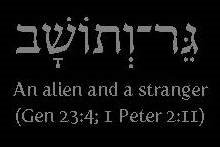
What is גֵּר־וְתוֹשָׁב for?

This blog has always featured a motley assortment of topics aimed at a variety of different audiences, or none at all. It began eleven years ago as a commonplace collection of quotations, shifted to a travelogue about our June 2007 trip to Turkey, and then, toward the end of its first year, morphed into a biblio-family-blog blend that combined pictures of my infant daughter with an analysis of scholarship on the meaning of Ioudaios. I eventually phased out (most of) the family photos and tried to make sure that my posts retained some sort of connection to biblical studies, ancient Judaism, language-teaching pedagogy, "productivity software," or scholarship in general. But I still let arcane posts about Zotero and work-in-progress on Josephus, Romans, and Luke-Acts sit cheek-by-jowl next to the occasional devotional reflection, comments on the weather in Saskatchewan, and the tribute I wrote for my mother's funeral--assuming that my readers, whoever they might be, could read what interests them and ignore the rest.

The world has changed over the last decade. As Peter Davids recently wrote, "We live in anxious times with all types of black and white thinking, herding, and other anxious behavior." My world has changed too, and it has occurred to me that this combination of the personal and the academic might be a liability. However much I still feel like a newbie, I am no longer a young scholar, fresh out of grad-school. Perhaps I should adopt a more professional posture, curate more responsibly, and project an image that contributes more directly to my own advancement or some greater good. If I want to be taken seriously as a scholar, it may not be in my best interests to comment on my personal life or my personal faith. (I am afraid this concern has affected what I choose to include here more than it should.)

On the other hand, academic posts can also be misunderstood. When I suggested a few years ago that ancient Jews could dine with gentiles without violating the law, someone commented: "Who cares? How does this help life in the real world? Is this seriously where our donation dollars are going?" I deleted the comment because I had concluded from a previous encounter that the commenter was not open to the possibility of conversion that genuine conversation requires. But I also jotted down what I would have said in response:
When I teach the book of Acts in my college context, concerns about the text's relevance to the 'real world', whatever that is, are front and center. I can assure you that the question I addressed in my last post has an impact on my understanding of Acts, and as a result, on how I teach the book. Moreover, it is because I hold Acts to be God's word, in the Christian sense, that I think the text merits careful attention. Asking "who cares?" too quickly may indicate a lack of respect for the Scripture God has given us. I don't feel obligated to connect all the dots on my blog, and you are under no obligation to read what I post if you don't care about the subjects I write about. The blog is not always addressed to a lay or college-level audience, so don't assume that my musings here accurately reflect what or how I teach in the classroom.

Consciousness of the liability of blogging in an anxious age has led to greater self-censorship on my part, and has occasionally contributed to a sense of paralysis as I wonder who I am writing for and why I am writing blog posts at all, especially when I should probably spend my time working toward publications that matter more. For the moment, however, I plan to continue, for a few different reasons: At a basic level, the act of thinking aloud in public sometimes helps me write. Contemplating an audience encourages me to work through ideas and get them down on "paper." The immediacy of publishing a blog post helps stave off the despair that presses in when I contemplate larger projects that are years from completion. And sometimes I have something to say that I hope people will read and benefit from. The blog is, finally, an attempt to practice in another medium what I try to do in the classroom, modeling what it might mean to think critically and live faithfully at the same time.

For a related post about the blog, see my "Ten-Year Blog Anniversary."

Tuesday, August 7, 2018

On the Comparison of 17th-Century Christianities: John Bunyan and Nicholas Ferrar

After visiting Little Gidding we drove 25 miles south to the town of Bedford and stopped for lunch by the River Great Ouse.
Our reason for stopping in Bedford, aside from the pleasant picnic spot, was to visit the shrine of another 17th-century protestant saint, whose best-selling book begins as follows:
"As I walked through the wilderness of this world, I lighted on a certain place where was a Den, and I laid me down in that place to sleep: and, as I slept, I dreamed a dream." 
The Den, I assume, was inspired by the Bedford County Jail where John Bunyan was imprisoned between 1660-1672, and where he began to write The Pilgrim's Progress:

The actual jail, of course, is long gone. Visitors today can view a replica in the John Bunyan Museum that stands next to a 19th-century Bunyan Meeting church building, a few blocks east of the old jail site:

In addition to the model jail cell, the museum houses a selection of 17th-century relics: This key may have belonged to Oliver Cromwell, this block of wood may have come from the Bedfordshire barn where Bunyan preached--that sort of thing. There is also a door that really was removed from the Bedford County Jail when it was demolished in 1801; whether the door goes back to 1672 is another question. The museum also includes a library of Bunyan's works published in a wide variety of modern languages.

In many ways, Nicholas Ferrar (1592-1637) of Little Gidding and John Bunyan (1628-1688) of Bedford could not be more different. Nicholas's father was an elite London merchant, members of the family were friends with royalty, and Nicholas served in parliament before the move to Little Gidding. John Bunyan's father was a tinker, just well-enough off to own his own cottage and provide for his son's basic education. Nicholas Ferrar was a Cambridge-educated scholar who was ordained by the future Archbishop of Canterbury. Bunyan was a nonconformist whose refusal to give up preaching without a government license led to his twelve-year imprisonment. Despite their differences, both shared an unwavering commitment to the proclamation of the gospel and to ordering their lives by their common faith.

My historian spouse reminds me that Bunyan and Ferrar also belonged to different generations. The English civil war (1642-1651) that came between the death of Nicholas Ferrar in 1637 and the adult re-baptism of John Bunyan in 1653 changed England dramatically. Bunyan's imprisonment must be understood in the context of a sudden shift from toleration of nonconformists under Oliver Cromwell to an official attempt after the restoration of the monarchy in 1660 to enforce conformity to a single church. (I don't know enough to comment on non-conformity and toleration before the civil war--but the shift from toleration back to official prohibition is one significant difference.) In any case, even though they both lived in the 17th century, you can't directly compare Ferrar in the 1630's with Bunyan in the 1660's anymore than you can juxtapose the 1950's and the 1980's. Conditions for existence had changed. Who knows? The same might be true of Judaism(s) in the Second Temple Period ....

Thursday, July 26, 2018

Scholarly Virtues: The Stone Seminar

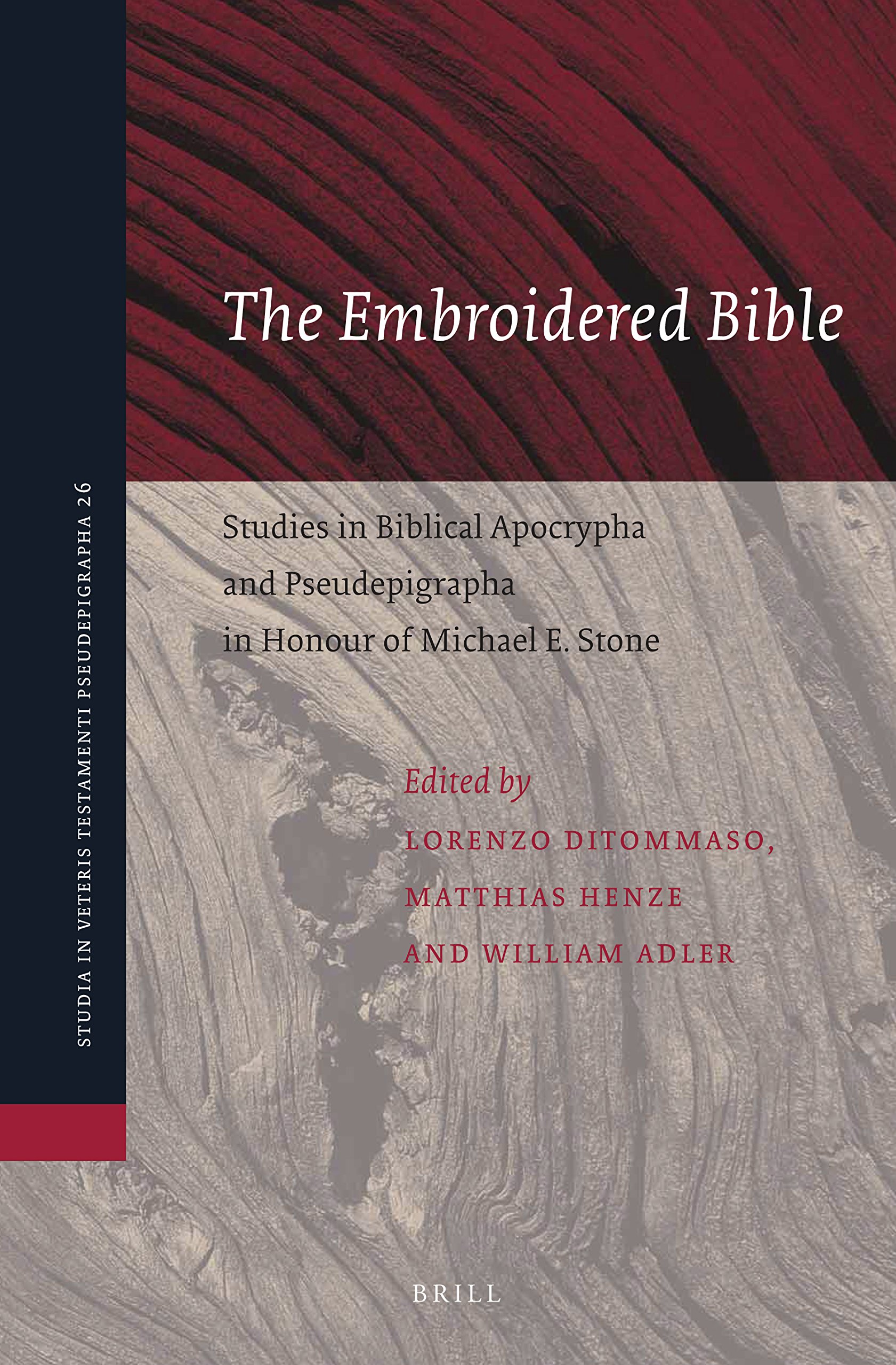
I perused the new Festschrift for Michael E. Stone recently, and was not surprised to find several references to the seminar he held for many years in his home. The tributes at the beginning of the volume brought back fond memories of my own experience as a member of the "Stone Seminar" during my year as a visiting research student at the Hebrew University of Jerusalem back in 2000-2001.

Some of the tributes comment on the seminar itself:
Harold Attridge: "Most memorable perhaps were the sessions of the seminar at your home in Jerusalem, where you and Nira so graciously hosted mature and budding scholars from around the world. You brought together there, as you have in many of your scholarly endeavors, talented people with very diverse interests, philological, socio-historical, literary. The one sine qua non was the competence to read ancient sources with care and be willing to contribute to the give and take of serious scholarly conversation. All of us who participated in that seminar or in conversations with you at international congresses learned from one another and from you." (p. 17) 
Esther Eshel: "Michael nourished our early academic appetites with exposure to scholars and scholarship—in his famous seminars. There we could meet first-rate visiting scholars, who shared with us their latest ideas and plans. And at the same time, we could share our first lectures, to be presented at international conferences, as well as our debut papers and articles. Here Michael’s criticism was the most valuable, because it always was constructive criticism. From Michael we learn to look at the broad picture, even when looking at the smallest philological question." (p. 35)
Others focus more on the way the seminar exemplified Michael Stone’s outstanding qualities as a teacher:
Esther Chazon: "I have been Michael Stone’s student for forty years. I will always be Michael’s student. It is impossible to put into words, especially in a brief tribute, all that Michael has taught his students. Reading ancient texts we had never heard of before was only the beginning. Over long coffee breaks on campus and in his home during evening seminars and private consultations, Michael continues to engage us in the texts, contexts, and broad implications. The image that encapsulates this for me is the move from precise textual work at his enormous living-room desk to the armchair conversations of “what it all means.” ... Like a father, but also as a friend, he never stops looking after our intellectual, professional, and emotional well-being." (pp. 24-25)
David Satran: "An initial meditation on Michael as teacher prompts me to remark on his extreme lack of caution. Now reckless isn’t a word that readily comes to mind in speaking about Michael Stone—it certainly would seem to fit neither the character of the man we so admire nor the scholarship we celebrate—but it may not be an inappropriate description of his pedagogy or, at least, our first impressions of his pedagogical method. Those of us who have enjoyed the privilege and the delight of studying with Michael—as well as the occasional attacks of anxiety which accompanied these—know that dizzying excitement of being sent off to track down the odd detail of an ancient text, armed only with a handful of obscure references and the encouragement to follow the path wherever it might lead. Those paths inevitably led many of us down innumerable rabbit holes, some with no apparent means of escape, but a fair number ultimately issued in seminar papers, theses, and even dissertations. Looking back, it seems difficult to fathom how Michael could have felt that we should be entrusted, at what seemed an impossibly early stage in our studies, with the responsibility of getting to the bottom of these matters. And no less: the solemnity with which we had to report back on our efforts and the seriousness with which these were recorded and held up for general discussion and appraisal. Slowly, at times ever so slowly, however, we began to trust Michael’s expectations from us and found ourselves more trusting of both our own research and our own judgment …. In his demonstration of confidence in our fledgling abilities and insights, Michael encouraged us to develop that intangible quality of security in our own work and in the scholarly directions we had begun to choose. In a certain sense, it is precisely this measure of his confidence which has come to define a large number of our own highly variegated pursuits." (pp. 31-32)
I am afraid I did not know enough to take full advantage of the seminar, but I still learned a great deal from Michael Stone that year. During the seminar we read the Letter of Thessalos and part of Philostratus’s Life of Apollonius of Tyana in Greek—a struggle for someone like me who had really only read the New Testament in Greek. We also heard papers from members of the seminar, as well as from Greg Sterling, Esther Eshel, and, if I’m not mistaken, Peter Brown. (I confess I had no idea who Peter Brown was at the time.) Fortunately, I had the good sense to look up and read some of the books and articles Professor Stone mentioned, including selections from E.R. Dodds, Gershom Scholem, and Stone’s own seminal essays “Lists of Revealed Things,” “Three Transformations in Judaism,” and Scriptures, Sects and Visions. It was on Stone’s recommendation that I read John Barton’s Oracles of God and acquired my own inexpensive copy of Menahem Stern’s Greek and Latin Authors on Jews and Judaism directly from the Israel Academy of Sciences and Humanities. My main point here, of course, is not to enumerate a list of now dated but still valuable books, but to confirm the influence of the teacher and the effectiveness of his pedagogy.

Bibliography
DiTommaso, Lorenzo, Matthias Henze, and William Adler, eds. The Embroidered Bible: Studies in Biblical Apocrypha and Pseudepigrapha in Honour of Michael E. Stone. SVTP 26. Leiden: Brill, 2017.

Wednesday, July 25, 2018

Scholarly Virtues: John Barclay on Michael Wolter's Romans

In a recent book review, John Barclay commends Michael Wolter's 2014 Romans commentary as "a new high-water mark." It "is, now, the first commentary that any student or scholar working on Rom 1–8 should consult."

As valuable as the positive review of Wolter's commentary, which I dutifully noted, are Barclay's comments about what it means to be a good biblical scholar, using Wolter as an example: 
"The result has all the hallmarks of his scholarly excellence: acute exegetical observation, historical precision, clarity of thought and expression, and an independence of mind and originality in argument that manages always to have something new and interesting to say about this well-worn text."

"His philological and historical approach refuses to be bent by a theological or any other ideological agenda, while he takes the theological subject matter of the letter with full seriousness and does not attempt to turn it into something else. ... It is this rigorous historical stance, together with his delightful independence of mind, that makes Wolter’s commentary so valuable."

"Throughout there is the highest regard for clarity: One gets the sense that every word and every phrase has been examined afresh: on numerous occasions, linguistic parallels, drawn from across Greek literature, help support or clarify a reading of Paul’s Greek, with an attention to detail that never becomes obsessive or verbose. It is also clear that Wolter has thought through every exegetical debate anew: often he begins from an original starting-point, while his argumentation is robust but courteous, sober and without rhetorical flourish, and always supported by evidence."

"I know of no current Pauline scholar who can match this argumentative rigor, clarity, and skill."

"There is no attempt to squeeze Paul here into a theological programme, or to salvage the text for a theological or ethical cause. At the same time, there is no anti-theological agenda, which can often produce readings of Paul just as over-determined, whether by a political, moral, or ideological concern. All the virtues of a historian are here displayed - honesty, thoroughness, precision, independence of mind – as applied to the historical roots, contexts, developments, and functions of Paul’s language. Paul’s theology is here, first and foremost, a language-event, and whatever one does with it thereafter should not be allowed to prejudge or distort one’s careful observation of how his text actually works. ...  But because he recognizes that this [Paul's] gospel is inescapably theological, in that it makes huge claims about God and God’s saving action in Christ, his commentary will be as significant for those with a theological investment in the text as for those with only historical interests."

Bibliography
Barclay, John M.G. “Review of Michael Wolter, Der Brief an Die Römer.” Early Christianity 9, no. 2 (2018): 247–52.

Wolter, Michael. Der Brief an die Römer Teilband I: Röm 1-8. EKK 6/1. Neukirchen-Vluyn: Neukirchener Theologie, 2014. (According to Amazon, volume 2 is due out in October 2018.)

Sunday, May 27, 2018

John Evelyn's Reading Recommendations

In 1704 the 17th-century man of letters, John Evelyn, wrote out a short book of advice for his twenty-two year old grandson, Evelyn's only surviving male descendant and heir to his estate. Memoires for my Grand-Son was preserved in the family library at Wotton until 1926 when it was transcribed and published. (Tragically, the library itself "was sold and dispersed" in the 1970's. I imagine it looked something like the library in Hatfield house, pictured on the right.)

The contents of the Memoires range from detailed lists of tools that need to be oiled and cleaned once a year to an inventory of "Mathematical Instruments" kept in the room next to the library. According to the editor,
"The chief value and interest of the manuscript lies ... in the admirable fussiness which impelled [Evelyn] to give such details of how a country gentleman should conduct his life and affairs. Many of these details throw light into obscure corners of the domestic economy of the late seventeenth century" (xi).

As you might expect, I was especially interested in the section on "Books & Studys for the Improvement of your knowledge." Evelyn begins the section by insisting on life-long learning:
"I thought I had say'd all that was necessary to be don as to your care within dores excepting that of the Library Appartments, which require your especial and constant Inspection, nothing more becoming a person whose Education has been something above that of most ordinary Country Gents who commonly unlearne and abolish all they had learn'd at schole, university, &c., when they come to their Estates, thro' a slothfullnesse and unacountable neglect of Cultivating their knowledge and the noblest facultys of their Intellectual Man, that is, by advancing toward something usefull as well as for merely entertainement of time. In order to this a constant and setl'd method should be resolv'd upon with an unvariable assiduity, and so order'd that none of these opportunitys be lost which do not necessarily require attendance or any publique Employment, there being none either of greate or buisy but leave such vaccuitys and Interstices as may aford a studious person time of improving his knowledge, which otherwise be cast away & utterly lost. My L. Chancellor Bacon has beside his owne example confirm'd what I have said, tho' he was a person in continual employment as a Lawyer, Judge, Privy-Conseller, & in perpetual buisinesse. The like were Raileigh, Selden, Hales, Vaughan, &c., besides forainers <in> aboundance ... Philologers, Noblemen, Souldiers, Advocats, Divines, Physitians, States-men, &c., (I name them promiscuously), to whom the knowing-world is oblidged for the Improvements of the present Age beyond a Thousand which are past." (pp. 38-40)

In today's jargon, Evelyn might say those who aspire to be leaders need a solid grounding in the liberal arts.

Next, Evelyn lists the kind of subjects a country gentleman should make the object of his study:
"Among these studys & Facultys most necessary for you, I think, would be more than a superficial Tincture of the Laws, Civile, Municipal; History, both in generall and particular by a judiciously chosen Method, Antient, Modern, Greeke, Roman, and from the decline of those Empires to our owne times, accompanyd with Chronologies, Geography, &c. And for the most usefull diversions assistant to innumerable subjects both speculative, but above all practicall, Mathematicks, which ... sharpens and settles the Judgement. ... But to be accomplisht, above all, Algebra. These well studied will furnish also innumerable other knowledges, accompanyd with such Treatises as every day occurr, relating to modern History and Arts, Travelles, discoverys, Transactions Philosoph:, &c., beside the most select pieces of all kinds which your library will afford you, poetical, political, Military, All the Classics, &c., and other noble entertaiments both pleasant and profitable, whilst your maine study should be such as we have recommended to us by the most grave and wisest Ancestors. ... One would not be notoriously Ignorant of anything belonging humanity, or laudably Entertaining at home in private and abroade or in Company, without ostentation." (41-43)
Evelyn commends the practice of keeping a commonplace book, both as an aid to memory and as  preparation for writing:
"In order to all this and all your other studys either by booke or conversation, A well digested Adversaria as to common places should by no meanes be neglected, in which to write down and note what you find most important & usefull in your Readings & not trust altogether to your owne Memory, so in a little time you will find your papers furnish <you> with materialls of all subjects; short notes and Referrences are sufficient for this unlesse wher you meete with some Remarkable passages which may require a larger transcription. From such a Magazine one is inabled to speake or write upon any occasion, & it would not be amisse to pitch upon some usefull subject to exercise your style in & to publish some Fruits of your studys, which cannot be don without Collections, no man being able to build anything whatever without the help <of> others which may stand or last longer <than> the Cobwebs spun out of the bowels of an Insect. But with this Advice, that, when once one has written what is of such intrinsical value as to gaine universal applause, To adventure out againe without extraordinary caution." (43-45)

Last, but not least, Evelyn states that Sundays and Holy days should be devoted to the study of Theology: 
"If now I have reserved that of Theology to the last place, it is not out of forgetfullnesse or that it ought not to have been the very first of all Recommended, but because all the studys hitherto mention'd are to be subservient to This, which, being of all others the most necessary and sublime, ought never to be omitted, That you may be able to give an Account of your Faith & choise of your Religion upon principles solid & rational, and not because it is your Country's profession onely. For this end, therefore, have your first & chiefe recourse to the Divine Revelation, The Holy Scriptures, handed downe to the world by those Holy and Inspired men, the prophets, Apostles and Successors. ... This to be the Employment of Sundays & Holy-days (as they call them) especially, & of every weekday, morning or Evening, after your privat prayers, in which, however short your leasure may be, consistent with other necessary buisinesse you may by degrees arive to a greate deale of the most Excellent knowledge of that unum necessarium in comparison of which all other is unprofitable. Let your choise (after competent acquaintance with the Scriptures, that sourse & perennial fountaine) be the most genuine and antient of those who immediatly writ after the Apostolic age and so downe to the present; nor let the Volumes of the Fathers, Councils, and Controvertists, afright you, these being so very few after the first foure Centurys (and they no way insuperable) which you have not sufficiently supplyd by many excellent Epitomisers of all that is considerable in them." (45-48)
Evelyn was evidently describing his own practice. Toward the conclusion of the Memoires, Evelyn explains that "Most of the devotional papers, books and sermons, were the tiresome [i.e., tiring] exercise of Sundays & Holydays, which in time swell'd into such bulk." (65)

Friday, March 16, 2018

On Delusional Optimism

"I have always believed that scientific research is another domain where a form of optimism is essential to success: I have yet to meet a successful scientist who lacks the ability to exaggerate the importance of what he or she is doing, and I believe that someone who lacks a delusional sense of significance will wilt in the face of repeated experiences of multiple small failures and rare successes, the fate of most researchers." - Daniel Kahneman, Thinking Fast and Slow (Penguin: 2012)
 Is the statement still true if you cross out "scientist" and write in "biblical scholar"?


Sunday, February 11, 2018

A Donald J. Verseput Bibliography

In a comment on my post about Donald J. Verseput, Peter Head recommended compiling a bibliography of Verseput's publications.

In addition to his published dissertation, the ATLA database lists 11 journal articles published over a 15-year period, the majority in top-tier journals, including four (!) in New Testament Studies, two in Novum Testamentum, and one each in Journal of Biblical Literature, Catholic Biblical Quarterly, and Journal for the Study of the New Testament.

Verseput's scholarly interests in Matthew and James are obvious. Equally clear is a concern to situate the New Testament in its Jewish and Greco-Roman contexts:

The Rejection of the Humble Messianic King: A Study of the Composition of Matthew 11-12. Frankfurt am Main: Lang, 1986.
“The Role and Meaning of the ‘Son of God’ Title in Matthew’s Gospel.” New Testament Studies 33.4 (1987): 532–56.
“The Faith of the Reader and the Narrative of Matthew 13:53-16:20.” Journal for the Study of the New Testament 46 (1992): 3–24.
“Paul’s Gentile Mission and the Jewish Christian Community: A Study of the Narrative in Galatians 1 and 2.” New Testament Studies 39.1 (1993): 36–58.
“Jesus’ Pilgrimage to Jerusalem and Encounter in the Temple: A Geographical Motif in Matthew’s Gospel.” Novum Testamentum 36.2 (1994): 105–21.
“The Davidic Messiah and Matthew’s Jewish Christianity.” Society of Biblical Literature Seminar Papers 34 (1995): 102–16.
“James 1:17 and the Jewish Morning Prayers.” Novum Testamentum 39.2 (1997): 177–91.
“Reworking the Puzzle of Faith and Deeds in James 2:14-26.” New Testament Studies 43.1 (1997): 97–115.
“Wisdom, 4Q185, and the Epistle of James.” Journal of Biblical Literature 117.4 (1998): 691–707.
“Genre and Story: The Community Setting of the Epistle of James.” Catholic Biblical Quarterly 62 (2000): 96–110.
“Considering the Needs of the Church: A Response to Craig Blomberg.” Bulletin for Biblical Research 11.2 (2001): 173–77.
“Plutarch of Chaeronea and the Epistle of James on Communal Behaviour.” New Testament Studies 47 (2001): 502–18.

I still remember Don commending Plutarch as a rich resource for understanding the New Testament.

Thursday, January 11, 2018

Stephen Westerholm on Kierkegaard and Scholarship

Stephen Westerholm has a great little reflection on Kierkegaard's Sickness unto Death and scholarship in the latest Expository Times (behind a pay wall). An excerpt:

"From a Christian perspective, he insisted, all scholarship, however rigorous, should, in the end, be edifying, concerned with what it means to live as a human being. And to live as a human being is to live ‘alone with the immense strenuousness, alone with the immense responsibility’ of life in the presence of God. Scholarship that distances itself from the concerns of such a life, that prides itself in its ‘objective’ approach and its ‘disinterested’ results, is marked by an ‘inhuman curiosity’; it is ‘frivolous and vain’. … For Kierkegaard, then, all Christian scholarship resembles the lecture of a teaching physician at the side of a sick-bed: however rigorous the lecture, its character is nonetheless shaped by its location—beside the-sick bed. Christian scholars may well want to expand the subject matter of their studies beyond what Kierkegaard seems to allow. But we would do well to bear in mind what he says of our location." - Stephen Westerholm. “And Finally….” Expository Times 129.4 (2018): 190.

If your library subscribes to the Expository Times, find it, and read the whole thing.

Tuesday, January 9, 2018

Nonpartisan Evangelical Scholarship Part 4: Donald J. Verseput

Before his untimely death of a brain tumour at age 51, Donald J. Verseput was a professor of New Testament at Bethel Seminary. In addition to the personal loss experienced by his family, the world of biblical studies lost a fine scholar who was "about half-way through" a major commentary on the book of James.

I had the good fortune of having Don as a faculty advisor during his year as a visiting professor at TEDS in 1997-1998. Although I never took a course from Don, he had an extraordinary impact on my education. As I recall, students at TEDS were to meet in “advisee groups” with a faculty member every two weeks. Don took the idea a step further by inviting us to join him for dinner once a week before an evening class. As a relatively unknown visiting professor, Don’s group was small, and I ended up being the only one who was able to accept his invitation. I was surprised that a faculty member would want to spend time with a mere MA student, and impressed to discover a scholar so committed to his family, so down-to-earth, and so candid. A few years later, I met up with Don at my first SBL in Denver 2001, and had to smile when I learned that he had his family—and skis—in tow, and planned to hit the slopes after delivering his paper. What else would you expect from someone who chose to do a PhD at the University of Basel because his family enjoyed skiing?

When in 2004 I heard that Don had passed away, I made a point of reading through some of his published articles. This had the effect of reinforcing what he had said about exemplary scholarship with a series of exemplary models.

To get a sense for the difference between partisan and non-partisan evangelical scholarship, one need only read Don’s response to Craig Blomberg in the 2001 issue of the Bulletin for Biblical Research.

Blomberg’s essay responded to the question, “Where Should Twenty-First-Century Evangelical Biblical Scholarship Be Heading?”, with a laundry list of academic topics that merit more attention by evangelical scholars. For example, work on the historical Jesus needs to be expanded to include the historicity of John’s Gospel and the historicity of the Old Testament; the historical context of the Bible needs to be examined “from an evangelical perspective”; we need an evangelical Hebrew grammar. And so on. These are not necessarily bad ideas, and those who work in the areas Blomberg recommends are not thereby “partisan” as long as they are willing to follow the evidence where it leads. (See F.F. Bruce’s comments in part 1 of this series).

What does strikes me as partisan is the location from which Blomberg surveys the field. Although Blomberg decries closet fundamentalists who are “committ[ed] to sociological separatism” and encourages his fellow evangelicals to “engag[e] the larger, scholarly world,” his comments presuppose and thus reinforce an insider-outsider divide between “us” evangelicals and “the scholarly world in general.”

Unlike Blomberg, Verseput’s reply is marked by a persistent refusal to make distinctions along tribal lines:
  • Where Blomberg called for “a thoroughgoing evangelical study” of Christian ethics to correct the work of Richard Hays, Verseput remarked that Hays, along with the German scholars, Wolfgang Schrage and Rudolf Schnackenburg, “need some help,” and then explained why, and why it matters for the church today. 
  • Wayne Meeks’s sociological study of the earliest Christian churches does not need to be redone “from an evangelical perspective,” it needs to be “updated” with attention to the theological convictions that Meeks overlooked, so that Christians in a post-Christian age can learn from the example of the early church.
Instead of evangelical bona fides, Verseput emphasized quality. Where Blomberg referred repeatedly to “evangelical scholars,” Verseput preferred different adjectives—“rigorous scholarship,” “leading biblical scholars,” “the latest research.” In fact, the word “evangelical” only appears in Verseput’s essay once, as part of a summary of Blomberg’s article. This is not, I take it, because Verseput rejected the label, but because he believed evangelical scholars need to do good scholarly work, and good scholars will necessarily engage and learn from the best contributions of the guild, irrespective of party affiliation.

What should distinguish evangelicals who are biblical scholars, Verseput implies, is not in-house conversations, or footnotes that cite only evangelical publishers, but scholarship that addresses “the needs of the church”: 
"Blomberg himself remarks that our scholarly efforts must "self-consciously serve the most crucial needs of the church of Jesus Christ at home and abroad." But if this is indeed the case, would it not be profitable to pause for a moment to ask what questions the church might have for us?" - Verseput (p. 173) 

Because the church’s needs are vital, Verseput urged Christian scholars to address them with all the academic resources at their disposal. Verseput’s footnotes, as much as the main text of his response, illustrate how he thought this sort of nonpartisan evangelical scholarship should be done.

Bibliography:
Blomberg, Craig L. “Where Should Twenty-First-Century Evangelical Biblical Scholarship Be Heading?” Bulletin for Biblical Research 11.2 (2001): 161–72. (Online here)

Verseput, Donald J. “Considering the Needs of the Church: A Response to Craig Blomberg.” Bulletin for Biblical Research 11.2 (2001): 173–77. (Online here)

Other posts in this series:
Part 1: F.F. Bruce 
Part 2: John Goldingay 
Part 3: N.T. Wright

Monday, January 1, 2018

Nonpartisan Evangelical Scholarship Part 3: N.T. Wright

If John Goldingay's Models for Scripture provided emergency roadside assistance partway through my PhD during my own little crisis of authority (see part 2 in this series), N.T. Wright's “How Can the Bible Be Authoritative?” (Vox Evangelica 21 [1991]: 7–32), has been more of a familiar traveling companion.

I first read Wright's essay shortly after Models for Scripture, and found it to reaffirm in more general terms what Goldingay had said. I have had occasion to reread it often since then because I assign it as a required reading when I teach Hermeneutics.

Whether or not N.T. Wright has succeeded in practice at being nonpartisan (in the sense I am using it), in this essay he defends nonpartisan evangelical scholarship:
"[E]vangelicals often use the phrase 'authority of scripture' when they mean the authority of evangelical, or Protestant, theology, since the assumption is made that we (evangelicals, or Protestants) are the ones who know and believe what the Bible is saying." (9)

"How can we handle this extraordinary treasure, responsibly? First, we have to let the Bible be the Bible in all its historical oddness and otherness. ... God forgive us that we have taken the Bible and have made it ordinary--that we have cut it down to our size. We have reduced it, so that whatever text we preach on it will say basically the same things. ... What we are seeing in such preaching is not the authority of scripture at work, but the authority of a tradition, or even a mere convention masquerading as the authority of scripture--which is much worse, because it has thereby lost the possibility of a critique or inbuilt self-correction coming to it from scripture itself." (23-24)

"If we really engage with the Bible in this serious way we will find, I believe, that we will be set free from (among other things) some of the small-scale evangelical paranoia which goes on about scripture. ... Of course the Bible is inspired, and if you're using it like this there won't be any question in your mind that the Bible is inspired. But, you will be set free to explore ways of articulating that belief which do not fall into the old rationalist traps of [the] 18th or 19th or 20th century. ... Of course you will discover that the Bible will not let you down. You will be paying attention to it; you won't be sitting in judgement over it. But you won't come with a preconceived notion of what this or that passage has to mean if it is to be true. ... I take it as a method in my biblical studies that if I turn a corner and find myself saying, 'Well, in that case, that verse is wrong' that I must have turned a wrong corner somewhere. But that does not mean that I impose what I think is right on to that bit of the Bible. It means, instead, that I am forced to live with that text uncomfortably, sometimes literally for years (this is sober autobiography), until suddenly I come round a different corner and that verse makes a lot of sense; sense that I wouldn't have got if I had insisted on imposing my initial view on it from day one." (29-30)

The substance of Wright's essay reappeared as part of Wright's The Last Word (HarperSanFrancisco, 2005), but the original shorter version is freely available online here.

This is part 2 in a 4-part series:
Part 1: F.F. Bruce 
Part 2: John Goldingay 
Part 3: N.T. Wright
Part 4: Donald J. Verseput  

Sunday, December 31, 2017

Nonpartisan Evangelical Scholarship Part 2: John Goldingay

The single most helpful book I have read on approaching the Bible honestly as a Christian is John Goldingay's Models for Scripture (Eerdmans / Paternoster, 1994). Although it left a lasting impression and I eventually acquired--and then lost and found--my own copy, I have seldom referred to it since I first read it in 2001 or 2002. At the time, however, Goldingay was a good Samaritan who stopped to help a broken-down stranger on a lonely road.

I don't have my copy of Models for Scripture with me to review, reassess, and excerpt. But the gist of Goldingay's nonpartisan approach to the Bible is incapsulated in this reflection on his students: 

If there are no aspects of scripture that they do not like and do not have to wrestle with, then they are kidding themselves. It means that they have bracketed them out or reinterpreted them. That is what as evangelicals we have to do. We know we have to accept all of scripture, so we make it mean something else so we can accept it. As a Bible teacher one of my basic concerns has become simply to get people to read the Bible with open eyes. Some people learn to, others do not. I want people to read the Bible, to be open to finding there things that they had not realized were there, to be enthralled and dazzled and appalled and infuriated and puzzled and worried and stimulated and kept awake at night by these extraordinary words from God, to let their mind and heart and imagination and will be provoked and astonished by them. - John Goldingay, To the Usual Suspects: One Word Questions (Paternoster, 1998), 153-4.
Long-time readers of this blog may recall encountering the same quote back in 2008. My students may recognize the quote from class (where I usually add that I'm not anxious for them to be appalled or infuriated by the Bible). Other references to Goldingay on this blog are collected here.

This is part 2 in a 4-part series:
Part 1: F.F. Bruce 
Part 2: John Goldingay 
Part 3: N.T. Wright
Part 4: Donald J. Verseput