Sunday, April 14, 2013

Biblical Sites in Turkey and Greece in their Ancient Context

I don't remember when I realized that with a few exceptions the maps in the back of my NIV Bible only listed places mentioned in the Bible. Obviously there must have been other settlements, but for those who haven't studied ancient history, your average Study Bible map can convey the impression that Attalia and Perga were the only cities in ancient Lycia. That's why I try to set Biblical sites in the broader context of the ancient world by showing my students maps like this one (click on the map for a larger image):
(I created the map using David Barrett's powerful but slow Bible Mapper program.)

The first map, however, only gives part of the picture. Here is a screen shot of Asia Minor, courtesy of the Pelagios Project that is hosted by the Ancient History Encylopedia:
Whence comes my interest in Asia Minor? Two weeks from today, participants on Briercrest's "Following Paul in Turkey and Greece" Study Tour will arrive in Istanbul. We will fly from there to the modern-day counterpart to ancient Attalia, and visit the sites included on the map below:
Can't wait!

Tuesday, April 2, 2013

Concerning the "Gate to Hell" in Hierapolis

Slow news day today: Reports are circulating about the discovery of a "Gate to Hell" in connection with the Temple to Apollo in Hierapolis: CTV news gushes "The mythical -- and, let's face it, horrifying -- "gate to hell" has finally been discovered in a cave in Turkey."  The source is, apparently, this Discovery Channel report, which has been picked up by the Huffington Post among others. Let it be known that I was there first, and reported on it back in 2007:
We were especially interested in the temple because the Blue Guide reports that "During the excavation, work was impeded considerably by noxious gas which seeped from the foundations. It was found that this gas originated in the Plutonium...a sanctuary dedicated to Pluto, the god of the underworld." The poisonous gas emanating from the Plutonium was well-known in antiquity. In the late 2nd or early 3rd century the Roman historian, Dio Cassius, "tested its lethal properties on birds" and "remarked also on the apparent immunity enjoyed by eunuchs" (Blue Guide 277). After what the guide books had to say, I imagined the Plutonium would be quite the tourist attraction, but the site is now overgrown with grass and is not exactly well-marked. The Lonely Guide comments that the gas "is still deadly poisonous. Before the grate was installed there were several fatalities among those with more curiosity than sense." Suitably warned, I took this picture using my camera's telephoto lens. 
For pictures, see the original post from my Turkey Travelogue.

Whether or not there is anything new to report, I'm really looking forward to returning to Hierapolis with the Briercrest Turkey/Greece study tour next month.

Wednesday, March 13, 2013

Echoes of Scripture in Matthew 24:30-35: Moses and the Prophets in Jesus' Consolation

A public service announcement for sojourners in Southern Saskatchewan: Professor Ken Guenter will be presenting a paper on Friday as part of this year's Briercrest College and Seminary Colloquium series. The paper is entitled "Echoes of Scripture in Matthew 24:30-35: Moses and the Prophets in Jesus’ Consolation." Here is Ken's abstract:
This article examines a portion of the Olivet Discourse to demonstrate the potential of an interpretive method that begins with Israel’s Scriptures as the primary context for a New Testament discourse. It becomes evident that within the chorus of echoes most originate in the Mosaic covenant and are subsequently developed by the Prophets. These precursor texts in both Moses and the Prophets look forward to Israel’s restoration. The harmony of these voices and ideas engenders confidence within the reader that Jesus is being heard, consoling his disciples from their Scriptures that, though their temple and city will surely be destroyed, Yahweh’s people Israel will never pass away.
This will be the last colloquium of the year, so please join us on Friday, March 15 in room S113 @ 12:30 PM if you can make it out.

Friday, March 8, 2013

N.T. Wright and Herod Pantipus

We are reading N.T. Wright's Lent for Everyone: Matthew during our family Bible time this year as a way of entering into Lent and preparing for Easter. (Why is it that there are all kinds of children's resources for Christmas, but not Easter?)

The picture on the left was the result of one of our deep theological discussions last week...after I accidentally mispronounced "Herod Antipas."

Overall, however, we are all benefiting from reading Matthew, and the accompanying text is vintage Wright, which is fine. At its best it fixes the text more firmly in mind and encourages devotional reflection. One also gets a succinct and accessible version of Wright's model of Jesus in his Jewish context.

Here, for example, I think Wright nails the difference between Jesus and the Pharisees without denigrating first-century Judaism too much:

"That was the real bone of contention between Jesus and the Pharisees. They were supporting a system which, at its best, was pointing forward to God's great desire to find a purified people for himself. Jesus was claiming that God was now doing this, through him. They were setting up signposts; he claimed to offer the reality which made the signposts redundant."

Monday, March 4, 2013

March comes in like a lion

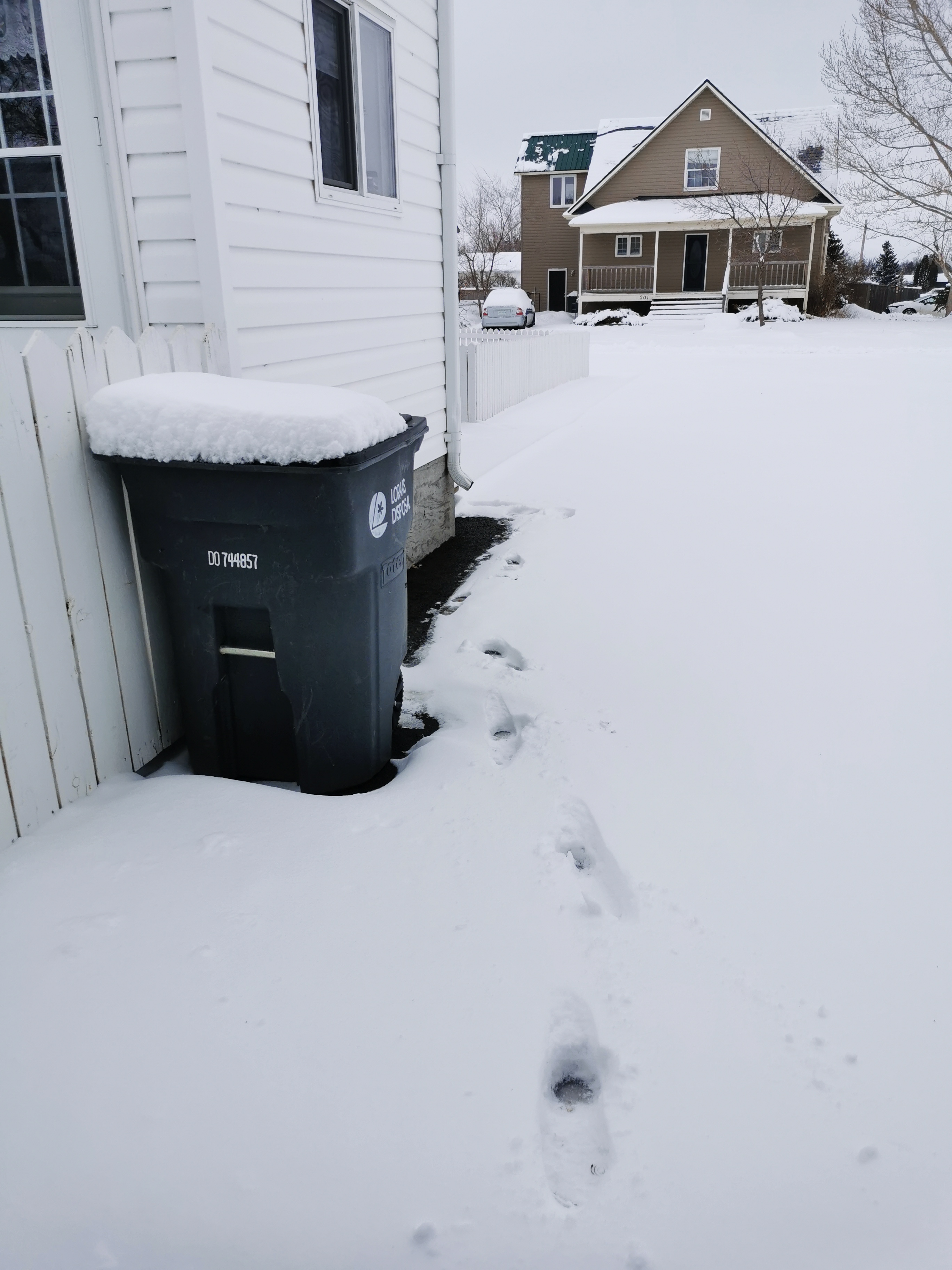
We woke up this morning to at least a foot of new, wet snow:
 Massive drifts (on top of all the snow we already had):
 And beautiful wind sculptures:
Before the latest edition, we could walk up the drift, over our back fence, and onto the prairie. Now the there is a 6 foot wide (at least) platform on top of the drift:

Thursday, February 28, 2013

Logos 5: Is an upgrade worth it?

Technical, first-world problem alert: This post assumes familiarity with the major Bible software programs (Logos, Bibleworks and Accordance), and an interest in electronic resources for the study of Greek and Hebrew.

Despite the incessant advertising, I haven't been able to convince myself that shelling out 100's of $ for an upgrade from Logos 3 (Gold) to Logos 5 is worth it. Special upgrade prices expired last month, but I have an offer of academic pricing at 50% off until mid-May, so I can still think about it. What am I missing?

Let me explain my situation in a bit more detail, and then I'll look forward to suggestions:
  • I use Bibleworks all the time. It is always open on my desktop. I consult it regularly in preparation for teaching, in general Bible reading, and in research. Bibleworks comes standard with morphologically tagged Greek texts of the New Testament, LXX, Apostolic Fathers, Philo and Josephus, as well as a morphologically tagged Hebrew Bible and morphologically tagged Aramaic Targumim. It also has more translations in more languages than you can shake a stick at. The best Greek and Hebrew dictionaries and Marty Abegg's tagged sectarian DSS (to name a few of interest to me), are available as add-on modules. I hesitate to pay good money to duplicate what I already have. 
  • I do not require a library of commentaries or other resources on the whole Bible since I teach and research in a more limited area. When I start to teach a new biblical book, I will build up my library accordingly. No doubt a complete set of good commentaries would come in handy from time-to-time, but not often enough to justify paying for a set that will sit mostly unused on my virtual shelves.
  • I am interested in more sophisticated ways to analyse and perform original-language grammatical searches on the Bible and related literature.
Questions about Logos 5:
  • A minimal cross-grade would give me access to a few new Lexham tagged texts and reverse interlinears, some pictures, and a few new datasets that would allow me to search by phrases instead of words. I'm just not sure I would do this kind of search enough to make it worth $130. (The Logos sales rep I talked to actually said the cross-grade isn't worth it. What I should really do, he said, is shell out $1,000+ for one of the larger packages.)
  • The Biblical Languages Upgrade looks more up my alley, except that I already have at least one morphologically-tagged database of everything in the package. What is the value of having multiple tagged texts of the same corpus? What is the benefit of reverse interlinears when any searches I do would be in the original language? I am open to being persuaded here. I'm just not seeing it. (If they threw in Moulton-Howard-Turner or the Lexham Discourse Greek New Testament Bundle as part of the package, it would suddenly look a lot more attractive.)
  • Which of these modules is worth the asking price?
How about independent resources: The Göttingen Septuagint, for example, is very tempting, and--as far as I know--not available on any other platform. If you were to purchase specialized resources geared towards work in the original languages, what would you recommend?

Saturday, January 26, 2013

A Turkey and Greece Study Tour Reading List


From an email I sent out to participants on this spring's Briercrest Study Tour of Turkey and Greece:

I compiled this list of readings for the academic course that goes along with the “Following Paul” study tour. Since I know from past experience that advance preparation pays off in a richer experience on the trip itself and more enduring memories afterward, I am sending it along to all of you. Don’t feel bad if you are not able to do all the readings; I encourage you to do as much as you can.

An Introduction to the History and Culture of Turkey and Greece

For most of us, the trip’s main attraction is its potential to help us understand the New Testament world better. Yet we cannot really return to the past. Our only access to ancient Greece and “Asia Minor” is through the twenty-first-century countries of Greece and Turkey. Focusing on only one small slice of the region’s history will actually distort our perspective on the period in which we are most interested. And, of course, there is a great deal that we can learn from the fascinating contemporary world that we will experience together. For these reasons, I encourage everyone to read about contemporary Turkey and Greece before we leave.

Students who take the study tour as a credit course will be required to read the “Understand Turkey” and “Understand Greece” chapters from the latest edition of the Lonely Planet Guides to Turkey and Greece. There may be better options, but these are short, engaging, and available on-line. The section on Greece is currently available from the Lonely Planet website as a free download. The section on Turkey will put you out $3.46 for the 90 page pdf. Here are the details:

·         Turkey: Bainbridge, James, et al. “Understand Turkey.” Pages 620-666 in Lonely Planet: Turkey (12th ed.), 2011. Chapter available online for $3.46: http://shop.lonelyplanet.com/turkey/turkey-travel-guide/turkey-understanding-turkey-and-survival-guide-chapter-12/.
·         Greece: Miller, Korina, et al. “Understand Greece.” Pages 710-758 in Lonely Planet: Greece (10th ed.), 2012. Chapter available online here: http://media.lonelyplanet.com/shop/pdfs/greece-10-understand-survival.pdf.

(You can purchase the entire guide books in print form if you like. Note, however, that the Lonely Planet series is geared primarily toward do-it-yourself travelers.)

The World of the New Testament

Students who take the study tour as a credit course will be required to read James S. Jeffers, The Greco-Roman World of the New Testament Era: Exploring the Background of Early Christianity (Downers Grove, IL: InterVarsity Press, 1999) before the tour begins. Based on my initial sampling, the book appears to be an excellent, well-written introduction to the social world of the earliest Christians. I think you will find that it brings to life the bare ruins we will visit. Recommended for everyone! The book will soon be available at the Briercrest Bookstore (http://www.briercrest.ca/bookstore); you can also order it through your favourite online retailer.

We are looking forward to the expert teaching of Dr. Mark Wilson during most of our time in Turkey. Students who take the study tour as a credit course will be required to read three of Dr. Wilson’s essays that deal with aspects of Paul’s missionary journeys and/or cultural life in Asia Minor:

Wilson, Mark. “The Rise of Christian Oracles in the Shadow of the Apollo Cults.” Ekklesiastikos Pharos 90 (2008): 162–175.
________. “The Role of the Holy Spirit in Paul’s Ministry Journeys.” Ekklesiastikos Pharos 87 (2005): 76–95.
________. “The Route of Paul’s First Journey to Pisidian Antioch.” New Testament Studies 55 (2009): 471–483.

Please email me if you would like a copy.

Ancient Sites

Student who take the study tour as a credit course will be required to read the relevant sections of Clyde E. Fant and Mitchell G. Reddish, A Guide to Biblical Sites in Greece and Turkey (New York: Oxford University Press, 2003). The book will soon be available at the Briercrest Bookstore (http://www.briercrest.ca/bookstore); you can also order it through your favourite online retailer.

If you have room in your luggage, you may want to purchase and bring along one or more of the following specialized guide books, which complement the general treatment in Fant and Reddish:

Ancient Sites in Turkey
·         Hemer, Colin J. The Letters to the Seven Churches of Asia in Their Local Setting. Grand Rapids: Eerdmans, 2001. (It reads like the dry doctoral dissertation it is, but the content—essentially a geographical commentary on Revelation 2-3—is fascinating and illuminating.)
·         McDonagh, Bernard. Blue Guide Turkey. 3rd ed. New York: W.W. Norton, 2001. (I found McDonagh’s Blue Guide to be an invaluable resource on a previous trip to Turkey, and also, remarkably, a lot of fun to read.)
·         Wilson, Mark. Biblical Turkey: A Guide to Jewish and Christian Sites of Asia Minor. Istanbul: Ege Yayinlari, 2010. (Lavishly illustrated in full colour, Mark Wilson’s guide is an excellent introduction to biblical sites in Turkey. As it is rather heavy, you may want to read it before you leave to whet your appetite for the trip itself.)

Ancient Sites in Greece – Both of the following books come highly recommended on Amazon. Take your pick:
·         Marker, Sherry, and James Pettifer. Blue Guide Greece: The Mainland. 7th ed. New York: W.W. Norton, 2006.
·         Mee, Christopher, and Tony Spawforth. Greece: An Oxford Archaeological Guide. Oxford University Press, 2001.

The Bible

Last, but not least, you will want to read Paul’s epistles, Revelation 1-3 and the relevant sections of Acts as you prepare for and participate on the tour. Here is a reading schedule for the tour itself, along with our final itinerary:

April 29, Monday Arrive Istanbul
·         Meet our Tutku Tour guide and transfer to the Grand Hotel Halic (www.grandhalic.com) in Istanbul. The rest of the day is free. Overnight in Istanbul. 

April 30, Tuesday Istanbul
·         On our first full day in Turkey we will sample some of the stunning sites in Istanbul, including the Hippodrome, the Blue Mosque, Hagia Sophia, Topkapi Palace, the Archaeological Museum, the Underground Cistern and the Grand Bazaar. Overnight in Istanbul at the Grand Hotel Halic.

May 1, Wednesday Morning Flight to Antalya; Perga - Attalia
·         After our arrival in Antalya, we will visit the Greco-Roman city of Perga (Acts 13:13-14; 14:25) and the Antalya Museum before taking a walking tour of Attalia that concludes at the Asia Minor Research Center. Overnight in Antalya at the Dedeman Antalya Hotel (http://www.dedeman.com/hotel-antalya/dedeman-antalya.aspx).
       Bible Reading: Acts 13-14; Galatians

May 2, Thursday Pisidian Antioch - Colossae
·         This morning we will drive to Yalvaç to visit Pisidian Antioch (Acts 13:14) and Yalvaç Museum. We will then drive west past ancient Apollonia and Apamea, with a brief stop at the unexcavated site of Colossae. Overnight in Pamukkale at the Lycus River Thermal Hotel (http://www.lycusriver.com/). 
·         Bible Reading: Colossians

May 3, Friday Hierapolis - Laodicea - Aphrodisias - Kuşadasi
·         Today we will visit the biblical cities of Hierapolis (Col 4:13) and Laodicea, and stop in Aphrodisias. Overnight Kuşadasi at the Grand Onder Hotel (http://www.onderotel.com/index.php). 
·         Bible Reading: Revelation 1-3

May 4, Saturday Ephesus
·         We will spend the day touring the ancient site of Ephesus, including terrace houses and the temple of Artemis, as well as St. John's Basilica and the museum in Selçuk. Overnight Kuşadasi at the Grand Onder Hotel. 
·         Bible Reading: Acts 18:18-20:1; Ephesians; 1 Timothy

May 5, Sunday Miletus - Didyma - Priene - Izmir
·         Today we will visit Miletus (Acts 20:15, 17), the Temple of Apollo at Didyma, and the Hellenistic city of Priene. Overnight Izmir at the Karaca Hotel (http://www.otelkaraca.com.tr/eng/).
·         Bible Reading: Acts 20

May 6, Monday Smyrna, Sardis, Philadelphia, and Thyatira - Bergama
·         Today we will concentrate on the cities mentioned in Revelation 2-3, with visits to Smyrna, Sardis, Philadelphia, and Thyatira. Overnight Bergama at the Berksoy Hotel (http://www.berksoyhotel.com/indexeng.htm). 
·         Bible Reading: Revelation 2-3

May 7, Tuesday Pergamum - Assos
·         We will spend most of the day visiting the extensive cite of Pergamum (Rev 2:12-17), including the acropolis, the Red Basilica, and the Asclepium. We will then drive past the port city of Adramyttium mentioned in Acts 27:2. Overnight Assos at the Grand Assos Hotel (http://www.grandassoshotel.com/). 
·         Bible Reading: Revelation 2:12-17; 27:2

May 8, Wednesday Assos - Troas - Troy - Transfer to Greece
·         After an early breakfast, we will tour the site of Assos (Acts 20:13-14), and then travel to Greece with stops along the way in Troas and Troy. Overnight Kavala at the Esperia Hotel (http://www.esperiakavala.gr/). 
·         Bible Reading: Acts 20:1-18

May 9, Friday. Neapolis - Philippi - Amphipolis
·         We will begin our day in Neapolis and then follow the route of Paul's second missionary journey with visits to Neapolis, Philippi and Amphipolis, and a final drive to Thessalonica. Overnight Thessaloniki at the Metropolitan Hotel (http://www.metropolitan.gr/en/). 
·         Bible Reading: Acts 16; Philippians

May 10, Saturday Thessalonica - Berea - Vergina
·         After visiting ancient Thessalonica, we will drive to Berea (Acts 17), and then visit the royal tombs of Macedonia at Vergina. Overnight Delphi at the Pythia Art Hotel (http://delphi-hotels.com/en/). 
·         Bible Reading: Acts 17:1-15; 1-2 Thessalonians

May 11, Sunday Delphi
·         We will spend the day at the beautiful ancient Greek city of Delphi. Overnight Corinth at the Kalamaki Beach Hotel (http://www.kalamakibeach.gr/).

May 12, Monday Corinth - Cenchrae
·         We will spend the day in the famous city of Corinth and the port of Cenchrae. Overnight Athens at the Jason Inn Hotel (http://www.douros-hotels.com/view_hotels.asp?hotel_id=1). 
·         Bible Reading: Acts 18:1-17; 1-2 Corinthians

May 13, Tuesday Athens the acropolis and agora; Mars hill.
·         On our final day, we will visit the acropolis of Athens, the extensive agora, and Mars hill. We will also tour the Parthenon museum. Overnight Athens. 
·         Bible Reading: Acts 17:16-18:1

May 14, Wednesday Transfer to Athens Airport

Happy Reading!