Showing posts with label Early Judaism. Show all posts

Monday, August 10, 2026

Jewish Backgrounds Online

Jewish Backgrounds to Early Christianity, a course I get to teach every second year, is being offered this fall through Briercrest Seminary with an online option. As with Hebrew, most students in this hybrid course will be in person. Online students will join the rest of the class over Zoom (Tues / Thurs 12:25-1:40 pm CST).

Here is the calendar course description: 

An introduction to the history, literature, and thought of early Judaism (from 300 BCE to 200 CE). This course highlights the Jewish origins of Christianity, illuminates the thought world of Jesus and his Jewish contemporaries, and explores the reasons for the eventual “parting of ways” between Judaism and Christianity.

If you have ever wanted to know about ancient Jewish texts that didn’t make it into the Protestant canon or wondered what happened during the so-called “400-silent years,” the course may be of interest.

 A copy of the syllabus is available at this link.


Saturday, May 16, 2026

Josephus and Jewish Ethnonyms

I am pleased to report that a pre-print version of my long article, “Josephus and Jewish Ethnonyms: Restoration Eschatology or Jewish Antiquity?” has appeared online at the Journal for the Study of Judaism website.

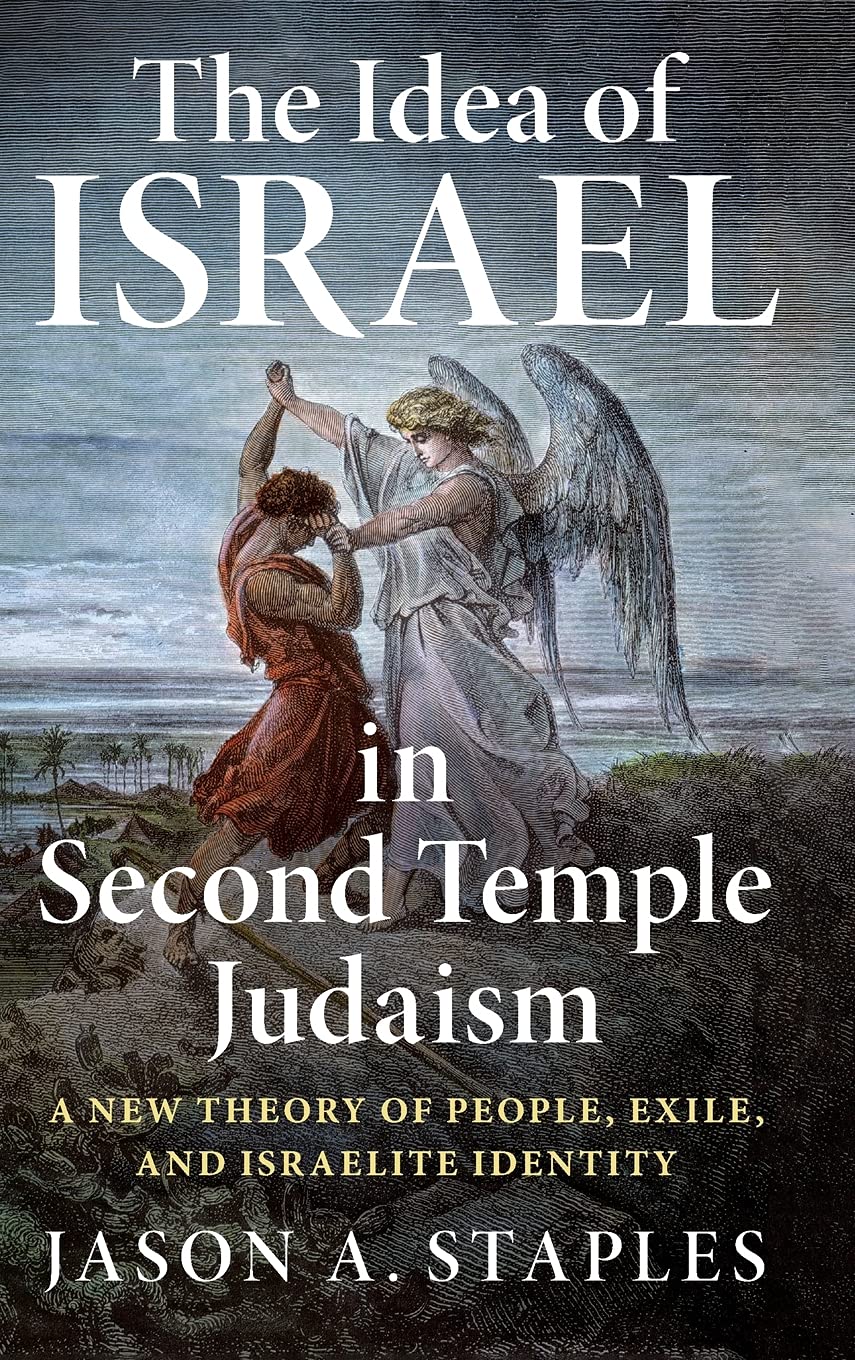
The article is framed as a response to the use Jason Staples makes of the ancient Jewish historian, Josephus, in his book, The Idea of Israel in Second Temple Judaism: A New Theory of People, Exile, and Israelite Identity (Cambridge University Press, 2021). In a nutshell, I agree with Staples that Josephus links the term Ioudaios (usually translated ‘Jew’ or ‘Judean’) to the tribe of Judah, but disagree that Josephus’ adoption of Ioudaios as the standard term for his people at the midpoint of his massive Jewish Antiquities has anything to do with a sense of ongoing exile or a hope for the restoration of the northern tribes of Israel.

In addition to responding to parts of Staples’ important monograph, I’d like to think the article makes its own contribution to our understanding of Josephus, in the first place by defending one of Staples’ main points about Josephus, which might otherwise be neglected; second, by critiquing Staples’ case for restoration eschatology in Josephus; and, finally, by highlighting how Josephus’ introduction of Ioudaios as a new name contributes to his defense of the Ioudaioi by way of a polemical opposition to the Samaritans. (There is also a close reading of sections of Antiquities book 11 and an exploration of Josephus’ ‘geography of exile’—his understanding of the boundaries of Babylon, Media and Persia—and what it implies about where Josephus thought the inhabitants of the northern and southern kingdoms of Israel and Judah were exiled.)

The article has had a long gestation period and has incurred debts along the way. I would like to acknowledge some of them here: I presented an early version of the essay at the Canadian Society of Biblical Studies in May of 2023, and a revised version at a faculty colloquium at my home institution in January 2024. I thank Briercrest for a semester sabbatical in 2025 that gave me time to finish the essay, and the other Dr. Miller for reading and talking about it more than she wanted to. Incisive, detailed and critical feedback from two anonymous reviewers for JSJ resulted in a much better, clearer (and longer) final product. I am also grateful to Staples himself: I learned a great deal from interacting with his work.

For anyone interested in more detail, here are the thesis and outline paragraphs:

The re-examination of Josephus’ ethnic terminology in this article confirms and reinforces one of Staples’ major points. When in Antiquities 11 Ioudaios first begins to be used as a common label, the term is in fact closely associated with the southern kingdom of Judah. I am not persuaded, however, by Staples’ additional claims that Ioudaios consistently refers to a subset of “all Israel” or that the shift from “Hebrews” and “Israelites” to Ioudaioi in Antiquities 11 reflects Josephus’ restoration eschatology. The point of introducing the label, Ioudaios, at the return from exile in Babylon is not to contrast southern kingdom Ioudaioi, on the one hand, and northern kingdom “Israelites” still in exile beyond the Euphrates, on the other. Nor is it to express hope for a still future restoration of the twelve tribes of Israel. When Josephus adopts Ioudaios as his preferred ethnonym and explains its connection to the tribe of Judah, his goal is to establish continuity between contemporary Ioudaioi and the past history of his people in the context of a wider polemical contrast with the Samaritans, whose claim to Israelite ancestry he regards as illegitimate. Once the antiquity of the label and the people it designates is validated, its meaning expands to encompass the whole people regardless of current location or tribal ancestry.

I begin by tracing the use of ethnonyms in Josephus’ paraphrase of the preexilic period (Ant. 1-10), noting that his preferred term for the people as a whole before the exile is “Hebrews,” that Ioudaios seldom appears, and that “Israelites” can designate the people as a whole or the northern tribes, as “Israel” does in his biblical source texts. The two established meanings of “Israelite” complicate attempts to determine whether Josephus presents the Ioudaioi as opposed to the Israelites, a subset of the Israelites, or synonymous with the Israelites. This ambiguity is the subject of sections two and three. Section two examines Josephus’ own explanation of the postexilic origins of Ioudaios and its links to the “tribe of Judah” (Ant. 11.173), and then explores his understanding of the regions where the northern and southern tribes were relocated by the Assyrians and Babylonians. Section three employs what Josephus says about Babylonia, Media and Persia as a diagnostic tool to help determine the meaning of “Israelite” and its relationship to Ioudaios in the first half of Antiquities 11. Although it is not always possible to identify the referent of “Israelite” in book 11, Josephus’ use of “Israelite” and Ioudaios does not point to a separation between Ioudaioi and “all Israel” when the southern tribes return from exile. Instead, the continued use of “Israelite” during the return narrative connects the Ioudaioi to their preexilic past. The next two sections challenge Staples’ claim that Josephus’ adoption of Ioudaios implicitly draws attention to the absence of the northern tribes. Section four argues that Josephus identified the end of exile with possession of the land and temple, not the return of all twelve tribes. References to “Israelites” or members of the “ten tribes” beyond the Euphrates do not, therefore, reflect Josephus’ restoration hope; nor does a sense of ongoing exile explain the shift to Ioudaios. Section five shows that, despite its initial connections to the southern kingdom of Judah, the term Ioudaios expands in scope in Antiquities 12-20, becoming, in effect, a postexilic replacement for “Israelite” and “Hebrew.” A concluding section attributes Josephus’ decision to switch to Ioudaios to his own reading of his biblical source texts, and suggests that he attempted to introduce the name into his narrative in a way that confirmed his people’s antiquity.

You can view the abstract here.

Finally, I tried to present Staples’ position accurately. Staples evidently thinks I failed to do so. So … if you wish to pursue the topic further, I recommend reading Staples’ book as well as my own essay. Let the conversation continue. 


Tuesday, April 22, 2025

Early Judaism Video Lecture: From Alexander to Antiochus IV

This video, the fourth in a series of lectures I recorded in the fall of 2020, offers a big picture overview of Greek rule in Judaea from the death of Alexander the Great to the conquest of the Levant by the Seleucid king Antiochus III (ca. 323 BCE - 198 BCE). I also introduce the concept of “Hellenization.”
It’s riveting, I assure you, but best watched at 1.5 - 2x speed. 

See this post for more information as well as links to other video lectures in the series.

Major secondary sources / influences:

Cohen, Shaye. From the Maccabees to the Mishnah. 3rd ed. Louisville: Westminster John Knox, 2014.

Nickelsburg, George W. E. Jewish Literature Between the Bible and the Mishnah: A Historical and Literary Introduction. 2nd ed. Minneapolis: Fortress Press, 2005.

Rainey, Anson F., and R. Steven Notley. The Sacred Bridge: Carta’s Atlas of the Biblical World. Jerusalem: Carta, 2006.

Schwartz, Seth. The Ancient Jews from Alexander to Muhammad. Cambridge: Cambridge University Press, 2014.

Schwartz, Seth. Imperialism and Jewish Society, 200 B.C.E. to 640 C.E. Princeton: Princeton University Press, 2001.

Tcherikover, Victor. Hellenistic Civilization and the Jews. Peabody, Mass.: Hendrickson, 1999.


Friday, March 28, 2025

Early Judaism Video Lectures

Five years ago, the college where I teach responded to the Covid pandemic by radically altering our regular semester schedule. To ensure flexibility in case an outbreak meant we had to switch everything online, our fourteen-week semester was divided into two more intensive seven-week terms, with daily classes but shorter class times to satisfy our Province’s restrictions on in-person meetings. (Chairs also had to be six feet apart, which meant that those of us with larger classes had to teach multiple sections.) Thankfully, we were still able to meet in person, students were obviously glad to be there, and the smaller class sizes and more intensive format helped contribute to the learning experience.

The big challenge for those of us who teach content-heavy courses was making up for lost lecture time. To solve this problem we were encouraged to “flip” our class format by pre-recording lectures and saving face-to-face class time for discussion. I have to say I hated this. The videos took an enormous amount of work, and the quality of what I produced was, I thought, very poor. 

In subsequent years, however, I have found myself returning to the videos I produced for my 300-level introduction to early Judaism course (“Jewish Backgrounds to Early Christianity”), sometimes to remind myself what I said in class and sometimes to require my students to watch specific videos as assigned “readings” when we get behind or to leave more room for discussion in class. 

The first few videos are indeed a wash. I won’t be posting them anywhere! But the quality does improve, the content is, I think, pretty good, and, if you speed up the video to at least 1.5x speed, you can get beyond my stilted delivery. It occurred to me that there might be some value in posting some of them to my YouTube channel and linking to them on this blog. 

I intend to keep this post updated as an index page as I upload more videos:

  • From Alexander to Antiochus IV - A big picture overview of Greek rule in Judaea from ca. 323 BCE - 198 BCE, with a discussion of “Hellenization.”
  • Purity and Impurity in Second Temple Judaism - This video, from about two-thirds of the way through the course, is on the ancient Jewish purity system. As it happens, I originally created a blog post about the video back in 2020. That post has been updated with a link to the YouTube version of the video. As I mention there, anyone interested in the topic should now subscribe to Logan Williams’ and Paul Sloan’s excellent “Jesus and Jewish Law” podcast.

Friday, February 14, 2025

Gary Anderson on Hebrew as the Language of Jesus

Reviewing the endnotes to Gary Anderson’s impressive history of sin (!), I came across this gem on New Testament scholars, Modern Hebrew and the language of Jesus:

Mishnaic Hebrew, in its limited sense, refers to the Hebrew of the Mishnah itself, a relatively early rabbinic work [ca. 200 CE] …. But when we speak of the dialect of Mishnaic Hebrew, we are talking about the living Hebrew language of the first couple of centuries of the Common Era, in other words, the language of Jesus himself.”

“Scholars vary in their opinions as to how fluent Jesus was in the various languages with which he was familiar (Aramaic, Hebrew, and Greek). Most New Testament scholars assume that Aramaic was his mother tongue and that Hebrew was a secondary language. …. Part of the problem is that the best scholarship on the Hebrew of the late Second Temple period is being done at the Hebrew University and is written in modern Hebrew. Only a handful of New Testament scholars could follow this discussion, and I know of none who do. As a result, the case being made for Hebrew as a living language in the first and second centuries CE has gone unnoticed.” 

~ Gary A. Anderson, Sin: A History (New Haven, CT: Yale University Press, 2009), 95-6, 215 note 1 (emphasis added)

The book itself is a fascinating analysis of a shift from sin conceived as burden to sin conceived as debt, that ranges across the testaments, through rabbinic literature and Christian Syriac, concluding with a rousing defense of Anselm’s Cur Deus Homo? I wager that only a handful of Old Testament scholars could attempt such a feat.

Back to the topic of Hebrew as a living language during the Second Temple period: My posts on Jesus’ mother tongue from 15 years ago (!) are here:

Jesus’ Mother Tongue

Jesus' Mother Tongue Part 2: The Supposed Dominance of Aramaic in First Century Galilee

Wednesday, January 17, 2024

Josephus and Jewish Ethnonyms Take 2

A public service announcement for anyone in the Caronport area:

This will be a partially-revised version of the paper I gave last year at the Canadian Society of Biblical Studies.

Tuesday, May 23, 2023

Josephus and Jewish Ethnonyms: Evaluating Jason Staples's Idea of Israel in Second Temple Judaism

I'm on to present a paper at the Canadian Society of Biblical Studies annual meeting at Congress in Toronto next Monday. I put the abstract together in January on a hunch, in the hopes that a deadline would force me to finish a book I wanted to read, and prime the writing pump. Since I didn't make nearly as much progress as I wanted over the semester, it also made a gauntlet of a winter-spring that much more demanding. Right now, however, I'm grateful because at least in a few moments over the last intense week of research and writing, the chance to concentrate on a single intellectual puzzle long enough to make headway has felt strangely like a mental vacation. 

The abstract is not quite what I would say now that I have a more-or-less complete rough draft in hand, but it is close enough to what the paper is still trying to do that I will post it here in case anyone is interested:

In The Idea of Israel in Second Temple Judaism (CUP, 2021), Jason Staples argues that instead of being mutually interchangeable terms for the same group, “Israel” referred to the “tribes of the biblical northern kingdom” or to “the twelve-tribe covenantal people,” while Ioudaios (and cognates) designated a “subset” of this larger group associated with the southern tribes and the biblical kingdom of Judah. This paper will test Staples’s proposal against the evidence in Josephus. I will consider Josephus’s explanation for his own shift in terminology within the narrative context of the Antiquities; reevaluate the dueling claims of Ioudaioi and Samaritans in Antiquities books 9 and 11; and examine the labels Josephus uses to designate both those who returned from exile and those who remained “beyond the Euphrates.” We will see that within Josephus Ioudaios could still serve as a label for the people as a whole, including descendants of the northern tribes.

I may have more to say once the draft is revised and the paper is presented.

Thursday, January 6, 2022

A 2022 Reading List


Scot McKnight used to give himself a new fountain pen every Christmas. This year I did something similar with books.


I read a draft of Adele Reinhartz's Befriending the Beloved Disciple in Jerusalem in December 2000. My former teacher's sequel, Cast out of the Covenant, has been on my to-read list since it came out in 2018. Now that I have a copy of my own, I hope to get to it sooner rather than later. For Adele's reflections on her "Journey with John" and an overview of the book's argument, see this short essay


I first encountered Jason Staples's "new theory of ... Israelite identity"--to quote the sub-title of his 2021 monograph--years ago at SBL, and have kept an eye on his work ever since. When Scot McKnight named The Idea of Israel as the "best academic book" he "read this year," I decided not to wait until the paperback edition comes out.


Christopher Stroup's The Christians Who Became Jews is not the only book whose title and topic make me wish I had written it first. Since my research and publishing efforts have centered on ethnicity in ancient Judaism and, separately, Luke-Acts, I decided to take advantage of a Yale University Press sale and a trip to the United States to pick up a copy of this monograph that treats both at once. 


Also from Yale University Press, Lawrence Wills's recent Introduction to the Apocrypha promises to inform the course I teach on "Jewish Backgrounds to Early Christianity."

To round out my Yale University Press order, I picked up a copy of Brent Nongbri's much-discussed, God's Library: The Archaeology of the Earliest Christian Manuscripts, which is, fortunately, now out in paperback.

Attentive readers of titles (and subtitles) will notice a pattern here: "Jews and Anti-Judaism in the Gospel of John," "Jewish Books in Christian Bibles," "The Christians who Became Jews," "The Idea of Israel in Second Temple Judaism." In different ways all four books deal squarely with my own persistent scholarly preoccupation with early Judaism, the Jewish context of early Christianity, and the relationship between Jews and early Christians. I don't expect to agree fully with any of these books (who does?), but I do expect to learn much and to be stimulated to look at familiar texts with fresh eyes.

I suffer from a tendency to buy books faster than I read them, but these I hope to get to in 2022. Just perhaps--come spring--I may pull one or two of my own languishing projects off the shelf and make some headway on writing as well as reading in pandemic year 3.

In addition to picking up a book order, our trip the United States including a little snowshoeing:


Sunday, February 28, 2021

On Jesus' address to God as Father and Ancient Judaism


It is a commonplace in New Testament scholarship that Jesus' characteristic address to God as Father was distinctive if not unique in the first century.

According to Scot McKnight, "'Father' occurs only occasionally in the evidence that survives from Second Temple Judaism." Jesus, by contrast, "taught his disciples to pray, as a matter of routine address, 'Our Father'" (McKnight 1999: 54-55; emphasis added).

Richard Bauckham maintains that Jesus' "almost exclusive use of 'Father' to address God was certainly very unusual" and proposes that Jesus' innovation was to adopt "the word 'Father' as his own chosen substitute for the Divine Name." (Bauckham 2020: 53)

Wesley Hill's brief popular exposition of the Sermon on the Mount contrasts Jesus' frequent use of "Father" for God with Old Testament and, by implication, with "[o]ther Jewish texts that ... use 'father' for God":

"T]here remains throughout the Old Testament a certain reserve about the father metaphor for God. ... It is almost as if these rare instances of the God of Israel being called (or calling Himself) 'father' are placeholders, awaiting some unforeseen future revelation that will cause them to take on a new resonance." (Hill 2019: 11 and 106 note 11).

Dale Allison's 1999 attempt at an accessible commentary on the Sermon on the Mount is now rather dated by the get-the-latest-new-book standards of New Testament scholarship, but seems to me to adopt a better approach:

"No prayer in the Hebrew Bible opens with this address, although the idea that God is the father of faithful Israel, his children, is certainly well attested. ... The Mishnah, however, does use the phrase, 'Our Father in heaven' ... and extrabiblical Jewish prayers do have invocations with 'Father.' .... In the light of all the parallels, especially the Qumran texts, it is unwise to insist (as so many have when writing on the Lord's prayer) that Jesus use of 'Abba' was unique. ... At the same time, it remains true that early Christian sources speak of God as Father much more frequently than contemporary Jewish sources; and since Mark 14:36; Rom. 8:15; and Gal. 4:6 transliterate the Aramaic 'abba' into Greek, there is a good chance that the address was thought special because characteristic of Jesus." (Allison 1999: 117)

To be sure, McKnight, Bauckham and Hill are careful enough scholars to avoid referring to Jesus' usage as "unique," but they continue to emphasize discontinuity between Jesus and his Jewish context. Allison explores the same evidence in more detail, and stresses continuity.

I suspect the difference between Allison, on the one hand, and McKnight, Bauckham and Hill, on the other, comes down to scholarly posture:

(1) Allison is more cautious when it comes to filling in historical gaps: As evidence for ancient Jewish references to God as father, Allison quotes from a story in the Bablylonian Talmud about Hanan, the grandson of Honi the Circle Drawer:

"When the world was in need of rain, the rabbis used to send school-children to him who seized the train of his cloak and said to him, Abba, Abba, give us rain! He said to God: Lord of the universe, render a service to those who cannot distinguish between the Abba who gives rain and the Abba who does not." (b.Taanit 23b in Allison 1999:117)

In this case, Allison's caution is warranted. We know far less about Honi the Circle Drawer and his grandson than we do about Jesus. When we crunch the numbers and compare Jesus' usage with that of other ancient Jews, we need to keep the fragmentary nature of our surviving evidence in mind.

(2) Allison actively resists the deeply-ingrained Christian impulse to set Jesus over against his Jewish environment--and for good reason after centuries of Christian denigration of Jews and Judaism. To paraphrase Amy-Jill Levine, we don't need a bad Judaism to have a good Jesus. The authority of Jesus' teaching does not rest on its being unique in all respects. As Allison observes, "A Jew wanting to have nothing to do with Jesus could still pray the Our Father" (1999: 134).

References

Allison, Dale C. The Sermon on the Mount: Inspiring the Moral Imagination. New York: Crossroad, 1999.

Bauckham, Richard. Who Is God?: Key Moments of Biblical Revelation. Acadia Studies in Bible and Theology. Grand Rapids: Baker Academic, 2020.

Hill, Wesley. The Lord’s Prayer: A Guide to Praying to Our Father. Bellingham, WA: Lexham Press, 2019.

Levine, Amy-Jill. “Bearing False Witness: Common Errors Made about Early Judaism.” Pages 759–63 in The Jewish Annotated New Testament. Edited by Amy-Jill Levine and Marc Zvi Brettler. 2d ed. Oxford: Oxford University Press, 2017.

Levine, Amy-Jill. The Misunderstood Jew: The Church and the Scandal of the Jewish Jesus. San Francisco: HarperSanFrancisco, 2006.

McKnight, Scot. A New Vision for Israel: The Teachings of Jesus in National Context. Grand Rapids: Eerdmans, 1999.

Sunday, October 4, 2020

Purity and Impurity in Second Temple Judaism

Update: This video (with its accompanying blog post) was originally published in 2020, and is now the first in a series. Anyone interested in the topic of purity in Second Temple Judaism, should subscribe to Logan Williams’ and Paul Sloan’s excellent “Jesus and Jewish Law” podcast.

Few Christians today linger over the ritual purity laws in the Pentateuch. This lack of familiarity with the Torah, and with how the Torah was understood in ancient Judaism, is often combined with a profound failure of historical imagination. The predictable result: major misreadings of the New Testament.

In this 28-minute video, prepared for students in my introduction to early Judaism course, I explain how Jewish systems of purity really worked 😏: 


There are still plenty of mistakes in delivery, production and, no doubt, in content, but this one turned out better than most of the videos I’ve produced so far. (It also takes the prize for most time-consuming to prepare.) I justify its length by telling my students to watch it at 2x speed.

I should note that I make no claim to originality here. The model I present is essentially that of Jonathan Klawans with a side of E.P. Sanders.  

Comments, corrections and recommendations for further reading are welcome.

A Working Bibliography

Hayes, Christine E. Gentile Impurities and Jewish Identities: Intermarriage and Conversion from the Bible to the Talmud. Oxford: Oxford University Press, 2002.
Kazen, Thomas. Jesus and Purity Halakhah: Was Jesus Indifferent to Impurity? 2d ed. CB 38. Winona Lake, IN: Eisenbrauns, 2010.
Klawans, Jonathan. Impurity and Sin in Ancient Judaism. Oxford: Oxford University Press, 2004.
________. “Notions of Gentile Impurity in Ancient Judaism.” AJS Review 20.2 (1995): 285–312.
Meier, John P. A Marginal Jew Volume 4: Law and Love. New Haven: Yale University Press, 2009.
Poirier, John C. “Purity beyond the Temple in the Second Temple Era.” Journal of Biblical Literature 122 (2003): 247-265.
Rogan, Wil. “Purity in Early Judaism: Current Issues and Questions:” Currents in Biblical Research 16.3 (2018): 309-339.
Sanders, E. P. Judaism: Practice and Belief: 63 BCE - 66 CE. London: SCM Press, 1998.
Thiessen, Matthew. Jesus and the Forces of Death. Grand Rapids: Baker Academic, 2020.
Wassen, Cecilia. “The Jewishness of Jesus and Ritual Purity.” Scripta Instituti Donneriani Aboensis 27 (2016): 11–36.

In addition to Klawans and Sanders, I found the chapter on Purity in John Meier’s 4th volume as well as the recent essays by Wil Rogan and Cecilia Wassen especially helpful. It will be obvious that I am not finally persuaded by Thomas Kazen or John Poirier. 

Monday, June 17, 2019

Maccabean Amnesia in Philo’s Embassy to Gaius

Two months ago, in my last contribution to this on-going series, I followed Daniel Schwartz in suggesting that King Agrippa I, the great-great-grandson of the last Hasmonean king who ruled Judaea and Galilee between 41-44 CE, seems not to have emphasized his Hasmonean ancestry. After publishing the post, I came across a possible piece of counter-evidence in my notes on Philo of Alexandria’s Embassy to Gaius. In this apologetic treatise, Philo includes a long letter that he claims Agrippa sent to Gaius Caligula in an attempt to convince the emperor not to set up a statue of himself in the Jerusalem temple (Leg. 276-329). In the letter’s introduction Agrippa reminds Caligula that his royal Hasmonean ancestors thought so highly of the temple that they valued their hereditary role as high priest more than the title of king:
“I as you know am by birth a Jew, and my native city is Jerusalem in which is situated the sacred shrine of the most high God. It fell to me to have for my grandparents and ancestors kings, most of whom had the title of high priest, who considered their kingship inferior to the priesthood, holding that the office of high priest is as superior in excellence to that of king as God surpasses men.” (Philo, Leg. 278 LCL)
Everyone agrees that the letter is Philo’s own composition rather than Agrippa’s ,[1] but it shows that Philo, at least, was aware of Agrippa’s Hasmonean ancestry and that he did not hesitate to refer to it in a text composed toward the middle of the first-century CE.[2]

The passage may, however, be an exception that proves the rule, for although the letter demonstrates Philo’s awareness of Hasmonean rule in the first century BCE, Philo goes on to have Agrippa deny that the Jerusalem temple had ever previously been desecrated in this way:
“This temple, my Lord Gaius, has never from the first admitted any figure wrought by men’s hands, because it is the sanctuary of the true God. … Thus no one, Greek or non-Greek, no satrap, no king, no mortal enemy, no faction, no war, no storming or sacking of the city, nor any existing thing ever brought about so great a violation of the temple as the setting up in it of an image or statue or any hand-wrought object for worship.” (Philo, Leg. 290, 292 LCL; cf. 300)
Did Philo not remember the Maccabean revolt?

In her commentary on The Embassy to Gaius, E. Mary Smallwood assumes that Philo did know about the “abomination that causes desolation” erected by Antiochus Epiphanes in the Temple, but chose to ignore it:
“Antiochus Epiphanes had actually robbed the Temple and devoted it to the cult of Olympian Zeus, setting up a statue in it …. But in his eagerness to provide uniformly favourable precedents for the treatment of the Jews, Philo deliberately avoids all mention of the action.”[3]
Possibly. But explaining Philo’s silence as a deliberate omission is itself an argument from silence. It is true that Philo’s description of the first-century CE crisis under Caligula reminds modern readers of the second-century BCE crisis under Antiochus Epiphanes; when I re-read the Embassy to Gaius last fall, my first reaction was to think that Philo was dependent on 1 Maccabees. But, as far as I know, Philo, whose extant works focus almost exclusively on the Pentateuch, never refers directly to the Maccabean revolt. A review of the three volumes in the Philo of Alexandria Annotated Bibliography yields nothing about Antiochus or the Hasmoneans / Maccabees, as such, and very few incidental references to 1-4 Maccabees. No one that I can see claims that Philo knew or was directly dependent on the Maccabean literature.

What am I missing?


[1] Daniel R. Schwartz, Agrippa I: The Last King of Judaea (TSAJ 23; Tübingen: Mohr Siebeck, 1990), 200–202 (Appendix VI: The Philonic Authorship of Agrippa’s Epistle to Gaius [Leg. 276-329]); see also Erich S. Gruen, “Caligula, the Imperial Cult, and Philo’s Legato,” SPhilo 24 (2012): 135–47.
[2] The embassy took place in 39-40 CE; Philo’s death is normally placed around 50 CE. See Gregory E. Sterling, “Philo,” in The Eerdmans Dictionary of Early Judaism (ed. John J. Collins and Daniel C. Harlow; Grand Rapids: Eerdmans, 2010), 1065.
[3] E. Mary Smallwood, Philonis Alexandrini: Legatio Ad Gaium (Leiden: Brill, 1961), 298–99.


Other posts in this series:
Part 1: First-Century Memories of the Maccabees -- A Footnote with Footnotes
Part 2: First-Century Memories of the Maccabees Part 2: The Origins of Hanukkah
Part 3: First-Century Memories of the Maccabees Part 3: Hanukkah in the First Century
Part 4: Memories of the Maccabees in the Dead Sea Scrolls
Part 5: The Maccabean Revolt and the Success of Hasmonean Propaganda
Part 6: The Case of the Disappearing First-Century Hasmoneans

Tuesday, April 16, 2019

The Case of the Disappearing First-Century Hasmoneans

This sixth instalment in my series on first-century memories of the Maccabean revolt amounts to a variation on a minimalist-sounding refrain. In this case, those who defend a link between the Maccabean revolt and the first Jewish revolt against Rome tend to ignore the gap between Hasmonean propaganda during the period of Hasmonean rule that ended in the 60’s BCE, and the Jewish revolt more than a century later in the 60’s CE. While Hasmonean popularity appears to have persisted through the reign of Herod the Great (see previous post), there is precious little concrete evidence between 3 BCE and 93/94 CE that anyone appealed either to Hasmonean ancestry or to Hasmonean precedent to buttress their leadership claims or to establish their personal credentials.

As far as I know, the only extant example of an appeal to Hasmonean ancestry in the first century comes from Josephus’s Life, which was written at the very end of the century in 93/94 CE. After cataloguing his priestly credentials, Josephus claims royal descent through the daughter of Judas’s brother, Jonathan:
“Moreover, on my [great-great-grand-]mother’s side I am of royal blood; for the posterity of Asamonaeus, from whom she sprang, for a very considerable period were kings, as well as high-priests, of our nation” (Life 2).[1]
Perhaps it is significant that Josephus only mentions his Hasmonean lineage once, near the end of his life. In the 70’s when he published the Jewish War, he passed over his Hasmonean ancestry in silence, identifying himself only as “a Hebrew by race, a native of Jerusalem and a priest” who was an eyewitness of many of the events he records (War 1.3).

Other explanations of Josephus’s silence in the 70’s CE are possible, of course, and it may be that Josephus’s self-description in the 90’s was typical of the century as a whole. Even though his resumé is the only one to survive, there may well have been others throughout the first century who were proud of their distant Hasmonean lineage.

In a valiant attempt to produce another example, William Farmer suggested “with some confidence” that Josephus suppressed the Hasmonean identity of Judas the Galilean, the founder of the “fourth philosophy” and the one on whom Josephus pinned the blame for the Jewish revolt against Rome in 66 CE. Farmer’s argument rests on a speculative combination of the name, Judas, which was common among Hasmoneans and non-Hasmoneans alike, opposition to Herod by the Jerusalem aristocracy for the murder of Judas’s father, Ezekias, and the supposition that the Jerusalem aristocracy at that time had intermarried with the Hasmoneans.[2] Needless to say, I do not share Farmer’s confidence.[3]
 
Daniel Schwartz supposes that priests in the first century looked on the Hasmoneans not so much as literal ancestors as exemplars of the best form of government, remembering with nostalgia “the good old Hasmonean days, when high priests ruled the land.”[4] This is possible. But priestly rule was not a Hasmonean innovation, and Schwartz assumes both that Hasmonean rule remained popular—the point in question here—and that “the ejection of Rome” from the land was “the goal toward which territorially-centered priestly religion must logically strive.”[5] (Does historical causation really follow such patterns of logical necessity?)

Instead of first-century Jews celebrating Hasmonean rule, the search for hard evidence yields Hasmonean descendants who did not draw on their Hasmonean heritage when they might have been expected to do so. Josephus is one example. Another is Herod the Great’s grandson, Herod Agrippa I, who was a descendant of Hasmonean royalty through the line of his grandmother, Mariamme. Agrippa I apparently made no attempt to burnish his leadership credentials by appealing to his Hasmonean ancestry when he was appointed king, first of the territory of his uncle Philip, then of Galilee, and finally of Judaea and Samaria.[6] Agrippa I’s son Agrippa II, a Roman through and through, appears to have “helped Titus celebrate the destruction of the Temple in the autumn of 70 C.E.”[7]
 
Agrippa I’s failure to play up his Hasmonean ancestry may have been a calculated decision. In the charged atmosphere of the mid-first century, an appeal to Hasmonean ancestry may have conveyed a desire for independence at a time when Agrippa had decided to throw in his lot with Rome as his grandfather Herod the Great had done. Indeed, one of the paradoxes of Agrippa’s life, according to Daniel Schwartz, is that even though he pursued an aggressively Herodian foreign policy, completely loyal to Rome and a benefactor of non-Jewish Greek cities both within and beyond the borders of his realm, Agrippa could not escape his Hasmonean ancestry:
“[A] man who knew better than anyone that the fate of Judaea, and of the Jews of the Mediterranean world, was dependent upon Rome, was stubbornly viewed by too many people as harbinger of the type of anti-Roman Jewish nationalism embodied by some of his ancestors. The hopes which were raised by his enthronement, and which refused to die with him, contributed to the faith which led to the great rebellion of 66-73 C.E., and to catastrophe.”[8]
If Schwartz is correct, the legacy of the Maccabees and their Hasmonean successors exerted such pressure on Jews and non-Jews alike that it shaped impressions of, and responses to, Agrippa, despite his best efforts to counteract them.

The problem, for my purposes, is that instead of providing direct evidence for first-century memories of the Maccabees among Jews and neighbouring gentiles, Schwartz’s proposal takes Hasmonean popularity (among Jews) and notoriety (among non-Jews) for granted:

The Hasmonean Legacy among Jews: Schwartz maintains that Agrippa’s Hasmonean ancestry fueled “anti-Roman Jewish nationalism” even though everyone knew that Agrippa himself, the putative Hasmonean heir, would have nothing to do with it:
“While such circles might have drawn some encouragement from Agrippa’s one-quarter Hasmonean descent, it was not to be expected that he would be the flag-bearer for the priests’ return to their former glory …. Some high priests and others, therefore, seem to have undertaken to bear that flag themselves.”[9]
The evidence Schwartz adduces—priestly support for the Jewish revolt itself a couple decades later and “Agrippa’s frequent switching of high priests”[10]—is only compelling if one assumes widespread first-century support for the Hasmoneans to begin with.

The Hasmonean Legacy among Non-Jews: Josephus describes in some detail how non-Jews in the cities of Caesarea and Sebaste rejoiced at Agrippa’s death:
“They hurled insults, too foul to be mentioned, at the deceased; and all who were then on military service … went off to their homes, and seizing the images of the king’s daughters carried them with one accord to the brothels, where they set them up on the roofs and offered them every possible sort of insult …. Moreover, they reclined in the public places and celebrated feasts for all the people, wearing garlands and using scented unguents; they poured libations to Charon, and exchanged toasts in celebration of the king’s death. In this they were unmindful not only of Agrippa, who had treated them with much generosity, but also of his grandfather Herod, who had built their cities” (A.J. 19.357-9).
According to Schwartz, this reaction to Agrippa’s death is “ironic” because Agrippa’s “policy … was that of his grandfather [Herod], not of the Hasmoneans.”[11] It is worth noting, however, that Josephus—our only source for this episode—says nothing about Agrippa’s Hasmonean ancestry. In its context, at the very end of book 19 of the Antiquities, the story illustrates the growing conflict between Jews and Gentiles within Agrippa’s realm that Josephus names as one of the causes of the Jewish revolt. Josephus goes on to say that the emperor Claudius had originally planned to discipline those who dishonoured Agrippa’s memory by relocating the cavalry units from Caesarea and Sebaste to Pontus, but in the end he was persuaded to let them stay in Judaea and, as a result “These men, in the period that followed, proved to be a source of the greatest disasters to the Jews by sowing the seed of the war in Florus’ time” (A.J. 19.366). From Josephus’s perspective, those who opposed Agrippa did so not because of his Hasmonean grandmother but because of his Jewishness.

The Hasmoneans and the Romans: There are also reasons to question an easy equation between Hasmoneans and opposition to Rome.

In the first place, Agrippa’s pro-Roman policy did not stop him from engaging in other activities that led to Roman censure, including fortifying the walls of Jerusalem (War 2.218-219; 5.147-160; A.J. 19.326-7) and meeting as royalty with other client kings (A.J. 19.338-342).[12] Were these actions somehow less provocative than claiming to be the heir of the Hasmonean dynasty? It is true that the Hasmoneans who attempted to regain power in Judaea after Pompey’s invasion called on the Parthians for help driving out the Romans. But during the first century the charge of supporting the Parthians was a convenient way for rivals to libel their opponents. According to Josephus, Agrippa himself had secured control of Herod Antipas’s realm by accusing his uncle of siding with the Parthians against Rome—and Antipas was no relation to the Hasmoneans (A.J. 18.250-2).

More importantly, appealing to one’s Hasmonean ancestry need not have been construed as anti-Roman in itself. Schwartz assumes that opposition to the Greek Seleucid rule of Antiochus and his successors in the original Maccabean storyline had by the first century been transferred to Rome. But substituting “Roman oppressor” in place of “Greek oppressor” was neither necessary nor inevitable. More than thirty-five years ago, Wayne Meeks warned about a tendency to read post-70 Jewish attitudes toward Rome back into the early first century:
“Popular treatments of early Christianity and early Judaism have focused so one-sidedly on Palestine and especially on the failed revolts of 66-70 and 132-135 that we tend to think of Rome as the implacable enemy of the Jews. The documents collected by Josephus, the two political tracts of Philo, and other evidence suggest rather that Jews of the cities more often regarded Rome as their protector.”[13]
Even in Judaea, an anti-Roman stance was not the only viable Hasmonean alternative. Agrippa could, for example, have pointed to the first Maccabean rulers who, according to 1 and 2 Maccabees, were close allies of the Romans (see 1 Macc 8; 12:1-4; 14:16-19, 24; 15:15-24; 2 Macc 4:11; 11:34-38).

In sum, instead of resulting from his pro-Roman policy, Agrippa’s apparent failure to mention his Hasmonean ancestry may suggest that neither he nor his contemporaries regarded it as significant.

To be sure, the disappearance of Hasmonean propaganda in support of Hasmonean leadership claims does not mean people no longer remembered the Maccabean revolt. Whatever the influence of Hasmonean propaganda, it is possible that by the end of the Hasmonean era memories of the Maccabean revolt were secure enough that they could be employed in different ways by those who sought a return to high-priestly rule or freedom from Roman control. People may have looked back fondly on the early stages of the Maccabean revolt while being critical of later Hasmonean rule. In the search for a smoking gun—for hard evidence that memories of the Maccabean revolt motivated popular acts of resistance or rebellion in the first century—most turn to the crisis under Caligula in 39/40 and the first Jewish revolt against Rome that culminated in the Temple’s destruction in 70 CE. I hope to evaluate both these events and the sources that report them later.

My basic point here, which admittedly says more about the limitations of our evidence than anything else, is that there is no direct evidence that people appealed to Hasmonean lineage to support their leadership claims from the immediate aftermath of the death of Herod in 4 BCE until the late first century when Josephus wrote his autobiography. At the very least, this silence should encourage caution about the way the Hasmoneans and Maccabees were remembered. We should not assume that support for the Hasmoneans remained constant or that the Maccabean storyline was reapplied in the same way.

[1] Since Josephus proceeds to give his father’s ancestry and to note how his father’s line was connected to the Hasmoneans through his great-great-grandmother, his reference to his “mother” in Life 2 probably refers to his great-great-grandmother. See Steve Mason, Life of Josephus (Leiden: Brill, 2003), 6 note 14.
[2] William Reuben Farmer, “Judas, Simon and Athronges,” New Testament Studies 4.2 (1958): 150–51. In “Judas, Simon and Athronges,” 155, Farmer only mentions as a possibility that the Judas of Galilee who was active after Herod’s death in 4 BCE (War 2.56) is the same as the Judas the Galilean mentioned in connection with Quirinius’s census 10 years later (War 2.117-118). In Maccabees, Zealots, and Josephus, however, Farmer appears to take the identification of the two Judas’s for granted. This view is defended in detail by Martin Hengel, The Zealots: Investigations into the Jewish Freedom Movement in the Period from Herod I until 70 A.D (Edinburgh: T&T Clark, 1989), 331–33. For the argument that the two Judas’s were two different individuals, see Steve Mason, Flavius Josephus: Translation and Commentary, Volume 1B: Judean War 2 (Leiden: Brill, 2008), 39 n. 341 and 81 n. 724.
[3] See David Goodblatt, Elements of Ancient Jewish Nationalism (New York: Cambridge University Press, 2006), 96, for reasons why Judas was unlikely to have been a priest, let alone a Hasmonean.
[4] Daniel R. Schwartz, Agrippa I: The Last King of Judaea, TSAJ 23 (Tübingen: Mohr Siebeck, 1990), 130.
[5] Schwartz, Agrippa I, 130, emphasis added. See David M. Goodblatt, The Monarchic Principle: Studies in Jewish Self-Government in Antiquity (TSAJ 38; Tübingen: Mohr Siebeck, 1994), for the argument that “priestly monarchy” was the dominant Judaean form of government throughout the Second Temple period.
[6] Schwartz, Agrippa I, 43, 173. Contrast Farmer, “Judas, Simon and Athronges,” 148 n. 3.
[7] Schwartz, Agrippa I, 175.
[8] Schwartz, Agrippa I, 175
[9] Schwartz, Agrippa I, 130.
[10] Schwartz, Agrippa I, 130
[11] Schwartz, Agrippa I, 132.
[12] Schwartz, Agrippa I, 137–44, proposes that Agrippa’s actions were criticized because the Roman legate of Syria, Vibius Marsus, was jealous of Agrippa’s success. But even if Agrippa’s intentions were innocent, his actions were liable to being construed as anti-Roman. For Rome’s evolving approach to governing the Near East and a gradual shift from government through client kings to direct administration, see Fergus Millar, The Roman Near East: 31 BC - AD 337 (Cambridge, MA: Harvard University Press, 1993); Seth Schwartz, The Ancient Jews from Alexander to Muhammad (Cambridge: Cambridge University Press, 2014).
[13] Wayne A Meeks, The First Urban Christians: The Social World of the Apostle Paul (New Haven: Yale University Press, 1983), 38.


Other posts in this series:
Part 1: First-Century Memories of the Maccabees -- A Footnote with Footnotes
Part 2: First-Century Memories of the Maccabees Part 2: The Origins of Hanukkah
Part 3: First-Century Memories of the Maccabees Part 3: Hanukkah in the First Century
Part 4: Memories of the Maccabees in the Dead Sea Scrolls
Part 5: The Maccabean Revolt and the Success of Hasmonean Propaganda

Friday, April 5, 2019

The Maccabean Revolt and the Success of Hasmonean Propaganda

In this fifth post in my series on first-century CE memories of the Maccabean revolt, I want to step back and (a) consider ways in which the Hasmoneans commemorated the Maccabean revolt while they were in power in the 2nd and 1st centuries BCE, and (b) begin to explore the extent of their popularity after the Roman takeover in 63 BCE.

During the second and first centuries BCE, the Hasmoneans had every reason to perpetuate memories of the Maccabean revolt because it helped them consolidate and legitimate their own rule. 1 Maccabees and possibly 2 Maccabees tell us what Hasmonean propaganda looked like while the Hasmoneans were in power.[1] The Hasmonean-inspired festival of Hanukkah is the most obvious example, but there are others. Albert Baumgarten has suggested that the annual half-shekel temple tax was a Hasmonean innovation introduced to “to reinforce the legitimacy of their rule.”[2] Eyal Regev argues against the consensus that the rise of pilgrimage to the Jerusalem temple originated before Herod’s Temple, in the Hasmonean era.[3] Even if the Hasmonean origins of these practices were eventually lost, the fact that a temple tax caught on in the Hasmonean period speaks to the success of the Hasmoneans in gaining popular support not only in the land of Israel but also in the Diaspora.

The Hasmoneans appear to have remained popular through the end of the first century BCE:
  • Josephus mentions three Hasmonean revolts between 57-55 BCE in the immediate aftermath of the Roman general Pompey’s conquest of Jerusalem in 63 BCE (War 1.160-178; A.J. 14.82-100).
  • Between 40-37 BCE, the Hasmonean Mattathias Antigonus controlled Jerusalem with the support of the Parthians (War 1.248-357).
  • About two years later, Herod the Great, now installed as king of Judaea by the Romans, had his Hasmonean brother-in-law, Aristobulus III, drowned because the people responded so positively to the return of a Hasmonean to the high priesthood (War 1.437).
  • There followed the execution of the Hasmonean former high priest, Hyrcanus II, whom Herod disliked because the throne “belonged to him by right” (War 1.434).
  • Herod murdered his Hasmonean wife, Mariamme, a year later in 29 BCE (War 1.441-444).
  • In 7 or 6 BCE, shortly before his own death, Herod finally executed his sons by Mariamme, who were still considered Hasmonean nobility (see War 1.445, 550-1).
  • In 3 BCE, within a year of Herod the Great’s death, a Hasmonean pretender appeared in Rome, claiming to be Mariamme’s son, Alexander, and, therefore, both the legitimate heir to Herod’s throne and the one who would carry forward the Hasmonean line.[4]
Here, however, our evidence for Hasmonean “propaganda” in service to Hasmonean royalty peters out for almost a century. While Hanukkah continued to be celebrated in Jerusalem, there is no evidence that it was tied any longer to support for the Hasmonean family. It is the significance of this silence that I want to explore in the next post in this series.


[1] Unlike 1 Maccabees, overt support for the Hasmonean regime is absent from 2 Maccabees; the book stresses God's deliverance of the people much more than the human agency of Judas and his brothers. But religious and political motivations may coincide. Since the final form of the book appends letters encouraging the celebration of Hanukkah to “the story of Judas Maccabeus and his brothers” (2:19), both the book and the festival it commends may have functioned to encourage support for the Hasmonean dynasty. See Daniel R. Schwartz, 2 Maccabees, CEJL (Berlin: de Gruyter, 2008), 14, 37.
[2] Albert I. Baumgarten, “Invented Traditions of the Maccabean Era,” in Geschichte - Tradition - Reflexion: Festschrift Für Martin Hengel Zum 70. Geburtstag, ed. Hubert Cancik, Hermann Lichtenberger, and Peter Schäfer, vol. 1 of (Tübingen: J. C. B. Mohr (Paul Siebeck), 1996), 197–210, here 199–202 and 201.
[3] See Eyal Regev, The Hasmoneans: Ideology, Archaeology, Identity, JAJSup 10 (Göttingen: Vandenhoeck & Ruprecht, 2013). Unfortunately, Regev does not address memories of the Hasmoneans in the later Second Temple period.
[4] Unlike War 2.101-110, the version of the story in Antiquities 17.324-338 emphasizes the false Alexander’s connection to the Hasmonean line through Mariamme. See especially A.J. 17.330, 335 and the discussion in William Reuben Farmer, “Judas, Simon and Athronges,” New Testament Studies 4.2 (1958): 148; Daniel R. Schwartz, Agrippa I: The Last King of Judaea, TSAJ 23 (Tübingen: Mohr Siebeck, 1990), 43; HT: Steve Mason, Flavius Josephus: Translation and Commentary, Volume 1B: Judean War 2 (Leiden: Brill, 2008), 67 n. 623.


Other posts in this series:
Part 1: First-Century Memories of the Maccabees -- A Footnote with Footnotes
Part 2: First-Century Memories of the Maccabees Part 2: The Origins of Hanukkah
Part 3: First-Century Memories of the Maccabees Part 3: Hanukkah in the First Century
Part 4: Memories of the Maccabees in the Dead Sea Scrolls
Part 6: The Case of the Disappearing First-Century Hasmoneans

Sunday, January 20, 2019

Memories of the Maccabees in the Dead Sea Scrolls

According to a hypothesis that dominated 20th-century scholarship, the Dead Sea Scrolls remember the Maccabees as villains. Jonathan, who succeeded his brother Judas as leader in 159 BCE and was appointed high priest by the Seleucid ruler Alexander Balas in 152 BCE, was, according to this theory, known as the “Wicked Priest” who took the high priesthood by force from the Essene “Teacher of Righteousness.”[1] The hypothesis is still debated,[2] but Essene antipathy toward the Hasmoneans is accepted on all sides. This helps explain why no copies of 1 or 2 Maccabees were preserved at Qumran, and why, with one or two possible exceptions, the Dead Sea Scrolls have nothing positive to say about Hasmonean rule.[3]

References to the later Hasmoneans are not quite the same as references to the Maccabean revolt, however. In this exercise in re-evaluating what most everyone takes for granted, I am looking for evidence that Jews in the first-century BCE/CE remembered the second-century BCE crisis under Antiochus IV Epiphanes.

This will be a long and somewhat technical series of posts—if I ever finish it—so let me say up front that the pickings are slim. Most proposed references in the Dead Sea Scrolls to the events leading up to the Maccabean revolt are not compelling on their own. Either the scenes of national devastation and foreign opposition are not specific enough to secure a link to Antiochus’s persecution (4Q179, 4Q381) or the text bespeaks the influence of Daniel with no necessary connection to the crisis Daniel had in view (1QM, 4Q246, 4Q248). That leaves (1) two or three texts with personal names that may indicate awareness of figures from the period (4Q169, 4Q245, 4Q523), (2) the reconstructed Apocryphon of Jeremiah C (4Q383, 385a, 387, 387a, 388a, 389), where I think a reference to the crisis under Antiochus is likely, and (3) the intriguing 4Q390, which I am still puzzling through.

My list of passages is drawn primarily from Hanan Eshel’s valuable, The Dead Sea Scrolls and the Hasmonean State (Grand Rapids: Eerdmans, 2008). If anyone can point me to additional references in the Scrolls to events associated with the Maccabean revolt, I would be grateful.

Other Posts in This Series
Part 1: First-Century Memories of the Maccabees -- A Footnote with Footnotes
Part 2: First-Century Memories of the Maccabees Part 2: The Origins of Hanukkah
Part 3: First-Century Memories of the Maccabees Part 3: Hanukkah in the First Century
Part 5: The Maccabean Revolt and the Success of Hasmonean Propaganda
Part 6: The Case of the Disappearing First-Century Hasmoneans


[1] For this hypothesis, see James C. VanderKam, The Dead Sea Scrolls Today, 2nd ed. (Grand Rapids: Eerdmans, 2010); Hanan Eshel, The Dead Sea Scrolls and the Hasmonean State (Grand Rapids: Eerdmans, 2008), 29–61. Geza Vermes, The Complete Dead Sea Scrolls in English, 7th ed. (London: Penguin, 2011), claimed that the hypothesis “was first formulated” by him in 1952. Frank Moore Cross, The Ancient Library of Qumran, 3d ed. (Minneapolis: Fortress, 1995), 101, acknowledged that the view was first “worked out most persuasively by Vermès and Milik,” but claimed that in general terms at least it was “by no means new.”
[2] For example, John J. Collins, Beyond the Qumran Community: The Sectarian Movement of the Dead Sea Scrolls (Grand Rapids: Eerdmans, 2010) dates conflict between the “Wicked Priest” and the “Teacher of Righteousness” to the first century BCE.
[3] The main exception is 4Q448 where על יונתן המלך could be translated “for King Jonathan” or “against King Jonathan”; the other is a possible reference to Hasmonean priests in 4Q387.

Monday, December 31, 2018

First-Century Memories of the Maccabees Part 3: Hanukkah in the First Century

1 and 2 Maccabees describe the origins of Hanukkah and commend its celebration, but both texts were composed in the late second or early 1st century BCE and, as I explained in an earlier post, there is very little concrete evidence that these two books circulated widely in the first century CE. What evidence do we have that the festival caught on enough to be “enthusiastically observed” a century or more after these texts were written, in Jesus’ day?

The short answer is not very much.

Josephus
We begin with Josephus, writing in Rome in the 90’s CE. After describing the rededication of the Temple in 164 BCE, Josephus adds a brief explanation about the “Festival of Lights”:
“So much pleasure did they find in the renewal of their customs and in unexpectedly obtaining the right to have their own service after so long a time, that they made a law that their descendants should celebrate the restoration of the temple service for eight days. And from that time to the present we observe this festival, which we call the festival of Lights, giving this name to it, I think, from the fact that the right to worship appeared to us at a time when we hardly dared hope for it.” – Josephus Jewish Antiquities 12.324-5 (Loeb Classical Library)
This passage offers valuable evidence about first-century practice, but its significance should not be exaggerated. Josephus refers to Hanukkah here not because the festival was important, but because he is rather slavishly following his source in 1 Maccabees, which mentions Hanukkah immediately after describing the rededication of the Temple:
“There was very great joy among the people, and the disgrace brought by the Gentiles was removed. Judas and his brothers and all the assembly of Israel determined that every year at that season the days of dedication of the altar should be observed with joy and gladness for eight days.” (1 Macc 4:58-59 NRSV)
In his expansive paraphrase of 1 Maccabees, Josephus gives the festival a name, which has puzzled commentators; he presents the decision to celebrate it annually as the formulation of a law; he explains why it was celebrated, emphasizing the right to worship according to their own “customs”; and he notes that the festival continues to be observed in “the present.”

Josephus’s comment about celebrating the festival in his own day, however, needs to be qualified by his complete silence about Hanukkah everywhere else. He never mentions the festival in any other description of Jewish daily life from the Maccabees to the destruction of the temple in A.D. 70. With the exception of Purim, which, like Hanukkah, is only mentioned once, other Jewish festivals appear repeatedly, not only when Josephus paraphrases his biblical source but also when he discusses later Second Temple events. Thanks to C. J. Goldberg’s helpful compilation, I can tell you that Passover appears twelve times in Josephus’s narrative from 65 BCE – 70 CE; the feast of Weeks (aka. Pentecost or Shavuot) is mentioned four times between the reign of John Hyrcanus (134-104 BCE) and the Jewish revolt in 66 CE; and the festival of Sukkot (or “Booths”) is mentioned eight times between the accession of Jonathan in 152 BCE and the beginning of the revolt against Rome in 66 CE.

It will not do to attribute Josephus’s silence about Hanukkah to an apologetic attempt to distance the Jewish way of life from the sort of nationalistic ideology that prompted the Jewish revolt because (a) Josephus does not do this with other feasts (e.g., Passover in War 2.224, 280; 5.98-105); and (b) Josephus associates Hanukkah not with political independence but with the “right to worship” according to Jewish law.

I conclude that Josephus’s silence is meaningful. Only once, prompted by a source that mentions the decision to celebrate the festival of Hanukkah, does Josephus himself mention Hanukkah. This may suggest that the festival was relatively insignificant in the first century.

The Gospel of John
Mid-way through the Good Shepherd discourse in John chapter 10, the Evangelist pauses to describe the scene:
“Then the festival of the Dedication (τὰ ἐγκαίνια) happened in Jerusalem. It was winter and Jesus was walking in the Temple in Solomon’s Colonnade” (John 10:22-23).
Since John is a sophisticated writer who links other major feasts to Jesus, the mention of Hanukkah may well be more than a comment about the weather. But how and to what extent John links Hanukkah to Jesus remains debated.[1] All too often, commentators on John assume that Hanukkah was universally observed, that everyone knew what it meant, and that the bits and pieces of evidence in our surviving literary sources can be stitched together and translated without further ado into a picture of common practice and common knowledge. This picture is then deployed as the theatrical background against which the drama of John plays out. Such an approach is deeply problematic.

In any case, my interest at the moment is with what John contributes to our understanding of Hanukkah not what Hanukkah contributes to our understanding of John. To avoid circularity—arguing from a background whose existence I am interrogating—I will leave to one side questions about the possible symbolic significance of Hanukkah and concentrate here on the explicit reference to the festival of Dedication: John tells us when the festival occurred (winter), he names the festival as “the Dedications” or “the consecrations,” and he locates its celebration in the Jerusalem temple. He does not tell us who celebrated the festival, how popular it was, or whether it was celebrated anywhere else.

Megillat Taanit
Megillat Taanit (“The Scroll of Fasting”) is a 38-line Aramaic list of days on which it is prohibited to fast or to say eulogies for the dead. The text survives in a handful of medieval copies, but there is consensus that it originated in the Second Temple period. The scroll is unusual because it is a non-biblical written text that was treated as a source of halakah in later rabbinic literature. Vered Noam concludes that the text was most likely composed “sometime during the three decades preceding the fall of the Temple” (350). Line 25 of Megillat Taanit mentions Hanukkah:
“On the twenty-fifth of it [Kislev] – Hanukka of eight days, and one is not eulogize.”[2]
Conclusion
There are references to Hanukkah, though not to the Maccabees, in the Mishnah (compiled ca. 200 CE), and in later rabbinic literature the celebration of Hanukkah is taken for granted.[3] But as far as I know, the passages I have just quoted are the only direct evidence for Hanukkah that can be dated either during or shortly after the end of the Second Temple period.

On the basis of Josephus, the Gospel of John and Megillat Taanit, I conclude that Hanukkah was celebrated in the first century CE—though not by everyone. There is no indication that it was celebrated by the Qumran sectarians or other Essenes who had an adversarial relationship with the Hasmoneans. Although Hanukkah appears to have been celebrated in the Jerusalem Temple, there is not enough evidence to know who celebrated it, how it was celebrated, what aspects of the story of the revolt were emphasized – or how popular it was. We cannot, in short, say it was a “big festival” or that it was “enthusiastically observed.”[4] We are on firmer ground with Martin Goodman, who suggests that “despite lack of biblical authority for its observance the festival probably remained popular in the first century A.D.”[5]

Other Posts in This Series
Part 1: First-Century Memories of the Maccabees -- A Footnote with Footnotes
Part 2: First-Century Memories of the Maccabees Part 2: The Origins of Hanukkah
Part 4: Memories of the Maccabees in the Dead Sea Scrolls
Part 5: The Maccabean Revolt and the Success of Hasmonean Propaganda

Endnotes

[1] For a review of the options, see Brian C. Dennert, “Hanukkah and the Testimony of Jesus’ Works (John 10:22—39),” JBL 132.2 (2013): 431–51, whose proposal is no more persuasive than the alternatives.
[2] For the text and translation, see Vered Noam, “Megillat Taanit - The Scroll of Fasting,” in The Literature of the Sages Second Part: Midrash and Targum, Liturgy, Poetry, Mysticism, Contracts, Inscriptions, Ancient Science and the Languages of Rabbinic Literature, ed. Shmuel Safrai et al., CRINT II 3.2 (Assen, Netherlands: Van Gorcum, 2006), 339–62. Online here: http://www.verednoam.com/articles/Noam%20MegillatTaanit.pdf.
[3] Gedalyahu Alon, “Did the Jewish People and Its Sages Cause the Hasmoneans to Be Forgotten?,” in Jews, Judaism and the Classical World: Studies in Jewish History in the Times of the Second Temple and Talmud, trans. Israel Abrahams (Jerusalem: Magnes Press, 1977), 1–17.
[4] Nicholas Thomas Wright, Jesus and the Victory of God (Minneapolis: Fortress, 1996), 582, 492.
[5] Martin Goodman, The Ruling Class of Judaea: The Origins of the Jewish Revolt against Rome, A.D. 66-70 (Cambridge: Cambridge University Press, 1987), 12 (emphasis added).

Wednesday, December 26, 2018

First-Century Memories of the Maccabees Part 2: The Origins of Hanukkah

(This post is the second in a series on evidence for first-century CE memories of the Maccabean revolt. Part 1 is here.)

In a 1956 attempt to establish the existence of a Maccabean-inspired national resistance movement in the first century, William Farmer responded to the question, “Were the Maccabees Remembered?” by appealing to evidence for popular celebrations commemorating the Maccabean revolt:
“We rest the case for our thesis that the Maccabees were remembered by the Jews in Palestine during the first century A.D. on the fact that there were national holidays celebrated annually by the Jews in this period which commemorated certain great events from the time of the Maccabees.” [1]
The most important and most widely attested such festival was Hanukkah:
“No one questions the fact that the festival of Hanukkah was instituted in the time of the Maccabees to commemorate the rededication of the temple after it had been recovered and cleansed from the defiling hands of the Seleucids by the victorious Judas and his brothers.” [2] (133).
N.T. Wright, who wonders why Farmer’s book was “so long neglected,” goes further: Hanukkah was a “big annual festival” that “was enthusiastically observed in Jesus’ day.” [3] The festival’s popularity is important because it means “a far wider circle than simply the literate few would have known the story; the connection of revolt against the pagans, action in the Temple, and the establishment of a royal house was firmly impressed on the popular mind.” [4]

Because first-century Jews knew the story and had Maccabees on the mind, otherwise obscure similarities take on major significance. Wright endorses Farmer’s brilliant suggestion that Jesus’ triumphal entry and Temple cleansing were “Maccabean actions” that recalled Judas’s purification of the Temple in 164 BCE. [5]

Gerd Theissen argues in much the same way from the celebration of Hanukkah to a precise parallel between the Maccabean revolt and Jesus’ eschatological discourse in Mark 13: “The annual Feast of Dedication … kept alive memories of the Maccabean revolt. … Thanks to the Feast of Dedication, every Jew, whether educated in the law or not, knew (1) what the ‘desolating sacrilege’ was, and (2) that it had already, once before, been the occasion for flight to the mountains.” [6]

I hope to return to Theissen’s and Wright’s proposals in due course. First, let’s examine the evidence. What do we know about the size of the Hanukkah festival in the first century? Can we be confident it was so enthusiastically observed that Jesus’ triumphal entry would have reminded the Passover crowds of Judas’s purification of the temple 200 years earlier?

In this post, I begin with our two most important sources for the Maccabean revolt and the origins of Hanukkah.

Dating 1 and 2 Maccabees

1 Maccabees was written after 134 BCE and almost certainly before 63 BCE. We know that 1 Maccabees was composed during or after the reign of John Hyrcanus (134-104 BCE) because 1 Macc 16:24 mentions the annals of John Hyrcanus’s high priesthood. The book’s attempt to legitimate the Hasmonean dynasty through its story of Mattathias and his sons, combined with its positive attitude toward the Romans, secures 63 BCE as the terminus ante quem because that is when the Roman general Pompey brought Judaea under Roman control, ending almost a century of independent Hasmonean rule. [7]

Dating 2 Maccabees is more difficult. A letter attached to the beginning of 2 Maccabees fixes the terminus post quem of the book’s final form to 124 BCE. [8] Although some scholars have proposed dates as late as the mid-first-century CE for the book’s composition, a date before 63 BCE is most likely because (1) as in 1 Maccabees, 2 Maccabees views the Romans positively (see 2 Macc 4:11); (2) the author would have been unlikely to say that Jerusalem was still “in the possession of the Hebrews” (2 Macc 15:37) after 63 BCE. [9]

Hanukkah in 1 Maccabees

According to 1 Maccabees, there was no initial victory celebration when Judas entered the Temple along with his brothers and the entire Israelite army in 164 BCE:
“There they saw the sanctuary desolate, the altar profaned, and the gates burned. … Then they tore their clothes and mourned with great lamentation; they sprinkled themselves with ashes and fell face down on the ground” (1 Macc 4:38-40a NRSV).
After inspecting the desecrated Temple compound, Judas assigned priests to tear down the altar Antiochus had defiled, to build a new altar, and to rebuild the Temple and its furnishings (1 Macc 4:41-51). When this work was finished, the people fell on their faces again, but this time with joy instead of lamentation:
53 [T]hey rose and offered sacrifice, as the law directs, on the new altar of burnt offering that they had built. 54 At the very season and on the very day that the Gentiles had profaned it, it was dedicated with songs and harps and lutes and cymbals. 55 All the people fell on their faces and worshiped and blessed Heaven, who had prospered them. 56 So they celebrated the dedication of the altar for eight days, and joyfully offered burnt offerings; they offered a sacrifice of well-being and a thanksgiving offering. 57 They decorated the front of the temple with golden crowns and small shields; they restored the gates and the chambers for the priests, and fitted them with doors. 58 There was very great joy among the people, and the disgrace brought by the Gentiles was removed. 59 Then Judas and his brothers and all the assembly of Israel determined that every year at that season the days of dedication of the altar should be observed with joy and gladness for eight days, beginning with the twenty-fifth day of the month of Chislev. (1 Macc 4:53-59 NRSV)
Hanukkah in 2 Maccabees

2 Maccabees contains three descriptions of Hanukkah:

(1) In the form we have it, 2 Maccabees begins with two letters. The first was sent in 124 BCE to “the Jewish brothers in Egypt” (1:1-9). The letter appears to quote from an earlier letter sent in 143 BCE that describes a period of affliction that began in the years after Jason departed from the land, when the Jews in Judaea prayed, offered sacrifices, “lit the lamps and set out the loaves” (1:7-8). The letter concludes by requesting the addressees to “keep the days of Tabernacles in the month of Chislev” (1:9). Remarkably, the embedded letter from 143 BCE does not refer directly to Antiochus Epiphanes, but dates the beginning of affliction to the departure of Jason—one of the leading Jewish “Hellenizers”—an event that occurred during Antiochus’s reign (175-164 BCE), and that is described in 2 Macc 5. Hanukkah is not mentioned in the quotation from the 143 BCE letter either, although it may be implied in the reference to sacrifices (1:8), especially as the 124 BCE letter concludes by asking the Jews in Egypt to celebrate a festival during the month of Chislev. [10]

(2) A much longer second letter (1:10-2:18) of dubious authenticity counts Judas among its authors and claims to have been sent to “the Jews in Egypt,” presumably on the occasion of the first celebration of Hanukkah in 164 BCE. [11]

Unlike the first letter, this letter makes the connection between the rededication of the Temple and the celebration of Hanukkah explicit:
1:18 Since on the twenty-fifth day of Chislev we shall celebrate the purification of the temple, we thought it necessary to notify you, in order that you also may celebrate the festival of booths and the festival of the fire given when Nehemiah, who built the temple and the altar, offered sacrifices. … 2:16 Since, therefore, we are about to celebrate the purification, we write to you. Will you therefore please keep the days? 17 It is God who has saved all his people, and has returned the inheritance to all, and the kingship and the priesthood and the consecration, 18 as he promised through the law. We have hope in God that he will soon have mercy on us and will gather us from everywhere under heaven into his holy place, for he has rescued us from great evils and has purified the place.” (2 Macc 1:18, 2:16-17 NRSV)
(3) The longest description of the rededication of the Temple and its accompanying festival appears in the body of the book. As it is difficult to excerpt, I quote the passage in full:
1 Now Maccabeus and his followers, the Lord leading them on, recovered the temple and the city; 2 they tore down the altars that had been built in the public square by the foreigners, and also destroyed the sacred precincts. 3 They purified the sanctuary, and made another altar of sacrifice; then, striking fire out of flint, they offered sacrifices, after a lapse of two years, and they offered incense and lighted lamps and set out the bread of the Presence. 4 When they had done this, they fell prostrate and implored the Lord that they might never again fall into such misfortunes, but that, if they should ever sin, they might be disciplined by him with forbearance and not be handed over to blasphemous and barbarous nations. 5 It happened that on the same day on which the sanctuary had been profaned by the foreigners, the purification of the sanctuary took place, that is, on the twenty-fifth day of the same month, which was Chislev. 6 They celebrated it for eight days with rejoicing, in the manner of the festival of booths, remembering how not long before, during the festival of booths, they had been wandering in the mountains and caves like wild animals. 7 Therefore, carrying ivy-wreathed wands and beautiful branches and also fronds of palm, they offered hymns of thanksgiving to him who had given success to the purifying of his own holy place. 8 They decreed by public edict, ratified by vote, that the whole nation of the Jews should observe these days every year.” (2 Macc 10:1-8 NRSV)
The final form of 2 Maccabees, with its two appended letters urging the celebration of Hanukkah, shows that the festival was important to an author in the late 2nd or early 1st century BCE. But the very fact that letters had to be sent to Egypt repeatedly shows that, at least in the Diaspora, it was not universally observed at this time.

Evaluation

Our two earliest sources for the celebration of Hanukkah describe the origin of the festival, and confirm that it originated in connection with the rededication of the Temple in 164 BCE. But they are not actually evidence for first-century CE memories of the Maccabean revolt. For one thing, both books were almost certainly composed before the Roman invasion that brought independent Hasmonean rule to an end in 63 BCE. For another, the books themselves do not prove that the stories they tell about the Maccabees were well known in the first century, since, as I mentioned in the previous post, we have very little concrete evidence for the circulation of 1 and 2 Maccabees in the first century CE.

More on first-century evidence for the celebration of Hanukkah in a subsequent post.

Other Posts in This Series
Part 1: First-Century Memories of the Maccabees -- A Footnote with Footnotes
Part 3: First-Century Memories of the Maccabees Part 3: Hanukkah in the First Century
Part 4: Memories of the Maccabees in the Dead Sea Scrolls
Part 5: The Maccabean Revolt and the Success of Hasmonean Propaganda

Footnotes
[1] William Reuben Farmer, Maccabees, Zealots, and Josephus: An Inquiry into Jewish Nationalism in the Greco-Roman Period (Westport, CT: Greenwood Press, 1956), 132.
[2] Ibid., 133.
[3] Nicholas Thomas Wright, Jesus and the Victory of God (Minneapolis: Fortress, 1996), 582, 492, emphasis added.
[4] Ibid., 492.
[5] “Maccabean actions” is Wright’s phrase (Ibid., 493). For Farmer’s proposal, see William Reuben Farmer, “Palm Branches in John 12:13,” JTS 3.1 (1952): 62–66; Farmer, Maccabees, Zealots, and Josephus, vii–viii, 198–200.
[6] Gerd Theissen, The Gospels in Context: Social and Political History in the Synoptic Tradition, trans. Linda M. Maloney (Edinburgh: T&T Clark, 1992), 158 note 66, emphasis added.
[7] Uriel Rappaport, “Maccabees, First Book Of,” in The Eerdmans Dictionary of Early Judaism, ed. John J. Collins and Daniel C. Harlow (Grand Rapids: Eerdmans, 2010), 904, dates the book during John Hyrcanus’s reign (134-104 BCE). According to George W. E. Nickelsburg, Jewish Literature Between the Bible and the Mishnah: A Historical and Literary Introduction, 2nd ed. (Minneapolis: Fortress Press, 2005), 106, “a date between 104 and 63 BCE is probable.” Michael Tilly, 1 Makkabäer, HTKAT (Freiburg: Herder, 2015), 48, opts “für die Zeit vor oder kurz nach seinem Tod.”
[8] See 2 Macc 1:9 and the discussion in Robert Doran, 2 Maccabees: A Critical Commentary, Hermeneia (Minneapolis: Fortress, 2012), 33. For an alternative dating of the letter to 143/142 BCE see Daniel R. Schwartz, 2 Maccabees, CEJL (Berlin: de Gruyter, 2008), 11–15, 519–29.
[9] See Frank Shaw, “2 Maccabees,” in The T&T Clark Companion to the Septuagint, ed. James K. Aitken (London: Bloomsbury T & T Clark, 2015), 275–77. Doran, 2 Maccabees, 14–15, refuses to assign a date, but agrees with John R. Bartlett, The First and Second Books of the Maccabees (Cambridge: Cambridge University Press, 1973), 215, that the main body of “the book may belong almost anywhere in the last 150 years B.C.”
[10] My interpretation of the letter follows Doran, 2 Maccabees, 23–38, closely. Schwartz, 2 Maccabees, 11–15, 143, 519–29, argues that the letter should be dated to 143 BCE (following 2 Macc 1:7), and that the date in 1:9 should read “the 148th year” (=164 BCE) instead of “the 188th year” (=124 BCE). I find Doran’s response compelling (2 Maccabees, 28–33).
[11] Doran, 2 Maccabees, 62–63 concludes that the attribution to Judas is a forgery because the letter’s worldview seems to presuppose Judaea’s complete independence. According to Schwartz, 2 Maccabees, 144, “it cannot be excluded that it is based upon an original going back to Judas himself …. However, if there was such an authentic kernel, it grew.”