Showing posts with label Books. Show all posts

Sunday, February 4, 2024

Aviya Kushner and the Grammar of God

“When I was a child I assumed that all families discussed the grammar of the Bible in Hebrew at the dining room table. When I entered kindergarten, I heard, to my shock, that most American-born children spoke English; I spoke only Hebrew then. On my first sleepover, I learned that many families did not discuss ancient grammar. Not over dinner, not at all. This struck me as a terrible shame, a missed opportunity, and it still does.”

So begins the Introduction to Aviya Kushner’s The Grammar of God, an enticing enough lede that it convinced me to read the whole book. The audiobook was all I could find for free through our public library system—not ideal because the reader didn’t know Hebrew—but I liked it well enough to order a paper copy. It is a quirky book, sort of a philologist’s memoir that combines reflections on texts and words from the Hebrew Bible with her own experience.

I thought Kushner’s comments about Hebrew, language, and translation worth returning to. Months later, however, what sticks in my head is her stories about her Jewish upbringing in the Hasidic neighbourhood of Monsey, NY, visiting her grandfather in Israel, and locating the house in Germany where he lived before the Shoah.

On her mother, who sounds like a character right out of a Chaim Potok novel:

“My mother had a life of the night. After everyone else went to sleep, she would sit at the dining room table with a large milk-shake and several piles of dictionaries. She was reading Akkadian tablets—I know because I used to wake up at night and watch her, sitting in her nightgown with her very long hair pinned up, from the darkness of the kitchen. Piles of papers and pens before her, she’d talk to herself in some ancient language that she told me you could hear recorded at the Smithsonian Institution. From a room away, I heard the rhyme and rhythm of antiquity. … I thought that all mothers were like that—mothers in the daytime, and something secret between midnight and when everyone else woke up.” (17)

On her mathematician father:

“I got to know my father during Shabbat. Perhaps that is why, in the aseret hadibrot [the Ten Commandments], honoring our parents and keeping Shabbat are neighbors: because time allows us to know, and honor, our own family. Respecting a person requires time. Moreover, and more deeply, the day in which I got to know my father—Shabbat—allowed me to love what I have. … Shabbat was the only time that he was in my sight, not writing and not doing, for all three meals and all the hours in between. I think that in that long expanse, in the Shabbats and all the hours in them, I met him.” (132-3)

On arriving in Bremen, Germany:

“My mother and I are both silenced by what we see when we get out of the train. We are standing in the Hauptbahnhof, the central train station, the place my grandfather had described hundreds of times as the place he last saw his parents and his four brothers …. My grandfather was twenty-two. His youngest brother was thirteen. … I remember the way my grandfather said: ‘I was just a boy. I was so sure I would see them again. I don’t even think I turned around to wave, to say goodbye.” (172)

Saturday, July 9, 2022

Frederick Buechner on the Gospel as Tragedy

"There are all kinds of pressures on the preacher, both from within and without, to be all kinds of other things and to speak all kinds of other words. To speak the truth with love is to run the risk always of speaking only the truths that people love to hear you speak, and the preacher's temptation, among others, is to deal with those problems only to which there is, however complex and hard to arrive at, a solution. The pressure on the preacher is to be topical and contemporary, to speak out like the prophets against injustice and unrighteousness, and it is right that he should do so, crucial even, and if he does not goad to righteous action he fails both God and man. But he must remember the ones he is speaking to who beneath all the clothes they wear are the poor, bare, forked animals who labor and are heavy laden under the burden of their own lives let alone of the world's tragic life.

"There is the one who can't stop thinking about suicide. The one who experiences his own sexuality as a guilt of which he can never be absolved. The one whose fear of death is only a screen behind which lies his deeper fear of life. The one who is in a way crippled by her own beauty because it has meant that she has never had to be loving or human to be loved but only beautiful. And the angry one. The lonely one. For the preacher to be relevant to the staggering problems of history is to risk being irrelevant to the staggering problems of the ones who sit there listening out of their own histories. To deal with the problems to which there is a possible solution can be a way of avoiding the problems to which humanly speaking there is no solution. When Jesus was brought to the place where his friend Lazarus lay dead, for instance, he did not offer any solution. He only wept. Then the other things he said and did. But first he simply let his tears be his word. . . . Rejoice is the last word and can be spoken only after the first word. The sheltering word can be spoken only after the word that leaves us without a roof over our heads, the answering word only after the word it answers."

~ Frederick Buechner, Telling the Truth: The Gospel as Tragedy, Comedy, and Fairy Tale (New York: HarperCollins, 1977), 34-35.

Thursday, January 6, 2022

A 2022 Reading List


Scot McKnight used to give himself a new fountain pen every Christmas. This year I did something similar with books.


I read a draft of Adele Reinhartz's Befriending the Beloved Disciple in Jerusalem in December 2000. My former teacher's sequel, Cast out of the Covenant, has been on my to-read list since it came out in 2018. Now that I have a copy of my own, I hope to get to it sooner rather than later. For Adele's reflections on her "Journey with John" and an overview of the book's argument, see this short essay


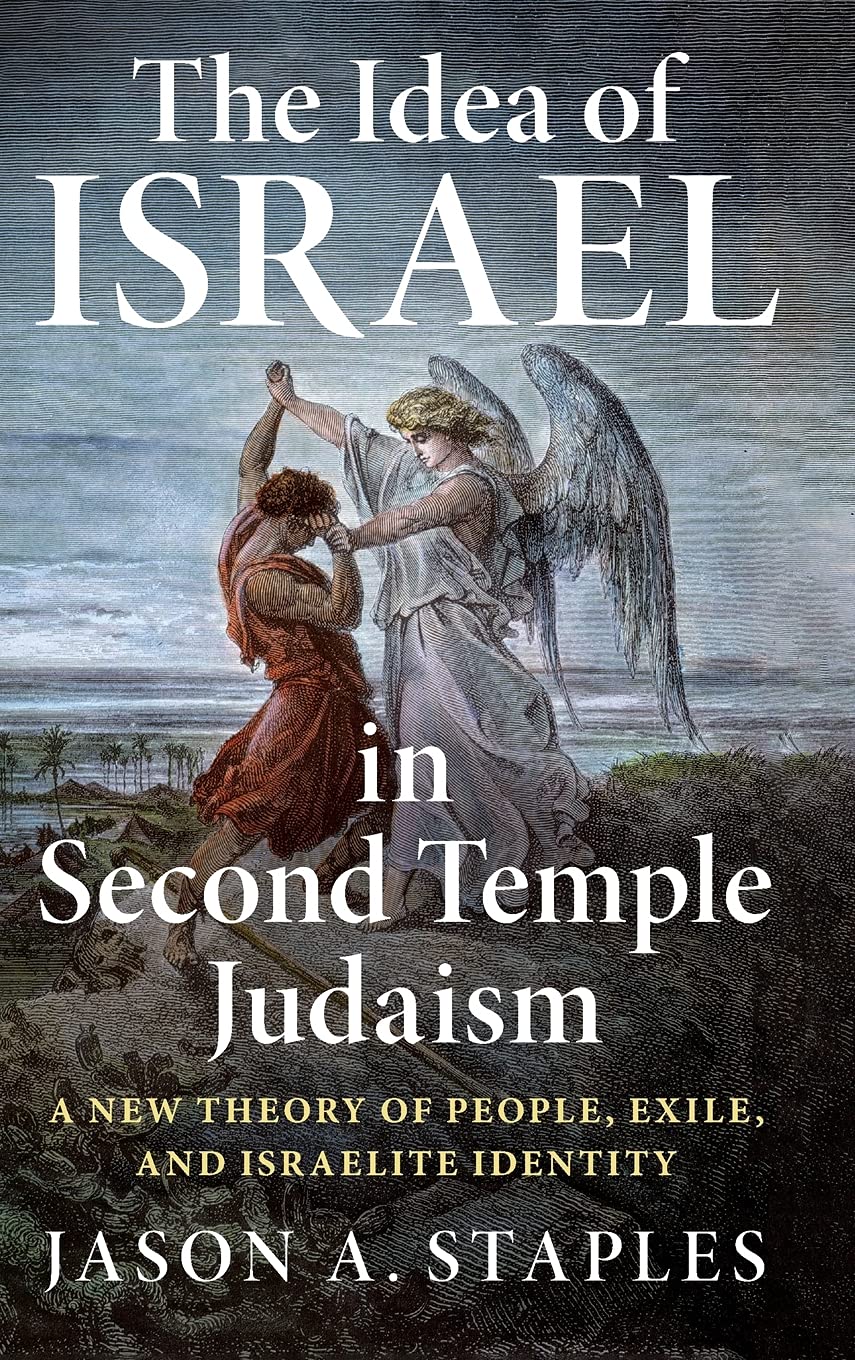
I first encountered Jason Staples's "new theory of ... Israelite identity"--to quote the sub-title of his 2021 monograph--years ago at SBL, and have kept an eye on his work ever since. When Scot McKnight named The Idea of Israel as the "best academic book" he "read this year," I decided not to wait until the paperback edition comes out.


Christopher Stroup's The Christians Who Became Jews is not the only book whose title and topic make me wish I had written it first. Since my research and publishing efforts have centered on ethnicity in ancient Judaism and, separately, Luke-Acts, I decided to take advantage of a Yale University Press sale and a trip to the United States to pick up a copy of this monograph that treats both at once. 


Also from Yale University Press, Lawrence Wills's recent Introduction to the Apocrypha promises to inform the course I teach on "Jewish Backgrounds to Early Christianity."

To round out my Yale University Press order, I picked up a copy of Brent Nongbri's much-discussed, God's Library: The Archaeology of the Earliest Christian Manuscripts, which is, fortunately, now out in paperback.

Attentive readers of titles (and subtitles) will notice a pattern here: "Jews and Anti-Judaism in the Gospel of John," "Jewish Books in Christian Bibles," "The Christians who Became Jews," "The Idea of Israel in Second Temple Judaism." In different ways all four books deal squarely with my own persistent scholarly preoccupation with early Judaism, the Jewish context of early Christianity, and the relationship between Jews and early Christians. I don't expect to agree fully with any of these books (who does?), but I do expect to learn much and to be stimulated to look at familiar texts with fresh eyes.

I suffer from a tendency to buy books faster than I read them, but these I hope to get to in 2022. Just perhaps--come spring--I may pull one or two of my own languishing projects off the shelf and make some headway on writing as well as reading in pandemic year 3.

In addition to picking up a book order, our trip the United States including a little snowshoeing:


Thursday, June 25, 2020

Samuel Sandmel on Making Many Books

"A lover of scholarship must in our days wonder if the explosion of learning has not yielded a superabundance. So great a flow has there been of books and essays that no one can keep up with it, as the honest scholar admits. The superabundance in part is marked both by an immense quantity of repetitive writings on the same general subject, and also by articles, some enlightening, but some confused and confusing, on minor points, marked by special theories ingeniously designed to solve the unsolvable." (vii)

"There is no ready cure in our time for the demands of specialization which tend to restrict broad study. Hence, only one who has had the privilege of not years, but decades of study can partially escape from a preoccupation with only a single area of the several here dealt with. Even such a person cannot achieve fullest mastery in all this variety. If I were to set forth a claim of some tolerable mastery, it would be in Bible (Old Testament0, in hellenistic Judaism, and in New Testament. I am experienced in Rabbinic literature, but am by no means an unqualified expert; I have studied and taught the Apocrypha and the Dead Sea Scrolls, but make no claim of special eminence. The full mastery of all these literatures, and of the scholarly writings about them, are beyond what one man can achieve in the normal span of a single life. I have dared to hope that where expertise has eluded me, responsible competency has not." (viii-ix)

From the preface to Samuel Sandmel's Judaism and Christian Beginnings (New York: Oxford University Press, 1978).

Wednesday, January 4, 2017

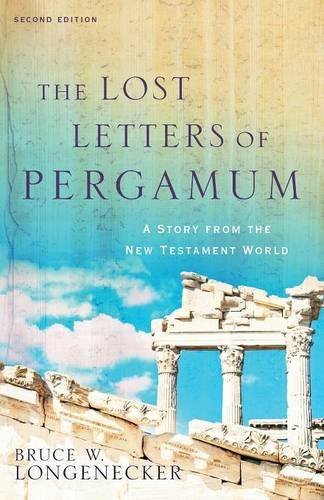
Bruce Longenecker's Lost Letters of Pergamum

Bruce Longenecker made my job a little easier last semester, by writing a great little book that students enjoy reading. I assigned the second edition of Longenecker's Lost Letters of Pergamum (Baker Academic, 2016) as a textbook for "Introduction to the New Testament," and students loved it.

Perhaps Baker Academic will consider adding these student blurbs to the back of the third edition:
"Extremely interesting!"

"Loved this book, eye-opening, never read Luke the same."
"Really enjoying The Lost Letters of Pergamum book so far!" 

A few students apparently neglected to read the preface, which explains that the letters are fictional:
"The Lost Letters I found pretty cool how I'm able to read letters from a very old historical event."
"I am really enjoying Longenecker's book because it includes actual letters of Luke, Antipas, Calpurnius. It gives a glimpse at life in the New Testament times and is extremely interesting." 

But how often do you find a textbook that prompts this sort of student response?
"Longenecker is by far my favourite thing I've read this whole semester. I was interested from page one. It's the best." 

Based on student feedback I decided to switch out the other two very short introductions I had assigned, but Lost Letters is a keeper - It succeeds in conveying a lot of information about the first-century Roman world, it paints a compelling and attractive picture of early Christian community practices, and--did I mention?--students enjoy reading it.


Monday, December 1, 2014

Birger Gerhardsson on Routinization of the Religious Life

"Routinization of the religious and ethical life comes to expression not only in thoughtlessness and weakness but also as a defense against God's true and living demands. Indeed, behind a fanatic zeal for God there may lie obduracy and hatred. An intense ethical program may be pursued at the same time as the heart is hardened and rebellious." (61)

"The opposite of the 'love' which is the ideal attitude in life (Deut. 6:5)...is egoism: withholding one's 'heart' from God and other people, regarding life as one's own possession, grabbing for oneself instead of giving to others." (139)

"Behind the façade and the routines, the center of the personality may very well remain unengaged, free to pursue its own interests. The heart is still closed to God; he is not permitted to rouse a living love or to inspire living deeds." (139-140)

Quotations from: Birger Gerhardsson. The Ethos of the Bible. Translated by Stephen Westerholm. Philadelphia: Fortress Press, 1981. 

(It's an oldie, but a goodie: an exposition of the ethos of Matthew, Paul and the Johannine literature, with a focus on the role of the Shema in shaping early Christian ethics. Well worth reading if you can find a copy--and apparently still available, thanks to a Wipf&Stock reprinting.)

Friday, December 20, 2013

Reading Notes: Ernst Käsemann on the "'The Righteousness of God' in Paul"

I think about Ernst Käsemann each time I teach Romans and introduce different ways of understanding the "righteousness of God", but I confess that I never got around to reading Käsemann's 1961 essay until this week--shortly after encountering this statement by Leander Keck about the essay's significance: "In a time of massive monographs and multivolume commentaries on a single book, Käsemann redirected the study of Paul with an essay of a mere fourteen pages." (Keck, Paul and his Letters, 152-3).

The experience reminded me that actually reading seminal scholarship is a far richer experience than getting it second-hand. It also helps explain current debate. I thought, for instance, that I could detect traces of Käsemann in contemporary scholars who defend perspectives rather different from Käsemann and from each other. Needless to say I will introduce the topic more carefully and with greater precision next time.

A few excerpts:
Righteousness as activity: "The widely-held view that God's righteousness is simply a property of the divine nature can now be rejected as misleading." Instead, the "righteousness of God" in Romans 1:16 "is for Paul, as it is for the Old Testament and Judaism in general, a phrase expressing divine activity, treating not of the self-subsistent, but of the self-revealing God" (174). Käsemann grants that righteousness is also a gift (cf. 169), but...
You can't have the gift without the giver: "Paul knows no gift of God which does not convey both the obligation and the capacity to serve" (170). This is because "the gift which is being bestowed here [i.e., the "righteousness of God"] is never at any time separable from its Giver. It partakes of the character of power, in so far as God himself enters the arena and remains in the arena with it. Thus personal address, obligation and service are indissolubly bound up with the gift. When God enters the arena, our experience is, that he maintains his lordship even in his giving; indeed, it is his gifts which are the very means by which he subordinates us to his lordship and makes us responsible beings." (174) 
On justification and sanctification: "[E]very gift of God which has ceased to be seen as the presence of the Giver and has therefore lost its character as personal address, is grace misused and working to our destruction. Justification and sanctification must therefore coincide, provided that by justification we mean that Christ takes power over our life. But at the same time the understanding we have now gained excludes the possibility of righteousness by works and of boasting of one's own moral achievement. The same Lord who calls us to his service enables us for it and requires us to render it in such a way as to ensure that his gift is passed on. As an instrument of grace, one cannot reasonably go on talking of one's own achievements." (175) 
On historical method: "[T]he historical is not simply that which can be shown to be what actually happened, but the field on which the self-understanding of the interpreter is either confirmed or shattered, or else triumphs by violence. We ourselves are at risk here" (173 n. 4).

The whole essay is gold. Tolle lege.

Bibliography:
Käsemann, Ernst. “‘The Righteousness of God’ in Paul.” 1961. English translation: Pages 168–82 in New Testament Questions of Today. Philadelphia: Fortress, 1969.
Keck, Leander E. Paul and His Letters. 2d ed. Philadelphia: Fortress, 1988.


Friday, December 13, 2013

50% off at Fortress Press

Fortress Press is currently offering a 50% discount on your first order when you sign up for email updates. This, it should be noted, is a better deal than the SBL/AAR conference discount. (If you are ordering from Canada, you will need to call in your order, but the discount still applies.)

Sunday, June 16, 2013

Romans Reading Recommendations

Chora Church, Istanbul (Photo by David M. Miller)
Update: See the addition below.

I get to teach an upper-level elective on the book of Romans every second year. Since my primary research focus is elsewhere, staying abreast of all the recent important scholarship on Romans is out of the question. My compromise is to try to read a few important books on Romans or Paul each time I ramp up to teach the course. (See this post for an earlier list.)

On my list this time are a couple seminal books on Paul from my bookshelf--which I acquired because they are important but never got around to reading--and a couple newish finds on Romans from the Archibald Library.

I will comment on the list below, but first let me say that I am interested in recommendations: What are some recent Romans and/or Paul 'must-reads' that I should not overlook?

Here is the list as it currently stands:

Beker, J. Christiaan. Paul the Apostle: The Triumph of God in Life and Thought. Philadelphia: Fortress, 1980.
  • Parts of this book were required reading for my comprehensive exams in early Christianity. I am now working my way through the whole thing. Jerry Sumney says the book was "[e]specially influential in shifting attention to the theology of other Pauline letters" aside from Romans. 
Watson, Francis. Paul and the Hermeneutics of Faith. London: T&T Clark International, 2004.
  • I purchased Paul and the Hermeneutics of Faith after hearing Richard Hays commend it as almost as important as his own monograph on Paul's use of scripture. Hopefully, I'll make it through all 500+ pages this summer before selling it on Amazon for $200. (Just kidding about the last part, but check out the link!)
Late addition: Keck, Leander E. Paul and His Letters. 2d ed. Philadelphia: Fortress, 1988.
  • Another unread volume from my bookshelf: Katherine Grieb says "Leander Keck's introduction to Paul's letters and his theology is the single most helpful resource I know for understanding the logic of Paul's thought at all levels of education" (p. 78 in Sumney below).
Grieb, A. Katherine. The Story of Romans: A Narrative Defense of God’s Righteousness. Louisville, KY: Westminster John Knox, 2002.
  • I am considering this as a secondary textbook. At first glance, it appears very well-written and accessible.
Sumney, Jerry L., ed. Reading Paul’s Letter to the Romans. Atlanta: Society of Biblical Literature, 2012.
  • Looks like a nice collection of recent essays by fine scholars. I thought at first that it might work well as a secondary textbook, but decided to make my own selection of paired essays if I go that route.

Note: If I could get my hands on an advance copy of N.T. Wright's Paul and the Faithfulness of God, it would be on my list.

Sunday, June 26, 2011

Romans textbooks and the craft of scholarly writing

The last couple times I taught Romans, I assigned as textbooks Leander Keck's commentary and Stephen Westerholm's accessible introduction to the worldview of Romans. I think Keck is great, but realized last time that it is still a little too technical for a third year undergraduate course. On a quest for up-to-date alternatives to both books, I ordered in several evaluation copies, all published within the last couple years:

Oakes, Peter. Reading Romans In Pompeii: Paulʼs Letter At Ground Level. Minneapolis: Fortress, 2009.
Gombis, Timothy G. Paul: A Guide for the Perplexed. Continuum, 2010.
Hultgren, Arland J. Paulʼs Letter to the Romans: A Commentary. Grand Rapids: Eerdmans, 2011.
Matera, Frank J. Romans. Grand Rapids: Baker Academic, 2010.


Reading Romans in Pompeii: Paul's Letter at Ground LevelI thought Reading Romans in Pompeii might substitute for Westerholm as an engaging secondary text on the social context of Romans. While I found it fascinating as a thought experiment about how the letter may have been heard by Gentile readers of Paul's letter, the book does little to welcome modern readers who are not already interested. After a 2.5 pp. preface, chapter one begins:
"We are standing in a street in Pompeii, looking into the doorway of Region I, Block 10, House 6 . . . flanked by the narrower entrances to Houses 5 and 7 (Figure 1.1)." 
How can I assign undergraduates a book that opens with a data dump? ...Next please.

Paul: A Guide for the Perplexed (Guides For The Perplexed)Introductions to Paul are a dime a dozen. I ordered in Timothy Gombis's Guide for the Perplexed because it is recent, because it received positive online kudos from J.R.D. Kirk and Scot McKnight, and because I was pretty sure T&T Clark would send me a free evaluation copy. There's lots to like here. Gombis does a fine job compiling verses on both sides of selected debates, there are helpful charts, and I love his articulation of Paul's mission:
"Paul is a herald of the Kingdom of God and of the victory and Cosmic Lordship of Jesus Christ. This is an intensely political vocation, since Paul is proclaiming the emergent reality of a radically new political order--the Kingdom of God--along with an alternative ruler; the crucified, risen, and exalted Jesus. This calling as a herald inevitably involved a pastoral task, since Paul's aim was to see the creation and establishment of Kingdom of God communities throughout the world." (23)    
Unfortunately, Gombis's evaluation of debated issues sometimes struck me as simplistic and one-sided. No doubt this is partly because I sometimes disagreed with Gombis's conclusions, but--as will be clear below--I have no trouble assigning readings that I disagree with. My concern is that in a guide that aims to introduce debated issues, opposing views should be presented in such a way that critics will agree with the way they are portrayed. The upshot is that I've decided to stick with Westerholm.

Paul's Letter to the Romans: A CommentaryOne look at Arland Hultgren's large commentary on Romans convinced me that it wouldn't do as an undergraduate textbook. Compare the short paragraph in Keck's succinct commentary to the three pages Hultgren spends discussing the first line of Paul's letter. Still, it looks to be an important contribution--Scot McKnight thinks so too--and I hope to read it during the fall semester.


Romans (Paideia: Commentaries on the New Testament)
Frank Matera's contribution to the Paideia series is short enough to work as a textbook, and it looks like an insightful, up-to-date contribution by a first-rate Pauline scholar. I look forward to reading it. Unfortunately, I fear my students would not, after reading the first paragraph:
"Romans is the first of the Pauline Letters in the NT. Although it enjoys this pride of place because it is the longest of the letters, its placement is well deserved since it is the most detailed presentation of Paul's gospel, and since it has influenced the course of Christian theology more than any other writing of the NT."
Thud. Commentaries don't have to be written this way. Here is how Keck begins his:
"Like widely differing siblings raised by the same parents, each letter produced by Paul has its own distinguishing character. For the historically minded critic, each letter's unique traits provide important clues for detecting the circumstances in which Paul wrote it as well as what he hoped to achieve with it." 
N.T. Wright prefers an extended metaphor:
"Romans is neither a systematic theology nor a summary of Paul's lifework, but it is by common consent his masterpiece. It dwarfs most of his other writings, an Alpine peak towering over hills and villages." (395)
Wright's contribution to the New Interpreter Bible Vol 10 is a very good, readable commentary on Romans. I've decided to assign it as a textbook this fall as a replacement for Keck.

Wright and Westerholm make unusual bedfellows, to be sure, since Westerholm is usually cast as an opponent of the "New Perspective" on Paul, and Wright one of its champions--but that (and the fact that I disagree with Wright here and there) is half the point. More important, Wright and Westerholm share the two qualities I'm most looking for in authors that I make my students read. (1) In different ways, both model exemplary scholarship; students will learn the craft by reading. (2) They are also fine, engaging writers. If, as John Trimble says, "good writing is good manners," they are both scholars and gentlemen to boot.

The bottom line: I want textbooks that students want to keep reading, that will help me teach by making my students more rather than less interested in the subject matter. I'm betting Wright and Westerholm will do the trick.

Tuesday, June 14, 2011

Portland's Finest Bookstores


No trip to Portland is complete without a stop at Powell's City of Books, perhaps the greatest used and new bookstore anywhere.


No biblical scholar's trip should be complete without a stop at one of Portland's Windows Booksellers outlets. Better yet, plan in advance: Check the online inventory at their much larger bookstore in Eugene, and ask them to have your order ready to pick up when you arrive. The result is great selection, great prices and $0 shipping. As an added bonus, the copies of Caird's The Language and Imagery of the Bible and Davies' The Setting of the Sermon on the Mount that I ordered in were previously owned and annotated by Robert Kysar and Krister Stendahl respectively.

Saturday, April 9, 2011

Mort's Day

"Shamus and Findley sat silently on the slivered wooden bench as the dirty fog of darkness hovered over them. . . . "

So begins "Mourir," a short story I wrote as an assignment for grade 12 English. The story itself is best forgotten, but I am still intrigued by the idea of a Mort's Day--a term and concept borrowed from my high school physics teacher--which the story develops. According to Mr. Armstrong, a Mort's Day is a 24 hour period between 11:59 and 12:00 a.m. when time stops for everyone but you.

The possibilities are endless, though I most often wish for one when I enter my office and look wistfully at Edwyn C. Hoskyns and Noel Davey's The Riddle of the New Testament (London: Faber & Faber, 1931) or C.F.D. Moule's The Birth of the New Testament (3rd ed. San Francisco: Harper & Row, 1982) sitting unread on my shelves.

Perhaps as a warning against such utopian dreams, my short story concluded on a darker note, with the bench "stained red with Shamus' blood."

Friday, October 22, 2010

Top Ten Books I Never Finished

I usually ignore memes, but Dale Harris's recent list of "Top Ten Books I Never Finished" is too good to pass up:
"So here's my list of the top ten literary ghosts of my past, rattling their unfinished chains at me from the dusty corners of my bookshelf. What about you? Any books back there that you started with the best of intentions only to get bogged down and abandon somewhere between "Once upon a time" and "happily ever after"?"
So among the scores of unread books on my shelves, here's a list of ten that I have attempted and, for the most part, grudgingly replaced:

Don Quixote: Complete and Unabridged (Signet Classics) 10. Don Quixote, Miguel de Cervantes. I began Don Quixote in high school because it was one of the books in our temporary residence, and a classic. I read enough to learn what quixotic means.

The Pilgrim's Progress (Penguin Classics) 9. Pilgrim's Progress, John Bunyan. I read the picture book as a child, but have never made it through the unabridged edition.

Modern Times Revised Edition: The World from the Twenties to the Nineties (Perennial Classics) 8. Modern Times, Paul Johnson. A gift from my uncle. I always thought I should finish it, until I realized that it is now a piece of history in its own right.

G.W.F. Hegel: Theologian of the Spirit (Making of Modern Theology) 7. G. W. F. Hegel: Theologian of the Spirit, G.W.F. Hegel. This collection from the writings of Hegel is, hands down, the most boring book I have ever attempted. Although I returned it to my bookshelf years ago, the bookmark is still in place.

Truth and Method (Continuum Impacts) 6. Truth and Method, Hans-Georg Gadamer. Compared to Hegel, Gadamer is impossible to put down. Lots of good stuff here, and I hope to return to it someday. Book-mark in place, but back on the shelf for now.

Calvin: Institutes of the Christian Religion (2 Volume Set) 5. Institutes of the Christian Religion, John Calvin. My failed dream of reading through Calvin's Institutes on his 500th anniversary is documented here. 600th anniversary, anyone?

Paul and Palestinian Judaism: A Comparison of Patterns of Religion 4. Paul and Palestinian Judaism, E.P. Sanders. I read the first 238 pages (on rabbinic Judaism) as a requirement in grad school, and loved it. Someday I'd like to return to the final 400.

The Problem of Pain 3. The Problem of Pain, C.S. Lewis. After two attempts, I decided the problem with this book was not mine: Lewis's apologetic is dated and not to my taste.

The Divine Conspiracy: Rediscovering Our Hidden Life In God 2. The Divine Conspiracy, Dallas Willard. I could make a separate list of failures as read-aloud-before-bed books. Whatever his other merits, Wallace Dillard (as he is affectionately known in our household), does not write for the ear. This one is still on my night stand, but has been usurped by #1.

The Cost of Discipleship 1. The Cost of Discipleship, Dietrich Bonhoeffer. As I recall, I read through most of The Cost of Discipleship in Kenya in 1995, but left the country without the book with a few chapters still to go. I am now trying again....

Wednesday, June 23, 2010

Distinguishing Grabbe from Grabbe

I was looking for an affordable used copy of Lester L. Grabbe's important two-volume reference work, Judaism from Cyrus to Hadrian, published by Fortress Press in 1992, but noticed (again) that he has another multi-volume series coming out with T&T Clark that appears to deal with the same material: A History of the Jews And Judaism in the Second Temple Period: Yehud: a History of the Persian Province of Judah (2004); A History of the Jews and Judaism in the Second Temple Period: The Early Hellenistic Period (335-175 BCE) (2008). Is this a reprint, an updating and expansion, or something else entirely?

Also, what is the difference between An Introduction to First Century Judaism: Jewish Religion and History in the Second Temple Period (T&T Clark, 1996), and Introduction to Second Temple Judaism: History and Religion of the Jews in the Time of Nehemiah, the Maccabees, Hillel, and Jesus (T&T Clark, 2010)--aside from price?

I'm not knocking the scholarship; I just want to know whether it is still worth purchasing the older and now cheaper editions.