Showing posts with label Politics. Show all posts

Monday, May 19, 2025

Recommended Reading on Israel, Palestine, and the War on Gaza

Two novels shaped my earliest thinking about the formation of the state of Israel. I read James Michener’s The Source (Random House, 1965) and Leon Uris’s Exodus (Doubleday, 1958) in boarding school at Rift Valley Academy (ca. 1986-89). Equally influential from a Palestinian perspective, was a memoir, Elias Chacour’s Blood Brothers (Chosen, 1984), which I read in Canada in grade 11 (1989-90). By the time I left for a year of study in Israel in the summer of 2000, I had also read Thomas Friedman’s From Beirut to Jerusalem (Farrar, Straus & Giroux, 1989) and, I’m ashamed to say, not much else about Israel or Palestine. 

Living in Jerusalem gave me a front row seat on the beginning of the second intifada. From the Hebrew University’s Mount Scopus campus, we could see evidence of the violence unfolding on the Temple Mount. From our apartment in West Jerusalem, we could hear the Israeli army shelling Bethlehem. And we tried not to think too much about suicide bombers when we boarded a city bus. 

Personal experience can lull you into thinking you know what you are talking about, but does not qualify you to speak with any sort of competence. To understand a region’s present, you must learn about its past. Although I tried to keep an eye on current events, I did little to educate myself about Israel’s immediate past in the years that followed, except for a couple audiobooks. I listened to Amos Oz’s memoir, A Tale of Love and Darkness (Harcourt, 2005), in 2018 while cycling to and from a research library in Cambridge. Ari Shavit’s My Promised Land: The Triumph and Tragedy of Israel (Spiegel & Grau, 2013), which I “read” in 2016, filled in the picture through the early 2000’s. 

News about Hamas’s brutal attack on Oct 7, 2023 and Israel’s inevitable response was too painful to follow closely after the initial shock. I also didn’t want to read anything shrill or reactionary ... and I thought I knew something about the conflict. 

I knew I knew nothing about Ukraine, however, so earlier this year I listened to Serhii Plokhy’s, The Russo-Ukrainian War: The Return of History (Norton, 2024), which had been recommended as a reliable primer on the geo-politics of Ukraine, including Russia’s 2014 and 2022 invasions. On the analogy of Ukraine, where my ignorance is complete, I finally decided to look for an audiobook related to the conflict in Israel and the occupied territories. 
  • I began with Rashid Khalidi’s The Hundred Years’ War on Palestine: A History of Settler Colonialism and Resistance, 1917–2017 (Metropolitan Books, 2020). Khalidi hails from a prominent Palestinian family with centuries-long ties to Jerusalem. Before retiring in 2024, he was the Edward Said professor of Modern Arab Studies at Columbia University. The picture Khalidi paints of Israeli colonialism and American collusion between 1917-2017 is deeply troubling. Critical reviews of the book sometimes take issue with Khalidi’s framing of the conflict in colonial terms, but I am not aware of any that dispute the facts he has assembled. To my surprise, I found Khalidi more even-handed than Plokhy, who understandably, and rightly, makes a case for Ukrainian national identity.
  • I turned from Khalidi’s Palestinian perspective to Peter Beinart’s just-releasted Being Jewish After the Destruction of Gaza: A Reckoning (Knopf, 2025). Beinart addresses his own anti-Zionist criticism of Israel’s war on Gaza to an insider Jewish audience. His argument is measured and, to my mind, compelling. It is also theological: The biblical prophets, Beinart suggests, would have had something to say about a Jewish exceptionalism that presents itself as always the victim and never the perpetrator:

“From the destruction of the Second Temple to the expulsion from Spain to the Holocaust, Jews have told new stories to answer the horrors we endured. We must now tell a new story to answer the horror that a Jewish country has perpetrated, with the support of many Jews around the world. Its central element should be this: We are not history’s permanent virtuous victims. We are not hardwired to forever endure evil but never commit it. That false innocence, which pervades contemporary Jewish life, camouflages domination as self-defense. It exempts Jews from external judgment. It offers infinite license to fallible human beings.” (10) 
“The legitimacy of a Jewish state—like the holiness of the Jewish people—is conditional on how it behaves. It is subject to law, not a law in and of itself (100). 
Blanket support for the state of Israel is, according to Beinart, a form of idolatry. Christian Zionist readers predisposed to support Israel without criticism should take note.

I have learned enough, I hope, to disclaim competence or punditry. But if you are at all concerned about current events in Israel, Gaza and the West Bank, I recommend starting with Beinart and moving from there to Khalidi—perhaps especially if your political orientation tends to differ from theirs. (For an Israeli perspective, try Shavit.)

If you have recommendations of your own, feel free to share them in the comments.

Monday, February 3, 2025

A Whole Canadian

Some 40 years ago I announced to an auditorium full of students at the American missionary boarding school I was attending that “I am a whole Canadian!” Unlike my three older siblings, who were born in Somalia and carried US passports, I was born in Canada not far from where our Canadian father was raised, and I traveled under a Canadian passport. 

Only later did I learn that US citizenship could not be so easily avoided. Because my American mother spent the first eighteen years of her life in the state of Oregon, I inherited US citizenship automatically. Like it or not I am a dual citizen. I brandish my US passport when I need to enter the United States, and I file US taxes as required by US law, but my political allegiance remains the same as it was for that 10-year-old boy: I am a whole Canadian. 

And so it is with considerable dismay that I watch the US president threaten a (now postponed) trade war intended to wreak havoc on his country’s closest ally under the false pretext of enhancing border security and the false claim of a trade deficit, but with the apparently serious aim of annexing Canada (!).

  • On enhancing border security as a pretext: The amount of Fentanyl passing through the Canadian border into the US is a tiny percentage of the total. Trump will not say what changes have to be made for the threat of tariffs to be lifted: “Figures from U.S. Customs and Border Protection (CBP) show the agency [seized 19.5 kilograms](https://www.cbp.gov/newsroom/stats/drug-seizure-statistics) of fentanyl at the northern border last year, compared to 9,570 kilograms at the southwestern one.” (Source)
  • On a so-called trade deficit: “Trump is fixated on the Canada-U.S. trade deficit, which is largely driven by American demand for cheaper Canadian oil. When oil exports are excluded, the Americans actually have a trade surplus with Canada, according to Canadian government data.” (Source)
  • On the economic impact of 25% tariffs: “The Canadian economy is set to face the most severe shock since the COVID-19 pandemic and will probably sink into a recession if a tariff war persists, say top economists.” (Source
  • On Trump’s desire to make Canada the 51st state: https://www.cbc.ca/player/play/video/9.6633776

It occurs to me that Trump’s bullying might stem from genuine ignorance as well as malice. He may not realize that Canadian identity has historically been formed by its opposition to the United States. Why wouldn’t Canadians want to join the Land of the Free and the Home of the Brave? An answer from someone who has lived in both countries, as well as Africa, Europe and the Middle East: Let me count the ways. 

There is precedent for Trump’s behaviour—none of it good: In 1866 “a bill to annex Canada was introduced in the U.S. Congress” (Source). Thanks to the aftermath of the American civil war, it never came to a vote. No coincidence that Canadian confederation occurred one year later, in 1867. More recent precedent includes Germany’s annexation of of German-speaking Austria in 1938, and Russia’s invasion of Ukraine in 2022.

To my American friends: This isn’t right. Please say something, at least in prayer.

As a Christian, Trump’s threats to my own nation prompt a different sort of reflection:

  • What does it mean to love my enemy? 
  • What does it mean to affirm that my primary political allegiance is to the one who is “Lord of all” (Acts 10:36; see Phil 3:20)?
  • I’ll be honest here: Evangelical American support for first-term Trump was a faith-shaking sucker punch to the gut. What does it say about the Truth I affirm when so many who profess it are so quick to believe lies? How can those who claim to be concerned with character and morality follow someone who cares not a wit for either of these things? … What, then, does it mean for me to treat my misguided co-religionists as brothers and sisters?

Saturday, October 26, 2024

A prayer for Donald Trump

A deep-fake image of a kneeling Donald Trump showed up in my Facebook feed recently. That image and the accompanying caption prompted this prayer: 

Dear Lord, bring this godless man to his knees, expose his lies, and prevent him from causing more harm to the United States and the world. 

Bring to their senses the so-called Evangelicals, who have turned for their deliverance to a "splintered reed of a staff, which pierces the hand of anyone who leans on it," who have abandoned the pursuit of righteousness, justice and the love of God in exchange for political power, and who have forgotten that the way of Jesus is the way of the cross. 

Lord have mercy. 

Amen. 

I touched on the reasons for my profound dismay over Evangelical Christian support for Donald Trump here. For more detail, see this excellent post by Chris Gehrz: "Is History Rhyming?

Sunday, June 23, 2024

Reading the Bible after the Holocaust

I consumed a steady diet of (audio)-books about the Holocaust this spring, including Doris Bergen’s War and Genocide: A Concise History of the Holocaust, Elie Wiesel’s powerful memoir, Night, his two holocaust novels, Dawn and Day, and, most recently, Dara Horn’s searing People Love Dead Jews. The reading (or listening in this case) began as preparation for a United States Holocaust Memorial Museum faculty seminar on “Reading the Bible after the Holocaust” in Washington, DC.


Doris Bergen’s textbook was recommended as an introduction to the Holocaust for those who needed a refresher. Turns out I did. General awareness over a lifetime can fool you into thinking you know more than you do. For me that included reading the stage version of Anne Frank’s Diary of a Young Girl and watching Corrie Ten Boom in grade school, reading a selection of James Michener and Leon Uris novels in grades 8-10, a summer tour of Europe in high school that included a visit to the Dachau concentration camp, and a belated visit to Yad Vashem in 2009. But these vague impressions from decades ago did little to help me speak intelligently about the Holocaust and antisemitism to college students who, one suspects, may never have heard that six million Jews were murdered in Europe during World War II—much less that Christians had anything to do with it. Bergen’s Concise History was just what I needed, especially when paired with a tour of the Holocaust Museum’s permanent exhibit. My reaction: Everyone should read this book.

Bergen mentions Elie Wiesel, who I had, of course, heard about, but never read. So I added Night to my audio playlist. The book’s conclusion will forever be linked in my mind with a morning walk from my hotel, past the White House and the Washington Memorial, to the Holocaust Museum where the seminar was held.

The seminar had an extensive required reading list of its own on the topic of “Reading the Bible after the Holocaust.” We looked at antisemitism in biblical scholarship before the Holocaust, Jewish and Christian theological responses to the Holocaust, including sermons by Rabbi Kalonymus Kalman Shapira, a Warsaw Ghetto rabbi whose sermon manuscripts were discovered after the war. We also discussed post-Holocaust biblical scholarship on texts about Jews in the New Testament, and genocide in the Hebrew Bible. It was tremendously valuable to be prompted to learn about the Holocaust, and then to have the chance to reflect on it in relation to my primary fields of teaching and research (Biblical Studies, ancient Judaism) in an interdisciplinary context. The combination of well-chosen texts, skilled facilitators and a diverse group of scholars made for an exceptionally rich experience that will continue to influence my thinking and teaching in significant ways.

But I left thinking less about biblical scholarship and more about similarities between Hitler’s rise to power and the rise of authoritarian movements today, where populist leaders once again stoke fear and hatred with lies and conspiracy theories, and, sadly, gain a following among Christians more enamored by power and force than love and the way of the cross.


Monday, February 21, 2022

A Man for All Seasons and a Trucking Convoy

I enjoyed the 1966 Academy Award winning A Man for All Seasons so much I read the play by Robert Bolt on which it is based. This dialogue between Sir Thomas More, his wife Alice, daughter Margaret, and future son-in-law William Roper comes to mind when I encounter "Friends" on Facebook who seem to want to overthrow our democratically-elected government: 

MARGARET: Father, that man's bad.

MORE: There is no law against that.

ROPER: There is! God's law!

MORE: Then God can arrest him.

...

ALICE: While you talk, he's gone! 

MORE: And go he should, if he was the Devil himself, until he broke the law!

ROPER: So now you'd give the Devil benefit of law!

MORE: Yes. What would you do? Cut a great road through the law to get after the Devil?

ROPER: I'd cut down every law in England to do that!

MORE: Oh? And when the last law was down, and the Devil turned round on you—where would you hide, Roper, the laws all being flat? This country's planted thick with laws from coast to coast—man's laws, not God's—and if you cut them down—and you're just the man to do it—d'you really think you could stand upright in the winds that would blow then? Yes, I'd give the Devil benefit of law, for my own safety's sake.*

YouTube to the rescue, here's the Paul Scofield version:


Sir Thomas More—at least the character in Bolt's play if not also the historical figure—is my political hero. If you haven't seen the film, do yourself a favour and watch it. 


* More's speech in the play may draw on this passage from William Roper's 1556 biography of More:

"Howbeit this one thing, son, I assure thee on my faith, that if the parties will at my hands call for justice, then all-were-it my father stood on the one side, and the devil on the other, his cause being good, the devil should have right." (HT: Robert Bork)

Saturday, September 8, 2018

The Hypocrisy and Moral Bankruptcy of the American Evangelical Right

In 1998 James Dobson, the founder of Focus on the Family, told his supporters that marital infidelity and lying should disqualify Bill Clinton from serving as president: 
"What has alarmed me throughout this episode has been the willingness of my fellow citizens to rationalize the President's behavior even after they suspected, and later knew, that he was lying. ... As it turns out, character DOES matter. You can't run a family, let alone a country, without it. How foolish to believe that a person who lacks honesty and moral integrity is qualified to lead a nation and the world! Nevertheless, our people continue to say that the President is doing a good job even if they don't respect him personally. Those two positions are fundamentally incompatible. In the Book of James the question is posed, 'Can both fresh water and salt water flow from the same spring?' (James 3:11, NIV). The answer is no." - James Dobson, as quoted by John Fea here and here.

Two decades later James Dobson not only endorsed but continues to support Donald Trump as president because he offers "relief from judicial tyranny."

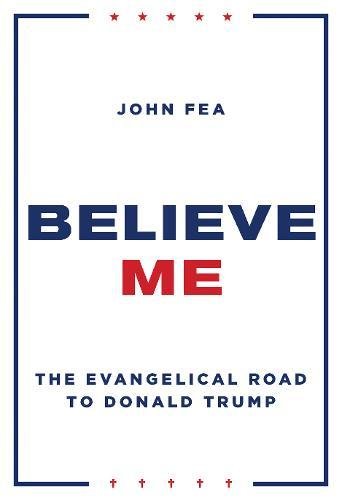
For more detail, and a response to American Evangelical reasons for supporting Trump, see John Fea's Believe Me: The Evangelical Road to Donald Trump (Grand Rapids: Eerdmans, 2018).