Showing posts with label Evangelicalism. Show all posts

Sunday, June 23, 2024

Reading the Bible after the Holocaust

I consumed a steady diet of (audio)-books about the Holocaust this spring, including Doris Bergen’s War and Genocide: A Concise History of the Holocaust, Elie Wiesel’s powerful memoir, Night, his two holocaust novels, Dawn and Day, and, most recently, Dara Horn’s searing People Love Dead Jews. The reading (or listening in this case) began as preparation for a United States Holocaust Memorial Museum faculty seminar on “Reading the Bible after the Holocaust” in Washington, DC.


Doris Bergen’s textbook was recommended as an introduction to the Holocaust for those who needed a refresher. Turns out I did. General awareness over a lifetime can fool you into thinking you know more than you do. For me that included reading the stage version of Anne Frank’s Diary of a Young Girl and watching Corrie Ten Boom in grade school, reading a selection of James Michener and Leon Uris novels in grades 8-10, a summer tour of Europe in high school that included a visit to the Dachau concentration camp, and a belated visit to Yad Vashem in 2009. But these vague impressions from decades ago did little to help me speak intelligently about the Holocaust and antisemitism to college students who, one suspects, may never have heard that six million Jews were murdered in Europe during World War II—much less that Christians had anything to do with it. Bergen’s Concise History was just what I needed, especially when paired with a tour of the Holocaust Museum’s permanent exhibit. My reaction: Everyone should read this book.

Bergen mentions Elie Wiesel, who I had, of course, heard about, but never read. So I added Night to my audio playlist. The book’s conclusion will forever be linked in my mind with a morning walk from my hotel, past the White House and the Washington Memorial, to the Holocaust Museum where the seminar was held.

The seminar had an extensive required reading list of its own on the topic of “Reading the Bible after the Holocaust.” We looked at antisemitism in biblical scholarship before the Holocaust, Jewish and Christian theological responses to the Holocaust, including sermons by Rabbi Kalonymus Kalman Shapira, a Warsaw Ghetto rabbi whose sermon manuscripts were discovered after the war. We also discussed post-Holocaust biblical scholarship on texts about Jews in the New Testament, and genocide in the Hebrew Bible. It was tremendously valuable to be prompted to learn about the Holocaust, and then to have the chance to reflect on it in relation to my primary fields of teaching and research (Biblical Studies, ancient Judaism) in an interdisciplinary context. The combination of well-chosen texts, skilled facilitators and a diverse group of scholars made for an exceptionally rich experience that will continue to influence my thinking and teaching in significant ways.

But I left thinking less about biblical scholarship and more about similarities between Hitler’s rise to power and the rise of authoritarian movements today, where populist leaders once again stoke fear and hatred with lies and conspiracy theories, and, sadly, gain a following among Christians more enamored by power and force than love and the way of the cross.


Saturday, September 8, 2018

The Hypocrisy and Moral Bankruptcy of the American Evangelical Right

In 1998 James Dobson, the founder of Focus on the Family, told his supporters that marital infidelity and lying should disqualify Bill Clinton from serving as president: 
"What has alarmed me throughout this episode has been the willingness of my fellow citizens to rationalize the President's behavior even after they suspected, and later knew, that he was lying. ... As it turns out, character DOES matter. You can't run a family, let alone a country, without it. How foolish to believe that a person who lacks honesty and moral integrity is qualified to lead a nation and the world! Nevertheless, our people continue to say that the President is doing a good job even if they don't respect him personally. Those two positions are fundamentally incompatible. In the Book of James the question is posed, 'Can both fresh water and salt water flow from the same spring?' (James 3:11, NIV). The answer is no." - James Dobson, as quoted by John Fea here and here.

Two decades later James Dobson not only endorsed but continues to support Donald Trump as president because he offers "relief from judicial tyranny."

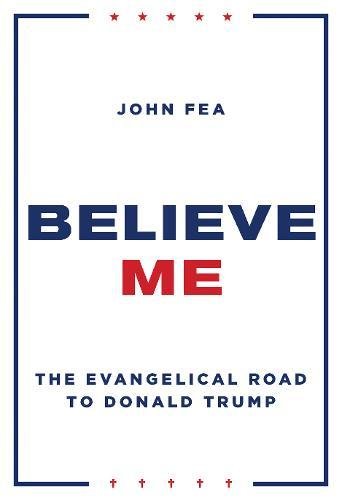
For more detail, and a response to American Evangelical reasons for supporting Trump, see John Fea's Believe Me: The Evangelical Road to Donald Trump (Grand Rapids: Eerdmans, 2018).

Tuesday, August 7, 2018

On the Comparison of 17th-Century Christianities: John Bunyan and Nicholas Ferrar

After visiting Little Gidding we drove 25 miles south to the town of Bedford and stopped for lunch by the River Great Ouse.
Our reason for stopping in Bedford, aside from the pleasant picnic spot, was to visit the shrine of another 17th-century protestant saint, whose best-selling book begins as follows:
"As I walked through the wilderness of this world, I lighted on a certain place where was a Den, and I laid me down in that place to sleep: and, as I slept, I dreamed a dream." 
The Den, I assume, was inspired by the Bedford County Jail where John Bunyan was imprisoned between 1660-1672, and where he began to write The Pilgrim's Progress:

The actual jail, of course, is long gone. Visitors today can view a replica in the John Bunyan Museum that stands next to a 19th-century Bunyan Meeting church building, a few blocks east of the old jail site:

In addition to the model jail cell, the museum houses a selection of 17th-century relics: This key may have belonged to Oliver Cromwell, this block of wood may have come from the Bedfordshire barn where Bunyan preached--that sort of thing. There is also a door that really was removed from the Bedford County Jail when it was demolished in 1801; whether the door goes back to 1672 is another question. The museum also includes a library of Bunyan's works published in a wide variety of modern languages.

In many ways, Nicholas Ferrar (1592-1637) of Little Gidding and John Bunyan (1628-1688) of Bedford could not be more different. Nicholas's father was an elite London merchant, members of the family were friends with royalty, and Nicholas served in parliament before the move to Little Gidding. John Bunyan's father was a tinker, just well-enough off to own his own cottage and provide for his son's basic education. Nicholas Ferrar was a Cambridge-educated scholar who was ordained by the future Archbishop of Canterbury. Bunyan was a nonconformist whose refusal to give up preaching without a government license led to his twelve-year imprisonment. Despite their differences, both shared an unwavering commitment to the proclamation of the gospel and to ordering their lives by their common faith.

My historian spouse reminds me that Bunyan and Ferrar also belonged to different generations. The English civil war (1642-1651) that came between the death of Nicholas Ferrar in 1637 and the adult re-baptism of John Bunyan in 1653 changed England dramatically. Bunyan's imprisonment must be understood in the context of a sudden shift from toleration of nonconformists under Oliver Cromwell to an official attempt after the restoration of the monarchy in 1660 to enforce conformity to a single church. (I don't know enough to comment on non-conformity and toleration before the civil war--but the shift from toleration back to official prohibition is one significant difference.) In any case, even though they both lived in the 17th century, you can't directly compare Ferrar in the 1630's with Bunyan in the 1660's anymore than you can juxtapose the 1950's and the 1980's. Conditions for existence had changed. Who knows? The same might be true of Judaism(s) in the Second Temple Period ....

Tuesday, January 9, 2018

Nonpartisan Evangelical Scholarship Part 4: Donald J. Verseput

Before his untimely death of a brain tumour at age 51, Donald J. Verseput was a professor of New Testament at Bethel Seminary. In addition to the personal loss experienced by his family, the world of biblical studies lost a fine scholar who was "about half-way through" a major commentary on the book of James.

I had the good fortune of having Don as a faculty advisor during his year as a visiting professor at TEDS in 1997-1998. Although I never took a course from Don, he had an extraordinary impact on my education. As I recall, students at TEDS were to meet in “advisee groups” with a faculty member every two weeks. Don took the idea a step further by inviting us to join him for dinner once a week before an evening class. As a relatively unknown visiting professor, Don’s group was small, and I ended up being the only one who was able to accept his invitation. I was surprised that a faculty member would want to spend time with a mere MA student, and impressed to discover a scholar so committed to his family, so down-to-earth, and so candid. A few years later, I met up with Don at my first SBL in Denver 2001, and had to smile when I learned that he had his family—and skis—in tow, and planned to hit the slopes after delivering his paper. What else would you expect from someone who chose to do a PhD at the University of Basel because his family enjoyed skiing?

When in 2004 I heard that Don had passed away, I made a point of reading through some of his published articles. This had the effect of reinforcing what he had said about exemplary scholarship with a series of exemplary models.

To get a sense for the difference between partisan and non-partisan evangelical scholarship, one need only read Don’s response to Craig Blomberg in the 2001 issue of the Bulletin for Biblical Research.

Blomberg’s essay responded to the question, “Where Should Twenty-First-Century Evangelical Biblical Scholarship Be Heading?”, with a laundry list of academic topics that merit more attention by evangelical scholars. For example, work on the historical Jesus needs to be expanded to include the historicity of John’s Gospel and the historicity of the Old Testament; the historical context of the Bible needs to be examined “from an evangelical perspective”; we need an evangelical Hebrew grammar. And so on. These are not necessarily bad ideas, and those who work in the areas Blomberg recommends are not thereby “partisan” as long as they are willing to follow the evidence where it leads. (See F.F. Bruce’s comments in part 1 of this series).

What does strikes me as partisan is the location from which Blomberg surveys the field. Although Blomberg decries closet fundamentalists who are “committ[ed] to sociological separatism” and encourages his fellow evangelicals to “engag[e] the larger, scholarly world,” his comments presuppose and thus reinforce an insider-outsider divide between “us” evangelicals and “the scholarly world in general.”

Unlike Blomberg, Verseput’s reply is marked by a persistent refusal to make distinctions along tribal lines:
  • Where Blomberg called for “a thoroughgoing evangelical study” of Christian ethics to correct the work of Richard Hays, Verseput remarked that Hays, along with the German scholars, Wolfgang Schrage and Rudolf Schnackenburg, “need some help,” and then explained why, and why it matters for the church today. 
  • Wayne Meeks’s sociological study of the earliest Christian churches does not need to be redone “from an evangelical perspective,” it needs to be “updated” with attention to the theological convictions that Meeks overlooked, so that Christians in a post-Christian age can learn from the example of the early church.
Instead of evangelical bona fides, Verseput emphasized quality. Where Blomberg referred repeatedly to “evangelical scholars,” Verseput preferred different adjectives—“rigorous scholarship,” “leading biblical scholars,” “the latest research.” In fact, the word “evangelical” only appears in Verseput’s essay once, as part of a summary of Blomberg’s article. This is not, I take it, because Verseput rejected the label, but because he believed evangelical scholars need to do good scholarly work, and good scholars will necessarily engage and learn from the best contributions of the guild, irrespective of party affiliation.

What should distinguish evangelicals who are biblical scholars, Verseput implies, is not in-house conversations, or footnotes that cite only evangelical publishers, but scholarship that addresses “the needs of the church”: 
"Blomberg himself remarks that our scholarly efforts must "self-consciously serve the most crucial needs of the church of Jesus Christ at home and abroad." But if this is indeed the case, would it not be profitable to pause for a moment to ask what questions the church might have for us?" - Verseput (p. 173) 

Because the church’s needs are vital, Verseput urged Christian scholars to address them with all the academic resources at their disposal. Verseput’s footnotes, as much as the main text of his response, illustrate how he thought this sort of nonpartisan evangelical scholarship should be done.

Bibliography:
Blomberg, Craig L. “Where Should Twenty-First-Century Evangelical Biblical Scholarship Be Heading?” Bulletin for Biblical Research 11.2 (2001): 161–72. (Online here)

Verseput, Donald J. “Considering the Needs of the Church: A Response to Craig Blomberg.” Bulletin for Biblical Research 11.2 (2001): 173–77. (Online here)

Other posts in this series:
Part 1: F.F. Bruce 
Part 2: John Goldingay 
Part 3: N.T. Wright