"The more conscious I became of the way theological thought actually develops--by historically conditioned insights rather than by logical deduction from a deposit of faith--the more I wanted to encounter the personality behind the letters [of Paul], and to determine the factors which led him to think in a particular way. This book contains the fruits of that quest, which are displayed with a certitude that all historians will recognize as spurious. Only definiteness, however, can provoke the reactions that in dialogue lead to progress. I make my own what J.A.T. Robinson said in the conclusion to a much more challenging work, 'all the statements of this book should be taken as questions.'" - Jerome Murphy-O'Connor, Paul: A Critical Life (Oxford, 1997), v.
The J.A.T. Robinson reference is to Redating the New Testament (London: SCM, 1976), 357.
Friday, December 16, 2016


Monday, November 14, 2016
The 'Prophet like Moses' and Josephus's Aristocratic Ideal

Josephus’s stated preference for an aristocratic form of government in Antiquities 4.223 is often understood in terms of the priestly aristocracy of Josephus’s early life in Jerusalem. Yet while Josephus’s description of first-century Judean political life and his other forays into Greco-Roman political discourse are important evidence for his political philosophy, interpreting Antiquities 4.223 merely as a reference to priestly aristocracy overlooks the function of 4.223 in its immediate context. Josephus’s claim that “aristocracy is indeed the best” contrasts rule by kings—criticized in Deuteronomy 17 and by Josephus in Antiquities 4.223-4—with a different form of government summarized in Antiquities 4.214-218. This passage, the first direct comment about rulers in Josephus’s account of the Jewish politeia (4.196-302), describes local leaders who judge legal cases in local cities (4.214-7), and what amounts to a court of appeals in Jerusalem, comprising “the high priest and the prophet and the council of elders” (4.218).
Sarah Pearce (2013) has argued convincingly that the “council of elders” corresponds to the Israelite “elders” who appear in leadership positions elsewhere in the Pentateuch, and that within the narrative context of Antiquities, the high priest represents Eleazar, and the prophet, Joshua. However, Pearce proposes that the members of the high court are left anonymous in 4.218 because Josephus wanted to depict the court as an “ideal constitution,” “valid for a timeless present” but instantiated only in Moses’ immediate successors. Pearce does not connect 4.218 with the reference to “aristocracy” in 4.223 and she denies that Josephus “is concerned … with an interpretation of distinct elements of the biblical text through a process of one-to-one substitution.” In this paper I will argue that in Antiquities 4.214-218 aristocracy is defined as supreme rule in the holy city by high priest, prophet and council of elders, that this formulation represents an interpretive paraphrase that abbreviates and combines Deuteronomy 16-17 with the description of the “prophet like Moses” in Deuteronomy 18, and that this aristocratic pattern—including the “prophet”—recurs elsewhere in the Antiquities and functions as a standard by which other forms of government are measured. While Josephus draws on contemporary Greco-Roman political discourse, his political philosophy—at least as it appears in the Antiquities—is also informed and shaped by his reading of Torah, including the description of the “prophet like Moses” in Deuteronomy 18:15.
Friday, November 11, 2016
Maccabean Characterization and Reverse Polemic in Acts

What follows is a slightly modified thesis paragraph from my current draft:
I will argue that Luke knows his story might appear to entail a rejection of Jewishness, like that of the Maccabean era, and he attempts to avert this misreading through a series of allusions to 1-2 Maccabees. First, he allows opponents of the Gentile mission to draw parallels between Jewish Christ-believers and the Jewish renegades of 1-2 Maccabees in order to set up Paul’s climactic rejection of this position in the latter chapters of Acts. Second, Luke reverses the Maccabean “script,” claiming that it is not Jewish Christ-believers but their Jewish critics who play the part of Antiochus and the renegades. This polemical contrast supports Luke’s argument that the Messianic claims of Jesus and the Gentile mission do not undermine the law or threaten the Jewish identity of Jesus’ Jewish followers. The contrast also indicates that the church in Luke’s own day had not moved as far toward a wholly non-observant Gentile Christianity as many suppose.If you happen to be in San Antonio at 9:00 a.m. on November 20th and can think of nothing better to do, why don't you find your way to session S20-113 in Convention Center 304B.
Saturday, October 29, 2016
Requesting a 1 Corinthians Reading List
 |
| Erastus Inscription, Corinth |
I taught 1 Corinthians once before, twenty years ago at a Bible school in Kenya, fresh out of college, with the first edition of Gordon Fee's NICNT commentary as a lifeline. In seminary I took a course on the Corinthian Correspondence from Murray J. Harris, who assigned C.K. Barrett's BNTC commentaries as textbooks. That is, more or less, my last serious academic engagement with the book.
Needless to say, I have some catching up to do. One of the reasons for the blog silence this semester is that I have been trying to read ahead for next semester. I am not as far along as I'd like, however, and a textbook deadline looms. I could use some help:
Primary Textbook: For courses like this, I typically look for an excellent, relatively short, and readable commentary, as a primary textbook. For 1 Corinthians, I haven't found anything better than Richard Hays's 1999 contribution to the Interpretation series.
Secondary Textbook/Articles: To fill in the secondary readings, I'm casting about for one or more of the following:
- A shorter, accessible book that introduces the text from a more practical or theological level (though Hays does both exceptionally well), or an introduction to the historical context.
- *A set of paired articles introducing diverse perspectives on major issues in 1 Corinthians.
Monday, September 12, 2016
Luke Timothy Johnson on Greek and Responsible Reading of the New Testament

One could say the same thing, of course, about the Old Testament and Hebrew.
Monday, September 5, 2016
On Plagiarism
You can click on the video if you want to hear what I said, though I should note that the best thing about it is the short talk at the beginning by recent Briercrest graduate, Breanna Bowker, on the importance of reading.
At the risk of subverting the point I was trying to make in the video, what I'd like to do here is add a little nuance:
(1) Plagiarism in biblical (and related) scholarship: Plagiarism, unfortunately, is not limited to college papers. Two examples:
- I recently encountered a major work by a prominent scholar (who shall remain nameless), whose summaries of alternative views routinely quote verbatim from the sources that are summarized, without quotation marks. This is plagiarism. I have no idea how it made it through the review process.
- Last month Eerdmans announced that it is withdrawing three major commentaries by Peter T. O'Brien that appeared between 1991 and 2010 in highly-regarded commentary series (more information here). O'Brien, now in his 80's, was until this point a respected New Testament scholar. O'Brien released a statement admitting to problems in his research, which "generated clear-cut, but unintentional, plagiarism," and apologizing for this not-on-purpose error. Based on what I have seen (here), the plagiarism is indeed clear-cut and totally unacceptable. (Those who attempt to defend O'Brien on the basis that all commentaries say the same thing, should conclude rather that we need fewer commentaries.) I don't pretend to understand what led to the plagiarism. People and their motivations are complex, and I am not in a position to judge O'Brien's intentions. (As I note in the video, however, intentions don't matter.) I am happy to grant that O'Brien's teaching and writing have contributed in significant ways to the church and to scholarship.
(3) Forgotten Influences: In the abstract for a paper that I am currently completing I referred to "a perceived threat to Jewish identity." When I composed the abstract, I'm sure I thought my formulation was original, but I recently came across Robert Tannehill's comment that "the cry of the accusers in the temple [in Acts 21:28] is the cry of a people trying to maintain itself against a perceived threat to its identity" (1990: 272), and I expect it influenced me when I first began work on the topic. Then again, F. Scott Spencer's 1997 commentary on Acts says almost the same thing without any reference to Tannehill:
Throughout the Greco-Roman world, scores of Gentile converts ignorant of the Mosaic law, at best, or prejudiced against it, at worst, have been incorporated into believing communities alongside Jews, thus creating a perceived threat to Jewish identity. (Spencer 1997; repr. 2004: 209)
Is this the independent identical formulation of a commonplace observation or a sign of the pervasive--but unacknowledged and possibly forgotten--influence of Robert Tannehill?
(3) Unmarked quotations and oral presentations: Conventions are less-defined for oral presentations, and it can be difficult to know what is appropriate documentation. In the script that I composed and basically memorized for the video, I included quotation marks when I defined plagiarism as "a failure to acknowledge sources," but I did not indicate where I got the phrase. (I reasoned that a popular talk of this sort would be distracting if I added a footnote.) Does this mean my definition of plagiarism is itself plagiarized? Just to be on the safe side, I hereby acknowledge my colleague, Rhoda Cairns, as my source. (For the ethics of documentation in sermons, see this post.)
All this does not change how I will deal with clear cases of plagiarism that I encounter in the classroom. No one will get away by appealing to the examples in this blog post.
When I do chat with students, however, I always emphasize that plagiarism is a major sin in an academic context, and I try to keep matters in perspective. There are far greater moral issues than this particular kind of theft, including the deadly sins of pride, envy, and greed, to which academics are perhaps especially prone. Still, I hope my students learn assiduously to avoid the minor sin of plagiarism in any academic and other writing and speaking that they do.
Sunday, September 4, 2016
Rejected Prophets
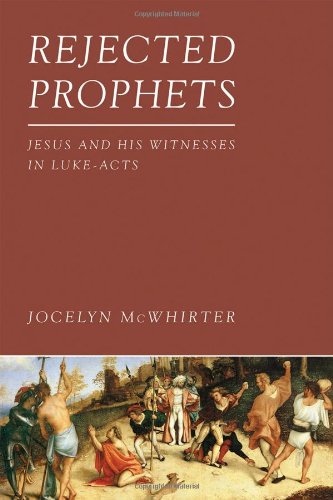
Nine months later, the review has now appeared. (For the record, I don't recommend binge writing over the Christmas holidays.)
Here is the final paragraph:
"Although readers will doubtless quibble over specific aspects of her argument, Rejected Prophets is a valuable contribution to scholarship on prophecy in Luke-Acts, and to the study of Luke-Acts in general. Specialists who are not persuaded by an approach that views Luke as a Jewish author writing within a Jewish context will still benefit from her careful attention to Luke’s use of the Jewish Scriptures, and to her explication of an important Lukan theme. Because it relates the theme of prophecy to other major themes in Luke-Acts, Rejected Prophets would work well as an introduction to Luke-Acts as a whole. The volume is accessible to beginning students who lack the original languages and who are unfamiliar with the historical context. More important still, McWhirter introduces Luke to her readers as a consummate story-teller and skillful reader of Scripture, illustrating at the same time how Luke’s own work may be read with profit."SBL members can view the whole review here: https://www.bookreviews.org/bookdetail.asp?TitleID=9710.
Subscribe to:
Posts (Atom)