Showing posts with label Luke-Acts. Show all posts

Tuesday, July 6, 2021

The Quest for Certainty and the Climax of the Book of Acts

Sunset at Waskesiu Lake, 23 May 2021
There is a humorous quality to the Roman tribune’s repeated attempts to find out the truth—literally, the “certainty” (τὸ ἀσφαλές; to asphales)—of the charges against Paul in Acts 21-23. First, there is too much of an uproar in the Temple (21:34). Then Paul’s speech to the crowd in the Temple sparks another riot, so the tribune decides on torture. Βut Paul is a Roman citizen, so he orders the Sanhedrin to meet because he wants to get to the bottom of the matter—the certainty (τὸ ἀσφαλές) of what he was accused by the Jews (22:30). Something similar happens in Caesarea when the Roman governor Festus explains to King Agrippa that he still does not have “anything certain” (ἀσφαλές τι) to write to the emperor about Paul (25:26).

If I may indulge in a bit of speculative word association, I am tempted to suggest that the references to “certainty” are clues. Αccording to Luke 1:4, Luke wrote to convince Theophilus of the “certainty” (ἀσφάλειαν) of the things about which he had been instructed. Are these speeches why Luke wrote Acts? Are the things about which Luke wants to convince Theophilus (and his other readers) embedded in these often ignored chapters?

Brown bear by Waskesiu Lake, 22 May 2021

For other reflections on the possible purposes of Acts, see these posts.


Thursday, November 15, 2018

The Holy Kiss as Family Practice among Christian Brothers

Among the biblical imperatives almost universally ignored by modern western Christians is Paul’s repeated injunction to “greet one another with a holy kiss” (Rom 16:16; 1 Cor 16:20; 2 Cor 13:12; 1 Thess 5:26). In an effort to live up to its Truth Made Clear™ motto, the New Living Translation replaces the concrete kiss with the abstraction of “Christian love.” This attempt to retain a timeless meaning while discarding the cultural husk obscures the real—and really challenging—point of the command, which has less to do with the heartiness of the handshake than with the embodiment of family.

In the Bible we encounter kissing between rulers and subjects (2 Sam 15:5; Ps 2:12), between a host and his guest (Luke 7:45), and between close friends (1 Sam 20:41), but in both the Bible and Greco-Roman society kissing was most commonly practiced between relatives (see Song of Solomon 8:1). In its first-century context, then, the “holy kiss” was a transgressive act:
“In the early years of Christianity, followers of Jesus were noted for kissing each other (probably, though not necessarily, on the lips) and for making the exchange of such greetings a part of their public liturgy. Paul’s emphasis that this greeting was to be a ‘holy kiss’ (cf. 1 Pet. 5:14) makes clear that nothing erotic was implied. Still, the practice was a novel one. … [T]here does not appear to have been any precedent in Jewish or Greco-Roman society for kissing between men and women who were not either relatives … or lovers.” - Mark Allan Powell summarizing Michael Philip Penn*
When slaves and their owners, gentiles and Jews, and males and females in Paul’s churches kissed each other, they enacted family unity, demonstrating to themselves and others that they really were brothers and sisters in Christ, members of one body. If the goal of translation is to convey the—in this case shocking—effect of the original, NLT’s “Greet each other with Christian love” fails miserably. I am not proposing that churches today should add a literal “holy kiss” into their order of service, but they should probably have the chance to be exposed to what Paul actually said so that they can reflect on what an analogous contemporary practice might look like. (If you are like me, such reflection is unsettling.)

Alongside the kiss was the early Christian practice of addressing fellow believers as “brothers.” Unfortunately, readers of the NIV, NLT and other dynamic equivalence translations will sometimes miss the import of this speech act. I have no objection to replacing the Greek word for “brothers” with the gender neutral “brothers and sisters,” but when translators substitute the less cumbersome “believers,” the family connotations of the underlying Greek expression are lost—and these connotations are hugely significant both for the meaning of the term and its effect on those among whom it was used.

In the early Jewish book of Tobit, for example, marriage makes husband and wife “brother” and “sister” (7:12)—if, that is, marriage is kept in the family. Tobias addresses his new bride Sarah as “sister” (8:4) after he dutifully followed his father’s instruction to choose a wife from among his brothers, just like Abraham and the patriarchs (4:12; 6:16). In Tobit, the family ultimately includes all Israelites, who as descendants from Abraham are “brothers” (e.g., 1:3, 10, 16). The marriage between Sarah and her close relative, Tobias, is emblematic of a concern in the book to promote endogamy within the larger family of Israel and prohibit intermarriage with gentiles.

In 1 Maccabees, “brothers” frequently denotes those faithful Israelites who stood with Judas and his literal brothers (e.g., 1 Macc 2:40-41; 5:32). It is true that later in the book, Jonathan and the “assembly of the Jews” address the Spartans as “brothers,” but this exceptional usage proves the rule, for the Spartans explain in their reply that they had discovered that both Jews and Spartans were descendants of Abraham (1 Macc 12:21). (With Christopher Jones**, I take it that the assertion of kinship was believed to be genuine, not just a rhetorical device.)

Despite differences in where they draw the boundaries, Tobit and 1 Maccabees illustrate a wider Jewish pattern of usage drawn from the Hebrew Bible, which can use “brother” to refer to any descendant of Israel (e.g., Deut 17:15).

Much like giving a kiss, then, Christians in Paul’s churches who addressed each other as “brother” or “sister” were signaling that they were family, insiders as opposed to outsiders. (I should add that even though the new Christian family reflected in Paul’s letters crossed ethnic boundaries, it was just as exclusive in its own way as the Jewish pattern from which it was derived.)

In the next post, I want to explore how “brother” is used as a form of address in Acts. There is, I think, a consistent pattern that is intentional, but also rather puzzling.

Works Cited 
*Mark Allan Powell, Introducing the New Testament: A Historical, Literary, and Theological Survey (Grand Rapids: BakerAcademic, 2009), 379, summarizing Michael Philip Penn, Kissing Christians: Ritual and Community in the Late Ancient Church (Philadelphia: University of Pennsylvania Press, 2005).
**Christopher Prestige Jones, Kinship Diplomacy in the Ancient World (Cambridge: Harvard University Press, 1999).
Sunday, November 11, 2018

A November Miscellany


You can chalk October's blog silence up to a trip to Dublin at the beginning of the month, for which I needed to prepare a paper, a trip to Caronport at the end of the month, for which I needed to prepare a course, and the ancillary packing, unpacking, and follow-up that simply takes time.

Both trips were a treat. In Dublin we got to see biblical manuscripts in the Chester Beatty Library ...

... and to marvel at Trinity College Dublin's Old Library:


Saskatchewan in October calls for a more refined palate that can appreciate different shades of brown, but the interaction with students, friends, and colleagues was rich, and the week of teaching "Jewish Backgrounds to Early Christianity" was very satisfying. I also had a few conversations that make me excited about the prospect of returning to full-time teaching next fall (see #4 below).

Real life takes precedence over the virtual, but I want to mention a few things quickly:

(1) Ambiguities in Acts: I hope to resume my blog series on the Law (and related topics) in the book of Acts shortly.

(2) The soundtrack to my daily commute right now is the audiobook version of Charles Marsh's superb Strange Glory: A Life of Dietrich Bonhoeffer (Vintage, 2015). This is no hagiography of Bonhoeffer, and all the better for that. Perhaps most remarkable from my middle-aged vantage point is that by age 25 Bonhoeffer had two doctorates, and by the age of 30 he was one of Germany's most vocal opponents to Hitler. What might the 20-somethings of today accomplish?

(3) One of the best available Bible programs--one that also happens to be free--has decided to make its accurate tagged databases of the Hebrew Bible, Septuagint, and Greek New Testament freely available for others to use and develop. Kudos to David Instone-Brewer and STEP Bible.

(4) Learn Ancient Greek as a Living Language in 2019: I am delighted to announce that Briercrest College and Seminary plans to offer an intensive sequence of 5 Greek courses next fall, all in one semester. Instead of the traditional grammar-translation approach, the courses will be team-taught in Koiné Greek, drawing on best practices in second language acquisition. I will have more to say about the program later on. In the meantime, you can read a selection of my earlier posts about teaching and learning Greek and Hebrew as living languages here, here, here, and here

Thursday, September 20, 2018

Three or Four Views on the Law in Acts: Preliminary Taxonomies

Bonus marks if you can identify the location of the stairwell.
Note: This is part 2 in a series on the Law in Acts. Part 1 is here.

At the risk of caricature, I begin with two rough-and-ready ways of classifying the major options.

Taxonomy 1: The first typology plots Jewish-Christian Torah observance along a trajectory from least observant (option 1) to most observant (option 2c):

(1) Freedom from the law within Acts: The book of Acts tells the story of a progressive, divinely-orchestrated, abandonment of the law, in tandem with the spread of the gospel to all nations. Acts narrates the emergence of Christianity out of Judaism and the replacement of Israel by the church as the people of God.* This view is the starting point for many ordinary readers who conflate Acts with a conventional understanding of Paul, and who assume the New Testament is about Christianity not Judaism; it remains a common scholarly option as well. [*Supersessionism is a slippery term. Some scholars finesse “replacement” differently, while still holding that Luke presents a move away from the law among Paul and other right-thinking Jewish-Christians within Acts.]

(2) Law-observant Jewish Christians & law-free gentile Christians: A second broad approach grants (a) that the conversion of Cornelius in Acts 10-11 and the Jerusalem Council in Acts 15 are focused on a law-free mission to gentiles, and (b) that Luke depicts Jewish Christ-believers within Acts—including Paul—as obedient to the law. What this means for Luke’s understanding of the significance of the law in his own time remains debated:

(a) A Torah-observant past within Acts vs. a law-free post-70 present in Luke’s own day: Acts distinguishes between Jewish and gentile Christians, defending a law-free gentile Christianity but depicting Paul—and therefore all Jewish Christians—as fully Torah observant. However, between the story of Acts and the time of writing a major break between Judaism and Christianity occurred. In Luke’s own post-70 (gentile?) context, there is no longer a distinction between Jewish and gentile Christians, and the law is not considered binding on anyone in the church. Supporters of this view (2a) often regard Luke’s description of law-observant Jewish Christianity in Acts as an attempt to justify the claims of gentile Christianity to be the people of God and heirs of Israel’s ancient heritage. As a result, view 2a often resembles view 1.

(b) A Torah-observant past within Acts and a Torah-observant option in Luke’s own day (?): Luke knows of Torah-observant Jewish Christians among his contemporaries, and he thinks it is fine for them to continue to keep the law, but he doesn’t think it is necessary to do so.

(c) A Torah-observant past within Acts and in Luke’s own day: Acts makes it clear that both Jews and gentiles are saved by faith alone, but the author distinguishes between “a people from the nations” who are not required to observe the law, and God’s covenant with Israel at Mount Sinai, which, Luke assumed, remained in effect. Faithful Jewish believers in Jesus are thus expected to continue to keep the law. More clearly than view 2a, adherents of this view tend to deny that Luke depicts gentile believers as replacing Israel as the people of God. The “true Israel”—not a biblical term, but a sectarian concept—consists rather of Jewish believers in Jesus.

This taxonomy helps us see at a glance the difference between the two major approaches to the law in Acts. On the first approach, Acts can be made to correspond with conventional readings of Paul's letters. On the second approach (options 2a-c), Acts presents Paul as fully Torah-observant.

A problem with the taxonomy is that it combines questions about the story Luke tells--“Are Jewish Christians Torah observant in Acts?”--with speculative reconstructions of Luke’s own later church context--for example, “Were Jewish Christians in Luke's later church still Torah observant?”

Taxonomy 2: Before attempting to form conclusions about Luke's own church context, we should probably begin by trying to relate the story Luke tells about the law with another closely-related theme (or themes) in Acts. So here is a second taxonomy organized like a JoHari Window that combines Luke’s depiction of the law in Acts (the x-axis) with Luke’s depiction of Jewish Christianity within Acts (the y-axis):

  • The x-axis plots Jewish Christianity as described in Acts as either “Torah observant” or “Law-free.” 
  • The y-axis focuses on the significance of the story Luke tells, with “(gentile) church replaces Israel” at one end, and “Israel reduced to a Jewish sect” at the other. 
View 1 on the first typology belongs in the top right quadrant: According to this view, the church described in Acts claims to replace Israel as the people of God and has already abandoned the law.

Views 2a and 2b belong in the top left quadrant: Acts depicts Jewish Christians as fully Torah observant, but presents all believers in Jesus, both Jews and non-Jews, as part of a single new people of God. In the opening chapters of Acts, we see the development of a sectarian movement consisting only of Jews who claim to be experiencing the fulfillment of God's promises to Israel. As the sectarian assembly (or "church") expands to include non-Jews alongside Torah-observant Jews, non- or "trans-" ethnic Christianity begins to emerge out of Judaism and to replace ethnic Israel as the people of God.

View 2c belongs in the bottom right left [!] quadrant: According to this view, Luke not only distinguishes between Torah-observant Jewish believers (including Paul) and law-free gentile believers, he also continues to distinguish between a Jewish-Christian sectarian group that claims to be “Israel restored,” and a non-Jewish “people from the gentiles” who share in salvation, the Holy Spirit, and the other blessings brought by Jesus, but who are never fully merged with Jewish followers of Jesus and who are never described as Israel.

No doubt there are still other ways of organizing the scholarly options. Before pursuing these further I hope in the next few posts to begin to lay out the evidence that is so variously interpreted by modern readers of Acts.

Wednesday, September 19, 2018

Three or Four Views on the Law in Acts

Anyone who has followed this blog for a while will know that I keep returning to the puzzle of Luke’s attitude toward the law. In 2014, in what was at least the third post on some aspect of the topic, I concluded that leaving the puzzle unsolved would be better than forcing all the pieces to fit:
Rover as "sober second thought"
As I have tried to push for consistency, for an interpretation of Acts that makes sense of all the data, I have found myself offering readings of individual passages that, on sober second thought, seem unsustainable. After multiple attempts to walk away with a solution to the problem of Luke and the law, it dawned on me that allowing two readings of Luke's silences to sit side-by-side without deciding finally between them is better than a tour de force that forces all the evidence to fit instead of admitting honestly where the difficulties are. (Click here for the whole post; here and here for earlier posts; and here, here, and here, for subsequent posts.)
For better or worse, by the time the essay I was working on was complete, I had decided to try my hand at a tour de force. Although I did allow that Luke may have envisioned a change in the food laws to enable Jewish believers to eat whatever was set before them by baptized gentile believers, I argued not only that Luke depicts Jewish Christians in Acts as consistently Torah-observant, but that he also thought Jewish believers in his own day should continue to observe the law.

I am now far enough removed from the argument of that essay to want to subject it to “sober second thought.” I like to tell myself that when I am not completely convinced by what I am saying I am probably trying to get at something important. Difficult questions exist for a reason. If the answers were obvious, the questions would have been resolved already. Still, while I was confident enough to go into print with it, aspects of the argument have always troubled me.

For one thing, my conclusions seem to put the author of the Gospel of Luke and the book of Acts at odds with the apostle Paul. Try as I might, I have not been able to persuade myself that comments about the law in Paul’s letters are addressed only to non-Jews, as proponents of the “Paul within Judaism” perspective tend to argue. When in Romans 6:15 Paul declares “we are not under law but under grace,” I take it that he includes all believers in Jesus, both Jews and gentiles. Paul’s self-description as one who became “without the law to those without the law” (1 Cor 9:21) and who was “persuaded in the Lord Jesus that nothing is unclean in itself” (Rom 14:14) is difficult to square with the Paul of Acts who insists, “I have in no way committed an offense against the law of the Jews” (Acts 25:8 NRSV)—if, that is, Luke means that Paul maintained a fully Torah-observant lifestyle.

To be clear, Paul’s letters do not determine what Acts must mean or vice versa. The unity of Scripture is, in my view, a theological dictum, not a hermeneutical method that can be used to impose an artificial harmony on the text. Nevertheless, I admit that my inability to reconcile the Paul of Acts and the Paul of the letters results in a certain amount of uncomfortable dissonance.

More importantly, the difference between my reading of Acts and my reading of Paul’s letters raises historical questions about the setting and purpose of Acts. Where in the late first or early second century would you encounter a church composed of Torah-observant Jewish Christians and law-free gentile believers? Was Luke really so unaware of the kind of things Paul said about the law in his letters?

There are also niggling doubts about bits and pieces of Acts that could point in other directions. Was I explaining the text or explaining it away?

Apart from being more reluctant to draw conclusions from the narrative of Acts about law observance in Luke’s own later context, I haven’t changed my mind on any major point (yet). But I have decided that I want to re-evaluate the puzzle of Luke’s attitude toward the law along the more expansive lines of what I suggested back in 2014—not by defending one option, but by presenting the main alternatives as persuasively as I can, and evaluating the evidence as fairly as I can.

My plan in subsequent posts is to use this space to think through the evidence and the options in more detail. Feedback, corrections, and comments are welcome.

Other posts in this series:
Preliminary Taxonomies

Sunday, May 20, 2018

Wesley Hill, Modern Marcionism and Torah Ethics

In a recent column in First Things, Wesley Hill calls out Andy Stanley for stating that the gospel “is completely detached … from everything that came before,” that Christians “are not accountable to the Ten Commandments,” and that “The Old Testament was not the go-to source regarding any behavior for the church.”

From Hill’s perspective, Stanley’s comments amount to a new Christian Marcionism not by denying the inspiration of the Old Testament, but by declaring that it has been superseded by the New Testament, and by implying that the Old Testament is irrelevant for Christian ethics.

To Stanley’s claim that the “apostolic decree” in Acts 15 “was a general call to avoid immoral behavior[,] but not immoral behavior as defined by the Old Testament,” Hill responds:
“New Testament scholars such as Markus Bockmuehl have demonstrated that the rules for Gentile converts outlined in Acts 15 themselves go back to the Old Testament’s guidelines for Gentile sojourners in Israel.” 
To be fair, some of the quotations from Andy Stanley’s sermon remind me of things I tell my students: It is true that Paul seldom refers directly to the Old Testament when he gives ethical instruction. You won't find the apostle trying to persuade his audience to agree with him by appealing to the authority of the Law of Moses as a legal code. And if Christians are "not under law, but under grace," then that law must include the Ten Commandments as well. Stanley is on to something.

I also agree with Stanley that the way the prohibitions in the apostolic decree are authorized is significant. In an essay on “Torah Ethics in Acts,” I wrote:
“Despite the absence of chapter and verse references, Luke’s readers would have connected the prohibitions against things defiled by idols, blood, what is strangled and sexual immorality (15:20) to the Torah. … Nevertheless, the four requirements of the decree are not authorized by Moses. While they are connected to the law of Moses (15:21), James formulates the terms of the decree as his judgement (15:19). In the letter the “apostles and elders” send to the Gentiles, the requirements are authorized by the Holy Spirit and the Jerusalem apostles and elders, not Moses (15:28, cf. 16:4).” (p. 85)
But Paul’s insistence that believers are free from the law, and the fact that the apostles and elders in Acts 15 do not appeal directly to the law when they issue ethical requirements does not mean that the Torah was no longer viewed as a divinely-inspired guide for human behaviour. Surely it was. In Torah Ethics and Early Christian Identity (Grand Rapids: Eerdmans, 2016), Susan Wendel and I asked contributors to consider not if, but how the Law of Moses continued to inform Christian ethical thinking even for those who, like Paul, did not think Torah observance was essential for salvation.


Hill's column demonstrates that the answer to this question can have important practical consequences.

In my essay on Acts, I concluded,
“[A]lthough Luke did not think that Gentile Christ-believers encounter the Torah in the context of God’s covenant with Israel, he presumably took for granted that the law—and controversy stories about the law in Luke’s Gospel—remains authoritative and relevant for Gentile Christ-believers when it is read as prophecy and applied by analogy.” (p. 91) (For what it means to read law as prophecy, you will need to read the essay itself.)

In Luke's writings, the Mosaic law continues to function authoritatively, but it is not the go-to source for Christian ethics--that honour goes to Jesus:
“The law in Luke’s writings plays a supporting role behind Luke’s overwhelming interest in Jesus. While Luke does not think they conflict, it is the example of Jesus, much more than the demands of Torah, that serves as the primary paradigm for the main characters in Acts, and hence for Luke’s Gentile readers.” (p. 91)
In this context, I would want to stress the absence of conflict. As Hill puts it, "One cannot pit Paul's sexual ethics against the Ten Commandments, from which they stemmed."

Sources:
Wesley Hill,  "Andy Stanley's Modern Marcionism," First Things (5.11.18)
Miller, David M. “Reading Law as Prophecy: Torah Ethics in Acts.” Pages 75–91 in Torah Ethics and Early Christian Identity. Edited by Susan J. Wendel and David M. Miller. Grand Rapids: Eerdmans, 2016.

Wendel, Susan J., and David M. Miller, eds. Torah Ethics and Early Christian Identity. Grand Rapids: Eerdmans, 2016.


Friday, November 11, 2016

Maccabean Characterization and Reverse Polemic in Acts


At SBL next Sunday morning I am scheduled to present a paper in the Book of Acts section on "Maccabean Characterization and Reverse Polemic in Acts." The rather long abstract I submitted in February can be read here, for anyone so inclined.

What follows is a slightly modified thesis paragraph from my current draft:
I will argue that Luke knows his story might appear to entail a rejection of Jewishness, like that of the Maccabean era, and he attempts to avert this misreading through a series of allusions to 1-2 Maccabees. First, he allows opponents of the Gentile mission to draw parallels between Jewish Christ-believers and the Jewish renegades of 1-2 Maccabees in order to set up Paul’s climactic rejection of this position in the latter chapters of Acts. Second, Luke reverses the Maccabean “script,” claiming that it is not Jewish Christ-believers but their Jewish critics who play the part of Antiochus and the renegades. This polemical contrast supports Luke’s argument that the Messianic claims of Jesus and the Gentile mission do not undermine the law or threaten the Jewish identity of Jesus’ Jewish followers. The contrast also indicates that the church in Luke’s own day had not moved as far toward a wholly non-observant Gentile Christianity as many suppose.
If you happen to be in San Antonio at 9:00 a.m. on November 20th and can think of nothing better to do, why don't you find your way to session S20-113 in Convention Center 304B.


Sunday, September 4, 2016

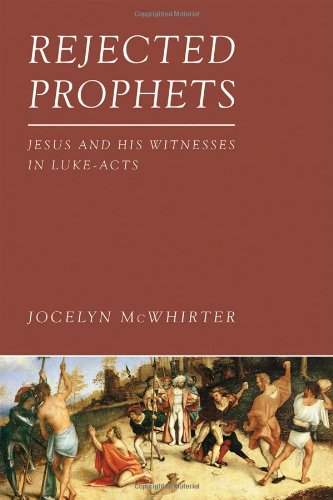
Rejected Prophets


I rang in the new year--just about--by hitting "submit" on my RBL review of Jocelyn McWhirter's Rejected Prophets: Jesus and His Witnesses in Luke-Acts (Minneapolis: Fortress, 2014).

Nine months later, the review has now appeared. (For the record, I don't recommend binge writing over the Christmas holidays.)

Here is the final paragraph:

"Although readers will doubtless quibble over specific aspects of her argument, Rejected Prophets is a valuable contribution to scholarship on prophecy in Luke-Acts, and to the study of Luke-Acts in general. Specialists who are not persuaded by an approach that views Luke as a Jewish author writing within a Jewish context will still benefit from her careful attention to Luke’s use of the Jewish Scriptures, and to her explication of an important Lukan theme. Because it relates the theme of prophecy to other major themes in Luke-Acts, Rejected Prophets would work well as an introduction to Luke-Acts as a whole. The volume is accessible to beginning students who lack the original languages and who are unfamiliar with the historical context. More important still, McWhirter introduces Luke to her readers as a consummate story-teller and skillful reader of Scripture, illustrating at the same time how Luke’s own work may be read with profit."
 SBL members can view the whole review here: https://www.bookreviews.org/bookdetail.asp?TitleID=9710.


Thursday, June 30, 2016

Assessing Ernst Haenchen on the Purpose of Acts

I summarized Ernst Haenchen's understanding of the purpose of Acts yesterday (here). Today I want to comment briefly on three key aspects of his model:

1. Authorizing Christianity - The suggestion that Luke wrote to secure approval for the early Christian movement as a "tolerated" religion remains very popular, at least in a modified form. Although some scholars deny that a religio licita category existed in the first two centuries CE (see Maddox, on the one hand, and the fine discussion in Keener, on the other), it is common to suggest that Luke presents Christianity in the Roman world as a legitimate and honorable religious alternative by highlighting its Jewish origins and appealing to the antiquity of its traditions in the Jewish Scriptures. (See e.g., Gerald Downing, Philip Esler, François Bovon, Daniel Marguerat, Craig Keener.)

My question is this: Does a bid for legitimacy in the Roman world adequately explain a trial narrative that appears to address and respond to Jewish concerns--in particular, concerns which I will argue elsewhere have to do with a perceived threat to Jewish identity posed by Paul's Gentile mission? Not impossible, but it seems an odd way to go about it.   

2. Jewish Opposition - Haenchen's model supposes that Jews complained to the Romans that Christian Gentiles were not legitimate Jews and hence were "hostile to the state." But when, where and under what circumstances would Jews care about Gentile Christians, and would they have been in a position to complain to the state after 70 CE? Shaye Cohen's recent comment about the "parting of the ways" seems relevant here:
    "There was no parting of the ways between gentile Christians and non-Christian Jews for the simple reason that their ways had never been united. ... [F]or gentiles who believed in Christ and for Jews who did not, there was no need for a parting of the ways, even if there was a need on occasion for polemic, apologetic, and recrimination" (From the Maccabees to the Mishnah [3rd ed; WJK, 2014], 232-3).
3. An External Audience - Haenchen's claim that Luke's apology in Acts was "designed to win over the Roman authorities" (116) has probably received the most criticism--and rightly so. C.K. Barrett's famous rejoinder is compelling: "No Roman official would ever have filtered out so much of what to him would be theological and ecclesiastical rubbish in order to reach so tiny a grain of relevant apology" (Luke the Historian in Recent Study [London: Epworth, 1961], 63).

Bibliography
Barrett, C. K. Luke the Historian in Recent Study. London: Epworth, 1961.

Bovon, François. “The Law in Luke-Acts.” In Studies in Early Christianity, by Bovon, François, 59–73. Grand Rapids: Baker Academic, 2005.

Cohen, Shaye. From the Maccabees to the Mishnah. 3rd ed. Louisville: Westminster John Knox, 2014.

Downing, Gerald F. “Freedom from the Law in Luke-Acts.” Journal for the Study of the New Testament 26 (1986): 49–52.

———. “Law and Custom: Luke-Acts and Late Hellenism.” In Law and Religion: Essays on the Place of the Law in Israel and Early Christianity, edited by Barnabas Lindars, 148–58. Cambridge: James Clarke, 1988.

Esler, Philip Francis. Community and Gospel in Luke-Acts: The Social and Political Motivations of Lucan Theology. SNTSMS 57. Cambridge: Cambridge University Press, 1987.

Haenchen, Ernst. The Acts of the Apostles: A Commentary. Hermeneia. Philadelphia: Westminster, 1971.

Keener, Craig S. Acts: An Exegetical Commentary: Volume 1: Introduction and 1:1--2:47. Grand Rapids: Baker Academic, 2012.

Maddox, Robert. The Purpose of Luke-Acts. Edinburgh: T&T Clark, 1982.

Marguerat, Daniel. The First Christian Historian: Writing the “Acts of the Apostles.” Edited by Gregory J. Laughery and Richard Bauckham. Cambridge: Cambridge University Press, 2002.

Other posts in this series:
Jewish Christianity in Acts: In Search of a Sitz im Leben
Part 1: Reflections on Hermeneutics and the Purpose of Acts
Part 2: The Purpose of Acts: Some Alternatives
Part 3a: Ernst Haenchen on the Purpose of Acts
Part 3b: Assessing Ernst Haenchen 

Assessing Ernst Haenchen

Ernst Haenchen (1894-1975) is not exactly a household name, except in scholarship on Acts and John. When his contribution to the prestigious German KEK series first appeared in 1955, it quickly established itself as the standard critical commentary on Acts. When a revised edition was translated and added to the NTL series in 1971, W.D. Davies lauded it as "a great work of scholarship" and celebrated its appearance, at last, in English.

Jacob Jervell, whose very different 1998 German commentary on Acts replaced Haenchen's in the same series, described his predecessor's contribution as "the most comprehensive and important work of the critical German post-World War II research on Acts."*

(As an aside, Martin Rese describes how "From the end of the sixties until his death in 1975 Ernst Haenchen took me as one of his discussion-partners. He called me up nearly every day for at least an hour, and we talked about the problems of interpreting Luke-Acts and the gospel of John."** What would that have been like, I wonder?)

(As a second aside, I note with dismay that, according to this German Wikipedia entry, Haenchen was a member of the Nazi party during WWII: That decision may have secured him a promotion during the War, but it cost him his official position, at least, after it was over. Update: See Joseph Tyson's longer discussion of Haenchen here. Tyson does not mention Haenchen's membership in the National Socialist party.)

For my part, I share W. Ward Gasque's judgement that the commentary "is in every way a magnificently impressive piece of scholarship -- a treasury of bibliographical, philological, and exegetical detail. ... Even when one does not agree with the conclusions of the author ... he must confess that Haenchen has made him look at  the text and the problem raised by it from every possible angle" (A History of the Interpretation of the Acts of the Apostles [Hendrickson, 1989], 243).

To be sure, Gasque immediately went on to add:
"When all is said and done, however, it must be noted with a sense of disappointment that it is probable that Haenchen's great commentary will be regarded by future generations of scholars more as a historical phenomenon belonging to one era of the history of exegesis than as a lasting contribution to New Testament research. ... [W]hen the storm has subsided and New Testament critics are in a position to look back over the past two or three decades of research from the perspective of history they will, I think, be able to see that the commentary of Haenchen is as tendentious and ultimately as unhistorical as he thinks the author of the Book of Acts was." (Gasque, History, 244).

For better or worse, Gasque's prediction has not come true: Haenchen's commentary remains a classic, and the recent excellent critical commentary by Richard Pervo in the Hermeneia series stands very much in the same tradition. (See this post for my initial reflections on Pervo's commentary.)


*Jacob Jervell as translated and quoted in Martin Rese, "The Jews in Luke-Acts: Some Second Thoughts," in The Unity of Luke-Acts (J. Verheyden, ed.; Leuven: Peeters, 1999), 185-6.
**Martin Rese, "The Jews in Luke-Acts," 185.

Wednesday, June 29, 2016

Ernst Haenchen on the Purpose of Acts

The introduction to Ernst Haenchen's classic commentary on Acts contains no separate section on the purpose of Acts, but it is clear enough from his discussion that he thinks Acts was written (1) to reassure Christians (a) about the continuation of the Christian story after the death and resurrection of Jesus (i.e., to respond to the delay of the parousia) and (b) about the salvation-historical continuity of Gentile Christianity with the story of Israel (i.e., to demonstrate the legitimacy of the law-free Gentile mission). In addition to reassuring Christians about these two theological issues, Acts was also written to address a political problem. In the face of criticism by Jews, Luke wrote (2) to convince Romans that Gentile Christianity should be tolerated as a religio licita, just as Judaism was:
Luke's narrative suggests "a problem-free, victorious progress on the part of the Christian mission. But in reality Luke the historian is wrestling, from the first page to the last, with the problem of the mission to the Gentiles without the law. His entire presentation is influenced by this. It is a problem with two aspects: a theological and a political. By forsaking observance of the Jewish law Christianity parts company with Judaism; does this not break the continuity of the history of salvation? That is the theological aspect. But in cutting adrift from Judaism Christianity also loses the toleration which the Jewish religion enjoys. Denounced by the Jews as hostile to the state, it becomes the object of suspicion to Rome. That is the political aspect. Acts takes both constantly into account" (100).
Luke's answer to the theological question about salvation-historical continuity also responds to the political problem:
"As a religion of the resurrection, Christianity was in the direct line of succession to Judaism. And one cannot ... expect the Roman State to trouble itself with theological niceties alien to its concern. On the other hand Christianity does not imply any transgression of Roman laws. Consequently the intelligent representatives of Rome always took a benevolent view of the Christian mission" (102).
According to Haenchen, Luke conveys the continuity between Christianity and Judaism (a) by emphasizing that the extension of the Gospel to Gentiles was divinely initiated and (b) by depicting Paul and the apostles--those who first carried the Gospel to Gentiles--as completely law-observant. Haenchen declares that "Luke knows no break in Paul's attitude to the law" (625). Paul's trial narrative, with its stress on Paul's innocence, illustrates this.

But Jewish Christianity was no longer a factor in Luke's Gentile church, and there were no longer any actual positive connections with non-Christian Jews when Luke was writing. In Acts, Jewish Christians (represented by the apostles, the Seven and Paul, etc.) play a symbolic role in witnessing to Jesus and securing the transition to a Gentile Church. This means both that Jewish Christianity has transitioned to Gentile Christianity and that "Christianity was in the direct line of succession to Judaism" (102).

Haenchen seems to suppose that after the destruction of Jerusalem by the Romans, any Jewish Christianity that still existed survived as an inconsequential Christian sect: "Jewish Christians after 70 had become unimportant, and the Gentile Christians were not Paulinists who had to contend with Judaizers for recognition. Luke no longer hoped for the conversion of the Jews" (693).

According to Haenchen, then, Acts depicts Jewish-Christianity as Torah observant, but because Jewish Christianity had, for all intents and purposes, passed from the scene, the church of Luke's day still represents a movement away from Judaism and the law. Although Luke claims continuity with Judaism, the evidence for that continuity lies in the past. Paul, according to Luke, may have been innocent of the charges against him, but the church of Luke's day was not. Luke's Jewish contemporaries were, in fact, right to accuse Christians of opposition to the Torah, Temple and the Jewish people (Acts 21:28). "For Luke the Jews are 'written off'" (128).

This is the third (or fourth) post in a series on the purpose of Acts. The earlier posts in this series, which also link to some of my reflections on the topic from previous years, are here:
Jewish Christianity in Acts: In Search of a Sitz im Leben
Part 1: Reflections on Hermeneutics and the Purpose of Acts
Part 2: The Purpose of Acts: Some Alternatives

Tuesday, June 28, 2016

The Purpose of Acts: Some Alternatives

In his excellent but now rather dated introduction to scholarship on Acts, Mark Allan Powell organizes proposals about the purpose of Acts into six major categories, which he admits are not mutually exclusive:
  1. Irenic - Acts was written to unify Petrine and Pauline branches of early Christianity (F. C. Baur).
  2. Polemical - Acts was written to respond to and reject heresies within Christianity--either Gnosticism (Talbert) or Jewish Christianity (Jack T. Sanders).
  3. Apologetic - Acts was written to respond to opposition from either Roman or Jewish outsiders. In some forms of this view, Acts is addressed directly to the outsider audience as an attempt to persuade them that, for instance, Christianity should be recognized as a legal religion, as Judaism was (Haenchen). Others argue that Acts was written to Christians to enable them to respond to opposition from outsiders. Jacob Jervell, for example, suggested that Acts was written to a Christian church facing opposition from Jewish opponents. 
  4.  Evangelistic - Acts was written to encourage non-Christian readers to convert to Christianity or to provide a model for Christian witness to non-Christians (F. F. Bruce).
  5. Pastoral - "If the book of Acts is addressed primarily to believers, then Luke's purpose may be to strengthen their faith and to offer them pastoral guidance" (17).
  6. Theological - According to Hans Conzelmann, Acts responds to "a theological crisis in the life of the early church" caused by the delay of the second coming of Jesus.

  7. Mark Allan Powell, What Are They Saying about Acts? (New York: Paulist, 1991), 13-19.
This is a helpful orientation to the topic, but it will not take us very far if we are concerned primarily with the way in which proposals about the purpose of Acts account for the function of the extensive trial narrative in Acts 21-28: I would not have guessed from reading Powell's summary that Ernst Haenchen gave tremendous weight to the trial narrative in the latter chapters of Acts, and insisted that the book was written to legitimate the Gentile mission as well as to convince a Roman audience to treat Christianity as a legal religion. More on Haenchen in the next post.

Saturday, June 25, 2016

Reflections on Hermeneutics and the Purpose of Acts

Recent scholarship on the purpose of the book of Acts is in disarray. I will explain below why I think this matters and then suggest two factors that need to be taken into account in any discussion, but first a sketch of the current situation:
  • Although some 20th-century scholars dated Acts before Paul's death in the mid-60's and a few others dated it to the 2nd century, it is fair to say that most scholars during the 20th century were content to locate Acts in the mid-80's CE. I still think a mid-80's date is preferable, but the current trend is to date Luke's second volume to 115 or beyond.
  • Dating is only one relatively minor introductory issue: Was Luke Jewish or Gentile? Was his church composed primarily of Jewish or Gentile Christians? To what extent can we read between the lines of Luke's narrative and recover the issues facing the church in Luke's own day? When does Luke idealize the past and when does he anachronistically impose his own context onto the past? On all these questions scholars remain divided. (For one example, see this post.)

These questions are important because construing the meaning of a text normally (always?) involves reconstructing its purpose. And when you ask why a text was written, you are soon asking when it was written and to whom.  

Before I go on, a few caveats and clarifications are in order:
  1. Reading a text in light of its overall purpose is more important for some texts--and some parts of some texts--than for others. You don't need a specific Sitz im Leben to read much of Genesis well because individual narrative cycles and thematic elements help explain the meaning. In the same way, Acts can be read with profit and insight from the general orientation provided by Luke's preface--Luke writes both volumes to confirm the Gospel (so R. Maddox)--and through attention to major themes.
  2. There is a hermeneutical circle, though not a vicious one. You get at the overall purpose in the first place by considering the details within the text, not primarily from larger models drawn from external evidence about, say, the structure of early Christian communities.
  3. Scholarly reconstructions can be overdone. The 20th century is littered with the remains of ever more elaborate, hypothetical, speculative settings constructed by historical critics to account for the purpose of a book. In such cases, the payoff tends to be limited.  Better to leave questions of setting and purpose unanswered than to impose a model that ignores or results in forced readings of specific details in the text.
  4. Some authors may not be able to articulate why they write, and may only have a general sense of their work's purpose. To take one example, I have been wondering why I am writing this blog post, and I am not at all sure who it is for. Perhaps it is only my attempt to work out for myself what I referred to recently as the great puzzle of the setting and purpose of Acts. Returning to Acts, it is possible that Luke included some episodes in Acts simply because they were interesting--they made a good story.
Nevertheless, I am persuaded by recurring emphases in the text itself that Luke wrote to address specific issues or, to put it another way, as he was writing Acts, he was preoccupied with specific questions. If it is true that "We can understand a text only when we have understood the question to which it is an answer" (Collingwood/Gadamer), what was Luke's question? 

I suggest that any construal of the purpose of Acts needs to take seriously the prominence of the Jews and Judaism at the beginning and end of Acts. The first 7 chapters of Acts announce the fulfillment of God's promises to Israel in the Jewish community of Jesus followers, a community that by chapter 6 has emerged as a separate Jewish sect. The final 8 chapters insist that in extending salvation to the Gentiles Paul (representing Jewish Christianity as a whole) has not violated the law.

Identifying Luke's emphasis on the Jewish beginning and Jewish ending of Acts is not yet an articulation of his question, but it provides a means of evaluating other attempts to summarize the purpose of Acts.

No promises, but I hope to return to the topic in another post or--don't hold your breath--a series of posts.

Monday, April 11, 2016

Waiting for the Summer


Winter semester classes ended last Tuesday. "Summer," for the purposes of this post, begins in another couple weeks--after I have made my way through a small mountain of marking, and submit final grades.

Then I transition from marking essays to writing them: I am happy to report that both my SBL proposals were accepted this year, which means that I will be presenting two papers in San Antonio in November, one in the Book of Acts section, the other in the Hebrew Bible and Political Theory section. It also means that I have two papers to write during the summer. Fortunately for me, neither is brand new:
  • "Maccabean Characterization and Reverse Polemic in Acts" will be a major revision of a paper I gave at the Canadian Society of Biblical Studies annual meeting last spring in Ottawa. More details about the CSBS version are here.
  •  "The 'Prophet like Moses' and Josephus's Aristocratic Ideal" will be a revision--minor, I hope--of a paper I am scheduled to give at this year's CSBS at the end of May in Calgary. Provided that the pieces of my argument come together in time, I hope to show that, at least in the Antiquities, Deuteronomy 18 informs Josephus's political philosophy. 
Summer also means preparing for next year's classes, including two brand new courses (a first year "Introduction to the New Testament" and a 300-level elective on 1 Corinthians), second-year Hebrew, and an upper level elective on the book of Acts. S'all good, but full.

Somewhere in there will be vacation too.


Wednesday, February 24, 2016

Jewish Christianity in Acts: In Search of a Sitz im Leben

In Acts, Luke responds to the charge that Paul teaches “all people everywhere against our people, the law and this place [the Jerusalem temple]” (Acts 21:28) with an emphatic, multi-chapter denial:
  • In Acts 22, Paul identifies himself as a Jew who is accurately instructed in the ancestral law, and who is as much a “zealot for God” as his audience in the Jerusalem temple (22:3).
  • In Acts 23, Paul claims to have always conducted himself with a “good conscience” (23:1).
  • On trial before Agrippa and Festus, he denies that he “sinned against the law … or the temple” (25:8).
  • And before the assembled Jewish elders in Rome, he insists that he did nothing “against the people or the ancestral customs” (28:17).
C.K. Barrett, finding Luke’s portrayal of Paul at odds with the Paul of the epistles, concludes that Luke was honestly mistaken: He knew Paul was a Jew, he knew that Jewish Christians in his own day in the late 1st century observed the law, and he assumed that Paul did too, not realizing that “[w]hen Paul expected Jews to eat with Gentiles he was asking them to give up some of their Jewishness” or that the way in which Paul could claim “to be a conscientious Jew" (cf. Acts 23:2) “would have destroyed Judaism as currently understood”*:
“Luke writes in a situation in which it is accepted that Jewish Christians may and do observe the Law, and it is part of his conviction that Paul was both a good Jew (this will be frequently repeated in the ensuing chapters) and a good Christian. Paul was in fact a Jewish Christian of a kind that could hardly continue to exist after the first generation--a fact that was not clearly seen by Luke. The story presupposes that Jewish Christians in Palestine, in Luke's day and before it, continued to observe the provisions of the Law.”*

Wolfgang Stegemann** agrees with Barrett that the charges against Paul reflect actual Jewish opposition to early Christianity, but he transposes the conflict to the late first century. When Acts was written during the reign of Domitian, Luke’s community was located uncomfortably between the synagogue and Roman authority. The Romans suspected Gentile Christians of adopting Jewish ways because they followed a Jewish Messiah, but after the destruction of Jerusalem in 70 CE, Christian acceptance of Gentiles without circumcision, indifference to the temple, and lax attitudes toward the law could only be regarded as apostasy by Luke’s Jewish neighbours. In addition to theological differences, conflict in Gentile cities caused by Christians tended to affect their Jewish neighbours. As a result, Jews distanced themselves from Christians. For non-Christ-believing Jews, the period after the destruction of the Second Temple corresponded to the period after the desecration of the Temple by Antiochus Epiphanes, and their Christians neighbours were like the Hellenizers of the Jewish reform after 175 BCE—people who abandoned the Jewish law and made a covenant with the Gentiles. After 70 CE, the Christian community could be conceived only as an “anti-Israel movement.”


According to Stegemann, actual practice in Luke’s Christian community justifies the conclusions of Jewish outsiders: Although Luke depicts Jewish Christians in Paul’s day as remaining faithful to the law, he shows no real interest in the details of the law, which shows that Torah observance was no longer a live issue in Luke’s own much later church context. Since Luke cannot deny the charges in his own time, he responds to contemporary conflict by projecting it onto the past when observant Jewish Christians still existed in the church and before the decisive break with the synagogue. The effect, I take it, is to blame non-Christ-believing Jews for the parting of the ways, and to attribute long-standing hostility to Jews.


Of interest to me is that these two proposals are almost precisely inverted:
  • For Stegemann, Jewish Christianity is no longer a viable option in Luke’s late 1st-century context, and present conflict (between a Gentile-dominated church and non-Christian Jews) has been retrojected onto the past.
  • For Barrett, Jewish Christianity is still alive and well. Luke lives in a time of harmony between Jewish and Gentile Christians in a church that has lost sight of Paul’s radical views about the law (and the conflict that accompanied them), and he has retrojected the absence of conflict between Gentile and Jewish Christians onto the past.

If you have read along this far in the hope that you will find out what I think, I am sorry to disappoint. The setting and purpose of Acts--in particular, a setting that makes sense of Acts 21-28--is a great puzzle to me. I don’t have it all worked out.


Notes:

*Quotations of Barrett are from C. K. Barrett, A Critical and Exegetical Commentary on the Acts of the Apostles (Vol. 2; Edinburgh: T. & T. Clark, 1998), pp. 1013-1014, 1058.


**Wolfgang Stegemann, Zwischen Synagoge und Obrigkeit: zur historischen Situation der lukanischen Christen (Göttingen: Vandenhoeck & Ruprecht, 1991), cf. esp. pp. 178-9, 186.


Much of the substance of Stegemann’s argument appears in English in chapter 11 of Ekkehard W. Stegemann and Wolfgang Stegemann, The Jesus Movement: A Social History of Its First Century (Minneapolis: Fortress Press, 2001).

Sunday, August 30, 2015

Could ancient Jews eat with Gentiles without violating the law?

Peter's vision by Domenico Fetti, via Wikimedia Commons

Could ancient Jews eat with Gentiles without violating the law?

It is safe to say that most readers of the New Testament (and many New Testament scholars) assume the answer is no. After all, (1) in Acts, when Peter returns from visiting Cornelius he is criticized for staying with uncircumcized men and "eating with them" (Acts 11:3). (2) In Galatians, Paul equates eating with Gentiles to living "like a Gentile (ethnikôs) and not like a Jew (ioudaikôs)" (Gal 2:12-14). These two passages seem parallel. (3) Since Peter responds to his critics by telling a story about clean and unclean food that concludes with the declaration, “what God has cleansed, do not regard as defiled” (11:9), readers of Acts routinely conclude that, from Luke's perspective at least, accepting Gentiles into the church meant doing away with the food laws.

I am not so sure. For one thing, Luke never explicitly draws the conclusion from Peter's vision or his encounter with Cornelius that the food laws were set aside. To the contrary, in the latter chapters of Acts Paul insists on his own continued fidelity to the Jewish way of life: Paul participates in temple worship to show that he “guards the law” (21:24); he also denies that he has done anything against the law (25:8) or his people’s ancestral customs (28:17).

Outside the New Testament, passages that emphasize the strictness with which some Jews observed the food laws also demonstrate that it was possible to "keep Kosher" in Gentile contexts: (1) Daniel and friends refuse the king's food and wine, requesting a diet of vegetables and water, but it was still the king's vegetables and water that they ate (Dan 1:8, 12). (2) Josephus describes a group of priests imprisoned in Rome who survived on a diet of figs and almonds out of piety toward God (Life 14). Martin Goodman concludes: "For pious Jews to eat with non-Jews, sharing a convivial table, was possible, but difficult" (Rome and Jerusalem 119).

Moreover, the food laws were interpreted differently by different Jews:
"It is important to remember that--notwithstanding many wide areas of absolute conformity--evolving Jewish law, even within the normative Orthodox wing alone, has never been monolithic. As a result, it is usual for all popular guides to the practice of kashruth (including cookbooks) to contain strong disclaimers and exhortations to the reader to consult local competent rabbinic authority at all times." - Gene Schram, "Meal customs (Jewish)" Anchor Bible Dictionary 4.649.
If this is true for Orthodox Judaism today, how much more may we suppose that there was room for variety in the first century?

E.P. Sanders explains that in addition to the avoidance of pork, food sacrificed to idols and food containing blood posed "potential problems" for observant Jews. "There are possible problems with other foods, especially the main liquids, oil and wine. A libation to a pagan deity might have been offered from wine before it was sold; oil also might have an idolatrous connection." Aside from these restrictions, Gentile food could be fair game, although "some Jews were generally unwilling to eat pagan food, even when there might be no legal objection to it." On the other hand, Sanders suggests that Paul was not the only first-century Jew who advised eating whatever was set before them without asking questions of conscience: "In 1 Cor. 10.27, Paul advises Christians not to ask about the source of food when in someone else's house, and it is most likely that in the Diaspora some Jewish families followed the same practice" (E.P. Sanders, Judaism: Practice and Belief: 63 BCE – 66 CE. [Philadelphia: Trinity Press International, 1992], 216).

To this evidence, we may add a passage from the Mishnah about Gentile wine and its use in idolatrous libations, which takes for granted that Jews could in some contexts eat with Gentiles:
"If an Israelite was eating with a gentile at a table, and he put flagons [of wine] on the table and flagons [of wine] on the side-table, and left the other there and went out, what is on the table is forbidden and what is on the side-table is permitted..." (Avodah Zarah 5.5).
However we understand NT passages such as Acts 10-11 and Galatians 2, we need to set aside once and for all the idea that Jews believed eating with Gentiles meant violating the law. That simplistic assumption rests on a failure to engage early Jewish sources--and a failure of historical imagination.

Saturday, July 4, 2015

The Maccabean Revolt and Reverse Polemic in Acts, and other summer projects

As usual when I forecast a blog post on a particular topic, nothing materializes (like rain this year in Saskatchewan). My excuse this time is that I needed to write the paper, not about it, and shortly after posting about the Maccabean revolt in Acts back at the beginning of May, I took the paper in a slightly different direction so that the question I meant to ask no longer seemed as pressing. For what it is worth, here is what I concluded when I presented the paper at the Canadian Society of Biblical Studies at the end of May:

Connections in Acts to the initial events leading up to the Maccabean revolt are more extensive than is generally recognized, and these challenge the view that Acts narrates a transition from Judaism to Gentile Christianity. The parallels between Acts and 1-2 Maccabees fall into two contrasting patterns. On the one hand, Jewish opponents of the Gentile mission appeal to the Maccabean revolt to paint the practices of Jewish Christ-believers as a threat to Jewish identity, just as the “renegades” had been during the reign of Antiochus Epiphanes. On the other hand, Luke reverses the polemic and asserts that it is the Jewish leadership in Judaea, as well as other hostile Jews, who resemble Antiochus and the “renegades,” and that Jewish Christ-believers, by contrast, correspond to the faithful Israelites who endured Antiochus’s persecution. Faithfulness, for Luke, now requires faith in Jesus. But the law remains important. Instead of triumphantly moving beyond Judaism and the law, Luke employs “reverse polemic” to try to show that the messianic claims of Jesus and the Gentile mission championed in Acts need not undermine the law or threaten the Jewish identity of Jesus’ Jewish followers.
When I got back from Ottawa, I intended to spend my remaining summer research time revising this and one other paper. I turned to the other paper first...and it promptly fell apart in my hands. I didn't want to leave the pieces scattered all over the floor, but picking them up and puzzling over where I think they now belong has required delving into an area (Greco-Roman political thought) in which I can claim no expertise, and has taken longer than I hoped. But that's how it goes. At times like these, I try to remind myself to breathe, relax, and enjoy the privilege of being able to study and learn new things. They say that quality can't be rushed.

In other news, it did rain today. When I went outside this evening, I found the remains of a robin's nest washed down the downspout on our garage, which just goes to show that even in a drought you shouldn't put your egg basket in a rain gutter.

Thursday, May 7, 2015

The Maccabean Revolt and the Ambiguous Identity of Gentile Christ-Believers in Acts

My major priority right now is finishing a draft of an essay that I am to present at the Canadian Society of Biblical Studies in Ottawa at the end of the month. I am posting a (lightly revised) version of the abstract I submitted in January because I hope to comment more on questions related to the paper in a bit:
In this paper I will argue that Luke draws on the familiar storyline of the Maccabean revolt both to present criticism of Paul and to respond to it. The claim that Paul, like the Hellenizers of the Maccabean era, defiled the temple, and taught against the law and the people (Acts 21:28) treats Paul’s Gentile mission as a threat to Jewish identity. Luke responds by reversing the Maccabean “script”: Instead of collapsing a distinction between Jews and Gentiles, Luke maintains that the charges against Paul confuse Paul’s instructions to Gentiles with his instructions to law-observant Jews, and suggests that it is not Christ-believing Jews, but Paul’s Jewish opponents who violate the law and are thereby responsible for the temple’s demise.
It is not coincidence that my paper deals with some of the same issues I was working through last year (here, here, here, here, and here).

Tuesday, November 25, 2014

Reading Law as Prophecy: Torah Ethics in Acts

A public service announcement for sojourners in Southern Saskatchewan:

This year's Briercrest College and Seminary Colloquium series kicks off on Friday, November 28th, just before the start of Briercrest's Christmas Festival. (Why not come for an academic paper, and stay for the music? ...Or vice versa.) 

I am up first this year. My paper is entitled "Reading Law as Prophecy: Torah Ethics in Acts." Here is the abstract:
The author of Acts distinguishes between Jewish Christians, who remain oriented to the law, and Gentile Christians, who are not subject to the law. Luke draws on the law’s demands as well as its predictions to present Torah-observant Jewish Christians as faithful Israel, and to demonstrate that salvation extends to Gentiles apart from the law without violating the law. Although Acts does not directly articulate a Torah ethic for Gentiles, Luke probably assumed that Torah should guide Gentiles ethically in the same way that he applied the predictions and demands of biblical prophecy by analogy to audiences not directly addressed by the prophets.
Please join us on Friday, November 28, in room 144 @ 12:30 PM if you can make it out. 

Friday, October 31, 2014

Luke's Conception of Prophets Considered in the Context of Second Temple Literature

Despite my supervisor's encouragement, I never submitted the Ph.D. thesis that I defended 10 years ago this month for publication as a monograph. While the topic of prophecy in early Christianity and early Judaism remains an ongoing research interest, and the dissertation has provided a starting point for several other journal articles,  essays, and conference presentations (click here for details), any book that eventually materializes will be very different from the dissertation I originally defended--not so much because I disagree with what I argued there, but because I have moved on in my thinking, and because a book should be more focused than the very broad scope of the original thesis. Since the thesis is freely available online, I thought I would link to it here for anyone with an interest in the topic: 
 
Miller, David M. “Luke’s Conception of Prophets Considered in the Context of Second Temple Literature.” Ph.D., Hamilton, ON: McMaster University, 2004.

Here is the abstract:
The fresh assessment of Luke's conception of prophets undertaken in this thesis is doubly warranted, both by recent scholarly debate about Second Temple Jewish beliefs concerning prophets and by ongoing discussion about Luke's terminology for prophets. The results of the thesis shed light not only on the role of prophets in Luke-Acts, but also on the author's familiarity with beliefs about prophets held by (other) Second Temple Jewish writers.

The results also challenge contemporary scholarship regarding Luke's Christology and his conception of salvation history. Luke does not distinguish prophets according to the period of salvation history to which they belong, nor does he suggest that prophecy had ceased. Instead, the prophets in Luke's infancy narrative join with the biblical prophets as they anticipate the time of fulfillment initiated by Jesus' birth. Luke was aware of expectations concerning the return of Elijah, but there is little evidence in Luke-Acts or in Second Temple literature for a belief in the "prophet like Moses" understood as an independent eschatological figure. Luke limits Jesus' prophetic role to his earthly life, subsuming it under the all-encompassing category of royal Messiah.

Luke attributes a fairly consistent but not unique range of characteristics to prophets. Though non-prophets sometimes "prophesy," the title "prophet" is reserved for individuals who served as prophets over an extended period of time. While the events of Pentecost led to an increase in prophetic activity among Jesus' followers, Luke does not portray all believers as prophets. That Luke does not identify members of the Twelve or the Seven as "prophets" points to a shift in focus: In Luke, Jesus is portrayed against the background of Scripture and first century Jewish life as one who functioned as a prophet and as the Messiah. In Acts, as exalted Messiah and Lord, Jesus becomes the primary background against which Luke's story of the church is told.