Showing posts with label Biblical Languages. Show all posts

Sunday, May 3, 2026

The Sisters of Sinai on Learning Ancient Greek as a Living Language

I recently finished reading Janet Soskice’s biography of the twin sister scholars, Agnes Lewis and Margaret Gibson, who in their 50’s joined the ranks of the world’s finest Western scholars of Syriac and Arabic, discovered one of the most important manuscripts of the Gospels, the Syriac Sinaiticus, and played an instrumental role in Solomon Schechter’s discovery of the Cairo Geniza.

All this was due, Soskice suggests, to the sisters’ decision to learn ancient Greek as a living language. As children, Agnes and Margaret’s father had made a deal: Learn a foreign language, and we’ll travel to that country. “On this happy plan, and with a twin as a constant practice partner, the sisters mastered French, German, Spanish and Italian while still quite young” (9).

When their father died suddenly in 1866—leaving “his twenty-three-year-old daughters entirely alone in the world, and very rich” (21)—Agnes and Margaret celebrated his memory by traveling up the Nile (in 1869) and determining to learn Arabic.

A decade later, in 1879, the still-single sisters, “threw themselves into the study of [ancient] Greek, … imposing on themselves the discipline of speaking only Greek to each other for days at a time” (56). Instead of the medieval pronunciation system reconstructed by Erasmus, the sisters adopted the current modern Greek pronunciation, following the advice of J. S. Blackie, Professor of Greek at the University of Edinburgh. This enabled them to kill two birds with one stone: By 1883 the sisters, “now quite fluent in Greek,” had embarked on a tour of Greece, which resulted in Agnes’s second published travel memoir (56-57).

Marriage intervened for both sisters in the 1880’s. Margaret was married to James Gibson for three years before his untimely death in 1886. Agnes was married to Samuel Lewis for just over three years before his untimely death in 1891. To paraphrase Oscar Wilde, “to lose one spouse, may be regarded as a misfortune; to lose both looks like carelessness.”

“[O]nly a couple months after Samuel’s death,” Agnes read that J. Rendel Harris had discovered a complete copy of the Apology of Aristides in Syriac at St. Catherine’s Monastery in the Sinai peninsula. “Agnes was so interested in this book that she began to study Syriac—not so difficult, she said, if one already had Hebrew and Arabic” (101).

“In January of 1892, less than nine months after Samuel’s death, Agnes and Margaret were in Cairo.” The sisters were able to secure permission from the Archbishop of Sinai to visit St. Catherine’s Monastery “not least because he had, early in their interview, formed the impression that the twins were on a mission to convert the whole of England to the correct pronunciation of Greek” (114). Once at the monastery, they befriended the Greek-speaking monks and were soon granted access to the monastery’s Syriac manuscripts, one of which turned out to be the Sinaitic Palimpsest, the oldest extant Old Syriac manuscript of the Gospels.

Back in Cambridge in 1893—and simplifying a more dramatic story—the 50-year-old sisters “threw themselves into the study of Syriac” (191). By 1894, “[a]fter what must count as one of the most remarkable of middle-aged retraining exercises, Agnes Smith Lewis and Margaret Dunlop Gibson stepped onto the world stage as oriental scholars of international repute” (200).

Quotations from Janet Soskice, The Sisters of Sinai: How Two Lady Adventurers Discovered the Hidden Gospels (New York: Vintage, 2010).

Sunday, March 29, 2026

John Wesley on Clergy, Learning and the Biblical Languages

“Men in general are under a great mistake with regard to what is called ‘the learned world.’ They do not know, they cannot easily imagine, how little learning there is among them. I do not speak of abstruse learning, but of what all divines, at least of any note, are supposed to have, viz., the knowledge of the tongues, at least Latin, Greek, and Hebrew, and of the common arts and sciences. How few men of learning, so called, understand Hebrew? Even so far as to read a plain chapter in Genesis? Nay, how few understand Greek? Make an easy experiment. Desire that grave man who is urging this objection only to tell you the English of the first paragraph that occurs in one of Plato’s Dialogues. I am afraid we may go farther still. How few understand Latin? Give one of them an Epistle of Tully [Cicero], and see how readily he will explain it, without his dictionary. … And with regard to the arts and sciences: how few understand so much as the general principles of logic? Can one in ten of the clergy (O grief of heart!) or of the Masters of Arts in either university, when an argument is brought, tell you even the mood and figure wherein it is proposed? Or complete an enthymeme? … Can one in ten of them demonstrate a problem or theorem in Euclid’s Elements? or define the common terms used in metaphysics?”

John Wesley, Appeals to Men of Reason and Religion (1743, 1745) as quoted in Stephen Westerholm and Martin Westerholm, Reading Sacred Scripture: Voices from the History of Biblical Interpretation (Grand Rapids, Eerdmans, 2016), 290 note 39.

Saturday, March 14, 2026

Looking up Hebrew Words in the Brown-Driver-Briggs (BDB) Lexicon Online

I regularly recommend StepBible.org as a resource for students who want to do original language Bible searches or who need to look up parsing and definitions for unfamiliar Hebrew and Greek words. Unfortunately, StepBible does not yet provide access to a full Hebrew-English lexicon. To look up the full discussion in the still-valuable 1906 Brown-Driver-Briggs (BDB) lexicon, you will need to go to another site, such as Sefaria.org. This little video demonstrates how it works: 


Monday, April 28, 2025

On Reading Biblical Hebrew: Advice for Beginners

My advice for students with a year of Biblical Hebrew under their belts who want to launch out on their own:

(1) Read & listen through the passage at least once without stopping to identify forms and unfamiliar words.

  • A high-quality recording produced by the Bible Society in Israel can be streamed or downloaded at Bible.is. (The recording is in a modern Israeli pronunciation, which means that distinctions between vocal and silent shewas are not always maintained, etc.)

  • Another more traditional recording narrated by Abraham Shmueloff can be accessed here: https://www.torahclass.com/audio-bible-in-hebrew.

(2) Look up unfamiliar forms:

(3) Read and Re-read until you can understand the text without looking up forms. I recommend a 1-2-3 reading process. For example, read Genesis 1:1-2 on day 1, Genesis 1:1-2 + 1:3-4 on day 2, and Genesis 1:3-4 + 1:5-6 on day 3. This way each reading will include review and new material.

Finally, some general advice:

  • Stay humble. You have learned enough Hebrew to be dangerous.
  • Be patient with yourself. There is lots more to learn.
  • Form a habit. Reading a little Hebrew regularly is much better than grand ambitions that never get off the ground.
  • Don’t stop.
  • Have fun!

Saturday, January 25, 2025

On Memorizing the (Whole) Bible

When I read Ruth in Hebrew I can still hear my first Hebrew teacher, Dennis Magary, declaiming the text. In class, when students would ask about a particular construction, Magary would pause for a moment, and then say, “It doesn’t occur.” If nothing else, I thought, that’s a neat teaching trick. None of us could call his bluff! But, John Monson claims in this rollicking podcast, Magary has the whole thing memorized. 

If you want to do the same, take a look at Kim Phillips’s article on medieval Bible memorization techniques: 

The verbatim memorisation of large stretches of the biblical text is almost entirely neglected today. We might do ‘memory verses’, but what about ‘memory chapters’ or ‘memory books’? For medieval Jews and Christians, on the other hand, large-scale scripture memorisation was a vital part of spiritual formation. Could it be that this neglect, perhaps encouraged by the ready access we have to the bible via our phones, means we are missing out on a once-treasured tool for discipleship?

Large-scale text memorisation played a significant part in education and spiritual formation throughout antiquity and the Middle Ages. This involved the disciplined training of one’s memory via intricate mnemonic techniques. Memorisation devices and techniques were discussed at length by various classical and medieval authors. This training aimed not at the ability merely to reel off large stretches of text parrot-fashion, but rather to encode a text in one’s memory in such a way that any part of the text could be retrieved at any point, or systematically searched.

Kim recommends beginning with the book of Psalms:

In historian Mary Carruthers’ fascinating study of memory in medieval culture, she notes: ‘The book which Christians, both clergy and educated laity, were sure to know by heart was the Psalms.’ In a recent study of manuscripts created as memory aids by members of the medieval Jewish community in Egypt, I have come to similar conclusions. Among all the biblical texts, the Psalter is the most frequently memorised, and this was not merely the feat of an exceptional minority, but was attained by a range of the Jewish community.

Or take Ellie Wiener’s account of memorizing the entire book of Job in Hebrew in 6 months: 

My routine was as follows: rising early, I would start familiar chapters of Job rolling through my head soon after popping out of bed. As my memorised chapters accumulated, I developed an elaborate system of rotating chapter review, practicing chapters every day until I felt confident to review that block of text every two days, then every three. Eventually, before arriving at Tyndale House to begin the work day, I had already gone over 7–10 chapters in my head. I was becoming a ‘mobile Job,’ able to bring the book with me to the gym, the shower, or the streets of Cambridge.

Then I devoted my first 60–90 minutes of library time to reviewing my most recently learned (and therefore most tenuous) material and adding new verses. My brain’s ability to absorb Hebrew happily increased over time, allowing me to raise my rate of acquisition: initially I added 5–6 new verses per day, and by the end, I was learning 8–10 new verses per day. … After finishing the whole book, I ran through 14 chapters in my head every day, 6 days per week, such that I would complete Job twice per week. With the text now well secured, I review just 7 chapters per day before coming to the library.

Or, if you prefer, be like Paul and memorize the whole Bible in Greek. According to E.P. Sanders,

“Paul had probably memorized the text of the Greek translation of Jewish Scripture. … Christian scholars with whom I have discussed this usually regard massive memorization as being so difficult that it is not worth considering as a possibility. Jewish scholars, however, think that it is not only plausible but probable. Jewish scholars still live in a world in which a good rabbi can quote not only the Bible but many rabbinic passages as well. They are consequently better positioned to understand the ancient world. … We would all understand Paul much better if the words of the Greek translation of the Hebrew Scriptures were running through our brains, as they were through his.” - E.P. Sanders, Paul: The Apostle’s Life, Letters, and Thought (London: SCM Press, 2016), 73-74.

As a modern analogy, someone in my household observed that any concert pianist will have 10’s of thousands of bars of piano music committed to memory.

Full disclosure: I am not currently engaged in any large-scale memorization project. Baby steps.


Sunday, July 7, 2024

Charlotte Brontë and Gabriel Wyner on Pronunciation and Efficient Language Learning

Notice the emphasis on (1) conversation, (2) memorizing texts not just isolated vocabulary, and (3) pronunciation in this passage from Charlotte Brontë’s novel, Jane Eyre:

Fortunately I had had the advantage of being taught French by a French lady; and as I had always made a point of conversing with Madame Pierrot, as often as I could, and had, besides, during the last seven years, learnt a portion of French by heart daily—applying myself to take pains with my accent, and imitating as closely as possible the pronunciation of my teacher—I had acquired a certain degree of readiness and correctness in the language, and was not likely to be much at a loss with Mademoiselle Adela. - Jane Eyre (Oxford World Classics), 102 

Polyglot Gabriel Wyner has “learn pronunciation first” as the first in his list of “three keys to language learning.” Why?

  • “[W]hen you’re not sure about the way your language sounds, you’re stuck learning two languages instead of just one” (54).
  • “If you can build a gut instinct about pronunciation, then every new word you read will automatically find its way into your ears and your mouth, and every word you hear will bolster your reading comprehension. You’ll understand more, you’ll learn faster, and you’ll spare yourself the hunt for broken words” (57)—words that we think are “pronounced one way, but [that are] actually pronounced a different way. These words can’t be shared between the written language and the spoken language, and as a result, they break up our little circle of friends” (55).
  • Quotations from Gabriel Wyner, Fluent Forever: How to Learn Any Language Fast and Never Forget It (New York: Harmony, 2014).

Substitute your preferred dead language (Greek, Hebrew, Latin) for French, and carry on.

Friday, May 17, 2024

Study Ancient Greek in Cyprus!

I am delighted to report that Briercrest’s next intensive Greek semester will take place in the fall of 2025 on the island of Cyprus:

I had the privilege of being involved in our first three Greek semesters (2019, 2021, 2023). Although I won’t be going along to Cyprus, I can say with confidence that the learning experience will be fantastic—to say nothing of the living experience on location in the Mediterranean!

There are still a few spots open, but you will need to act soon if you want to go along. For more details, see the press release: https://www.briercrest.ca/post/trip-to-cyprus-2025

For reflections on what these first Greek semesters were like, see this post and follow the links back.

Saturday, September 16, 2023

Ancient Greek Picture Flashcards in Anki

I completed a set of 500 ancient Greek picture flashcards just in time for the beginning of Briercrest's third intensive Greek semester. The cards are designed to help create a direct link between Greek words and their meaning. On one side of each card is an image:


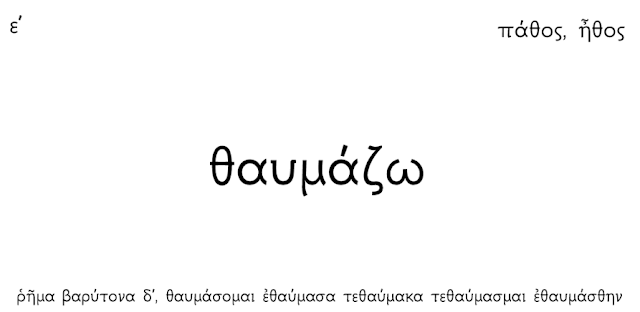
On the other side is the lexical form of the Greek word along with additional information about the word:


The top line notes the chapter in which the word appears in our course textbook and identifies the word's semantic domain category (τάξις), in this case πάθος, ἦθος. The bottom line provides details about the word's grammatical form, beginning with its part of speech (μέρος λόγου), in this case ῥῆμα. Verbs are classified into their ancient Greek verbal pattern (συζυγία), e.g., βαρύτονα δ'. Principal parts are also included for about 100 verbs.

The format for nouns is similar. Here, for instance, is an ἄμαξα: 

On the back of the card, the bottom line informs you that the word is a feminine noun in the first declension declined with η, and that the genitive singular form is ἁμάξης: 


There is no English on the cards because our goal is reading fluency in Greek. Bypassing English wherever possible and avoiding the habit of mentally translating as one reads speeds up the reading (and language learning) process.

The 500 words include classroom vocabulary, common semantic domains such as animals, fruits and vegetables — θρίδαξ anyone? — as well as words that appear in the Italian version of Ἀθήναζε, our main textbook. 

My colleague, Wes Olmstead, is responsible for coming up with authentic ancient Greek ways of categorizing Greek grammatical forms, for carefully tagging the grammatical information that appears on the back of the cards, and for compiling an initial list of words for our students to learn. 

My job was to find useable images that suit the words, to set up the mail merge process, and to produce the finished product:
Printing, cutting, and sorting multiple sets of 500 cards is a bit of a massive undertaking (even with the whole family involved), so I was relieved to find that — thanks to my work with Hebrew picture flashcards earlier this summer — the process of importing the Excel file and images into a digital version of the flashcards went smoothly:


Anki's spaced-repetition flashcard app has several advantages to printed cards, not least of which is the ability to make them freely available online.
  • The full set of cards is too large for Anki's free hosting service, but I have uploaded a sample, which should appear presently. Try searching for "Ancient Greek Picture Flashcards." 
  • The full decks, Briercrest Ἀθήναζε and Briercrest Ἀθήναζε Reversed, are hosted on my Google Drive account. You can download them here. 
  • See this post for more information about Anki, and basic instructions about installing and using the decks: https://gervatoshav.blogspot.com/2023/06/using-anki-to-review-biblical-hebrew.html 
Production notes:
Comments and feedback are welcome.

Saturday, June 24, 2023

Biblical Hebrew Picture Flashcards in Anki

Update: See links to the corrected Flashcard files below.

Last summer I made a set of 270 Biblical Hebrew picture flashcards for our introductory Hebrew students:


The images help create a direct link between Hebrew words and their meaning. There is no English on the cards because our goal is reading fluency in Hebrew. Bypassing English wherever possible — and avoiding the habit of mentally translating as one reads — speeds up the reading (and language learning) process. 

The cards are designed to be accessible to beginners and still useful to more advanced students. Students who have learned the alphabet can practice reading words they have already been introduced to in class, and ignore the smaller print around the borders of the cards. Some cards appear twice, first in the participle / qotel form (the normal Biblical Hebrew way of conveying present time):


After the qatal / perfect form has been introduced in class, the same picture can be reintroduced with the standard dictionary form and more grammatical information in small print:


In the top right corner, we learn that the word is a verb (פֹּעַל) that occurs in the Qal Binyan (קַל) and belongs to a class of weak verbs with an aleph in the first root letter (פ׳א). 

The bottom right corner draws on the method Randall Buth uses in his 500 Friends Hebrew word list to indicate succinctly what the verb looks like in a variety of verb patterns. (If you have studied Hebrew, you will see what I mean.)

The bottom left corner classifies the word in one of several semantic domains—in this case, food (מַאֲכָל). 

The cards can, of course, be sorted and reviewed in categories (e.g., all words in the piel Binyan or all words in a particular semantic domain).
 

Noun cards are similar:

In the top right corner we learn that the word is a feminine (נְקֵבָה) noun (שֵׁם עֶצֶם). The bottom right corner provides singular and plural absolute and construct noun forms.

Now that the school year is over, I have had time to complete a digital version of the flashcards for use in Anki's spaced repetition flashcard app. Here is an example:

The back looks like this:


Among other benefits, the digital version makes it far easier to sort and review specific kinds of cards. The digital version also makes it possible for me to share the cards freely online. You can download them here:


Update: This post now links to a corrected version of the Anki Flashcard files. (Due to an error in my Excel spreadsheet, the tags on the original card decks were misaligned; the image filenames have also been simplified in this version.)

In this follow-up post I provide a brief set of instructions for those who are new to Anki: https://gervatoshav.blogspot.com/2023/06/using-anki-to-review-biblical-hebrew.html


Saturday, March 18, 2023

Briercrest's Fall 2023 Ancient Greek Semester

I am pleased to report that we will be running our third immersive Greek semester this coming fall on the Briercrest College & Seminary campus. As I wrote last time,

Our intensive series of five three credit-hour courses is designed to take students from the Greek alphabet to a reading knowledge of ancient Greek, including the Koiné Greek of the New Testament. In our immersive classroom context on the Briercrest College & Seminary campus, students have the opportunity to learn ancient Greek in ancient Greek, as they would any modern language. Because it is geared to the way people naturally learn languages, an active communicative approach to learning Greek leads to deeper and longer-lasting learning than the conventional grammar-translation approach used in most North American academic settings; it also appeals to a wider range of learning styles (and is more fun!) 

As far as I know, our immersive, semester-long approach to teaching Ancient Greek in Ancient Greek is unique in North America. (For more detail, see this post and follow the links.)

Our Immersive Greek Semesters run every second year. Almost four years after the first iteration, we have begun to see the payoff:

  • There's the graduating student who took Greek Semester 1.0 in the fall of 2019, who tells me she still regularly reads her Greek New Testament.

  • Six students from Greek Semester 2.0 (fall 2021) elected to read through the Greek text of Acts last semester as part of their course requirements in my English-Bible Acts class. I sat down with each student twice during the semester to have a conversation in Ancient Greek about selected passages from Acts. None of us would claim fluency, but I was uniformly impressed at how much they understood from the text of Acts and how well they could make themselves understood in Greek.

  • I am currently sitting in on my colleague Wes Olmstead's Greek VII course, partly to see how he runs advanced classes, and partly because I wanted to read the extrabiblical texts he assigned. So far this semester, the seven students in the class have read Galatians, they are about halfway through Matthew's Gospel, we recently finished Plato's Apology--a text I had never read before in Greek--and we have started on Melito of Sardis's 2nd century Easter homily, Peri Pascha, a text I'm afraid I was totally unfamiliar with. Need I mention that the class is taught in Greek? 

In short, it's working. Care to join us? 

Thursday, June 3, 2021

Koiné Greek Immersive Semester 2.0

This fall Briercrest College and Seminary will be offering its innovative immersive Greek semester for a second time, and there is still room for a few more students in the class.

Our intensive series of five three credit-hour courses is designed to take students from the Greek alphabet to an introductory / intermediate* reading knowledge of ancient Greek, including the Koiné Greek of the New Testament. In our immersive classroom context on the Briercrest College & Seminary campus, students will have the opportunity to learn ancient Greek in ancient Greek, as they would any modern language. Because it is geared to the way people naturally learn languages, an active communicative approach to Koiné Greek leads to deeper and longer-lasting learning than the conventional grammar-translation approach used in most North American academic settings; it also appeals to a wider range of learning styles (and is more fun!)

So if you want:
  • To begin to develop actual fluency in ancient Greek,
  • To read Koiné Greek with better comprehension than you would after a conventional grammar translation course of the same length,
  • And you want to complete a two-year Greek language requirement in one semester,
Then the program might be for you!

The immersive semester will run in-person five days a week throughout the 15-week fall semester, so you will need to relocate to our Canadian campus in order to participate. 

For more information, see the course descriptions (here), as well as my posts about the first immersive semester:

Sunday, November 1, 2020

On Learning Biblical Hebrew as a Living Language

After a week to catch our breath, term two of Briercrest College's modified fall semester begins tomorrow. For me and my students this means a full semester of Introductory Hebrew compressed into 6.5 weeks. Because I want to reserve class time for Hebrew learning, I made a short video to explain in advance why we are going to study a “dead” language like Hebrew as one would a living language:


I am reproducing the first part of what I say in the video, for those like me, who prefer reading to watching:

This course takes a “Living Language” approach to learning Biblical Hebrew. Among other things, this means the course will be conducted, as far as possible, in Biblical Hebrew. You are going to spend a lot of time in this class listening to Biblical Hebrew. You will be learning to speak Biblical Hebrew as well as to read and write Biblical Hebrew.

This is different from how Biblical Hebrew has traditionally been taught in North America. In a traditional language classroom you would spend most of your time in class listening to your teacher talk about Hebrew in English. Homework would consist of painfully trying to memorize English glosses for Hebrew words, and translating Hebrew sentences into English.

Now, the goal of any Introductory Biblical Hebrew course is to help students learn to read and understand an ancient text. The traditional approach takes for granted that the easiest, quickest way to learn to read Hebrew is to focus on grammar and translation. There are no native Biblical Hebrew speakers. You don't need to know how to buy food in the market or how to hire a taxi in Biblical Hebrew. Why bother making the extra effort to speak Hebrew? Why emphasize hearing when all you really need to do is read letters on a page? 

But if your goal is to internalize the language so that you can read with understanding, and if you want long-term retention—not just passing a test, but being able to continue to read 10 years down the road—the traditional approach turns out to be neither efficient nor particularly effective.

For one thing, I can say from experience that memorizing lists of vocabulary words is very time consuming ... and doesn't work very well. More importantly, the preoccupation with translation—as if Hebrew must be turned into English to be understood—actually gets in the way of internalizing the language.

For more detail, as well as a few comments about what motivates me to teach Hebrew, you will need to watch the video itself. It's only five minutes long. 

I have never taught Biblical Hebrew using a fully communicative approach before, and the pressure to prepare for daily classes will be intense. But I am grateful to be able to ply my trade in a context where face-to-face teaching is still an option, even if it means I need to learn how to say ‘put on your masks’* in Biblical Hebrew.

*I've settled on עֲטוּ עַל־פְּנֵיכֶם, which uses Leviticus 13:45 as a model. My thanks to Aaron Eby for the suggestion.

Tuesday, August 18, 2020

On Relearning Aramaic via Syriac

I will leave communication about Briercrest’s plans for on-campus course delivery this fall to official channels, and say only that if I knew what was coming, studying Syriac and Targumic Aramaic during parts of May and June would not have made it onto my summer agenda. But last September, when I agreed to supervise a student’s Aramaic independent study, I thought it would be fun to take yet another stab at learning this third biblical language. Since we both had had some previous exposure to biblical Aramaic, I proposed a more oblique approach that would, I hoped, be more successful than my two previous attempts. 

Instead of using Frederick Greenspahn’s conventional Introduction to Aramaic textbook, which I have worked through twice before, we spent the first three weeks or so listening to the recordings in Niek Arentsen and Jordash Kiffiak’s Living Christian Aramaic (Syriac), and the next four completing the exercises and readings in Thomas Lambdin & John Huehnergard’s free online Introduction to the Aramaic of Targum Onqelos. 

Living Christian Aramaic appears to use the same pictures as the Biblical Language Center's other picture lessons products, and it is equally effective. I'll admit that I found the recordings--authentic as they may be--a little grating, but I can still hear  in my head. 

If you have worked with Lambdin's Introduction to Biblical Hebrew, you know what to expect from Lambdin & Huehnergard's Aramaic primer: bare-bones grammar notes, paradigms, and exercises in classic grammar-translation style. About a dozen chapters in the pace seems to pick up. The second half of the book introduces a dizzying array of new paradigms too fast to assimilate. Although I don't like the approach, I found the written exercises--even adding vowel pointing--to be effective and well-designed. The book ends with the text of Targum Onqelos on Genesis 12-16. If you have done the exercises, you can read the Targum. 

Despite major differences between these two language streams, beginning with oral Syriac helped me secure some of the vocabulary and basic syntactical patterns of Targumic Aramaic, and Targumic Aramaic is, in turn, quite close to the Biblical Aramaic of Daniel. As a bonus, I felt comfortable making my way through Targum Onqelos and confident that I could do the same with other Aramaic Targumim--at least when I finished the book. Once I relearn the Estrangelo Syriac script, I should be able to at least dabble in the Syriac Peshitta versions of both Old and New Testaments. Learning a completely foreign script also helped me appreciate what it must be like for my students to learn the Hebrew alphabet!

I will probably agree to supervise another Aramaic independent study in the future, should the opportunity arise, because I confess I am not doing the one thing needed to retain Aramaic, which is to use it. If I may be allowed an excuse, Aramaic has been crowded out by Hebrew. More on that, perhaps, in another post.

Sunday, May 24, 2020

Reflections on Teaching Ancient Greek as a Living Language 3: Endnotes

Back in January I posted an initial report on Briercrest’s first Intensive Koiné Greek Semester: five immersive courses in a 15-week fall semester, beginning from scratch and culminating in the Greek text of the Gospel of Mark. As I mentioned in that post, the semester was distinguished by its intensive five-days-a-week format and by our approach to teaching Ancient Greek in Ancient Greek as a living language.

Here at last is a follow-up post with a little more detail about what we did in class, our influences, and the resources we used.


The Classroom

The Intensive Semester would not have succeeded the way it did without the outstanding contribution of our three student interns. With five co-teachers, we were able to give attention to each student in a class of about 25 students, and to provide much more active and more engaging learning experiences than we would otherwise have been able to do. In addition to active instruction, role-playing, and “Total Physical Response” exercises from the front of the class, we were able to break into stations with different teachers leading different activities (including WAYK), and to work together in table groups with a different teacher assigned to each table each day. Five co-teachers also meant that we could share tutorial responsibilities in the afternoons after a full morning of class.

About half the class had already taken a semester-based version of the first two courses the previous year, and sat in on the first six weeks for review. Their enthusiasm and basic familiarity with the language helped the brand new students get up to speed.

Influences

Other contributions were less obvious to students, but no less important. The field of active ancient Greek language instruction is changing so rapidly it might not have been possible to offer an intensive semester of Ancient Greek by immersion ten years ago. In any case, we could not have pulled it off without help from others under whom we have studied and whose recently-developed resources we employed.

My colleague, Wes Olmstead, who both organized the Greek semester and shouldered most of the teaching and lesson planning, spent much of the summer of 2019 learning under Christophe Rico at Polis Institute courses in the United States.

In an earlier post I mentioned attending one of the Biblical Language Center's Greek Fluency Workshops in the summer of 2012. Almost a decade later, I can see the formative impact of these workshops (2011-2013) on the growing movement of people involved in living Greek language instruction. The teachers the summer I attended included Randall Buth, Jordash Kiffiak and Ben Kantor. (BLC's plans to restart the workshops in 2020 have moved online, which may make them more accessible. Highly recommended!)

Bryn Olmstead picked up the idea of Greek fluency and ran with it farther than I imagined possible. Although Bryn and Felicia were not physically present to help teach the course, they did a tremendous amount of work behind the scenes throughout the semester, most notably by preparing incredibly effective Keynote slides. Bryn informs me that their contribution was heavily indebted to his teacher, Gonzalo Jerez Sánchez: “Much of what we produced is simply creative adaptation of what we learned from him for your particular situation at Briercrest.”

Resources

It is no coincidence that several of our influences reappear as authors and creators of resources we used.

Much of Koiné Greek I, the first course in the series, was built around:
(1) The Biblical Language Center’s Living Koiné Greek: Foundations “Picture Lessons.”
(2) Jordash Kiffiak's Omilein videos and a pre-publication draft of his workbook, which is designed to be used alongside the BLC “Picture Lessons.”
In my view, Jordash’s ΟΜΙΛΕΙΝ curriculum, with its blend of high-quality TPR videos and a lavishly-illustrated workbook, is currently the best beginning Greek resource available for those who want to lead students through the equivalent of a first semester of Greek using a communicative approach. Jordash now offers online courses through his own ΟΜΙΛΕΙΝ website.
In Koiné Greek II-IV we combined Christophe Rico’s Polis curriculum with the Italian version of the classical Greek textbook, Athenaze:
(3) Christophe Rico, Polis: Speaking Ancient Greek as a Living Language, Level One (Polis Institute Press, 2015).
(4) Balme, Maurice, Gilbert Lawall, Luigi Miraglia, and Tommaso Francesco Bórri. Athenaze: Introduzione al greco antico. Parte I. 2d ed. Montella, Avellino: Accademia Vivarium Novum, 2018. (Why the Italian Athenaze you ask? Consider these answers.)
(5) We also used audio resources produced by Gonzalo Jerez Sánchez of Classics at Home.
(6) As an additional source of comprehensible input in class, we dipped into Seumas MacDonald’s Lingua Graeca per se Illustrata (LGPSI), which provided the inspiration for the map at the beginning of this post.
In these three courses (Koiné Greek II-IV), we made it through chapter 15 of Athenaze, all of Polis Level One, and part of a pre-publication draft of Polis 2.

Our task in Koiné Greek V was to read and talk about the Gospel of Mark in Greek.
(7) Ben Kantor's excellent Koiné Greek Gospel of Mark video was a tremendous help:

By the end of the semester, I had the repeated experience of sitting around a table with students who were helping me explain the Greek text of Mark to each other in Greek. What more could you ask for?

(Note: This is the third in a series of posts on last fall’s Intensive Greek Semester. You can read the first two here and here.)