Showing posts with label Historical Criticism. Show all posts

Friday, March 30, 2018

A Gadamer Cake

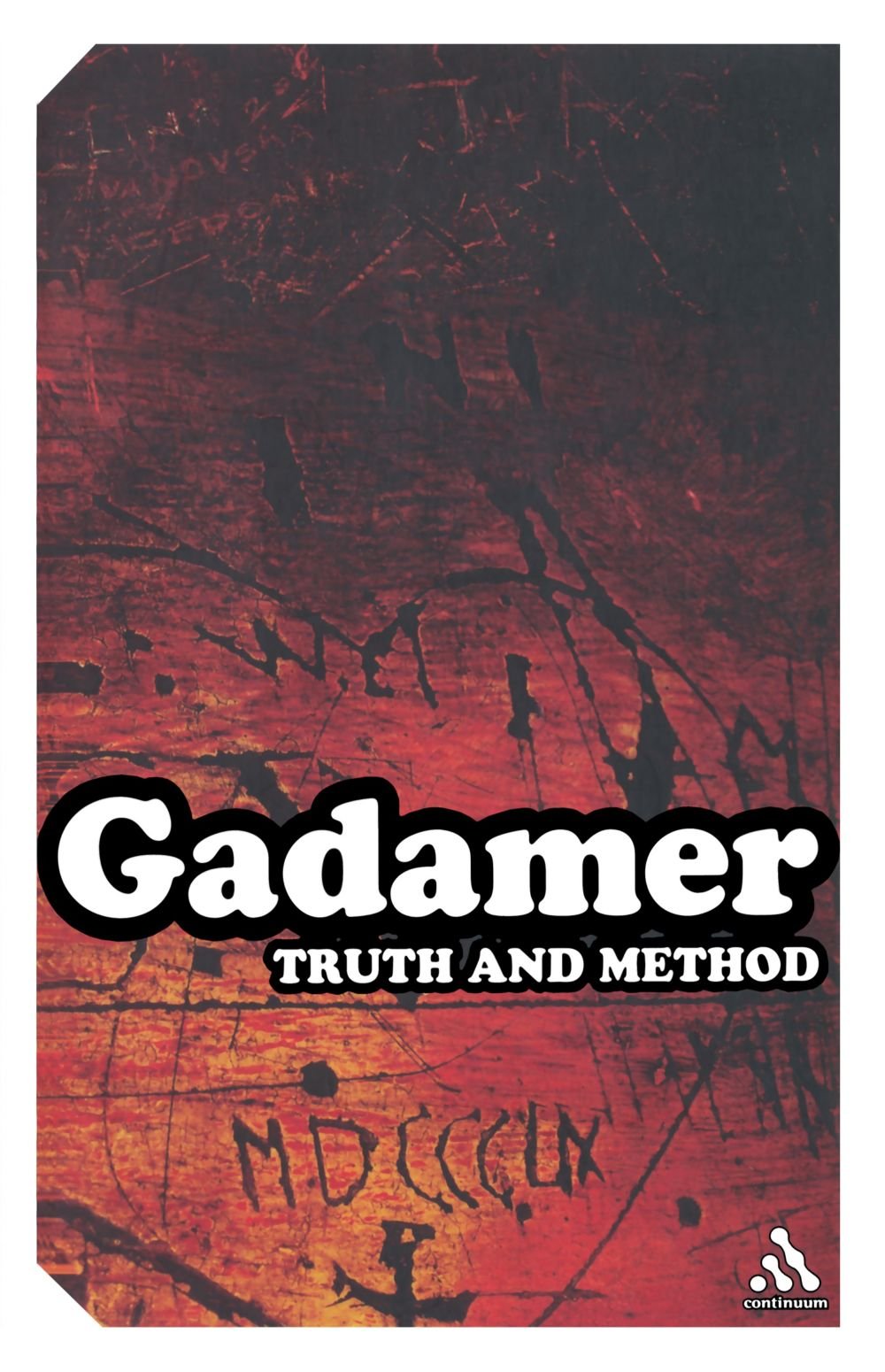
I began Hans-Georg Gadamer's Truth and Method in 2008, read a little over 100 pages, and stopped (evidence: here, here and here). The tome languished in my personal library graveyard for unfinished books until this January, when I picked it up again. Completing the final 450 pages almost a decade later feels like an accomplishment worth celebrating. t. suggested a cake, and the conversation quickly turned to what a Gadamer Cake would be like: Dense, I said, and layered. No, not a fruit-cake. It's more substantial than that. It has to be taken in small servings, and it really does a number on your system.

The translator's preface puts it this way: "The book is powerful, exciting, but undeniably difficult. Published when Gadamer was sixty, it gathers the ripe fruit of a lifetime's reading, teaching and thinking."

The book must have been healthy too--Gadamer was born in 1900 and died in 2002. What follows is an excerpt from the 25-page Afterward, first published in 1986 with Gadamer's collected works. This dessert course warns of the dangers of a "scientific" over-reach that forgets its and humanity's own epistemic limits:
"In a time when science penetrates further and further into social practice, science can fulfill its social function only when it acknowledges its own limits and the conditions placed on its freedom to maneuver. Philosophy must make this clear to an age credulous about science to the point of superstition." (556)
The same goes for the social sciences:
"However uncertain are the factual bases on which rational management of social life might be possible, a will to believe impels the social sciences onward and drives them far beyond their limits." (557)
I recall an atheist Canadian New Testament scholar who, rather too conveniently, dismissed hermeneutics as in effect a cover for "theological obscurantism." I expect a similar approach is common to the scientism of the new atheists. Gadamer responds that such a dogmatic refusal to consider the limits of the scientific method is irrational:
"A philosophy of the sciences that understands itself as a theory of scientific method and dismisses any inquiry that cannot be meaningfully characterized as a process of trial and error does not recognize that by this very criterion it is itself outside science. ... By raising 'critical rationality' to the status of an absolute measure of truth, empirical theory of science regards hermeneutic reflection as theological obscurantism. ... What is remarkable is that, for the sake of rationality, theory of science here abandons itself to complete irrationality .... It fails to recognize that it is itself complicit with a much more fatal immunization against experience--for example, against that of common sense and the experience one gains in living. It always does so when it promotes the uncritical expansion of scientific management beyond specific contexts--for example, when it assigns responsibility for political decisions to experts." (558-9)
Quotations are from the second revised edition: Hans-Georg Gadamer, Truth and Method (London: Continuum, 2004).

Friday, December 16, 2016

Jerome Murphy O'Connor on Taking Statements as Questions

"The more conscious I became of the way theological thought actually develops--by historically conditioned insights rather than by logical deduction from a deposit of faith--the more I wanted to encounter the personality behind the letters [of Paul], and to determine the factors which led him to think in a particular way. This book contains the fruits of that quest, which are displayed with a certitude that all historians will recognize as spurious. Only definiteness, however, can provoke the reactions that in dialogue lead to progress. I make my own what J.A.T. Robinson said in the conclusion to a much more challenging work, 'all the statements of this book should be taken as questions.'" - Jerome Murphy-O'Connor, Paul: A Critical Life (Oxford, 1997), v.

The J.A.T. Robinson reference is to Redating the New Testament (London: SCM, 1976), 357.

Wednesday, September 7, 2011

C.E.B Cranfield on the writing of commentaries, the history of interpretation, and long sentences

Take a deep breath, and then read the following sentence aloud:
"But to gain something more than an altogether superficial knowledge of the course of the tradition is to learn a deep respect and affection for, and gratitude to, those who have laboured in the field before one, irrespective of the barriers between different confessions, theological and critical viewpoints, nations and epochs; to learn to admire the engagement with Paul's thought of some of the greatest minds from the third to the twentieth century, but also to be humbled by the discover that even the weakest and least perceptive have from time to time something worth while to contribute; to learn that it is naïve to imagine that old commentaries are simply superseded by new ones, since, even the good commentator, while he will have some new insights of his own and will be able to correct some errors and make good some deficiencies of the past, will also have his own particular blind spots and will see less clearly, or even miss altogether, some things which some one before him has seen clearly; and, above all, to learn that all commentators (including those who in the next few pages will be most highly praised and also--and this is perhaps the most difficult lesson for any commentator to grasp--oneself) have feet of clay, and that therefore both slavish deference to any of them and also presumptuous self-confidence must alike be eschewed." - C.E.B. Cranfield, Romans 1.31-32.
Breathe.

(Brilliant stuff, really.)

Sunday, July 3, 2011

What was old is new again: Richard Bauckham and Hugo Grotius on the Raising of Lazarus

One of the intriguing proposals in Richard Bauckham's Jesus and the Eyewitnesses explains why the resurrection of Lazarus in John 11 is ignored by the earlier Evangelists, Matthew, Mark and Luke:
"Lazarus could not have been protected in the early period of the Jerusalem church's life by telling his story but not naming him. His story was too well known locally not to be easily identifiable as his however it was told. For Lazarus 'protective anonymity' had to take the form of his total absence from the story as it was publicly told. . . . If the raising of Lazarus was not only the remarkable event that John portrays but also such a key event in leading to Jesus' death, its absence from Mark -- and so, presumably, from the pre-Markan passion narrative -- is certainly puzzling. But the difficulty is removed when we recognize that the need for 'protective anonymity' in Lazarus's case would require his complete absence from any public telling of the passion narrative in the early Jerusalem church" - Richard Bauckham, Jesus and the Eyewitnesses: The Gospels as Eyewitness Testimony (Eerdmans, 2006), 196. 
The solution, it turns out, is not completely novel. According to William Baird, it was advanced at least as early as the 17th century, by Hugo Grotius (1583-1645), and subsequently adopted by others:
"As to the reason the other evangelists neglected to record the raising of Lazarus, Grotius adopts the hypothesis--popular with later apologetic exegetes--that Matthew, Mark, and Luke wanted to protect Lazarus and his family from the wrath of the high priests (12:10) and, therefore, kept the story secret. Years later, after their Gospels were written and the danger had passed, John was able safely to recount the miraculous event." - William Baird, History of New Testement Research, Vol. 1: From Deism to Tübingen (Minneapolis: Fortress, 1992), 11.
Since Bauckham does not cite Grotius--or anyone else--in this regard, he may have come across the same solution independently. (After all, great minds think alike.) But Bauckham has a monograph on 16th century English apocalyptic thought, and he may have encountered Grotius in this connection.

Thursday, June 9, 2011

Hoskyns & Davey on Criteria for the Study of the Historical Jesus

Perhaps this just shows just how little I know about 1930's historical Jesus scholarship, but these final two quotes from Hoskyns and Davey strike me as another instance of being ahead of their time.

This one reminds me of the reasonable insistence by recent scholars that one's reconstruction of the historical Jesus must be able to explain the existence of the church:
The life of Jesus "must be described in such a manner that the emergence of the primitive church is also intelligible on the basis of the life and death of Jesus of Nazareth. For any historical reconsturction which leaves an unbridgeable gulf between the faith of the primitive church and the historical Jesus must be both inadequate and uncritical: inadequate, because it leaves the origin of the church unexplained; and uncritical, because a critical sifting of the evidence of the New Testament points towards the life and death of Jesus as the groudn of primitive Christian faith, and points in no other direction." (170)
Their concern for the big picture reminds me of N.T. Wright:
"An historical reconstruction is possible only when the uniform nature of the whole material at our disposal is perceived, so that each fragment is seen not only to be part of the whole, but to contain the whole; or, to put it differently, so that each fragment of it not only rests upon a common background, but expresses it. To lay bare this uniform nature, this background, is to discover the Jesus of history" (172).

Wednesday, June 8, 2011

More from Hoskyns & Davey on Historical Criticism

Stephen Neill commented that Hoskyns and Davey's The Riddle of the New Testament (3rd ed.; London: Faber & Faber, 1947) "has great and abiding value" because "[i]t puts in clear form almost all the problems which have to be dealt with in the interpretation of the New Testament" (219). Judge for yourself:

On the assured results of historical criticism: "The progress of critical historical investigation of the New Testament cannot be compared to a gradual mounting the steps of a ladder. One generation does not achieve a number of results which pass into the text-books, so that the next generation is enabled to mount a few steps higher. Rather, as each advance is made, the problem as a whole begins to look different; and the 'assured results' of the previous generation require constant reconsideration when seen in a new perspective. This does not, of course, mean that the modern critic stands aloof from the older criticism. He is completely dependent upon the work of his predecessors. But, where they supposed that they had reached definite and final conclusions, he sees new problems; and the older conclusions appear in their new context almost irrelevant, and, at times, trivial" (11-12).

History and Christian theology: "The historian of primitive Christianity is a mere hewer of wood and drawer of water; it is his function to act as the slave of the theologian or of the philosopher, as the slave also of the simple believer or of the equally simple unbeliever...The historian has therefore to make clear and accessible the material which has shown such remarkable ability to galvanize thought and faith and unbelief. The historian, then, is neither an apologist for the Christian religion nor an apostle of irreligion; still less is he an interpreter of the New Testament in terms of modern thought" (171).

History and faith: "The whole spiritual and moral power of the primitive church rested ultimately, not upon a mystical experience, but upon its belief that what Jesus had asserted to have been the purpose of his life and death was in very truth the purpose of God. Further than this the historian dare not and cannot go. On the basis of a purely critical examination of the New Testament documents he can reconstruct a clear historical figure, which is an intelligible figure; and he can, as a result of this reconstruction, show that the emergence of the primitive church is also intelligible" (177).


Monday, June 6, 2011

The Riddle of the New Testament

I first encountered Sir Edwyn Hoskyns in Stephen Neill's fantastic history of The Interpretation of the New Testament, and have been intrigued by Hoskyns and Davey's The Riddle of the New Testament (3rd ed.; London: Faber & Faber, 1947) ever since reading Markus Bockmuehl's Seeing the Word. Neill calls it "a series of hammer blows, at what . . .was a widespread understanding of the gospels" (215). It is that, but it is also a series of hammer blows against theological liberalism, for, as Neill explains,  "[T]he most important thing of all about Hoskyns was that, like Karl Barth, he was a converted liberal" (213).

As one would expect from a book first published in 1931, parts of The Riddle of the New Testament are rather dated. I find the authors a little too confident in the results of historical criticism. However, it is worth your time at least as much as C.F.D. Moule's Birth of the New Testament, and it is an easier (and shorter) read. In many respects it seems far ahead of its time. It is also a model of clarity, forceful argument, and verve. The whole book is written around the riddle of the relationship between Jesus and the church:
"There is a riddle in the New Testament. And it is a riddle neither of literary criticism, nor of date and authorship, nor of the historicity of this or that episode. The riddle is a theological riddle, which is insoluble apart from the solution of an historical problem. What was the relation between Jesus of Nazareth and the primitive Christian church? That is the riddle. The New Testament documents, all of them, emerged from the primitive church. They reflected piety and encouraged faith. Was there, or was there not, a strict relationship between this rich piety and exuberant faith and the historical figure of Jesus of Nazareth? Did the life and death of Jesus of Nazareth control the life of the primitive church? or were his life and death submerged by a piety and faith wholly beyond his horizon? . . . The adequacy of the modern historical critical method is therefore finally tested by its success or failure in answering the problem of the Jesus of history. The authors of this book are confident that the critical method does survive this very severe test, and that it does disclose results, even assured results..." (12).
Hoskyn's and Davey's answer is, in a word, Yes. The life and death of Jesus controlled the life of the primitive church:
"No single strand in the evidence deprives Jesus of the conscious sense that he was bringing into being a new order and working out a purpose . . . . Nowhere in the New Testament are the writers imposing an interpretation upon a history. The history contains the purpose, and is indeed controlled by it. That is to say, the historian is dealing in the end with an historical figure fully conscious of a task which had to be done, and fully conscious also that the only future which mattered for men and women depended upon the completion of his task. The future order, which it was the purpose of Jesus to bring into being, depended upon what he said and did, and finally upon his death." (172)
I, for one, find their answer compelling.

Monday, May 9, 2011

Hoskyns & Davey on historical criticism as a necessity for Christian faith

"[T]he Christian religion is not merely open to historical investigation, but demands it, and its piety depends upon it. Inadequate or false reconstruction of the history of Jesus of Nazareth cuts at the heart of Christianity. The critical and historical study of the New Testament is therefore the prime activity of the church." - The Riddle of the New Testament (3rd ed.; London: Faber & Faber, 1947), 10.

Monday, February 28, 2011

Academic Freedom and Teaching in a Christian Post-Secondary Context

Blog posts are always work in progress: In my previous post I was thinking exclusively of research, academic writing, and intellectual environment. I should add that there are all sorts of factors that affect what I say in class (and, to some extent, what I post on my blog). The most important of these are students and the school's mission. According to Briercrest's home page,
Briercrest College and Seminary is a community of rigorous learning that calls students to seek the kingdom of God, to be shaped profoundly by the Scriptures, and to be formed spiritually and intellectually for lives of service.
I aim to help my students cultivate a robust faith that combines the kind of critical thinking that a university is supposed to strive for, and a responsiveness to God that is at the heart of the Christian tradition. The point is not to tear down--much less to be "an incubator of evil"--but to build up. As Thomas H. Benton (aka William Pannapacker) put it not too long ago, to steer "students away from self-gratification, materialism, and worldly ambition toward a purity of purpose sustained by cultivation of the intellect, discipline, and cheerful self-denial."

It is common, I think, for first year university students to be more interested in answers than in learning to think through questions. A Christian context adds an additional twist in that some students suppose that critical thinking and spiritual formation are opposed to each other. Questions can be threatening. If I can't wed the two or demonstrate the practical relevance of what I am teaching, I risk losing my students.

So because I want to begin by reaching my students where they are at, and because there is a positive goal of contributing to students' formation, there are limits on a say-whatever-you-like version of academic freedom. But, again, it is a voluntary restriction and, arguably, richer for having a shared purpose. And, of course, there are similar restrictions on the academic freedom of "secular" university teachers. In a non-confessional university context, for example, I would not have the same freedom to talk openly about the practical significance, for Christians, of Christian Scripture, or to discuss how one can live Christianly with the difficult questions that academic study sometimes raises.

Monday, February 21, 2011

Responding to Bart Ehrman

Misquoting Jesus: The Story Behind Who Changed the Bible and Why (Plus)Since Misquoting Jesus, at least, bestselling author Bart Ehrman has framed his popular-level books around his own journey from fundamentalism to agnosticism. The narrative implies that agreeing with Ehrman's arguments will lead naturally to the abandonment of one's faith. It is no wonder, then, that Ehrman is public enemy #1 for some evangelical apologists. He even gets free publicity in the form of a website, the Ehrman Project, that is dedicated to refuting him.

In his critical review of the Ehrman Project, Bob Cargill points out that "most of Ehrman’s textual arguments are essentially the well-established and long-accepted consensus views of just about every worthwhile critical biblical scholar not teaching at a Christian university, seminary, or school with the word “Evangelical” in the title," and that "the criticism of Dr. Ehrman (and the larger academy by proxy) is largely being done by a small number of vocal scholars at very conservative seminaries at the behest of a campus minister and a religion major who didn’t like their faith challenged by critical scholarship."

I confess that I have not done more than look around at the Ehrman Project, but I suspect Cargill has a point. In the field of textual criticism, at least, Ehrman is a first-rate scholar whose methods are widely accepted across the theological spectrum. I would simply like to add that--in regards to textual criticism, at least--the theological spectrum includes evangelicals.

I've had a lot of respect for Ehrman's stature as a textual critic ever since Ehrman and his Orthodox Corruption of Scripture was mentioned positively in a graduate course in textual criticism that I took at Trinity Evangelical Divinity School. I regularly require my Greek Exegesis students to read an essay by Ehrman that I regard as an excellent introduction to textual criticism. I read Misquoting Jesus when it first came out and, though I disagreed with some of his examples, I was impressed by how conventional most of the content was. The only (?) really sensational bit was the anti-Christian autobiographical spin. Far from prompting me to question my faith, however, Ehrman's anti-testimony struck me as a sad parable about the dangers of a view of Scripture so narrow and rigid that it is unable to handle the evidence about the transmission of the biblical text.

It seems to me that the best response to a scholar like Ehrman is not to attempt to marginalize or denigrate his scholarship but to counter the story by showing that the practice of textual criticism need not threaten one's faith. The scholars involved in the Evangelical Textual Criticism blog do an excellent job on this score.

Note that since the only popular level work by Ehrman that I have read is Misquoting Jesus, my comments only relate to what Ehrman has to say about textual criticism.

Thursday, December 2, 2010

Keck on the Agony of Theological Education

"One reason a modern theological education brings so much agony to the students is that they find the ramparts of faith on which they thought they were standing to be really the ruins of Christendom, and that the gospel actually summons them to a radical kind of faith for which they are scarcely prepared. They are in agony because no one has told them that believing and preaching the gospel in a world without Christendom means literally risking their lives. None of the things they had taken for granted, such as the authority of the Bible, the absoluteness of the gospel, the meaning of Jesus, and the work of the church can be taken for granted today, but must be avowed as decisions of faith. Students are pained because, in our day, learning more about the Bible, theology, Jesus, and the church does not make it easier for them to believe, but actually defines the borderline on which they must be willing to make a commitment in faith." - Leander Keck, Mandate to Witness: Studies in the Book of Acts (Judson Press, 1964), 107.

Tuesday, July 6, 2010

Scot McKnight on the Historians' Jesuses and the Church's Jesus

In a recent follow-up to his Christianity Today article announcing the end of an era of historical Jesus scholarship, Scot McKnight clarifies his point:
So one more time: I am calling into question the theological value of the historical Jesus enterprise. I am not calling into question the value of historical work. . . . But the historical Jesus enterprise is a different kettle of fish, and it is all I was saying: the historical Jesus enterprise has one major goal: to separate the real Jesus from the Church's beliefs about Jesus and to reconstruct what the real Jesus was really like, in spite of what the Church has always believed. To do this, it pronounces on what is historical or authentic and it then dismisses that which is determined inauthentic and then, with the evidence that survives the scrutiny, reconstructs what Jesus was really like. . . . My article was an attempt to argue against the historical Jesus enterprise, not an argument against doing history or the value of history when it comes to our knowledge about Jesus. The Church has a Jesus; it is found in the apostolic witness to Jesus in the Four Gospels. That is the Jesus upon whom we need to focus. The Jesus(es) of the historical Jesus enterprise are here today and gone tomorrow, and the next generation will find another Jesus and so on and on forever and ever. I've got shelves and shelves of such books ... and most people don't know the names nor care about the ideas of those scholarly proposals of what Jesus was really like (for them, in their time). The question is this: Which Jesus will we choose? The Church's Jesus or the historian's Jesus?

I'm on board with McKnight's main concern (clarified still further in comment 20). He is right to criticize the anti-church bias of the historical Jesus enterprise. I fully agree that the Gospels have theological priority over any historical reconstruction that accepts part of the Jesus tradition and rejects others. But the way McKnight concluded his post made me wonder about the opposition he draws between the constructions of historians and the singular Church's Jesus, so I asked (comment 16):
. . . Can't part of your argument against historical Jesus study be applied to any text that requires interpretation? Let's take the book of James, for example. Scholars argue that the text does not mean what it seems, the next generation advances new and quite different interpretations, commentaries replace commentaries, and the laity throw up their hands in despair: If even the experts disagree, how can we hope to interpret it for ourselves? I think this plurality is an unfortunate, but necessary implication of serious study (and it doesn't necessarily lead to despair). Every interpretation of the book of James is a construction; any attempt to say what James really meant will presumably find itself up against established tradition. As a good Protestant, I'm not offended when a convincing interpretation of the book of James overturns what the church has always believed about James. Just as the inevitable plurality of interpretations of James don't mean that we should call a halt to scholarly study of James, the inevitable plurality of interpretations of Jesus doesn't count against the Quest.

As a good Protestant, I'm not about to let a reconstruction of the historical Jesus replace the authority of the four canonical Gospels, but I think the incarnation requires historical study of Jesus, and that means facing the uncomfortable possibility that the results of one's historical investigation may not coincide with the Evangelists' portraits. Since it is required by the incarnation, historical study of Jesus is a priori theologically significant, but that doesn't make it a safe enterprise. To be sure, the canonical Gospels (the "church's Jesus") have theological priority, but I guess I'm not sure we are permitted to choose either the church's Jesus or the historians' reconstructions; each requires and is informed by the other.

Scot replied: "intense historical work on James that doesn't aim to find the "real" James behind the current letter is not analogous." (comment 18)

I think I agree, but my point--or, at least, the point that in retrospect I want to emphasize--is a little bit different. So let me try again: Interpretations of texts are as much constructions as are interpretations of historical figures. Without construction, there is no such thing as the Church's Jesus, there is only the individual portraits of the four Evangelists which must themselves be interpreted. This is because--although I agree with Richard Burridge that the Gospels present for us one recognizable Jesus--they don't all agree in all respects. Two examples:
  • According to Matthew, Mark and Luke, Jesus cleanses the Temple at the end of his ministry; in John the Temple cleansing occurs at the beginning.
  • According to Mark 11:7 Jesus sat on a colt; according to Matthew 21:7 Jesus apparently sat on both a donkey and its colt. (The TNIV and NASB conclude that the pronoun 'them' refers back to the garments, but the repetition of the pronoun and the connection with Zech 9:9 suggests that the animals are in view.)

There are ways to reconcile the differences, but any reconciliation is, by necessity, as much a construction as the approach that says one is authentic and one is not. McKnight's "Church's Jesus" is not, as he claims, the Jesus of the New Testament, but a Jesus that is constructed by harmonizing the four portraits of the four Evangelists. It is self-consciousness of reconstruction that points toward and partly legitimizes a form of the historical Jesus enterprise.

Sunday, May 2, 2010

Free Audiobook of Dale Allison's The Historical Christ and the Theological Jesus

I was running out of reading material last week, so I took the subway down to Crux Books*, and picked up a copy of Dale C. Allison Jr.'s The Historical Christ and the Theological Jesus (Grand Rapids: Eerdmans, 2009). I soon realized I had already listened to an audio version narrated by Allison himself. In the introduction, Allison explains "I wrote this book in preparation for the Kenneth W. Clark lectures, which I delivered at Duke University in February of 2008." The lectures were recorded, and are still available online here.

The book is short, and worth reading (or listening to) twice. Allison is one of my favourite New Testament scholars. I like his bracing honesty; I resonate with his "doubt seeking understanding," though I prefer to doubt less--or less confidently--than he does; and I admire the depth and breadth of his knowledge: I recall Allison saying once that he learns more from reading outside the guild of biblical studies than he does within it--but when he writes on a subject within biblical studies you can be sure he has read virtually all there is to read on it. In a Christianity Today cover article announcing the "death of latest historical Jesus studies as we know them," Scot McKnight refers to Allison as "the most knowledgeable New Testament scholar in the United States" (page 4). In his blurb on the back of Allison's book, McKnight says: "In the last 125 years there have been five truly epochal thinkers who altered the course of Jesus researcH: Martin Kähler, Albert Schweitzer, Rudolf Bultmann, Ernst Käsemann--and the fifth one is Dale Allison." High praise, though I'm puzzled that E.P. Sanders didn't make the cut.

If you read Allison, you should also listen to Richard Hays's recent response to N.T. Wright, which raises similar questions about the uneasy relationship between history and theology, but which places rather more emphasis on theology than on history as it is conventionally understood. 

____
*In case you are wondering what I am doing in the land of subways and Crux Books, I have spent the last week in Toronto hanging out with my dad, and visiting my mom in the hospital. Thankfully, there has been time to read and listen to a few Wheaton conference podcasts in evenings, during the daytime when Mom naps, and while traveling to and fro. My current goal is to complete book #4 on Tuesday's return flight.

Sunday, April 4, 2010

Historical Criticism and the Talmud

Two things strike me in the following quotation from Robert Goldenberg's outstanding introduction to the Talmud: (1) The issues raised by historical criticism of the Talmud are similar to the issues raised by historical criticism of the Bible; (2) Goldenberg's response is to shift the locus of meaning from authors to texts:

Modern scholars approach the Talmud seeking the answers to all sorts of questions--usually questions of their own devising--and they have developed techniques for working out more or less reliable answers to these questions. In earlier ages, the pious Jew normally approached this same text with one unchanging question in mind, a question itself received from the past: how does the God of Israel, the Creator of the Universe, want me to live? Questions of historical reliability, or of outside cultural influence, were in the long run irrelevant to this kind if inquiry.

Modern historical consciousness actually makes the traditional inquiry more difficult than ever. The new types of investigation are not simply "irrelevant" to such a quest, they impede it. How can the Talmud reveal the eternal word of God if it turns out to be the work of third- or fourth-century men living in the fading world of Near Eastern antiquity? How can questions of Jewish law be resolved from a text that may conceal scribal error on every line? These considerations help explain why modern, critical Talmud study was long resisted in traditional yeshivot and is still excluded from many of them. Historical relativity in general and text criticism in particular turn out to raise new religious issues, issues that earlier masters of the rabbinic tradition never had to face.

Nevertheless, Talmudic study has remained entirely unchanged in a very important respect, and will remain unchanged as long as people engage in it. the Talmud is a book put together by people who saw intellectual activity as sanctifying. They found holiness in their effort to bring rational order to their tradition, and as a result problem solving and disciplined logic became important characteristics of rabbinic discourse. . . . This relish for complicated but careful argument is entirely available to the modern reader, and is very much in keeping with modern tastes. In an important sense, it is immune from historical criticism, because it comes from the text of the Talmud, not from the particular individuals who once composed that text. And the text is still there.

Robert Goldenberg, “Talmud” in Barry W. Holtz, ed., Back To The Sources׃ Reading the Classic Jewish Texts (1984; repr. New York: Simon & Schuster, 1992), 165-6:

Sunday, March 21, 2010

A Hermeneutics of the Golden Rule

In class a couple weeks ago I said something about being "loving" historians. We were talking about the Pharisees, whose rather one-sided portrayal in the Gospels leads many Christians to view them as uniformly bad: They are the hypocrites who strain out a gnat and swallow a camel. They are the legalists. Preoccupied with the letter of the law, they lost touch with its spirit. Committed to piety and establishing their own righteousness they went home condemned by God. And so on.

If we want to approach the Pharisees historically, as real people, we have to acknowledge that they would not have regarded themselves as hypocrites. "Loving" history will seek to recover a view of the Pharisees that made sense to them. I suggested that the Pharisees, like most Second Temple Jews, would have regarded the Torah as God's gift, and their obedience as a response to God's gracious covenant with them. Along with most other Jews, they would have agreed that “the yoke of the commandments, and the yoke of the kingdom of heaven were not burdens but opportunities for the service of God” (Shaye Cohen, From The Maccabees To The Mishnah [Louisville: WJK, 2005], 70). 

But then, spurred on by this post, I got to thinking: Since love covers over a multitude of sins, what about the distortions that "love" brings? According to Albert Schweitzer, the greatest studies of the historical Jesus "are written with hate." While love believes all things, hate suspects all things, and it is suspicion that is the historian's stock-in-trade. Is it possible or good to write a "loving" history of Stalin or Hitler?  Does a hermeneutics of love preclude value judgements? Must we affirm with E.P. Sanders that, at the end of the day, first century Jews--high priests and Pharisees included--were really nice liberal protestants in disguise? (I exaggerate for effect.)

No, for at its best the practice of history is a game of the imagination in which scholars try to construct models that make the best sense of all the available data. Whether motivated by love or hate, our hypotheses can be brought up short by the evidence. One might object that neither "love" nor "hate" is relevant to the study of history since it doesn't matter how we feel, it matters only that we are fair. I agree.

But I am defining love as the golden rule: Especially in the case of religious traditions other than our own, we should depict the object of our study in terms with which its adherents would agree, just as we would like others to present our own views as we would defend them ourselves.

Saturday, September 19, 2009

Faith and History Déjà vu

According to April DeConick, "the MOST IMPORTANT discussion of my generation" is the question "whether we are willing or not to abandon our field to confessional claims to knowledge and truth in the post-modern age":
There is a big difference between confessional scholarship and its working assumptions and historical-critical scholarship and its working assumptions, and we must never confuse the two. . . . Confessional scholars are willing (some even feel compelled) to allow for the physical resurrection of Jesus to be historical fact. Of course it is not. Dead bodies don't come back to life. And Jesus' body did not come back to life. This is a theological doctrine that was historicized in the literature of the early believers. . . . [T]his is a very serious issue for our field, and now that post-modernism is gripping the academy, we see the abuse of philosophy in order to bolster the positions of confessional scholars who want to continue to make the argument that their theology (and their scripture) is history.
I confess to being puzzled why April thinks this is the "MOST IMPORTANT discussion" of her generation. I thought it was an important discussion in the 19th century--one that Albert Schweitzer believed had already been solved. Schweitzer was wrong. The debate continued because thoughtful modern scholars (not just apologetic post-modern wannabees) argued that the practice of history and theism can go together. Instead of recycling Schweitzer's arguments (or the ones he took for granted), it is surely worth examining the history of debate since Schweitzer to find out why his views have not carried the day.

For thoughtful contemporary responses to April's post, see this post by Mark Goodacre, and this one by Doug Chaplin. And here are a few links to my earlier posts on faith and historical criticism:

History, Criticism, and Christian Conviction - Part 1
History, Criticism, and Christian Conviction - Part 2
Barth and Barrett on Criticism
Martin Hengel and Historical Criticism
On Confessional and Secular Biblical Scholarship

Saturday, August 8, 2009

K.L. Noll vs. H.-G. Gadamer

In a recent opinion piece in the Chronicle of Higher Education on "The Ethics of Being a Theologian," Kurt L. Noll asserts that theology does not advance knowledge and that theologians who claim a legitimate place in the academy are unethical. Tyler Williams at Codex now has an excellent even-handed response.

I will only add my surprise at how Noll defends the place of religious studies (as opposed to theology) by subordinating the humanities and social sciences to the natural sciences. Noll writes:
In my view, the purpose of academe is to advance knowledge, or an understanding of how things are in the real world. . . . Our colleagues in the natural sciences have an advantage over us, in that they are able to wrestle with reality using research tools unavailable to the humanities or social sciences. Nevertheless, when unencumbered by overtly ideological agendas, even those of us in the humanities and social sciences can advance knowledge. (Italics added.)
I would have thought scholars in the humanities would have more confidence in the legitimacy and independent value of their own discipline after Gadamer, who argued that "a logically consistent application of this method [of the natural sciences] as the only norm for the truth of the human sciences would amount to their self-annihilation" (Truth and Method [1960, repr. Continuum, 2004],17).

Now it is possible that Noll has read Gadamer and disagrees with him, but some acknowledgement of Gadamer's critique "of modern approaches to humanities that modeled themselves on the natural sciences (and thus on rigorous scientific methods)" (wikipedia) is surely in order.

Thursday, July 16, 2009

History, Criticism and Christian Conviction - Part 2

RogueMonk pointed out in a comment to my original post that "a study of scripture that is guided by Christain conviction is completely safe because [we believe] it it is firmly held in the hand of a sovereign God." This is an important corrective to my statement that reading Scripture is not a safe enterprise. Nevertheless, it remains true that a careful reading will lead--for some people on some occasions--to questions that deal with issues which are central to faith.

Because careful historical study and the reading of Scripture is not a safe enterprise (see part 1), I may at some point reevaluate certain of the convictions about the world that I now take as given. For this reason, I reject the claim that as a believer my historical study of the Bible requires affirmative answers.

However, I don't surrender hold on my deepest convictions whenever I read the Bible or enter into a historical question. We can't start from scratch as Descartes tried to do--not, at least, if we want to retain our sanity. My commitment to the historic Christian tradition means that I affirm the resurrection and the virgin birth, though I lisp at the Creed's "descended into hell." This commitment has as much to do with my own past experiences as it does with an examination of the evidence. This is not unreasonable, for in practice we consider our basic convictions warranted by experience as well as intellectual reflection.

So while reexamining and sometimes changing working assumptions about the world happens from time to time, to abandon my faith (μὴ γένοιτο!) would be to undergo a paradigm shift of the first magnitude. Historical criticism alone wouldn't lead me there. That is because the historical-critical method is not well-suited to address these reasonable but non-rational assumptions that form the basis of our world-views--assumptions, however varied, that are a part of the world-views of atheist and theist alike. Historical criticism is not well-suited, that is, to deal with what Leander Keck calls "self-involving truth claims"--the claims whose acceptance means the transformation of a world-view.

Another weakness of historical criticism is also one of its greatest strengths: It allows for conversation. This means, on the one hand, that I am limited in the reasons I can give for specific arguments in certain conversations. Because not everyone shares it, I cannot argue for a particular interpretation on the basis of the resurrection, though my whole life is shaped by it. On the other hand, in very many topics careful reading (whatever we label it) allows for conversation with and the opportunity to learn from all sorts of people.

Saturday, July 11, 2009

History, Criticism and Christian Conviction - Part I (again)

I am republishing this post from 22 September 2008 because I'd like to finish part 2, which never appeared. Assuming that I complete part 2 in the near future, it will make more sense after (re)reading part 1:

I once dreamed I was trying to explain the difference between the historical Jesus and the Christ of faith to a close relative. It was a nightmare really, brought on, I suspect, by reading Albert Schweitzer's brilliant Quest of the Historical Jesus. In his introduction Schweitzer explains that "hate as well as love can write a life of Jesus, and the greatest of them are written with hate" (4). He was thinking of Reimarus, and perhaps also of himself, for unlike many of his contemporaries whose Jesus was "only the reflection of Liberal Protestant face, seen at the bottom of a deep well" (George Tyrrell), Schweitzer did not like the deluded apocalyptic Jew he discovered. In an unforgettable passage, Schweitzer describes 'his' Jesus, who
"comes...and in the knowledge that he is the coming Son of Man lays hold of the wheel of the world to set it moving on that last revolution which is to bring all ordinary history to a close. It refuses to turn, and he throws himself upon it and is crushed" (370).
Schweitzer began with what he regarded as three assured results of scholarship: Markan priority, an apocalyptic Jesus, and naturalism--God may exist, but miracles do not. His review of the quest is a fascinating tale of conflict between confessional and secular scholarship in 19th century Germany. Sound familiar?

This brings me, in a roundabout way, to Nick's comment on my post (from back at the beginning of August) on Bill Arnal: "So what do you make of his [Bill's] charge that confessional scholars must necessarily find affirmative results in their investigation of the historical beginnings of their faith? It seems a fair question to ask."

I think he has a point. Conservative scholarship on the historical Jesus all too often unfolds like a Hollywood movie: You can enjoy the action because you know that everything will turn out in the end and that the ‘right’ answers you had at the beginning will be confirmed. Whatever the intentions of those involved, it seems like some scholars treat history as a game of lining up criteria and evaluating the evidence in order to confirm what they thought all along. The result tends to be predictable and rather dull.

Of course, we bring our past knowledge and experiences, our presuppositions, to everything we do. I am not advocating methodological doubt. It is fine to begin with a hypothesis that the narrative of Acts, for example, is reliable, and then test it as Colin Hemer and William Ramsay apparently did. But to study a historical question is to enter into the possibility of being wrong. It is not a safe enterprise.

The same goes for study of the Bible. Often this functions positively: Because the Bible is not safe, those who approach it as Scripture are challenged and shaped by studying it. Sometimes, however, a careful reading will lead--for some people on some occasions--to questions that deal with issues which are central to faith. For this reason too, honest study of the Bible is not a safe enterprise.

To be continued...

Tuesday, July 7, 2009

Barth and Barrett on Criticism

Barrett comes first because he is summarizing F.C. Baur (1792-1860) with whom he is here in agreement:
"[O]ur sources . . . do not tell the same story, and the historian's task is not to harmonize them but to set them over against one another. This is criticism; and it is when the reader observes that the first Christian decades were not a period of universal peace that he begins to ask why Acts gives the impression that they were, and to inquire what tendency led Luke to write as he did" - C. K. Barrett, Acts (ICC; Edinburgh: T&T Clark, 1998), 2.lxxiii.

And here is Barth, The Epistle to the Romans (Oxford: 1968):
"The commentator is thus presented with a clear 'Either--Or' The question is whether or no he is to place himself in a relation to his author of utter loyalty. Is he to read him, determined to follow him to the very last word, wholly aware of what he is doing, and assuming that the author also knew what he was doing?...Anything short of utter loyalty means a commentary ON Paul's Epistle to the Romans, not a commentary so far as is possible WITH him--even to his last word. True exegesis involves, of course, much sweat and many groans" (17).
But utter loyalty can be misunderstood:
"It is precisely a strict faithfulness which compels us to expand or to abbreviate the text, lest a too rigid attitude to the words should obscure that which is struggling to expression in them and which demands expression. this critical freedom of exegesis was used by Calvin in masterly fashion, without the slightest disregard for the discipline by which alone liberty is justified. The attentive reader will perceive that I have employed this method, believing it to be demanded by the text. ... I have resolutely determined not to make use of the method in order to criticize Paul..." (19).
I don't mean to set Barrett and Barth completely over against each other, as Barrett has been accused of being too Barthian himself. But it is interesting how Barth--fully aware how classic historical criticism operates--seeks to move beyond it:
"I have nothing whatever to say against historical criticism. I recognize it, and once more state quite definitely that it is both necessary and justified (6). . . . When, however, I examine their [historical critics'] attempts at genuine understanding and interpretation, I am again and again surprised how little they even claim for their work. By genuine understanding and interpretation I mean that creative energy which Luther exercised with intuitive certainty in his exegesis; which underlies the systematic interpretation of Calvin; and which is at least attempted by such modern writers as Hofmann, J. T. Beck, Godet, and Schlatter. For example, place the work of Jülicher side by side with that of Calvin: how energetically Calvin, having first established what stands in the text, sets himself to re-think the whole material and to wrestle with it, till the walls which separate the sixteenth century from the first become transparent! Paul speaks, and the man of the sixteenth century hears. The conversation between the original record and the reader moves round the subject-matter, until a distinction between yesterday and to-day becomes impossible." (7)