Thursday, July 26, 2018

Scholarly Virtues: The Stone Seminar

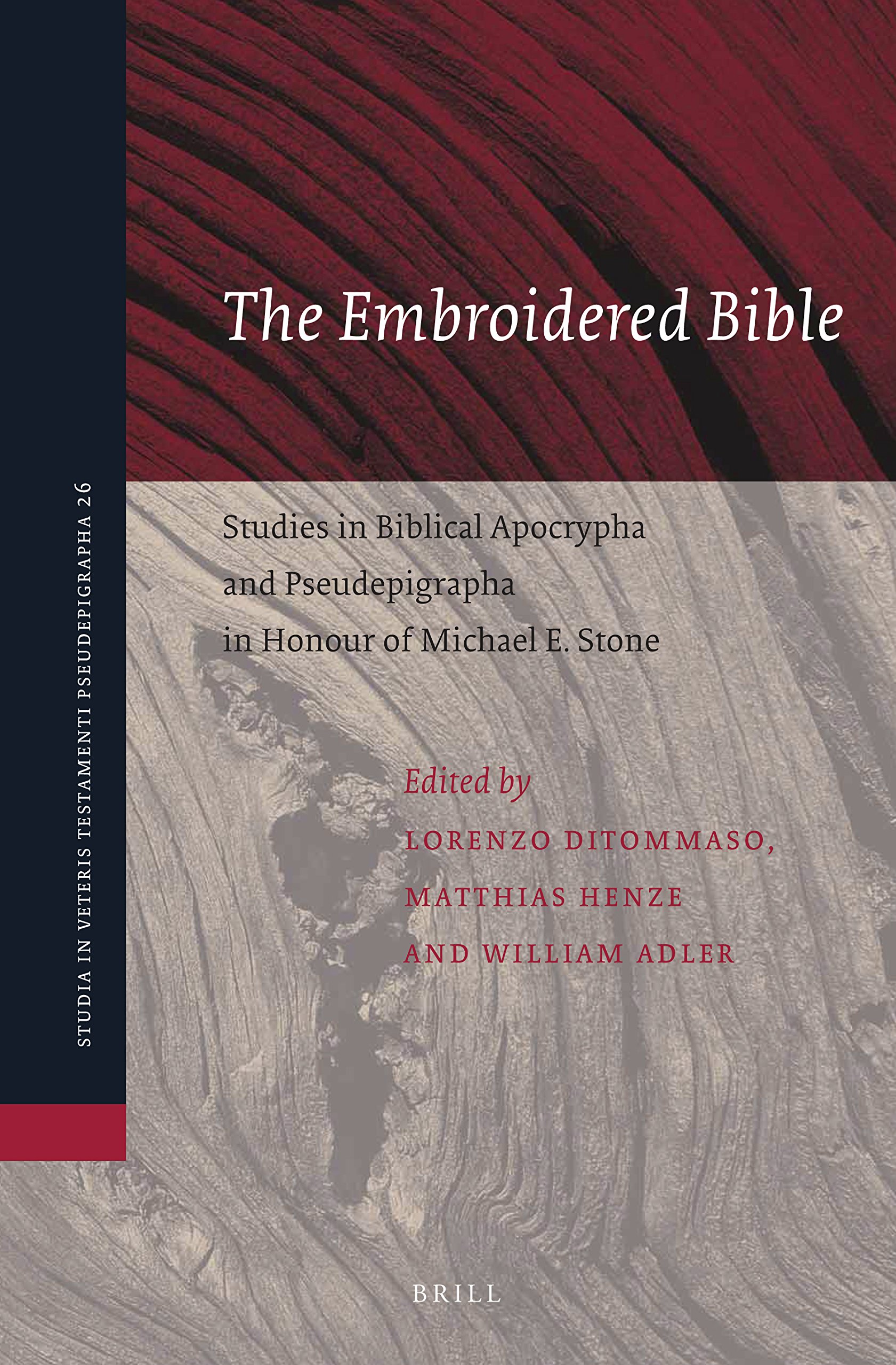
I perused the new Festschrift for Michael E. Stone recently, and was not surprised to find several references to the seminar he held for many years in his home. The tributes at the beginning of the volume brought back fond memories of my own experience as a member of the "Stone Seminar" during my year as a visiting research student at the Hebrew University of Jerusalem back in 2000-2001.

Some of the tributes comment on the seminar itself:
Harold Attridge: "Most memorable perhaps were the sessions of the seminar at your home in Jerusalem, where you and Nira so graciously hosted mature and budding scholars from around the world. You brought together there, as you have in many of your scholarly endeavors, talented people with very diverse interests, philological, socio-historical, literary. The one sine qua non was the competence to read ancient sources with care and be willing to contribute to the give and take of serious scholarly conversation. All of us who participated in that seminar or in conversations with you at international congresses learned from one another and from you." (p. 17) 
Esther Eshel: "Michael nourished our early academic appetites with exposure to scholars and scholarship—in his famous seminars. There we could meet first-rate visiting scholars, who shared with us their latest ideas and plans. And at the same time, we could share our first lectures, to be presented at international conferences, as well as our debut papers and articles. Here Michael’s criticism was the most valuable, because it always was constructive criticism. From Michael we learn to look at the broad picture, even when looking at the smallest philological question." (p. 35)
Others focus more on the way the seminar exemplified Michael Stone’s outstanding qualities as a teacher:
Esther Chazon: "I have been Michael Stone’s student for forty years. I will always be Michael’s student. It is impossible to put into words, especially in a brief tribute, all that Michael has taught his students. Reading ancient texts we had never heard of before was only the beginning. Over long coffee breaks on campus and in his home during evening seminars and private consultations, Michael continues to engage us in the texts, contexts, and broad implications. The image that encapsulates this for me is the move from precise textual work at his enormous living-room desk to the armchair conversations of “what it all means.” ... Like a father, but also as a friend, he never stops looking after our intellectual, professional, and emotional well-being." (pp. 24-25)
David Satran: "An initial meditation on Michael as teacher prompts me to remark on his extreme lack of caution. Now reckless isn’t a word that readily comes to mind in speaking about Michael Stone—it certainly would seem to fit neither the character of the man we so admire nor the scholarship we celebrate—but it may not be an inappropriate description of his pedagogy or, at least, our first impressions of his pedagogical method. Those of us who have enjoyed the privilege and the delight of studying with Michael—as well as the occasional attacks of anxiety which accompanied these—know that dizzying excitement of being sent off to track down the odd detail of an ancient text, armed only with a handful of obscure references and the encouragement to follow the path wherever it might lead. Those paths inevitably led many of us down innumerable rabbit holes, some with no apparent means of escape, but a fair number ultimately issued in seminar papers, theses, and even dissertations. Looking back, it seems difficult to fathom how Michael could have felt that we should be entrusted, at what seemed an impossibly early stage in our studies, with the responsibility of getting to the bottom of these matters. And no less: the solemnity with which we had to report back on our efforts and the seriousness with which these were recorded and held up for general discussion and appraisal. Slowly, at times ever so slowly, however, we began to trust Michael’s expectations from us and found ourselves more trusting of both our own research and our own judgment …. In his demonstration of confidence in our fledgling abilities and insights, Michael encouraged us to develop that intangible quality of security in our own work and in the scholarly directions we had begun to choose. In a certain sense, it is precisely this measure of his confidence which has come to define a large number of our own highly variegated pursuits." (pp. 31-32)
I am afraid I did not know enough to take full advantage of the seminar, but I still learned a great deal from Michael Stone that year. During the seminar we read the Letter of Thessalos and part of Philostratus’s Life of Apollonius of Tyana in Greek—a struggle for someone like me who had really only read the New Testament in Greek. We also heard papers from members of the seminar, as well as from Greg Sterling, Esther Eshel, and, if I’m not mistaken, Peter Brown. (I confess I had no idea who Peter Brown was at the time.) Fortunately, I had the good sense to look up and read some of the books and articles Professor Stone mentioned, including selections from E.R. Dodds, Gershom Scholem, and Stone’s own seminal essays “Lists of Revealed Things,” “Three Transformations in Judaism,” and Scriptures, Sects and Visions. It was on Stone’s recommendation that I read John Barton’s Oracles of God and acquired my own inexpensive copy of Menahem Stern’s Greek and Latin Authors on Jews and Judaism directly from the Israel Academy of Sciences and Humanities. My main point here, of course, is not to enumerate a list of now dated but still valuable books, but to confirm the influence of the teacher and the effectiveness of his pedagogy.

Bibliography
DiTommaso, Lorenzo, Matthias Henze, and William Adler, eds. The Embroidered Bible: Studies in Biblical Apocrypha and Pseudepigrapha in Honour of Michael E. Stone. SVTP 26. Leiden: Brill, 2017.

Wednesday, July 25, 2018

Scholarly Virtues: John Barclay on Michael Wolter's Romans

In a recent book review, John Barclay commends Michael Wolter's 2014 Romans commentary as "a new high-water mark." It "is, now, the first commentary that any student or scholar working on Rom 1–8 should consult."

As valuable as the positive review of Wolter's commentary, which I dutifully noted, are Barclay's comments about what it means to be a good biblical scholar, using Wolter as an example: 
"The result has all the hallmarks of his scholarly excellence: acute exegetical observation, historical precision, clarity of thought and expression, and an independence of mind and originality in argument that manages always to have something new and interesting to say about this well-worn text."

"His philological and historical approach refuses to be bent by a theological or any other ideological agenda, while he takes the theological subject matter of the letter with full seriousness and does not attempt to turn it into something else. ... It is this rigorous historical stance, together with his delightful independence of mind, that makes Wolter’s commentary so valuable."

"Throughout there is the highest regard for clarity: One gets the sense that every word and every phrase has been examined afresh: on numerous occasions, linguistic parallels, drawn from across Greek literature, help support or clarify a reading of Paul’s Greek, with an attention to detail that never becomes obsessive or verbose. It is also clear that Wolter has thought through every exegetical debate anew: often he begins from an original starting-point, while his argumentation is robust but courteous, sober and without rhetorical flourish, and always supported by evidence."

"I know of no current Pauline scholar who can match this argumentative rigor, clarity, and skill."

"There is no attempt to squeeze Paul here into a theological programme, or to salvage the text for a theological or ethical cause. At the same time, there is no anti-theological agenda, which can often produce readings of Paul just as over-determined, whether by a political, moral, or ideological concern. All the virtues of a historian are here displayed - honesty, thoroughness, precision, independence of mind – as applied to the historical roots, contexts, developments, and functions of Paul’s language. Paul’s theology is here, first and foremost, a language-event, and whatever one does with it thereafter should not be allowed to prejudge or distort one’s careful observation of how his text actually works. ...  But because he recognizes that this [Paul's] gospel is inescapably theological, in that it makes huge claims about God and God’s saving action in Christ, his commentary will be as significant for those with a theological investment in the text as for those with only historical interests."

Bibliography
Barclay, John M.G. “Review of Michael Wolter, Der Brief an Die Römer.” Early Christianity 9, no. 2 (2018): 247–52.

Wolter, Michael. Der Brief an die Römer Teilband I: Röm 1-8. EKK 6/1. Neukirchen-Vluyn: Neukirchener Theologie, 2014. (According to Amazon, volume 2 is due out in October 2018.)

Monday, July 16, 2018

Biblical Leadership according to Josephus

In the first half of Flavius Josephus’s twenty-volume Jewish Antiquities, composed in the 90’s CE for a non-Jewish audience, the Jewish historian rewrites the narrative parts of the Hebrew Bible / Old Testament in his own words. Although he claims not to have added or omitted anything, much has changed in the telling. There are entirely new episodes, like Moses’ conquest of Ethiopia at the head of an Egyptian army—the back story, if you will, of the strange biblical reference to Moses’ marriage to a Cushite woman in Numbers 12. There are also major omissions. The golden calf, for instance, has entirely vanished from Josephus’s account. As a Greco-Roman historian, Josephus also follows convention by inventing speeches and attributing them to characters in his narrative.

One such speech that may at first appear to be entirely Josephus’s own creation is Moses’ final address to the Israelites on the eve of their entry into the promised land. In the Bible, Moses’ final speech consists primarily of a review of the wilderness wanderings and a series of laws that take up most of the book of Deuteronomy. Josephus omits the review of events because it duplicates what he has already described; much of the legal material appears in a separate summary of the Jewish national “constitution” that, according to Josephus, Moses presented to the people in a book. This gives Josephus freedom to innovate with the speech itself. The result is a shorter, punchier version that focuses on leadership—a topic that would have resonated with his Roman audience. Here is my slightly paraphrastic attempt at an idiomatic translation of part of the speech:
Now I am leaving you, rejoicing in your good things and entrusting you to the temperance of the laws, to the order of the constitution, and to the virtues of the governors who will take thought for what is profitable for you. And God who has been your ruler until now—and, really, it is a result of his decision that I have been of any use to you—God, I say, will not at this point stop providentially caring for you. No, you will continue to benefit from his thoughtful care as long as you wish to have a benefactor in the ways of virtue—provided, that is, that you remain in the ways of virtue. And the high priest Eleazar, Joshua, and the council of elders, as well as the tribal leaders, will propose the best counsels to you. If you follow their direction, you will experience true happiness (eudaimonia). Listen to them without causing trouble, knowing that all who know well how to be ruled will also know how to rule if they ever come to a position of authority. (Jewish Antiquities 4.184-6)
One might object that Josephus’s focus on human leaders obscures Deuteronomy’s overwhelming emphasis on God, that Josephus’s Moses resembles a Stoic philosopher, and, of course, that the words Josephus attributes to Moses never actually appear in the Bible in this form. Nevertheless, the speech deserves consideration as an interpretation of Deuteronomy, not just as an invention inserted to appeal to Josephus’s first-century audience.

Josephus rarely simply makes stuff up. His rewriting of his biblical source is a thoughtful interpretation that attempts to explain the text (or texts) he had in front of him, often in a surprisingly conservative way. With a few exceptions, Josephus’s imaginative conclusions about what biblical figures must have done and said are matched, I suspect, by popular contemporary interpretations of the Bible. If his revisions to the Bible seem strange, it is because his assumptions are foreign enough for us to notice them, while we tend to ignore the ways our own cultural assumptions influence what we think the Bible says. Indeed, the value of reading Josephus lies in part in his attention to details our own cultural blinders keep us from seeing. As a first-century interpreter, Josephus can also help us understand the basic assumptions and worldview of his contemporaries, including the writers of the New Testament.

I would suggest that the passage I quoted actually distills much of what Deuteronomy says about leadership. In Josephus, as in Deuteronomy, God is presented as the supreme ruler. And Deuteronomy does, after all, have quite a bit to say about human leadership, both directly in instructions about tribal leaders, judges, kings and prophets (Deut 1:9-18; 13; 16:18-20; 17; 18:14-22), and indirectly in its depiction of Moses as a model for other leaders, like Joshua, who will follow him (Deut 3:28; 4:22; 31:23; 34:5-12).
  • Good leaders are characterized by virtue. 
  • Virtue comes from fearing God and following the “temperance of the laws.” 
  • Good leaders, therefore, are those who have learned to follow.
Note that Moses does not encourage the Israelites to become leaders; he exhorts them to follow. As the speech continues, Moses reminds the people of their previous leadership conflicts in the wilderness. Examples of this conflict—including Korah’s revolt, jealousy about the choice of Aaron as high priest (Num 16-17), and the opposition of Zambrias (based on Num 25)—would be fresh in Josephus’s readers’ minds because Josephus has just described them in detail. Leaders are necessary, but in Josephus’s world, too many aspiring leaders results in civil strife.

While the language of “virtue” is obviously influenced by popular Greek philosophical thought, it is well-suited to what Deuteronomy says about the character qualities of leaders. In Deut 16:18-20, for instance, the cardinal Greek virtue of “justice” is given pride of place. Although the term is rare, the same concern for virtue emerges even more clearly in the New Testament, for example in the list of the fruit of the spirit in Galatians 5:22-23, in Phil 4:8 where the word “virtue” (aretê) actually appears, and in the qualifications for church leaders in 1 Timothy and Titus. In the Bible as well as Josephus, leaders are known by their virtue—not their mission, vision, and values. (For an example of why virtue—or “goodness”—is relevant in today’s context, consider Scot McKnight’s reflections on the recent problems at Willow Creek Community Church, which is known to many as the home of the Global Leadership Summit.)

Monday, June 25, 2018

Perspicuity 4: Suspended Reading and Wilful Misunderstanding

I once tried to dignify my typical reaction to reading the Old Testament as “The Spiritual Discipline of Bewilderment.” If I were called upon to teach or preach regularly from the Old Testament, the time and effort expended in careful study would doubtless clarify much of what at first seems confusing. I will gladly grant that specialists in Jeremiah might regard this Old Testament book as more understandable than Romans. But while no real discipline is required to be baffled by an initial encounter with an unfamiliar text, I was trying to get at something important about the posture of faithful reading.

A belief in the “verbal plenary” clarity of Scripture may generate an unhelpful anxiety that leads readers to move too quickly from questions to a premature conclusion about the one definitive right answer. After all, if the whole text is clear, I am at fault for not understanding, right?

I am not denying that correct interpretation is a valid goal and that better understanding is, in most cases, possible. I know from experience that puzzling out difficult texts is both arduous and richly rewarding. Still, there is something to be said for practicing a kind of reading that remains suspended between the question and the answer.

According to Augustine, this is the place to begin:
“In all these books those who fear God and are of a meek and pious disposition seek the will of God. And in pursuing this search the first rule to be observed is, as I said, to know these books, if not yet with the understanding, still to read them so as to commit them to memory, or at least so as not to remain wholly ignorant of them.” - Augustine, On Christian Doctrine, 2.9.14
What I am calling “suspended reading,” N.T. Wright refers to as living uncomfortably with the text:
“I take it as a method in my biblical studies that if I turn a corner and find myself saying, ‘Well, in that case, that verse is wrong’ that I must have turned a wrong corner somewhere. But this does not mean that I impose what I think is right on to that bit of the Bible. It means, instead, that I am forced to live with that text uncomfortably, sometimes literally for years . . ., until suddenly I come round a different corner and that verse makes a lot of sense.” - N.T. Wright, “How Can the Bible Be Authoritative?” 30
Scripture is a multi-faceted splendour that, as Gregory the Great said, is a river where a lamb may wade, and an elephant swim. The pressure to understand may, paradoxically, impoverish reading by leaving no place for wonder, and by making of interpretation an individual pursuit when, to comprehend the text more fully, we need each other’s varied perspectives.

But while it is okay not to understand, and it is important not to rush to easy answers, complaints about the Bible’s complexity are not always innocent. According to Erasmus,
“This doctrine [i.e., the teaching of Scripture] in an equal degree accommodates itself to all . . . . not only does it serve the lowliest, but it is also an object of wonder to those at the top. . . . It keeps no one at a distance, unless a person, begrudging himself, keeps himself away.” - Erasmus, Paraclesis, 96. 

No one put the danger of willful misunderstanding as forcefully as Søren Kierkegaard, and with these two quotes I conclude:
“[I]t is regarded in the world as definitely settled that people would like to know the truth if only they had the capacity and the time for it and if it could be made clear to them. What a superfluous concern, what an ingeniously fabricated evasion! Every human being truly has capacity enough to know the truth …. The one who has any knowledge of himself at all knows from his own experience that it is rather that one has in one’s innermost being a secret anxiety about and wariness of the truth, a fear of getting to know too much.” – Kierkegaard, Christian Discourses, 170 in Westerholm & Westerholm, 340-1.
“Suppose that it was said in the New Testament – we can surely suppose it – that it is God’s will that every man should have 100,000 dollars: do you think there would be any question of a commentary? … But what is found in the New Testament (about the narrow way, dying to the world, and so on) is not at all more difficult to understand than this matter of the 100,000 dollars. The difficulty lies elsewhere, in that it does not please us – and so we must have commentaries and professors and commentaries. … We really wish it to be doubtful, and we have a tiny hope that the commentaries may make it so. … We have invented learning in order to escape from God’s will.” - Kierkegaard, The Last Years: Journals 1853-1855, 334-35 in Westerholm & Westerholm, 347.
Other Posts in This Series:
Perspicuity 1: Is the Bible Understandable?
Perspicuity 2: The NET Bible on Old Testament Obscurities
Perspicuity 3: Limited Clarity, Perspicuous Theology and the Importance of Historical Context 

Works Cited
Augustine, Saint. On Christian Doctrine. Translated by D. W. Robertson. Upper Saddle River, N.J.: Prentice Hall, 1997.

Erasmus. “The Paraclesis.” Pages 97–108 in Christian Humanism and the Reformation: Selected Writings of Erasmus with the Life of Erasmus by Beatus Rhenanus. Translated by John C. Olin. 3rd ed. New York: Fordham University Press, 1987.

Naselli, Andy.  “On Swimming Elephants.” http://andynaselli.com/on-swimming-elephants. (For the Gregory the Great citation and the photo of a swimming elephant.)
Westerholm, Stephen, and Martin Westerholm. Reading Sacred Scripture: Voices from the History of Biblical Interpretation. Grand Rapids: Eerdmans, 2016.

Wright, Nicholas Thomas. “How Can the Bible Be Authoritative?Vox Evangelica 21 (1991): 7–32.

Monday, June 18, 2018

Perspicuity 3: Limited Clarity, Perspicuous Theology and the Importance of Historical Context

In his essay on “The Perspicuity of Scripture,” Wayne Grudem explains that his theological method is an expression of his understanding of the clarity of Scripture:
“The clarity of scripture tells me that its doctrines can be taught in a way that ordinary people are able to understand. ... Neither Jesus nor Paul nor even the writer to the Hebrews felt compelled to make their teaching of doctrine so inaccessible to ordinary Christians, and I wondered if it might be possible to imitate the clarity of Scripture rather than the opacity of [Louis] Berkhof in writing about theology.”
By all accounts Grudem’s Systematic Theology is admirably clear, but there are problems with the analogy:
  1. Conflating Understandability and Clarity: I am convinced that Paul’s letter to the Romans is understandable both in its overall message and in detailed points of argumentation, but that the letter is far from clear to the general reader is apparent from the history of interpretation—and the testimony of my students. 2 Peter 3:15-16 says of the letters of “our beloved brother Paul,” “that there are some things in them hard to understand.” Indeed. Erasmus wrote that “The difficulty of this letter equals and almost surpasses its utility!” This is an overstatement, but my students sympathize. Although Paul no doubt wrote to be understood, Romans does not approach the clarity that Grudem attributes to his own Systematic Theology. Understandability is not the same as clarity.
  2. Confusing Clarity and Accessibility: The little I have read of Berkhof’s Systematic Theology I find very clear indeed, but that does not mean Berkhof’s tome is accessible to those with no academic training. This is because clarity is not the same as accessibility. What is clear to one reader may be opaque to another.
To be fair, Grudem cites 2 Peter 3:15-16 later in the article, he acknowledges that some texts are more difficult to understand than others, and he explains that, in his view, “The clarity of scripture is a doctrine about its understandability, not about how various people actually understand it.” Still, it seems to me that the Systematic Theology analogy is telling. Although Grudem grants that understanding is a process and that it deepens over time, his commitment to the Bible’s complete accessibility leads him to minimize difficulties inherent in reading the Bible.

In my last post, I discussed one way Grudem minimizes difficulties in understanding the Bible. Here I want to respond to Grudem’s suggestion that “historical background information” is unnecessary “for getting a proper sense of a text” by relating this claim to Grudem’s common-sense approach to theology.

Grudem allows that “[s]ome awareness of the wisdom contained in the church’s history of interpretation” is “useful.” His essay interacts with the 1646 Westminster Confession of Faith and cites Mark Thompson’s book on the Clarity of Scripture, which comments on the history of the debate. Nevertheless, Grudem’s discussion of the clarity of Scripture pays insufficient attention to the historical framework within which the doctrine was first articulated. The result, I think, is a case of perspicuity “mission creep” that leads to a new and unhelpful expanded meaning of the term.

In 1516 Desiderius Erasmus expressed his wish for the “Gospels and the Pauline Epistles” to be “translated into all languages so that they could be read and understood,” adding a line that would be taken up by William Tyndale:
“Would that, as a result, the farmer sing some portion of them at the plow, the weaver hum some parts of them to the movement of his shuttle, the traveler lighten the weariness of the journey with stories of this kind!” (Erasmus, "The Paraclesis")
For Erasmus, this does not mean that the meaning of the Bible is completely clear. In a 1524 response to Martin Luther, Erasmus wrote:
“[T]here are some secret places in the Holy Scriptures into which God has not wished us to penetrate more deeply and, if we try to do so, then the deeper we go, the darker and darker it becomes, by which means we are led to acknowledge the unsearchable majesty of the divine wisdom, and the weakness of the human mind. ... [T]here are many passages in the sacred volumes about which many commentators have made guesses, but no one has finally cleared up their obscurity ... yet there are other things which God has willed to be most plainly evident, and such are the precepts for the good life” (Erasmus, “On the Freedom of the Will,” quoted in Thompson 144).
A year later, Luther replied:
“[I]n opposition to you I say with respect to the whole Scripture, I will not have any part of it called obscure. ... Christ has not so enlightened us as deliberately to leave some part of his word obscure while commanding us to give heed to it, for he commands us in vain to give heed if it does not give light” (Luther, “The Bondage of the Will,” quoted in Thompson 147).
By the time the dust had settled at the end of the 16th century, William Whitaker, Regius Professor of Divinity at the University of Cambridge, explained:
“[O]ur fundamental principles are these: First, that the Scriptures are sufficiently clear to admit of their being read by the people and the unlearned with some fruit and utility. Secondly, that all things necessary to salvation are propounded in plain words in the Scriptures. Meanwhile, we concede that there are many obscure places, and that the Scriptures need explication; and that, on this account, God’s ministers are to be listened to when they expound the word of God, and the men best skilled in Scripture are to be consulted.” (Whittaker 1588, quoted in Thompson 153)

According to Thompson, “Whitaker explicitly argued that this was in all respects the same argument as that published by Luther sixty years earlier” (153). Whitaker also anticipated the Westminster Confession, which limits the clarity of Scripture to things that are necessary for salvation. For what it’s worth, Louis Berkhof, writing in 1938, said much the same thing.
Thanks to the historical context, we learn that the classic Protestant formulation of the perspicuity of Scripture was, in effect, a statement about the value of reading Scripture, and a claim that everyone should be allowed to read the Bible for themselves. If Whitaker and Berkhof are correct, affirmations of the clarity of Scripture were always limited and never absolute.

To be sure, the traditional limited view of the Bible’s perspicuity may be mistaken, but it should at least give us pause when we encounter a contemporary theologian who advances what appears to be a new understanding of the term. In this case, I think there are good reasons for retaining the traditional view. Instead of affirming Scripture’s “understandability,” why not simply quote Whitaker or the Westminster Confession?

Believers who regard the Bible as authoritative must not let hermeneutical challenges keep them from saying anything at all. But it won’t do to paper over the complexity within which understanding takes place, and it won’t do to neglect historical context.

Other Posts in This Series:
Perspicuity 1: Is the Bible Understandable?
Perspicuity 2: The NET Bible on Old Testament Obscurities
Perspicuity 4: Suspended Reading and Wilful Misunderstanding   

Works Cited
Berkhof, Louis. Systematic Theology. Grand Rapids: Eerdmans, 1938.
Erasmus, Desiderius. “The Paraclesis.” Pages 97–108 in Christian Humanism and the Reformation: Selected Writings of Erasmus with the Life of Erasmus by Beatus Rhenanus. Translated by John C. Olin. 3rd ed. New York: Fordham University Press, 1987.
Grudem, Wayne. “The Perspicuity of Scripture.” Themelios 34, no. 3 (2009): 288–308.
Grudem, Wayne. Systematic Theology: An Introduction to Biblical Doctrine. Leicester: IVP, 1994.
Thompson, Mark D. A Clear and Present Word: The Clarity of Scripture. Downers Grove: InterVarsity Press, 2006.

Sunday, June 10, 2018

Perspicuity 2: The NET Bible on Old Testament Obscurities

The NET Bible makes up for its overly paraphrastic translation by providing detailed notes that are more helpful for original language work than most commentaries. As I make my way through Old Testament books that I have not read in Hebrew before, I have found I can count on the NET Bible notes to comment on matters of Hebrew grammar, word meanings, and text criticism. Often the notes will include a literal translation and explain the rationale, typically stylistic, for the much smoother NET Bible translation. They also justify textual emendations, and identify when the translation follows the Greek or Syriac, for instance, instead of the Masoretic Hebrew text. In Jeremiah, which I have been reading recently, comments such as the following are not unusual:

(1) Explaining the NET Bible’s substitution of “Zedekiah” for “Jehoiakim” in Jeremiah 27:1:
The reading here is based on a few Hebrew MSS and the Syriac and Arabic versions. The majority of Hebrew MSS and most of the versions read “At the beginning of the reign of Josiah's son, Jehoiakim king of Judah” as in Jer 26:1. The LXX does not have this whole verse. It has long been recognized that the text of Jer 27:1 is textually corrupt. The date formula in the majority of Hebrew MSS at Jer 27:1 is contradictory both with the context of the passage which deals with an event in the reign of Zedekiah ... and the date formula in Jer 28:1 which refers to an event “in that same year” and then qualifies it with “Early in the reign of Zedekiah.” Hence it is preferable to read “Zedekiah” here in place of “Jehoiakim” and explain the error in the Hebrew manuscripts as an erroneous copying of Jer 26:1.
(2) The NET Bible offers this smooth translation of Jeremiah 28:1: “The following events occurred in that same year, early in the reign of King Zedekiah of Judah. To be more precise, it was the fifth month of the fourth year of his reign.” The note explains:
The original text is unusually full here and deemed by many scholars to be corrupt: Heb “And it happened in that year in the beginning of the reign of Zedekiah king of Judah, in the fourth year, in the fifth month Hananiah…said to…” Many scholars see a contradiction between “in the fourth year” and “in the beginning of the reign.” … However, it is just as likely that there is really no contradiction here. I.e., the term “beginning of the reign” can include the fourth year.
(3) The fourth note on Jeremiah 33:5 is just under 600 words long. It provides a literal translation of the Hebrew and Greek texts of Jeremiah 33:4-5, comments on the Hebrew syntax, and evaluates a proposed textual emendation. Here is a sample from the beginning and end of the note:
The translation and precise meaning of vv. Jer 33:4-5 are uncertain at a number of points due to some difficult syntactical constructions and some debate about the text and meaning of several words. … Until a more acceptable explanation of how the difficult Hebrew text could have arisen from the Greek, the Hebrew should be retained, though it is admittedly awkward.
(4) After translating Jeremiah 39:8 as “The Babylonians burned down the royal palace, the temple of the LORD, and the people’s homes…,” the NET Bible notes explain:
The reading here is based on an emendation following the parallels in Jer 52:13 and 2Ki 25:9. The Hebrew text here does not have “the temple of the LORD” and reads merely “house of the people.” The text here is probably corrupt.
In this case, the NET Bible’s reading is harmonized out of thin air because there is no manuscript evidence that supports a reference to the “house of the LORD.” Most English translations stick with a minor shift from a singular house to plural houses, and translate “the king’s house and the houses of the people.”

Since we do not have the ‘original’ text of the Old Testament, it should not trouble us that scholars sometimes declare words or phrases in our surviving Hebrew copies to be corrupt, and defend a reading preserved in another language as more likely to be original. Everyone agrees that the great medieval manuscripts printed in modern editions of the Hebrew Bible have errors. Often the copyists’ mistakes are obvious. Sometimes, as in the examples cited above, there is no consensus, but it is still possible to offer reasons in support of a particular conclusion. All modern translations depart from the Masoretic Hebrew text from time to time, but they often do it silently. The NET Bible is more conscientious than most about letting readers know where and why they have done so.

My point here is not so much to commend the NET Bible notes—although they are a fantastic resource and are freely available online—as to put Wayne Grudem’s comments about the clarity of Scripture in perspective.

In his article on “The Perspicuity of Scripture,” Grudem admits that “There are some places in Scripture where we still are not sure what a certain Hebrew or Aramaic or Greek word means.” So he adds this qualification:
“Scripture is able to be understood everywhere where we are able to translate it accurately; moreover, that the yet-unknown words are relatively few in comparison to the whole scope of scripture, and that even where the meaning of a word is unknown, the sense of the passage as a whole is usually quite understandable.”

As my examples above demonstrate, this is a significant oversimplification. I agree that the general gist of a larger passage is “usually quite understandable,” but uncertainty about the meaning of the Bible often extends beyond individual words, to matters of grammar and the text itself. In most cases, careful readers can still make up their own minds and come to an understanding about the meaning of the text. But decisions are required. If clarity means absence of uncertainty or scholarly consensus, we must conclude that not all the Bible is “clear” in the way Grudem defines it.

And sometimes we have lost the clue entirely. No one reading the NET Bible translation of Jer 40:5 would have any questions about the meaning of “Before Jeremiah could turn to leave, the captain of the guard added, ‘Go back to Gedaliah.’” The note, however, acknowledges that this is not what the Hebrew text says:
The meaning of the first part of v. Jer 40:5 is uncertain. The text is either very cryptic here or is corrupt, perhaps beyond restoration. The Hebrew text reads, “and he was not yet turning and return to Gedaliah” … which is very cryptic.
After working through various possible solutions, the translator concludes, “[I]t is perhaps best to retain the Hebrew and make the best sense possible out of it,” and then adds: “All of this shows that the meaning of the text at this point is very uncertain.”

In other words, not all the parts of the Bible are currently “understandable” in any meaningful sense of the term.

Incidentally, the NET Bible’s evangelical pedigree can be traced back to the faculty at Dallas Theological Seminary. Based on the notes, it appears that the translators would agree with the Westminster Confession’s statement that “All things in Scripture are not alike plain in themselves, nor alike clear unto all.”

Other Posts in This Series:
Perspicuity 1: Is the Bible Understandable?
Perspicuity 3: Limited Clarity, Perspicuous Theology and the Importance of Historical Context
Perspicuity 4: Suspended Reading and Wilful Misunderstanding  

Tuesday, June 5, 2018

Is the Bible Understandable?

If you are like me, the answer to this question seems so obvious your initial reaction is to wonder why anyone would think to ask it. Nevertheless, the question was posed recently, and I want to take some time to reflect on it here.

The obvious answer is “yes.” What motivates my work as a college professor is the conviction that ordinary readers can learn to read and apply the Bible for themselves. I would not have welcomed the opportunity to teach an introductory course on hermeneutics regularly over the last fourteen years if I did not think the Bible was understandable.

But what do we mean when we affirm that the Bible is understandable? I take for granted that the Bible is not always easy to understand, and that reading well requires effort and skill. In my classes I explain that I want my students to develop confidence in their ability to interpret the Bible and at the same time grow in humility as they come to appreciate the complexity of the task and their own human limitations. We see through a glass darkly. Scripture is understandable the way God is understandable, and the self-revealing God is beyond our comprehension.

Does “understandable” allow for this complexity? Can those who affirm the Bible’s “understandability” admit that no one knows what this or that or that Hebrew word means, or confess to being unable to resolve a particular interpretive issue? Must we always arrive at answers, or are we allowed to live with questions from time to time?

I gather that the Protestant doctrine of the Bible’s perspicuity or clarity lies behind the question and the answer it invites. Indeed, in a 2009 article Wayne Grudem proposed using “understandability” as an alternative way of describing the Bible’s clarity.

I am going to argue that this substitution is problematic. “Clarity” and “understandability” mean different things, and conflating them leads to confusion. But if we assume for the moment that when we discuss the Bible’s “understandability” we really mean its “perspicuity,” the natural place to turn is the classic statement in the 17th-century Westminster Confession of Faith:
“All things in Scripture are not alike plain in themselves, nor alike clear unto all: yet those things which are necessary to be known, believed, and observed for salvation are so clearly propounded, and opened in some place of Scripture or other, that not only the learned, but the unlearned, in a due use of the ordinary means, may attain unto a sufficient understanding of them.” (WCF 1.7; online here)
Grudem, however, explicitly rejects the Westminster Confession’s limitation of the Bible’s clarity to “those things which are necessary … for salvation,” and attempts to apply the doctrine in as expansive a way as possible. Grudem grants that understanding the Bible requires effort and time, that other people contribute to understanding, and that our understanding is never complete; he also allows that “there are still today a few words that we are not sure how to translate.” But he insists that if the Bible is authoritative, “clarity” must be affirmed “as a characteristic of Scripture as a whole” and not limited to things that are necessary for salvation: “[T]he meaning of the whole of scripture on many topics is able to be understood by God’s people.” In other words, Grudem defends something like a verbal plenary understandability that extends to (almost) every part of the text.

As a corollary to Scripture’s clarity, Grudem suggests, on the one hand, that “translations should be encouraged,” but he denies, on the other hand, that knowledge of the Bible’s historical context is necessary for understanding—that would put the meaning of the Bible out of the reach of ordinary people.

I share Grudem’s desire to help ordinary people read and understand the Bible. Nevertheless, there are major problems with Grudem’s broad interpretation of the clarity of Scripture. In the next few posts I want to consider weaknesses of Grudem’s approach, explaining why “clarity” and “understandability” should be distinguished, and why the original limited sense of “clarity” as it is presented in the Westminster Confession should be preferred.

Bibliography: Grudem, Wayne. “The Perspicuity of Scripture.” Themelios 34, no. 3 (2009): 288–308.

This is the first post in a series on the perspicuity of Scripture:
Perspicuity 2: The NET Bible on Old Testament Obscurities
Perspicuity 3: Limited Clarity, Perspicuous Theology and the Importance of Historical Context
Perspicuity 4: Suspended Reading and Wilful Misunderstanding