(1) Semi-Intensive Format: This year for the first time we are offering our four-course (12 credit hour) Hebrew sequence in one year instead of two. Imagine beginning class in September at “Shalom!” and ending in April with a reading knowledge of Biblical Hebrew.
(2) Hybrid Option: We are opening enrolment to online students who will be able to join on-campus students over Zoom in our state-of-the-art hybrid classroom.
Our courses are ABHE and ATS-accredited, so if you are looking to complete language requirements at Briercrest or another college or seminary, but are not able to relocate to our campus in Saskatchewan, you can take all four courses online from the comfort of your home. (For my part, I can’t imagine why anyone interested in the Bible or considering pastoral ministry wouldn’t jump at the chance!)
A Note on our Communicative Approach: At Briercrest, we teach the biblical languages using a communicative or “living language” approach. Among other things, this means class will be conducted, as far as possible, in Biblical Hebrew. Students will spend most of their time in class listening to Biblical Hebrew, and they will learn to speak Biblical Hebrew as well as to read and write it.
This “living language” approach is different from how Biblical Hebrew has traditionally been taught in North America. In conventional language classes, the majority of class time is spent talking about Hebrew in English; students labour over analysing word forms, memorizing vocabulary by rote, and producing their own English translations. The traditional grammar-translation approach appeals only to a small percentage of analytical learners and even at the best of times tends to result in a superficial understanding about how the language works, not a knowledge of the language itself. (There is a reason why most students who study Hebrew in seminary do not succeed in maintaining a long-term reading knowledge of the language!) Our active communicative approach to learning Hebrew is geared to the way people naturally learn languages and results in much more exposure to the language. As a result, it leads to deeper and longer-lasting learning; it also appeals to a wider range of learning styles—and is more fun! (For more detail on this approach as it relates to Ancient Greek, see this post and follow the links back.)
Course Details and Fine Print:
During the fall semester, classes will run M/T/W/Th at 10:40-11:55 a.m. and F, 1:00-2:15 p.m. CST.
Homework expectations: Learning any language requires a significant time commitment. You should expect to invest @ 2 hours of homework / class. Most of the homework will consist of watching or listening to the outstanding resources produced by the Biblical Language Center (now part of Whole Word Institute). I can’t promise you a walk in the park; I can assure you that if you put in the time, you will have fun and you will learn.
Most of the students in the class will be in-person on-campus. The hybrid model with an online option is a pilot project that will require sufficient online enrolment to proceed.
Members of the B-Greek forum have been posting tributes in memory of Carl Conrad, the forum's long-time co-moderator, who passed away on February 20th at the age of 90:
AKMA: "Carl was a mighty man of old of the B-Greek mailing list, back when it was strictly a mailing list, and we all learned much from him — many of us about Greek, but all of us about how to conduct ourselves with grace and patience in a mixed group of international scholars, intermediate and beginning students, autodidact experts, axe-grinding non-experts, and wayfaring strangers. ... I know my colleagues all well enough; I can estimate what they might say, how they’re likely to respond to an argument. I never dared assume I could anticipate what Carl would make of my ideas, not because he was arbitrary or capricious, but because his judgement was so much more richly funded with knowledge of the texts and with the experience of worked through them and taught them so fully and carefully. I'm surrounded by great classicists here [at Oxford], all of them erudite and judicious. And I still think of Carl as my Greek-analytical conscience."
Steve Runge: "His insights regularly filled in gaps, highlighted broader patterns, or shattered ill-formed ideas (including mine), always in the name of deepening our understanding of and appreciation for ancient Greek. I came to rely on his instincts as an early sanity check or corrective for the discourse features I sought to describe. He was one of the loudest voices in my head when I wrote. ... His persistence, curiosity, attention to detail, patience, respect for those with whom he disagreed, incredible memory, and an insatiable thirst to learn indelibly shaped my understanding of what it means to be a scholar."
Randy Leedy: "The unflagging persistence with which he responded to nearly every imaginable question on B-Greek is a tribute to his dedication as a teacher. Those who did not know the forum during its heydey probably can't imagine the workload that his fully engaged participation entailed. And if you knew Carl, you know that his replies were not terse: he regularly expanded the discussion into realms that the questioner had not even been aware of but that were important for adequate perspective to understand the fullest possible answer that Carl wanted to provide. The hours required for such thoughtful interaction with such a large number of discussions must have mounted well beyond 10,000--likely double that--over the years. All free of charge, as a public service, out of his love for the language and its students."
Jonathan Robie: "Carl welcomed me graciously, answered my questions, suggested better ways to go about studying the language, and even putting me in contact with other people who could help. I never felt like he was talking down to me. He was always the consummate teacher, taking the time to understand how I was thinking about something before suggesting other ways that might be more helpful. For me, that was at least as important as his vast knowledge and deep intuitive grasp of the Greek language."
I first encountered Carl when I joined the B-Greek email list (as it was then) as a young seminary student. (I am still embarrassed by my claim to be a "Greek scholar" on a survey Carl conducted in 1997.) A short while later I came across a reference to Carl's unpublished Harvard PhD dissertation from 1964, which seemed like a long time ago, though it is now almost as long since I joined the list!
Carl's "Observations on Ancient Greek Voice" (originally posted to the list in 1997) anticipated a spate of publications on the subject by others in the early 2000's and shaped my own thinking on the topic. His enthusiasm for a living approach to learning ancient Greek served as strong validation for those of us "Little Greeks" moving in that direction.
Interviews with and bios of Peter Brown routinely mention his extraordinary facility with languages ancient and modern. For example:
Thomas D’Evelyn (1988) for the Christian Science Monitor on the occasion of Brown’s award of a MacArthur Genius grant: “Brown learned modern languages - German, French, Italian, and Russian - before Greek. He knew the impact of the Middle Ages on modern man before he knew the classics, which gave him a unique view of his field.”
The Library of Congress (2008) on the occasion of Brown’s award of the Kluge Prize: "As Brown developed linguistic capacity in Arabic, Persian, Syriac, and Turkish, as well as in the major classical and European languages, he reconceived Western history from the sixth to the 11th century as a pan-Mediterranean era.”
Ruby Shao (2017) in The Daily Princetonian: “Every day, he wakes up at 4 a.m. He then studies up to three languages, each for an hour, using books and recordings. Language learning constitutes Brown’s main hobby. He dismissed his familiarity with over 20 languages as ‘not so difficult,’ given the numerous cognates involved. ‘I speak as many as I need for traveling,’ he said.”
Joseph Epstein (2023) reviewing Brown’s memoir: “In Journeys of the Mind he seems always to be off learning another necessary language, contemporary or ancient, for the composition of his own books. After the Latin and Greek he acquired in school, he learned German and subsequently the modern romance languages. Then there was Hebrew, which he learned ‘as a prelude to Syriac.’ He resolves one day to learn Coptic to be able to read Manichaen in manuscript, and eventually does so. In preparation for travel through the Middle East, he acquires Arabic, also Ottoman and modern Turkish. On page 699, in the penultimate sentence of the last page of his book, he reports, ‘I have begun to read in Ge’ez (in Classical Ethiopic) texts that still echo, at a vast distance of time and space, the controversies and ascetic legends of Syria and Egypt of the fifth and sixth centuries, which had trickled down the Nile and Red Sea to Ethiopia, to yet another “micro-Christendom” founded in late antiquity and still surviving in the Horn of Africa.’”
The part of Brown’s 99-chapter autobiography that left the deepest impression on me is his description of how he went about preparing to write his biography of St. Augustine by reading through Augustine’s entire massive oeuvre in Latin:
“First and foremost, these were years of deep reading. I would sit in a large armchair with a board across the arms and read my way through the folio volumes of the works of Augustine published … between 1679 and 1700. I would work my way down those generous pages noting on a piece of paper the page … and the position … of the passages that interested me. … Then, having read through the entire text, I would return to copy into my notes those passages that I had marked. This method of taking notes had a direct effect on the way in which I absorbed the works of Augustine. I hardly ever made a précis of what Augustine wrote. Instead, I went out of my way to copy by hand every passage in the original Latin. By doing this, I aimed to capture, through citations, not only what Augustine said, but, quite as much, how he said it. By taking notes in this way, I found myself catching his tone of voice.” - Peter Brown, Journeys of the Mind: A Life in History (Princeton University Press), 249.
Later in the book, Brown reflects on the difference between this sort of extensive reading and the fluency that it produces, and grammatical analysis:
“Confronted with a class of keen graduate students, mainly in classics and comparative literature, I suddenly realized that I knew the Confessions inside out—but I did so only as a historian, instinctively looking at it for evidence of Augustine’s life and times. I had never expounded it as a masterpiece of Latin prose. I had been like a window cleaner, wiping a pane of glass until I could see through it into the fourth century. Now I was expected to be a chemist, and to analyze the texture of the glass itself. I had to know how to parse each sentence in correct grammatical terms. … I realized that I had read Augustine’s entrancing Latin for so long that I took it for granted.” - Peter Brown, Journeys of the Mind, 566.
All very impressive. But what is the point? Brown puts it this way, in a 2024 interview with Nawal Arjini in The New York Review:
“I travel because it always surprises me. Places and monuments, works of art and landscapes are never quite what one imagines them to be. Nor are people. Some of the languages useful for my research abroad are what we call “dead” languages: Latin, Greek, classical Hebrew, Coptic, Ge’ez (Ethiopic), etc. These are keys to entire past civilizations. But even in the modern world, languages are a reminder that all societies have their own surprises. To attempt to read and use languages other than one’s own, even if only a few phrases, is a mark of respect for the otherness of other people. For this reason, I have always encouraged my students of late antiquity to learn not only the classical languages but the languages in which modern scholarship has been conducted, so that they realize that historical research is a worldwide matter, and that it is many centuries old—like a great symphony that has been playing for centuries.”
Notice the emphasis on (1) conversation, (2) memorizing texts not just isolated vocabulary, and (3) pronunciation in this passage from Charlotte Brontë’s novel, Jane Eyre:
Fortunately I had had the advantage of being taught French by a French lady; and as I had always made a point of conversing with Madame Pierrot, as often as I could, and had, besides, during the last seven years, learnt a portion of French by heart daily—applying myself to take pains with my accent, and imitating as closely as possible the pronunciation of my teacher—I had acquired a certain degree of readiness and correctness in the language, and was not likely to be much at a loss with Mademoiselle Adela. - Jane Eyre (Oxford World Classics), 102
Polyglot Gabriel Wyner has “learn pronunciation first” as the first in his list of “three keys to language learning.” Why?
“[W]hen you’re not sure about the way your language sounds, you’re stuck learning two languages instead of just one” (54).
“If you can build a gut instinct about pronunciation, then every new word you read will automatically find its way into your ears and your mouth, and every word you hear will bolster your reading comprehension. You’ll understand more, you’ll learn faster, and you’ll spare yourself the hunt for broken words” (57)—words that we think are “pronounced one way, but [that are] actually pronounced a different way. These words can’t be shared between the written language and the spoken language, and as a result, they break up our little circle of friends” (55).
I am delighted to report that Briercrest’s next intensive Greek semester will take place in the fall of 2025 on the island of Cyprus:
I had the privilege of being involved in our first three Greek semesters (2019, 2021, 2023). Although I won’t be going along to Cyprus, I can say with confidence that the learning experience will be fantastic—to say nothing of the living experience on location in the Mediterranean!
I am pleased to report that we will be running our third immersive Greek semester this coming fall on the Briercrest College & Seminary campus. As I wrote last time,
Our intensive series of five three credit-hour courses is designed to take students from the Greek alphabet to a reading knowledge of ancient Greek, including the Koiné Greek of the New Testament. In our immersive classroom context on the Briercrest College & Seminary campus, students have the opportunity to learn ancient Greek in ancient Greek, as they would any modern language. Because it is geared to the way people naturally learn languages, an active communicative approach to learning Greek leads to deeper and longer-lasting learning than the conventional grammar-translation approach used in most North American academic settings; it also appeals to a wider range of learning styles (and is more fun!)
As far as I know, our immersive, semester-long approach to teaching Ancient Greek in Ancient Greek is unique in North America. (For more detail, see this post and follow the links.)
Our Immersive Greek Semesters run every second year. Almost four years after the first iteration, we have begun to see the payoff:
There's the graduating student who took Greek Semester 1.0 in the fall of 2019, who tells me she still regularly reads her Greek New Testament.
Six students from Greek Semester 2.0 (fall 2021) elected to read through the Greek text of Acts last semester as part of their course requirements in my English-Bible Acts class. I sat down with each student twice during the semester to have a conversation in Ancient Greek about selected passages from Acts. None of us would claim fluency, but I was uniformly impressed at how much they understood from the text of Acts and how well they could make themselves understood in Greek.
I am currently sitting in on my colleague Wes Olmstead's Greek VII course, partly to see how he runs advanced classes, and partly because I wanted to read the extrabiblical texts he assigned. So far this semester, the seven students in the class have read Galatians, they are about halfway through Matthew's Gospel, we recently finished Plato's Apology--a text I had never read before in Greek--and we have started on Melito of Sardis's 2nd century Easter homily, Peri Pascha, a text I'm afraid I was totally unfamiliar with. Need I mention that the class is taught in Greek?
This fall Briercrest College and Seminary will be offering its innovative immersive Greek semester for a second time, and there is still room for a few more students in the class.
Our intensive series of five three credit-hour courses is designed to take students from the Greek alphabet to an introductory / intermediate* reading knowledge of ancient Greek, including the Koiné Greek of the New Testament. In our immersive classroom context on the Briercrest College & Seminary campus, students will have the opportunity to learn ancient Greek in ancient Greek, as they would any modern language. Because it is geared to the way people naturally learn languages, an active communicative approach to Koiné Greek leads to deeper and longer-lasting learning than the conventional grammar-translation approach used in most North American academic settings; it also appeals to a wider range of learning styles (and is more fun!)
So if you want:
To begin to develop actual fluency in ancient Greek,
To read Koiné Greek with better comprehension than you would after a conventional grammar translation course of the same length,
And you want to complete a two-year Greek language requirement in one semester,
Then the program might be for you!
The immersive semester will run in-person five days a week throughout the 15-week fall semester, so you will need to relocate to our Canadian campus in order to participate.
For more information, see the course descriptions (here), as well as my posts about the first immersive semester:
After a week to catch our breath, term two of Briercrest College's modified fall semester begins tomorrow. For me and my students this means a full semester of Introductory Hebrew compressed into 6.5 weeks. Because I want to reserve class time for Hebrew learning, I made a short video to explain in advance why we are going to study a “dead” language like Hebrew as one would a living language:
I am reproducing the first part of what I say in the video, for those like me, who prefer reading to watching:
This course takes a “Living Language” approach to learning Biblical Hebrew. Among other things, this means the course will be conducted, as far as possible, in Biblical Hebrew. You are going to spend a lot of time in this class listening to Biblical Hebrew. You will be learning to speak Biblical Hebrew as well as to read and write Biblical Hebrew.
This is different from how Biblical Hebrew has traditionally been taught in North America. In a traditional language classroom you would spend most of your time in class listening to your teacher talk about Hebrew in English. Homework would consist of painfully trying to memorize English glosses for Hebrew words, and translating Hebrew sentences into English.
Now, the goal of any Introductory Biblical Hebrew course is to help students learn to read and understand an ancient text. The traditional approach takes for granted that the easiest, quickest way to learn to read Hebrew is to focus on grammar and translation. There are no native Biblical Hebrew speakers. You don't need to know how to buy food in the market or how to hire a taxi in Biblical Hebrew. Why bother making the extra effort to speak Hebrew? Why emphasize hearing when all you really need to do is read letters on a page?
But if your goal is to internalize the language so that you can read with understanding, and if you want long-term retention—not just passing a test, but being able to continue to read 10 years down the road—the traditional approach turns out to be neither efficient nor particularly effective.
For one thing, I can say from experience that memorizing lists of vocabulary words is very time consuming ... and doesn't work very well. More importantly, the preoccupation with translation—as if Hebrew must be turned into English to be understood—actually gets in the way of internalizing the language.
For more detail, as well as a few comments about what motivates me to teach Hebrew, you will need to watch the video itself. It's only five minutes long.
I have never taught Biblical Hebrew using a fully communicative approach before, and the pressure to prepare for daily classes will be intense. But I am grateful to be able to ply my trade in a context where face-to-face teaching is still an option, even if it means I need to learn how to say ‘put on your masks’* in Biblical Hebrew.
*I've settled on עֲטוּ עַל־פְּנֵיכֶם, which uses Leviticus 13:45 as a model. My thanks to Aaron Eby for the suggestion.
Back in January I posted an initial report on Briercrest’s first Intensive Koiné Greek Semester: five immersive courses in a 15-week fall semester, beginning from scratch and culminating in the Greek text of the Gospel of Mark. As I mentioned in that post, the semester was distinguished by its intensive five-days-a-week format and by our approach to teaching Ancient Greek in Ancient Greek as a living language.
Here at last is a follow-up post with a little more detail about what we did in class, our influences, and the resources we used.
The Classroom
The Intensive Semester would not have succeeded the way it did without the outstanding contribution of our three student interns. With five co-teachers, we were able to give attention to each student in a class of about 25 students, and to provide much more active and more engaging learning experiences than we would otherwise have been able to do. In addition to active instruction, role-playing, and “Total Physical Response” exercises from the front of the class, we were able to break into stations with different teachers leading different activities (including WAYK), and to work together in table groups with a different teacher assigned to each table each day. Five co-teachers also meant that we could share tutorial responsibilities in the afternoons after a full morning of class.
About half the class had already taken a semester-based version of the first two courses the previous year, and sat in on the first six weeks for review. Their enthusiasm and basic familiarity with the language helped the brand new students get up to speed.
Influences
Other contributions were less obvious to students, but no less important. The field of active ancient Greek language instruction is changing so rapidly it might not have been possible to offer an intensive semester of Ancient Greek by immersion ten years ago. In any case, we could not have pulled it off without help from others under whom we have studied and whose recently-developed resources we employed.
My colleague, Wes Olmstead, who both organized the Greek semester and shouldered most of the teaching and lesson planning, spent much of the summer of 2019 learning under Christophe Rico at Polis Institute courses in the United States.
In an earlier post I mentioned attending one of the Biblical Language Center's Greek Fluency Workshops in the summer of 2012. Almost a decade later, I can see the formative impact of these workshops (2011-2013) on the growing movement of people involved in living Greek language instruction. The teachers the summer I attended included Randall Buth, Jordash Kiffiak and Ben Kantor. (BLC's plans to restart the workshops in 2020 have moved online, which may make them more accessible. Highly recommended!)
Bryn Olmstead picked up the idea of Greek fluency and ran with it farther than I imagined possible. Although Bryn and Felicia were not physically present to help teach the course, they did a tremendous amount of work behind the scenes throughout the semester, most notably by preparing incredibly effective Keynote slides. Bryn informs me that their contribution was heavily indebted to his teacher, Gonzalo Jerez Sánchez: “Much of what we produced is simply creative adaptation of what we learned from him for your particular situation at Briercrest.”
Resources
It is no coincidence that several of our influences reappear as authors and creators of resources we used.
Much of Koiné Greek I, the first course in the series, was built around:
(2) Jordash Kiffiak's Omilein videos and a pre-publication draft of his workbook, which is designed to be used alongside the BLC “Picture Lessons.”
In my view, Jordash’s ΟΜΙΛΕΙΝ curriculum, with its blend of high-quality TPR videos and a lavishly-illustrated workbook, is currently the best beginning Greek resource available for those who want to lead students through the equivalent of a first semester of Greek using a communicative approach. Jordash now offers online courses through his own ΟΜΙΛΕΙΝ website.
(4) Balme, Maurice, Gilbert Lawall, Luigi Miraglia, and Tommaso Francesco Bórri. Athenaze: Introduzione al greco antico. Parte I. 2d ed. Montella, Avellino: Accademia Vivarium Novum, 2018. (Why the Italian Athenaze you ask? Consider theseanswers.)
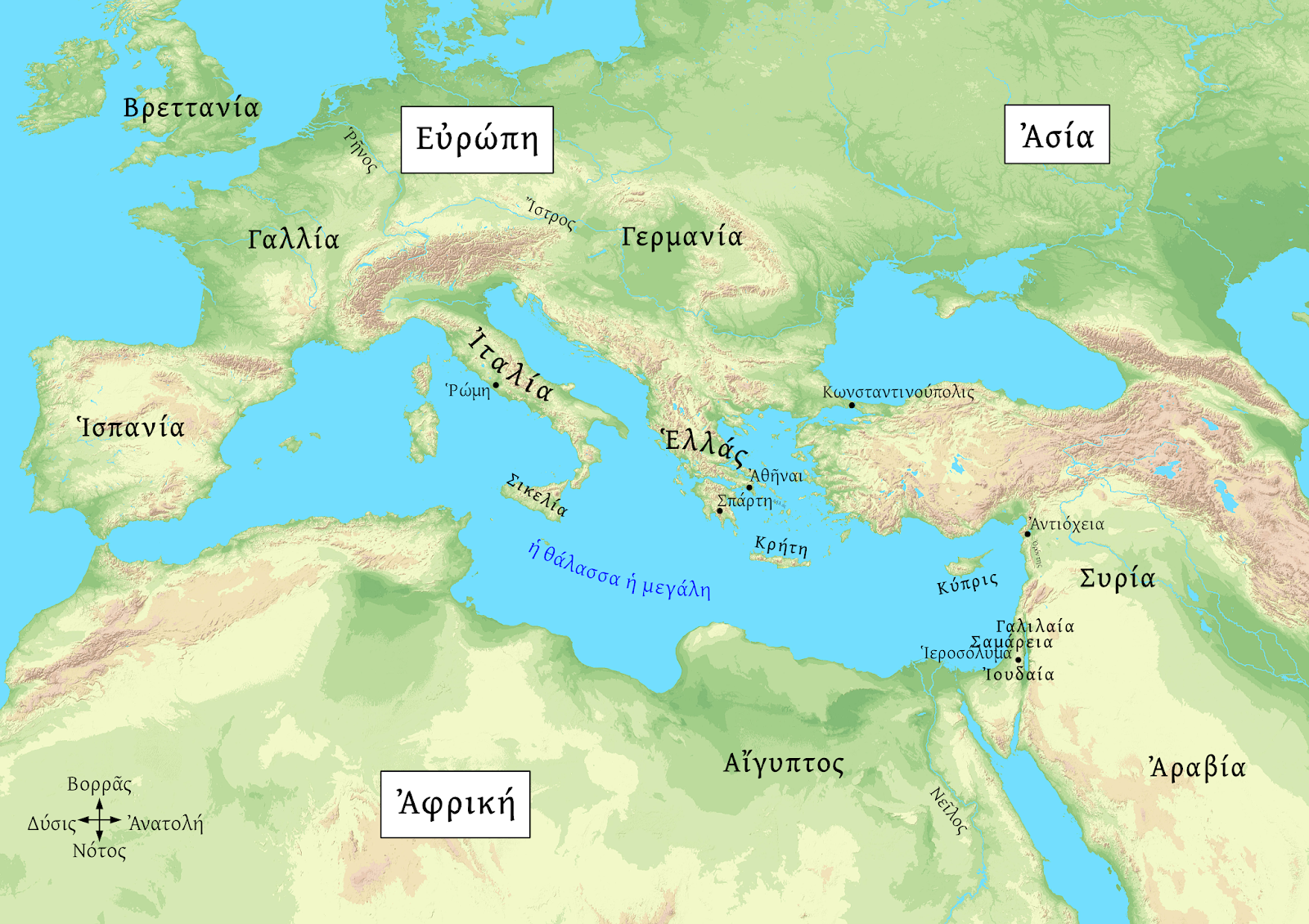
(6) As an additional source of comprehensible input in class, we dipped into Seumas MacDonald’s Lingua Graeca per se Illustrata (LGPSI), which provided the inspiration for the map at the beginning of this post.
In these three courses (Koiné Greek II-IV), we made it through chapter 15 of Athenaze, all of Polis Level One, and part of a pre-publication draft of Polis 2.
Our task in Koiné Greek V was to read and talk about the Gospel of Mark in Greek.
By the end of the semester, I had the repeated experience of sitting around a table with students who were helping me explain the Greek text of Mark to each other in Greek. What more could you ask for?
(Note: This is the third in a series of posts on last fall’s Intensive Greek Semester. You can read the first two here and here.)
In seminary I fancied myself a Greek scholar. I had, after all, taken courses on advanced Greek grammar and advanced Greek exegesis, and I had struggled through the entire Greek New Testament (and nothing else). A few decades later, I see I have only just begun--partly because I was going about it the wrong way, partly because I was hardly going about it at all.
Laziness no doubt played a role, but to be charitable to my former self, I didn’t fathom what was possible, and I didn’t grasp what is necessary. If my experience is anything to go by, the language bar is set very low in New Testament scholarship. I would hazard that most of those who publish on New Testament Greek grammar don’t qualify as Greek scholars, if basic competence in non-biblical Koine Greek is a criterion.
Yet even if I could claim a fluent reading knowledge of the entire corpus of ancient Greek literature, I would still want to be included in Jonathan Robie’s definition of a “Little Greek”:
“A ‘Little Greek’ is someone who is still learning Greek. … Those who don't know aren't dangerous; those who insist they do know are very dangerous. This is just as true for Really Big Greeks as for Little Greeks. Each of us knows only in part; if we want to profit by studying Greek, we must have the humility and the patience to learn one step at a time, to be corrected by others, and be open to the Spirit who guides us in all truth.” - Jonathan Robie
With this in mind, I left my Greek VI students at the end of the semester with three suggestions for Little Greeks like us:
(1) Re-read. To paraphrase Justin Slocum Bailey in this excellent talk, if you want to develop Greek fluency, “the next . . . text you should read” is the one you just finished reading. Here is Slocum Bailey again, explaining the point in more detail:
“From the perspective of second language acquisition, the only way to waste time reading is to read a text exactly once. …. If you read the text many times, your fluency will skyrocket. Lots of language learners waste time by struggling through texts that are too difficult for them or by immediately moving on from a text without having absorbed much of its language or content. By rereading, you ensure that a text does all it can for your fluency, and that all the time you spend reading actually translates into increased fluency.” - Justin Slocum Bailey, “Don't Read, Reread”
(2) Keep Reading. By all means, set goals and aim high, but more importantly, build a habit. A little bit every day is better than grand ambitions that never get off the ground. Probably, this means choosing something fun to read. It also means being kind to yourself.
(3) Read with other people. I said this without irony, though our class was meeting over Zoom. In a strange way, social distancing may make reading together more conceivable than in the past because we now know we don't need to be in one place to do so.
I have been dreaming about a more effective way to teach the biblical languages since the late 1990’s when I watched classmates complete their seminary language requirements without acquiring a lasting ability to read the Bible in Greek or Hebrew. I already knew by experience how valuable it is to be able to read the New Testament in Greek, but I could see that the traditional approach to teaching the biblical languages was not serving the majority of students well. Around this time I first encountered Randall Buth making what was then an unusual proposal: Why not draw on best practices in second language acquisition and teach the biblical languages by immersion, as modern languages are taught? I had grown up in Africa in a multilingual environment and had observed my missionary parents teaching English to speakers of other languages, so on one level the idea made a lot of sense. But I had my doubts about applying living methods to so-called “dead” languages. A few years later I was in Jerusalem studying modern Hebrew by immersion when I noticed a dramatic improvement in my ability to read biblical Hebrew. From that point, I was sold on the concept. An immersive method clearly produces deeper, longer-lasting results. The problem was I did not know Greek well enough to apply it. In the summer of 2012, with several years of traditional grammar-translation Greek teaching under my belt, I participated in a Biblical Language CenterGreek Fluency Workshop designed both to help Greek instructors develop proficiency in spoken Koine Greek and to demonstrate how to teach ancient Greek as a living language. During the workshop, I posted a sort of personal manifesto on my blog:
I am … persuaded that the languages are worth learning well, that Bible software “power tools” are no substitute, and that—in theory—it should be reasonable for pastors to acquire a reading knowledge of Greek and Hebrew, and maintain the languages while they are in ministry. I am also committed to doing whatever I can to create a better long-term success rate for my students. This means helping students learn deeper with greater retention, and helping them see the payoff and have fun in the process so that they are motivated to continue learning once required classes are done. I am convinced the church needs pastors in general—not just a select few pastor scholars—who read the Bible in its original languages. Perhaps one of the most important ways I can serve the church is to teach the biblical languages effectively, working to turn theory into reality.
That fall, in a first attempt to switch to an immersive approach, I went half-way, trying to merge traditional and living-language methods in my Introductory Greek course. I was pleased with the results of this preliminary experiment, but class scheduling demands, a sabbatical, and a trip to England, meant that a second chance to teach introductory Greek never materialized. I did sometimes wonder why—if teaching the languages was so important to me—I wasn’t doing more to develop my own competence in Greek and Hebrew. But in the years that followed I turned my attention to the conventionalthings an academic is supposed to do, and I began to fear that the effort I had put into developing any sort of active facility in the language would be wasted. Meanwhile, back in the Greek-language classroom, my colleague, Wes Olmstead, made the switch to a living language approach to teaching ancient Greek. When Wes proposed the idea for an “Intensive Semester” of immersive Greek, I jumped at the opportunity to be involved—both to support the experience in any way I could and to learn Greek more deeply in the process. I wrote up some initial reflections on the fall semester at the beginning of January, which you can read here. Then came the winter semester and the challenge of attempting to teach through the Greek text of 1 Corinthians in Greek. (Εἰ θέλεις μανθάνειν τὴν Ἑλληνικὴν γλῶσσαν, δίδαξον αὐτήν!) Now that the dust has settled, I hope to return to a sequel that gives a little more detail on what we did last fall, our influences and the resources we used. Stay tuned.
This is the second post in a 3-part series. Click on these links for Part 1 and Part 3.
Last fall I had the privilege of helping lead Briercrest’s first Intensive Koiné Greek Semester. We were able to pack the equivalent of five conventional courses (and then some) into one extended 15-week semester, with classes running all morning, Monday to Friday, and a required tutorial each afternoon. Our goal was not simply to cover a lot of material, but to create the conditions for an immersive, active, and living learning environment where Ancient Greek could be taught in Ancient Greek, and students could learn Ancient Greek as they would any other modern language.
In traditional biblical language courses, the majority of class time is spent talking about Greek or Hebrew in English. Students labour over analysing word forms, memorizing vocabulary by rote, and producing their own English translations. This approach appeals only to a small percentage of analytical learners, and even at the best of times tends to result in a superficial understanding about how the language works, not a knowledge of the language itself. There is a reason why most students who study Greek or Hebrew do not succeed in maintaining a long-term reading knowledge of the language.
Thankfully, there is growing interest in another approach to teaching the biblical languages that draws on best practices in modern second-language pedagogy. We decided to adopt this approach and teach Ancient Greek in Greek out of a desire to make the language more accessible to anyone who wants to learn, and to help students internalize the language so that they will be better prepared to develop a life-long practice of reading the Bible in Greek. As far as I know, the combination of an intensive five-course semester of Greek with a living-language methodology is unique in North America.
Of course, there are things we will do differently next time, but the initial experiment was a success. Students who began the semester without even knowing the Greek alphabet spent the final three weeks working through the Greek text of the Gospel of Mark, and talking about it in Greek. On our last day of class, we read and discussed Mark’s account of Jesus’ death and resurrection (chapters 15-16). Then the room full of 30 students stood and recited the Lord’s prayer in unison. The following day, the students wrote their final exams, including essay questions, entirely in Greek. I call that a win.
Time will tell how many of our Greek guinea pigs maintain a long-term reading knowledge of the language, but there is an initial sign that the course achieved one major goal: to inspire students to continue studying Greek. Students who major in Biblical Studies at Briercrest are required to complete four language courses in either Greek or Hebrew. Our students have already completed five, and more than half the class are now registered for next semester’s entirely optional Koiné Greek VI course on the Greek text of 1 Corinthians.
This is the first in a 3-part series. Parts 2 and 3 are here:
My clickbait title is admittedly a paraphrase, but I think it gets at (part of*) the substance of what Luther actually said:
"For though the Gospel has come and daily comes through the Holy Spirit alone, we cannot deny that it has come by means of the languages, by which it was also spread abroad, and by which it must be preserved. ... In proportion, then, as we prize the Gospel, let us guard the languages. For not in vain did God have His Scriptures set down in these two languages alone—the Old Testament in Hebrew, the New in Greek. The languages, therefore, that God did not despise but chose above all others for His Word, we too ought to honor above all others. ... And let us be sure of this: we shall not long preserve the Gospel without the languages. The languages are the sheath in which this sword of the Spirit is contained; they are the casket in which we carry this jewel; they are the vessel in which we hold this wine; they are the larder in which this food is stored; and as the Gospel itself says, they are the baskets in which we bear these loaves and fishes and fragments. If through our neglect we let the languages go (which may God forbid!), we shall not only lose the Gospel, but come at last to the point where we shall be unable either to speak or write a correct Latin or German. As proof and warning of this, let us take the wretched and woeful example of the universities and monasteries, in which men not only unlearned the Gospel, but corrupted the languages so that the miserable folk were fairly turned into beasts, unable to read or write a correct German or Latin and wellnigh losing their natural reason to boot. ... Hence it is certain that unless the languages remain the Gospel must finally perish." - Martin Luther, "To the Councilmen of All Cities in Germany That They Establish and Maintain Christian Schools" (1524) as quoted by Michael Gilleland.
* The other part could be paraphrased thus: If you value the gospel, encourage the study of the biblical languages by others if you are not able to study them yourself.
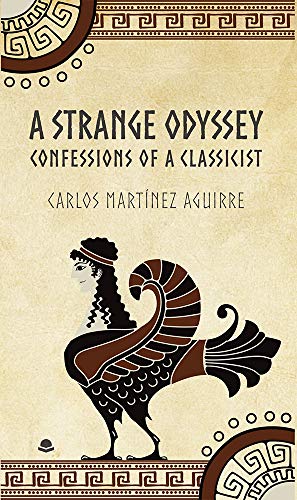
The English translation of Carlos Martínez Aguirre’s fascinating language-learning memoir, A Strange Odyssey: Confessions of a Classicist, is now out on Kindle. The book is a short narrative diagnosis of problems with traditional “dead” language pedagogy, a compelling demonstration that there is a viable alternative, a sobering description of what is required to develop competence in the “communicative method,” and a whirlwind introduction to some of the resources that are now available. A few excerpts:
From the introduction, on language-learning standards:
“For those outside the range of our subjects, it is normal to think that every Latin or Greek teacher has a mastery of their specialised languages, as would be expected of a German, English or Chinese teacher. That is, anyone not related to the world of Classical Languages would assume that a good teacher of Classical Studies of Secondary School level (and even more so at University level) would be able to speak Classical Latin or Greek with a measure of fluency, write correctly these languages, and of course, be able to comfortably read any text in the original language. However, this is very far from being the case. … [I]f any Russian teacher admitted that he couldn’t improvise the translation a page of Dostoyevsky in situ, nobody would take him seriously. I also see no reason why learning Russian should be easier to learn for any Spaniard than Classical Greek, and even less so Latin.”
On the traditional grammar-translation approach:
“[A]fter eight years of studying Latin and Greek (two in secondary school and six at university), I … not only remained incapable of being able to speak Latin or Greek ... but also of being able to write two lines correctly in these languages, or to translate a page without suffering like a condemned man at the gallows.”
On the possibility of true fluency:
“The most effective way I have discovered to show the cave dwellers [“of classical philology”] the error of their ways is by presenting them with some adolescents speaking Latin and Greek fluently, making comments and even jokes about the texts of the classic authors in that same language, and also explaining that they learnt Latin and Classical Greek without too much difficulty and with the same methodology as they learnt English or French.”
In conclusion:
“At no point have I presumed that it is not possible to master Latin and Greek by the grammar and translation method. What I do attest to is that in my case that system was a failure and that many teachers of Classics … have shared with me of having experienced the same frustration and the feeling of being defrauded when they completed their studies. … [A]lthough all roads lead to Rome, it is evident that some are more tortuous than others.”
The book is self-published, and I’m afraid it shows. The English translation and proofing could have used another round of edits, and the structure and content of the memoir itself would benefit, I think, from additional revision. But for anyone interested in teaching or learning ancient languages, it is more than worth the $3.36 USD list price. Tolle lege!
Last week the Paideia Institute released a video in Latin (with English subtitles) about a Latin course offered at Princeton University last fall that was taught entirely in Latin:
But when due allowance is made for an organization’s own promotional literature, the Living Latin course, and the fact that it was offered at Princeton, is still an exciting development: The course was offered in response to student demand; Joseph Conlon, who holds a PhD in classics from Princeton University, evidently knows Latin—along with about 10 other languages—very well indeed, and he appears to be an excellent teacher; eminent Princeton historian, Anthony Grafton, was impressed with the class. More importantly, students clearly loved it. Here are a few excerpts (in English translation) from the video:
"It is difficult to understand classical literature without speaking Latin or Greek. But it is difficult to speak Latin without friends who also can or want to learn to speak Latin."
"Before the course I could read Latin, but I had to translate every word into English, and now I can better understand the words of the ancient authors."
"I am always happy when I come to class. Even if I am having a bad day, I am happy in class."
The video itself makes a great case for a living language approach to teaching so-called “dead” languages. Watch the video, and you’ll see why I think the biblical languages should be taught this way too.
After describing how he taught himself Latin (see the previous post), John Newton goes on to say how he gave it up for the sake of Christ:
"In short, in the space of two or three voyages I became tolerably acquainted with the best classics …. [A]t length I conceived a design of becomingCiceronian myself, and thought it would be a fine thing indeed to write pure and elegant Latin.--I made some essays towards it, but by this time the Lord was pleased to draw me nearer to himself, and to give me a fuller view of the 'pearl of great price,' the inestimable treasure hid in the field of the holy scripture, and for the sake of this, I was made willing to part with all my new acquired riches. I began to think that life was too short (especially my life) to admit of leisure for such elaborate trifling. Neither poet or historian could tell me a word of Jesus, and I therefore applied myself to those who could." - 166-7
I find this posture--one is tempted to call it "anti-intellectual"--a bit unfortunate. Why can't you be devoted to God and read the classics? Newton seems almost to boast in the next excerpt about never reading Classical Greek, when that would only help, not hinder, a reading of the New Testament, and he goes on to remark, "I would rather be some way useful to others, than die with the reputation of an eminent linguist." Why must it be one or the other? Still, for Newton, who left school when he was 10 years old, being an "anti-intellectual" meant teaching himself Greek, Hebrew and Syriac (Aramaic):
"I devoted my life to the prosecution of spiritual knowledge, and resolved to pursue nothing but in subservience to this main design. This resolution divorced me … from the classics and mathematics. My first attempt was to learn so much Greek, as would enable me to understand the New Testament and Septuagint; and when I had made some progress this way, I entered upon the Hebrew the following year; and two years afterwards, having furnished some advantages from the Syriac version, I began with that language. You must not think that I have attained or ever aimed at a critical skill in any of these: I had no business with them, but as in reference to something else. I never read one classic author in the Greek; I thought it too late in life to take such a round in this language, as I had done in the Latin. ... In the Hebrew I can read the historical books and psalms with tolerable ease; but in the prophetical and difficult parts I am frequently obliged to have recourse to Lexicons, etc. However, I know so much, as to be able, with such helps as are at hand, to judge for myself the meaning of any passage I have occasion to consult." - 204-5
Would that all pastors today were "anti-intellectuals" like Newton.
In the 11th letter of his epistolary autobiography, John Newton describes how he taught himself Latin while serving as captain of a slave ship:
"Having now much leisure, I prosecuted the study of the Latin with good success. I remembered a dictionary this voyage, and procured two or three other books; but still it was my hap to chuse the hardest. … I was not aware of the difference of style; I had heard Livy highly commended, and was resolved to understand him. I began with the first page, and laid down a rule, which I seldom departed from, not to proceed to a second period till I understood the first, and so on. I was often at a stand, but seldom discouraged: here and there I found a few lines quite obstinate, and was forced to break-in upon my rule, and give them up, especially as my edition had only the text, without any notes to assist me. But there were not many such; for before the close of that voyage, I could (with a few exceptions) read Livy from end to end, almost as readily as an English author. And I found, in surmounting this difficulty, I had surmounted all in one." - John Newton, Authentic Narrative (1764), pp. 165-6
The key ingredients here are dedication, time and freedom from distraction. For a more efficient approach, I recommend learning Latin--or any "dead" language really--as you would a living language. Take Babylonian, for instance:
"A Cambridge academic has taught himself to speak ancient Babylonian and is leading a campaign to revive it as a spoken language almost 2,000 years after it became extinct. Dr Martin Worthington, a fellow of St John’s College, has created the world’s first film in the ancient language with his Babylonian-speaking students dramatising a folk tale from a clay tablet from 701BC." - Charles Hymas in The Telegraph
You can watch the very interesting film here (with subtitles if you prefer):
Click here for more information about the film, with a link to Dr. Worthington's book, Teach Yourself Complete Babylonian.
You can chalk October's blog silence up to a trip to Dublin at the beginning of the month, for which I needed to prepare a paper, a trip to Caronport at the end of the month, for which I needed to prepare a course, and the ancillary packing, unpacking, and follow-up that simply takes time.
Both trips were a treat. In Dublin we got to see biblical manuscripts in the Chester Beatty Library ...
... and to marvel at Trinity College Dublin's Old Library:
Saskatchewan in October calls for a more refined palate that can appreciate different shades of brown, but the interaction with students, friends, and colleagues was rich, and the week of teaching "Jewish Backgrounds to Early Christianity" was very satisfying. I also had a few conversations that make me excited about the prospect of returning to full-time teaching next fall (see #4 below).
Real life takes precedence over the virtual, but I want to mention a few things quickly:
(1) Ambiguities in Acts: I hope to resume my blog series on the Law (and related topics) in the book of Acts shortly.
(2) The soundtrack to my daily commute right now is the audiobook version of Charles Marsh's superb Strange Glory: A Life of Dietrich Bonhoeffer (Vintage, 2015). This is no hagiography of Bonhoeffer, and all the better for that. Perhaps most remarkable from my middle-aged vantage point is that by age 25 Bonhoeffer had two doctorates, and by the age of 30 he was one of Germany's most vocal opponents to Hitler. What might the 20-somethings of today accomplish?
(3) One of the best available Bible programs--one that also happens to be free--has decided to make its accurate tagged databases of the Hebrew Bible, Septuagint, and Greek New Testament freely available for others to use and develop. Kudos to David Instone-Brewer and STEP Bible.
(4) Learn Ancient Greek as a Living Language in 2019: I am delighted to announce that Briercrest College and Seminary plans to offer an intensive sequence of 5 Greek courses next fall, all in one semester. Instead of the traditional grammar-translation approach, the courses will be team-taught in Koiné Greek, drawing on best practices in second language acquisition. I will have more to say about the program later on. In the meantime, you can read a selection of my earlier posts about teaching and learning Greek and Hebrew as living languages here, here, here, and here.
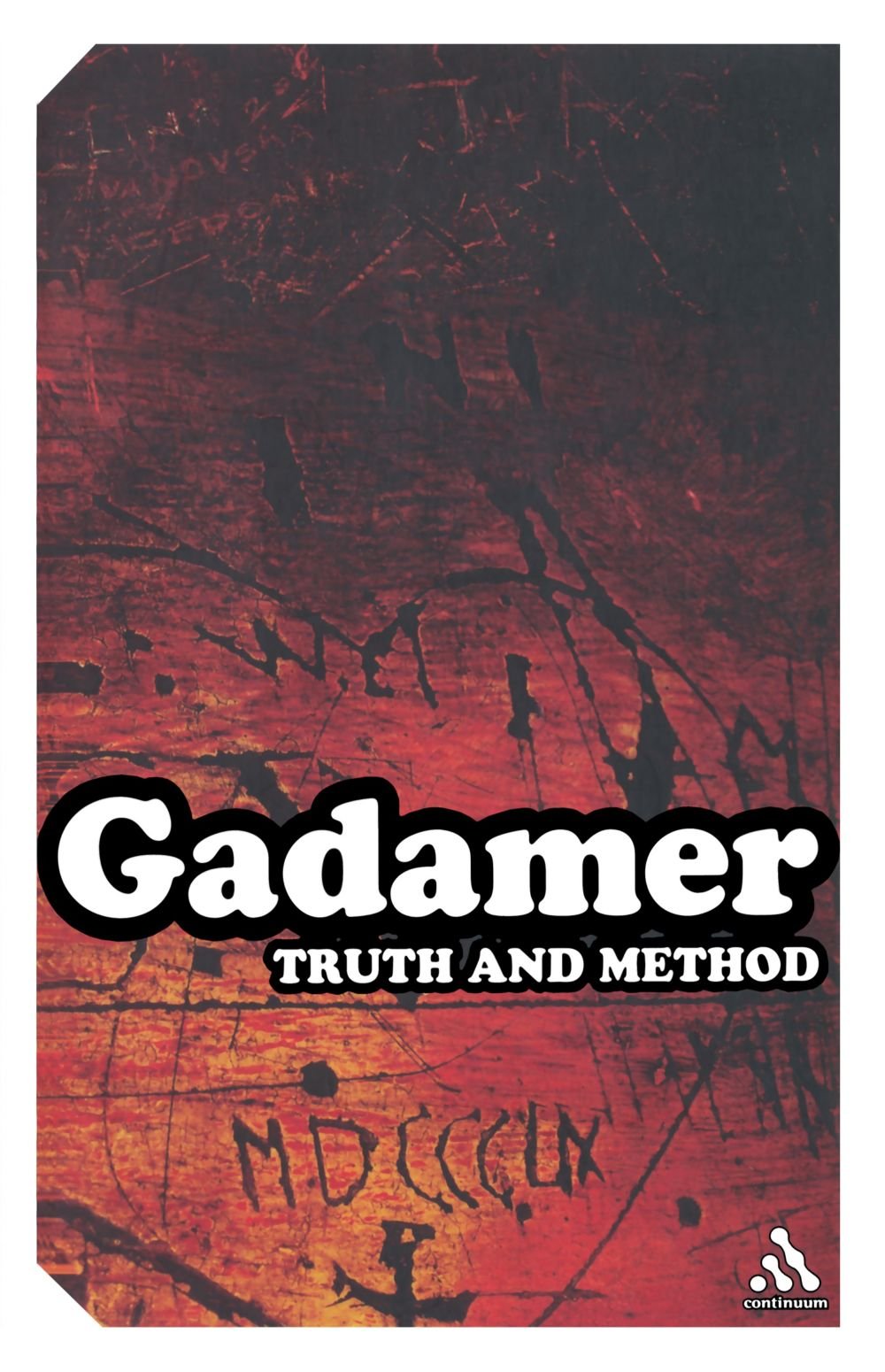
The following excerpts are ripped from their context in Hans-Georg Gadamer's Truth and Method and applied to two issues that Gadamer does not directly address, but that I care quite a lot about: why those who view the Bible as authoritative should learn the biblical languages, and how they should go about learning them.*
"[E]very translation," Gadamer declares, "is at the same time an interpretation." This is now a cliché, and Gadamer, surely, was not the one who coined it. In class, I like to quote the saying attributed to the Israeli poet and translator, Haim Nahman Bialik: "Reading the Bible in translation is like kissing your bride through a veil."**
Gadamer goes on to say that those who read a translated text can only engage in an interpretation of the translator's interpretation, not the original. In the somewhat stilted prose of Gadamer's translators:
[H]aving to rely on translation is tantamount to two people giving up their independent authority. Where a translation is necessary, the gap between the spirit of the original words and that of their reproduction must be taken into account. But in these cases understanding does not really take place between the partners of the conversation, but between the interpreters. ... The requirement that a translation be faithful cannot remove the fundamental gulf between the two languages. ... Every translation that takes its task seriously is at once clearer and flatter than the original. Even if it is a masterly re-creation, it must lack some of the overtones that vibrate in the original. ... [T]ranslating is like an especially laborious process of understanding, in which one views the distance between one's own opinion and its contrary as ultimately unbridgeable. And, as in conversation, when there are such unbridgeable differences, a compromise can sometimes be achieved in the to and fro of dialogue, so in the to and fro of weighing and balancing possibilities, the translator will seek the best solution--a solution that can never be more than a compromise." (pp. 386-8)
When he turns to learning a foreign language, Gadamer sets the bar higher than is normally done in your typical Greek or Hebrew language class:
"To understand a foreign language means that we do not need to translate it into our own. When we really master a language, then no translation is necessary--in fact, any translation seems impossible. ... For you understand a language by living in it--a statement that is true, as we know, not only of living but dead languages as well. Thus the hermeneutical problem concerns not the correct mastery of language but coming to a proper understanding about the subject matter, which takes place in the medium of language. Every language can be learned so perfectly that using it no longer means translating from or into one's native tongue, but thinking in the foreign language. Mastering the language is a necessary precondition for coming to an understanding in a conversation. ... Everything we have said characterizing the situation of two people coming to an understanding in conversation has a genuine application to hermeneutics, which is concerned with understanding texts." (pp. 386-7).
In other words, understanding the subject matter requires mastery of the language, and real mastery means living in the foreign language long enough to be able to think in it.
By this measure, I have a way to go before I reach fluency in Biblical Greek and Hebrew. But the limited progress I have made convinces me both that the effort is worth it and that we can do a better job learning and teaching the biblical languages if we make this sort of fluency the goal and then adopt best practices in second-language acquisition.
For helpful reflections on what this can look like, I heartily recommend Seumus Macdonald's blog, The Patrologist.
*For some of my other posts on learning Biblical Greek and Hebrew, see here, here, and here.
**What Bialik actually said was either "He who knows Judaism in translation is like one who kisses his mother through a veil" (Michael D. Schwartz's translation) or "He who knows Judaism through translation is like a person who kisses his mother through a handkerchief" (Liran Yadgar). The original Hebrew saying can be found here.
Imagine a fish swimming in a sea of Hebrew. The sea is rough, it takes a lot of hard swimming to get to the other side, and the fish can’t wait to get there. Finally, there is land in sight. The fish leaves the deep water, races through the shallows, and with a flying leap lands on a nice sandy beach. The fish lies there, gills flapping contentedly. In a short while, the fish is dead. Don’t be that fish. Stay in the water.


.jpg/800px-Enoch_106.8-18%3B_Melito's_Homily_1-4_(CBL_BP_XII%2C_f.13v).jpg)