Tuesday, May 25, 2010

Advanced Studies in New Testament Literature


My teaching assignment for the winter semester next year includes BLST415 Advanced Studies in New Testament Literature. According to the calendar description, the course is "An advanced study of a selected New Testament book(s), texts, or themes as selected by the instructor."

I'll be working with a theme, but I'm not sure which one. It's easy enough to come up with ideas that fascinate me and that I'd like to learn more about (such as NT ethics). The trick is narrowing the list down to topics of interest to students, and about which I can reasonably claim some teaching competence--in other words, topics that are close enough to my current research interests or that I can fit into my research schedule over the next seven months. I welcome any and all feedback on the following short list:
  1. Prophecy after the Prophets -  Topics could include early Jewish and Christian perceptions about OT prophets and interpretations of OT prophecies; the question of the "cessation" of prophecy; eschatological prophets; NT prophets (Acts, Pauline Epistles); comparison with early Jewish and Greco-Roman prophecy. Biggest challenges: organizing the course into a coherent whole; finding suitable secondary readings.
  2. Twentieth Century Lives of Jesus - I envision this as a (heavy) reading course, focusing on recurring historical, hermeneutical and theological issues. We would begin with Albert Schweitzer and then turn to short books by major twentieth century Jesus scholars such as _____ (insert name of 2nd quester), Vermes, Sanders, Wright, Allison, Fredriksen, and--to balance things out!--something from the Jesus Seminar and/or its descendants (Crossan, Borg, Arnal?). (I'm afraid my own affinities for the so-called "third quest" as opposed to the Jesus Seminar are obvious.) Biggest challenges: The topic appeals to me because it would be a chance to do a lot of reading I haven't done yet, but do I have time? I'm afraid the course will raise more questions than I have answers for. Are there enough pastoral elements to make it worthwhile in my teaching context?
  3. Jewish Roots of Christian Theology - Unlike "Jewish Backgrounds to Early Christianity," which I teach as an introduction to Second Temple Judaism, this course would focus in on theological NT topics--e.g., eschatology, apocalypticism, resurrection, the Messiah, the Synagogue (and church), women, ethnicity and identity--that are rooted in Second Temple Judaism and that require a knowledge of Second Temple Judaism to be understood well. I've considered teaching the whole course on a number of the topics listed above. What I'm proposing here would be more of a grab-bag approach. I suppose the content may still overlap too much with Jewish Backgrounds, but how can you have too much early Judaism?
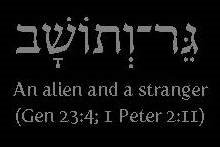
(Artwork by Gregory Johnson, created during Jewish Backgrounds last semester; used by permission)

Monday, May 24, 2010

Talk about Suffering Part 2: Discipleship

A recent issue of Mission Frontiers on the theme of suffering includes an excerpt from John Piper's book, Filling Up the Afflictions of Christ. In the excerpt Piper argues that, "God's design for the evangelization of the world and the consummation of his purposes includes the suffering of his ministers and missionaries." As evidence Piper points to passages in the Gospels such as Luke 21:17 and John 15:20 where Jesus explains that his followers can expect to suffer as he did: "voluntary suffering and death to save others is not only the  content but it is also the method of our mission." But Piper is also concerned to guard against misunderstanding, so he quickly clarifies that Christian suffering is not redemptive: "There is only one Redeemer. Only one death atones for sin--Christ's death. ...[O]ur sufferings add nothing to the atoning worth and sufficiency of Christ's sufferings."

While I want to affirm with Piper the unique significance of Jesus' atoning death, I think the emphasis Piper places on the differences between Christ's suffering and that of his followers is unbiblical. The New Testament writers took for granted the uniqueness of Jesus' death, but they were not afraid to emphasize the similarities with Christian suffering, and they were more interested in the similarities than the differences. Consider the following passages:
  • Peter quotes from Isaiah 53 and declares that Christ "bore our sins in his body on the tree so that we might die to sin and live to righteousness; by his wounds you were healed" (1 Peter :2:24), but this statement about the significance of Christ's death is to serve as "an example, so that you might follow in his steps" (2:21).
  • Paul says “Now I rejoice in my sufferings for you, and I fill up in my flesh what is lacking of the afflictions of Christ, for the sake of his body, which is the church” (Col 1:24). Whatever this verse means, Christ's afflictions for the sake of the church are paralleled by Paul's sufferings for the Colossians.
  • In Acts, Luke lays out the practical consequences of following Jesus by drawing links between Jesus’ death and the suffering of his followers. As Stephen (slide), the first Christian martyr, is stoned to death, he says “Lord Jesus receive my spirit” (7:59) just as Jesus had said “Father, into your hands I commit my spirit” (Luke 23:46). And just as Jesus said “Father, forgive them for they know not what they do” (Luke 23:34), Stephen cries out, “Lord, do not hold this sin against them” (Acts 7:60). In Acts 12, Peter is arrested by Herod who planned to execute him around Passover just as another Herod had been involved in the arrest of Jesus during an earlier Passover celebration (Acts 12). The parallels are extensive: While Jesus is raised from the dead, Peter is miraculously released from his tomb-like prison and the sentence of death. There are also parallels between Jesus’ journey to Jerusalem, his trial and execution, and Paul’s long journey to Jerusalem, his trial, and eventual execution (in Rome). The lives of the early Christians mirror the life and death of Jesus.

Not only is Piper's emphasis on the differences between Christ's suffering and Christian suffering unbiblical, it obscures a fundamental New Testament theme, and misses the explanation for suffering that the biblical writers provide. As far as I can see, Piper offers no reply to the question why it is part of God's plan for Christian ministers to suffer, except to say that God has decreed it.

The New Testament answer, I think, is that we participate in the merits of Christ's unique atoning death by participating in his death. This includes death to sin, death to self--but it also includes suffering up to and including physical death. And this suffering is not just for those involved in ministry (pace Piper), but for everyone who wishes to follow Jesus on the way of the cross.

More detail, drawn from the same source that lies behind part 1 in this series, below the jump break:

Sunday, May 23, 2010

Barth on Truth

"Truth permits no one to use it as a plaything; and it puts an end to all tragedy. Truth is far too merry and noble for us ever to justify our present life and address the present moment: 'Remain with me! thou art so fair!' Truth is far too grim and terrible for us ever to desire to wrest it to ourselves, for example, by despairing and putting an end to our life." - Karl Barth, The Epistle to the Romans(Oxford: 1968), 287.
(Barth is commenting on Romans 8:11 and, in context, is referring to the Spirit who "is the Truth", but it reminds me of Ben Myer's recent post on "Writing and truth-telling."

A Zotero Wishlist (or things EndNote does that Zotero doesn't do...yet)

I wish Zotero...
  • listed the total number of records.
  • (Type ctrl-a, and the total number will appear in the right column.)
  • allowed you to search in a highlighted column by typing.
  • allowed you to open more than one database at the same time (see this thread: http://forums.zotero.org/discussion/2266/).
  • allowed you to search and replace data (see EndNote's powerful "change and move fields" command).
  • displayed tags on the same page as basic record information.
  • sorted by complete author instead of by last name.
  • allowed you to add formatting to titles (I understand this will be implemented soon).
  • imported multiple PDF's (EndNote doesn't do this either).
  • did not take so long to load large databases.
Hopefully, many of these will be implemented soon.


For the record, I still prefer Zotero to EndNote.

Tuesday, May 18, 2010

Fron EndNote to Zotero: Take Two


This rather technical post has nothing to do with the above picture, which I took on our way back from Buffalo Pound last week. It is rather a follow-up to this description of the process I used to import my EndNote library into Zotero:

With help from the Zotero Forums and the excellent free Komodo Edit utility, I successfully modified the javascript for the Zotero RIS translator so that it imports my all-important "Date Read" and "Label" EndNote fields into the sortable Zotero "libraryCat" and "Rights" fields, and so that the "Series Number", "Number of Volumes" and "Edition" fields can be translated.

I also made extensive changes to my Revised version of EndNote's RIS Output style so that it interfaces with Zotero's RIS translator and correctly (for the most part) captures all (or almost all) *my* data. Since the EndNote data entry process is flexible, I can't guarantee that it will correctly capture anyone else's data, but it should work as a starting point that improves on the current filters available through Zotero and EndNote. Feel free to download the following files and modify them as you wish, but don't hold me responsible for what happens to your data (or your computer)!

Zotero RIS translator (created by Simon Kornblith; modified by me): RIS.js (I will post the relevant code on the relevant Zotero Forum.)
EndNote RIS Output style (I deleted all but the following reference types: Journal Article, Book, Book Section, Edited Book, Encyclopedia, Conference Paper, Newspaper Article, Thesis, Unpublished Work, Web Page): RefMan (RIS) Export Revised

Update: My final (?) Zotero post is a wishlist.
___________

Regular non-Zotero-related blogging will resume soon.

Thursday, May 13, 2010

EndNote Output Styles for Biblical Studies Journals

During the past three years I modified the poorly executed Society of Biblical Literature output style supplied by EndNote, and used it to create new output styles for the journals Catholic Biblical Quarterly, Currents in Biblical Research, and Novum Testamentum (footnotes only). To my relief, the IS department had my data backed up, so I was able to recover the work I thought I had lost. Click on the links below to download the styles:

Society of Biblical Literature
Catholic Biblical Quarterly
Currents in Biblical Research
Novum Testamentum

The styles are provided as is. Some more fine tuning may be necessary.

Finally, this post links to the revised EndNote RIS style and the modified Zotero translator that I used to import my database into Zotero. Zotero already has an SBL style that works well; CBQ, CBR and NovT have yet to be created. When I get around to creating or translating them into Zotero, I will link to them as well. (Alternatively, if anyone would like to translate them, I'll be glad to make use of the translated versions!)

Monday, May 10, 2010

Importing EndNote Records into Zotero

Update: See Take Two for an updated Zotero RIS translator and a new version of EndNote's RIS Output Style.

It took me about 8-10 hours to import my database of 4000+ records from EndNote X1 into Zotero. I decided not to worry about my EndNote Groups, but the rest of my data (I think), and my links to PDF files, transferred successfully. This is what I did:
  1. Delete duplicate records - For some reason, EndNote created multiple copies of some of my records (another reason to switch from EndNote). I used EndNote's "Find Duplicates" function to create a subset of about 800 records, and deleted a few hundred duplicates manually.
  2. Modify EndNote's RIS Output Style (time consuming technical step) - The basic process for importing records from EndNote to Zotero is described on the Zotero website here. There are also extensive Zotero forums discussion (beginning in 2006) with additional technical information here and, to a lesser extent, here. Zotero's recommendation, which I followed, is to export data using EndNote's Reference Manager (RIS) Output Style, save as a text file, and then open the text file in Zotero. The process works smoothly, but I encountered two major issues with my own data: 
  3. a. The RIS text file did not include a Customized data field I use all the time in EndNote to indicate when I read a book or article. I was not about to lose this information or reenter it manually.
    b. The RIS text file tagged EndNote's "Label" field, which I use to indicate where books and articles are located (in the library, in my personal collection, in my filing cabinet, on my hard drive, etc.), as a note (N1). I wanted this field to appear on Zotero's "Info" column (perhaps as Archive or "Loc. in Archive" or even as "Library Catalog"), not as a separate note.
    It took me quite awhile to find a suitable workaround. I have worked enough with EndNote's import and export filters to know that just about any EndNote field can be linked to just about any field in another program or bibliography layout. It just takes time to (re)learn how it is done, and to troubleshoot what isn't working. Unfortunately, Zotero's import filters are not adjustable in the same way--unless you are a programmer, but even then changes to Zotero code would presumably have to be approved. So my options were limited. I had to find out which RIS field codes the Zotero import filter recognizes and how it transfers them. Then I had to choose fields that would work best for me. I found the necessary details here:
    •  This webpage explains RIS field code labels. This apparently does the same thing.
    •  This page identifies Zotero field codes, which helps explain the code for the RIS Zotero translator. The latter explains which RIS field codes the Zotero import filter recognizes.
    In the end, for problem a., I decided to adjust EndNote's RIS Output style to tag EndNote's "Label" field as a Keyword (KW), which Zotero reads as a tag. This means that my Location data is listed along with subject keywords in Zotero, but tags are easily searchable, and this is better than including the information as a separate note. It works.
    For problem b., I linked my "Date Read" (Custom 1) EndNote field to M1, which Zotero inserts into the Extra field in Zotero's record info column. Unfortunately, I can't sort my records by "Date Read" (the Extra field) as I can in EndNote, but at least the data is there as a field. (Zotero also doesn't list the total number of records in a library. Why is that?)
  4. Highlight All Records and Copy Formatted in EndNote - I couldn't get my revised RIS Output Style to output correctly as a text file, so I selected all records, and selected "copy formatted" in EndNote, and then pasted the whole thing into an empty WordPad file.
  5. Update Links to PDF Files - EndNote doesn't provide the full pathname to PDF files. Zotero offers a script that can make the changes for you. I found it easier to do a global search and replace with the correct path name.
  6. Save as a Unicode Text file. This is important if you have any German, Greek or Hebrew text in the file you want to import.
  7. Import into Zotero as described here.
  8.  
    QED.