
Sunday, May 31, 2020
John Donne on Pentecost


Sunday, May 24, 2020
Reflections on Teaching Ancient Greek as a Living Language 3: Endnotes
Back in January I posted an initial report on Briercrest’s first Intensive Koiné Greek Semester: five immersive courses in a 15-week fall semester, beginning from scratch and culminating in the Greek text of the Gospel of Mark. As I mentioned in that post, the semester was distinguished by its intensive five-days-a-week format and by our approach to teaching Ancient Greek in Ancient Greek as a living language.
Here at last is a follow-up post with a little more detail about what we did in class, our influences, and the resources we used.

About half the class had already taken a semester-based version of the first two courses the previous year, and sat in on the first six weeks for review. Their enthusiasm and basic familiarity with the language helped the brand new students get up to speed.
My colleague, Wes Olmstead, who both organized the Greek semester and shouldered most of the teaching and lesson planning, spent much of the summer of 2019 learning under Christophe Rico at Polis Institute courses in the United States.
In an earlier post I mentioned attending one of the Biblical Language Center's Greek Fluency Workshops in the summer of 2012. Almost a decade later, I can see the formative impact of these workshops (2011-2013) on the growing movement of people involved in living Greek language instruction. The teachers the summer I attended included Randall Buth, Jordash Kiffiak and Ben Kantor. (BLC's plans to restart the workshops in 2020 have moved online, which may make them more accessible. Highly recommended!)
Bryn Olmstead picked up the idea of Greek fluency and ran with it farther than I imagined possible. Although Bryn and Felicia were not physically present to help teach the course, they did a tremendous amount of work behind the scenes throughout the semester, most notably by preparing incredibly effective Keynote slides. Bryn informs me that their contribution was heavily indebted to his teacher, Gonzalo Jerez Sánchez: “Much of what we produced is simply creative adaptation of what we learned from him for your particular situation at Briercrest.”
Much of Koiné Greek I, the first course in the series, was built around:
Our task in Koiné Greek V was to read and talk about the Gospel of Mark in Greek.
By the end of the semester, I had the repeated experience of sitting around a table with students who were helping me explain the Greek text of Mark to each other in Greek. What more could you ask for?
(Note: This is the third in a series of posts on last fall’s Intensive Greek Semester. You can read the first two here and here.)
Here at last is a follow-up post with a little more detail about what we did in class, our influences, and the resources we used.

The Classroom
The Intensive Semester would not have succeeded the way it did without the outstanding contribution of our three student interns. With five co-teachers, we were able to give attention to each student in a class of about 25 students, and to provide much more active and more engaging learning experiences than we would otherwise have been able to do. In addition to active instruction, role-playing, and “Total Physical Response” exercises from the front of the class, we were able to break into stations with different teachers leading different activities (including WAYK), and to work together in table groups with a different teacher assigned to each table each day. Five co-teachers also meant that we could share tutorial responsibilities in the afternoons after a full morning of class.About half the class had already taken a semester-based version of the first two courses the previous year, and sat in on the first six weeks for review. Their enthusiasm and basic familiarity with the language helped the brand new students get up to speed.
Influences
Other contributions were less obvious to students, but no less important. The field of active ancient Greek language instruction is changing so rapidly it might not have been possible to offer an intensive semester of Ancient Greek by immersion ten years ago. In any case, we could not have pulled it off without help from others under whom we have studied and whose recently-developed resources we employed.My colleague, Wes Olmstead, who both organized the Greek semester and shouldered most of the teaching and lesson planning, spent much of the summer of 2019 learning under Christophe Rico at Polis Institute courses in the United States.
In an earlier post I mentioned attending one of the Biblical Language Center's Greek Fluency Workshops in the summer of 2012. Almost a decade later, I can see the formative impact of these workshops (2011-2013) on the growing movement of people involved in living Greek language instruction. The teachers the summer I attended included Randall Buth, Jordash Kiffiak and Ben Kantor. (BLC's plans to restart the workshops in 2020 have moved online, which may make them more accessible. Highly recommended!)
Bryn Olmstead picked up the idea of Greek fluency and ran with it farther than I imagined possible. Although Bryn and Felicia were not physically present to help teach the course, they did a tremendous amount of work behind the scenes throughout the semester, most notably by preparing incredibly effective Keynote slides. Bryn informs me that their contribution was heavily indebted to his teacher, Gonzalo Jerez Sánchez: “Much of what we produced is simply creative adaptation of what we learned from him for your particular situation at Briercrest.”
Resources
It is no coincidence that several of our influences reappear as authors and creators of resources we used.Much of Koiné Greek I, the first course in the series, was built around:
(1) The Biblical Language Center’s Living Koiné Greek: Foundations “Picture Lessons.”
(2) Jordash Kiffiak's Omilein videos and a pre-publication draft of his workbook, which is designed to be used alongside the BLC “Picture Lessons.”
In my view, Jordash’s ΟΜΙΛΕΙΝ curriculum, with its blend of high-quality TPR videos and a lavishly-illustrated workbook, is currently the best beginning Greek resource available for those who want to lead students through the equivalent of a first semester of Greek using a communicative approach. Jordash now offers online courses through his own ΟΜΙΛΕΙΝ website.In Koiné Greek II-IV we combined Christophe Rico’s Polis curriculum with the Italian version of the classical Greek textbook, Athenaze:
(3) Christophe Rico, Polis: Speaking Ancient Greek as a Living Language, Level One (Polis Institute Press, 2015).
(4) Balme, Maurice, Gilbert Lawall, Luigi Miraglia, and Tommaso Francesco Bórri. Athenaze: Introduzione al greco antico. Parte I. 2d ed. Montella, Avellino: Accademia Vivarium Novum, 2018. (Why the Italian Athenaze you ask? Consider these answers.)
(5) We also used audio resources produced by Gonzalo Jerez Sánchez of Classics at Home.
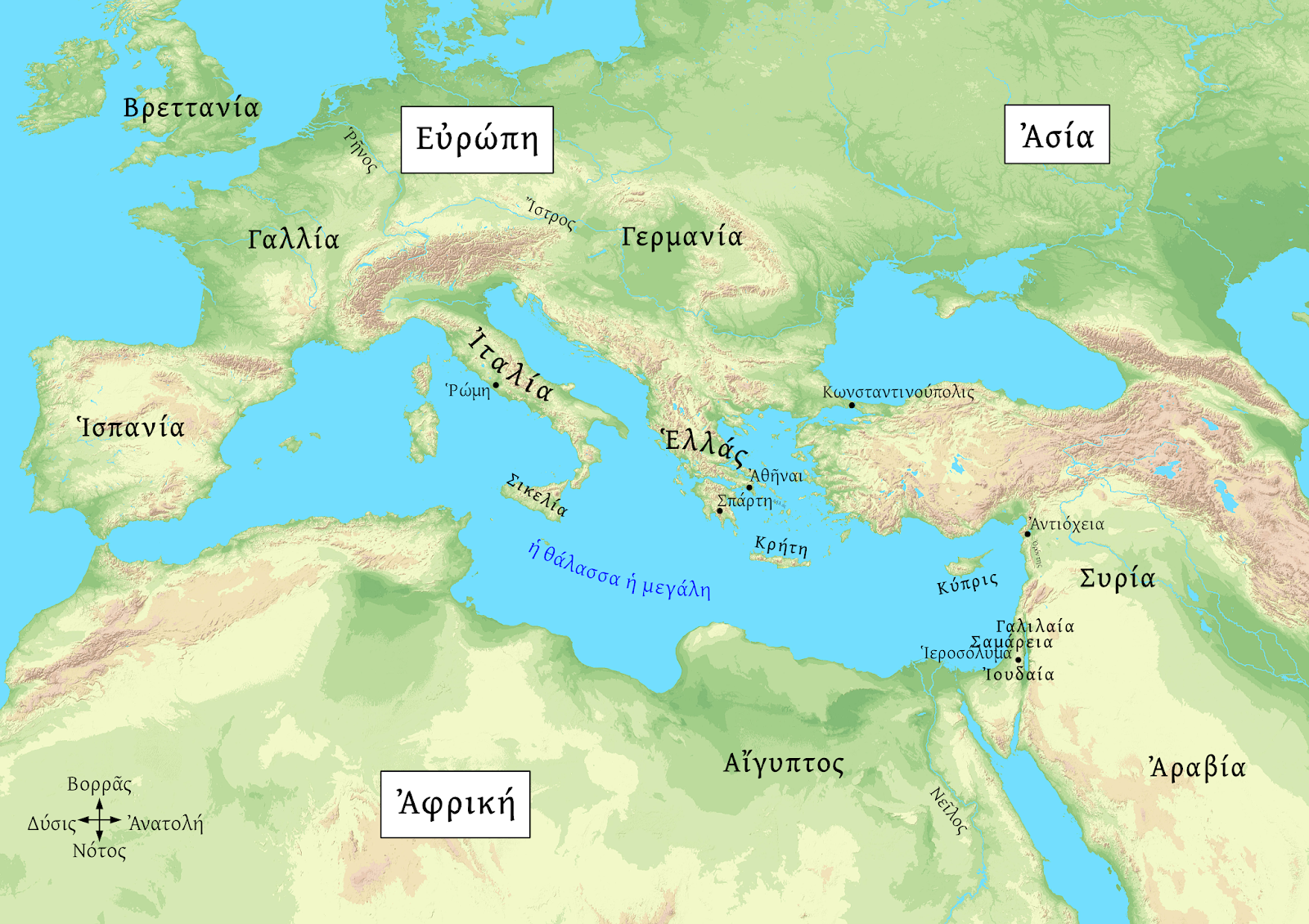
(6) As an additional source of comprehensible input in class, we dipped into Seumas MacDonald’s Lingua Graeca per se Illustrata (LGPSI), which provided the inspiration for the map at the beginning of this post.In these three courses (Koiné Greek II-IV), we made it through chapter 15 of Athenaze, all of Polis Level One, and part of a pre-publication draft of Polis 2.
Our task in Koiné Greek V was to read and talk about the Gospel of Mark in Greek.
(7) Ben Kantor's excellent Koiné Greek Gospel of Mark video was a tremendous help:
(Note: This is the third in a series of posts on last fall’s Intensive Greek Semester. You can read the first two here and here.)
Tuesday, May 12, 2020
Iain Provan on Serious Christian Education

“[T]hose who care greatly about the Bible's authority must necessarily care greatly about the Bible's proper meaning, and the elucidation of that meaning requires literary competence at various levels of Bible reading …. It is not by accident that the churches arising out of the Reformation, with their emphasis on sola scriptura, have historically been primary advocates and organizers of education for everyone. The Reformers understood that reading the Bible well required education—not least because the ability to read itself was the necessary prerequisite of Bible reading. We now live in a world, on the other hand, in which many factors currently conspire against literacy in general, even where people are technically capable of reading words on pages. Literary competence certainly cannot be taken for granted, even in general terms; and if people cannot read well in general, it stands to reason that they will not be able to read the Bible well in particular. In such a situation there is a need for the revival of serious Christian education—education that will not so much tell people what to think about the Bible, but will rather enable them to reengage with the Bible …. If, for example, Old Testament narrative is exhausting but also engaging, it is surely no part of the minister's task to try to intervene between the Bible and the congregation in order to make it less so. The task is surely to facilitate the exhaustion and the engagement, so that God may speak to people through the Scriptures as they experience both realities. The task is to teach literary competence with respect to the Bible as much as it is to preach the Bible's message, so that the sheep in our various flocks are not only hearing the word but also themselves reading it with understanding.” - Iain W. Provan, “Literary Competence and Biblical Authority.” Word & World 26.4 (2006): 375–82, here 382.
Tuesday, May 5, 2020
Where to from here? Three suggestions for "Little Greeks"

In seminary I fancied myself a Greek scholar. I had, after all, taken courses on advanced Greek grammar and advanced Greek exegesis, and I had struggled through the entire Greek New Testament (and nothing else). A few decades later, I see I have only just begun--partly because I was going about it the wrong way, partly because I was hardly going about it at all.

Yet even if I could claim a fluent reading knowledge of the entire corpus of ancient Greek literature, I would still want to be included in Jonathan Robie’s definition of a “Little Greek”:
“A ‘Little Greek’ is someone who is still learning Greek. … Those who don't know aren't dangerous; those who insist they do know are very dangerous. This is just as true for Really Big Greeks as for Little Greeks. Each of us knows only in part; if we want to profit by studying Greek, we must have the humility and the patience to learn one step at a time, to be corrected by others, and be open to the Spirit who guides us in all truth.” - Jonathan RobieWith this in mind, I left my Greek VI students at the end of the semester with three suggestions for Little Greeks like us:
(1) Re-read. To paraphrase Justin Slocum Bailey in this excellent talk, if you want to develop Greek fluency, “the next . . . text you should read” is the one you just finished reading. Here is Slocum Bailey again, explaining the point in more detail:
“From the perspective of second language acquisition, the only way to waste time reading is to read a text exactly once. …. If you read the text many times, your fluency will skyrocket. Lots of language learners waste time by struggling through texts that are too difficult for them or by immediately moving on from a text without having absorbed much of its language or content. By rereading, you ensure that a text does all it can for your fluency, and that all the time you spend reading actually translates into increased fluency.” - Justin Slocum Bailey, “Don't Read, Reread”(2) Keep Reading. By all means, set goals and aim high, but more importantly, build a habit. A little bit every day is better than grand ambitions that never get off the ground. Probably, this means choosing something fun to read. It also means being kind to yourself.
(3) Read with other people. I said this without irony, though our class was meeting over Zoom. In a strange way, social distancing may make reading together more conceivable than in the past because we now know we don't need to be in one place to do so.
Saturday, May 2, 2020
Reflections on Teaching Greek as a Living Language 2: The Prequel

I have been dreaming about a more effective way to teach the biblical languages since the late 1990’s when I watched classmates complete their seminary language requirements without acquiring a lasting ability to read the Bible in Greek or Hebrew. I already knew by experience how valuable it is to be able to read the New Testament in Greek, but I could see that the traditional approach to teaching the biblical languages was not serving the majority of students well.
Around this time I first encountered Randall Buth making what was then an unusual proposal: Why not draw on best practices in second language acquisition and teach the biblical languages by immersion, as modern languages are taught? I had grown up in Africa in a multilingual environment and had observed my missionary parents teaching English to speakers of other languages, so on one level the idea made a lot of sense. But I had my doubts about applying living methods to so-called “dead” languages. A few years later I was in Jerusalem studying modern Hebrew by immersion when I noticed a dramatic improvement in my ability to read biblical Hebrew. From that point, I was sold on the concept. An immersive method clearly produces deeper, longer-lasting results. The problem was I did not know Greek well enough to apply it.
In the summer of 2012, with several years of traditional grammar-translation Greek teaching under my belt, I participated in a Biblical Language Center Greek Fluency Workshop designed both to help Greek instructors develop proficiency in spoken Koine Greek and to demonstrate how to teach ancient Greek as a living language. During the workshop, I posted a sort of personal manifesto on my blog:
I am … persuaded that the languages are worth learning well, that Bible software “power tools” are no substitute, and that—in theory—it should be reasonable for pastors to acquire a reading knowledge of Greek and Hebrew, and maintain the languages while they are in ministry. I am also committed to doing whatever I can to create a better long-term success rate for my students. This means helping students learn deeper with greater retention, and helping them see the payoff and have fun in the process so that they are motivated to continue learning once required classes are done. I am convinced the church needs pastors in general—not just a select few pastor scholars—who read the Bible in its original languages. Perhaps one of the most important ways I can serve the church is to teach the biblical languages effectively, working to turn theory into reality.That fall, in a first attempt to switch to an immersive approach, I went half-way, trying to merge traditional and living-language methods in my Introductory Greek course. I was pleased with the results of this preliminary experiment, but class scheduling demands, a sabbatical, and a trip to England, meant that a second chance to teach introductory Greek never materialized. I did sometimes wonder why—if teaching the languages was so important to me—I wasn’t doing more to develop my own competence in Greek and Hebrew. But in the years that followed I turned my attention to the conventional things an academic is supposed to do, and I began to fear that the effort I had put into developing any sort of active facility in the language would be wasted.
Meanwhile, back in the Greek-language classroom, my colleague, Wes Olmstead, made the switch to a living language approach to teaching ancient Greek. When Wes proposed the idea for an “Intensive Semester” of immersive Greek, I jumped at the opportunity to be involved—both to support the experience in any way I could and to learn Greek more deeply in the process.
I wrote up some initial reflections on the fall semester at the beginning of January, which you can read here. Then came the winter semester and the challenge of attempting to teach through the Greek text of 1 Corinthians in Greek. (Εἰ θέλεις μανθάνειν τὴν Ἑλληνικὴν γλῶσσαν, δίδαξον αὐτήν!) Now that the dust has settled, I hope to return to a sequel that gives a little more detail on what we did last fall, our influences and the resources we used. Stay tuned.
Thursday, January 2, 2020
Reflections on Teaching Ancient Greek as a Living Language

In traditional biblical language courses, the majority of class time is spent talking about Greek or Hebrew in English. Students labour over analysing word forms, memorizing vocabulary by rote, and producing their own English translations. This approach appeals only to a small percentage of analytical learners, and even at the best of times tends to result in a superficial understanding about how the language works, not a knowledge of the language itself. There is a reason why most students who study Greek or Hebrew do not succeed in maintaining a long-term reading knowledge of the language.
Thankfully, there is growing interest in another approach to teaching the biblical languages that draws on best practices in modern second-language pedagogy. We decided to adopt this approach and teach Ancient Greek in Greek out of a desire to make the language more accessible to anyone who wants to learn, and to help students internalize the language so that they will be better prepared to develop a life-long practice of reading the Bible in Greek. As far as I know, the combination of an intensive five-course semester of Greek with a living-language methodology is unique in North America.
Of course, there are things we will do differently next time, but the initial experiment was a success. Students who began the semester without even knowing the Greek alphabet spent the final three weeks working through the Greek text of the Gospel of Mark, and talking about it in Greek. On our last day of class, we read and discussed Mark’s account of Jesus’ death and resurrection (chapters 15-16). Then the room full of 30 students stood and recited the Lord’s prayer in unison. The following day, the students wrote their final exams, including essay questions, entirely in Greek. I call that a win.
Time will tell how many of our Greek guinea pigs maintain a long-term reading knowledge of the language, but there is an initial sign that the course achieved one major goal: to inspire students to continue studying Greek. Students who major in Biblical Studies at Briercrest are required to complete four language courses in either Greek or Hebrew. Our students have already completed five, and more than half the class are now registered for next semester’s entirely optional Koiné Greek VI course on the Greek text of 1 Corinthians.
This is the first in a 3-part series. Parts 2 and 3 are here:
Tuesday, December 31, 2019
A 2019 Reading Retrospective
Since everyone else is doing it and I wanted to get a blog post written before the year runs out, I’ve decided to post a lightly annotated list of books I finished reading in 2019.
First, a few stats: My Zotero records tell me I finished reading 33 books in 2019, including Winnie the Pooh, The House at Pooh Corner, The 21 Balloons, and The Hound of the Baskervilles. That’s up from 32 in 2017, and tied with 2018, but this year I didn’t read War and Peace, so 2018 still takes the cake.
All but 7 were completed before I returned to Canada and to full-time teaching. (Go figure.) I count 15 novels and children’s books, 5 audiobooks, and 5 that I read aloud. (As long as my 12-year-old daughter will consent to having books read to her, I will keep reading them. We are currently enjoying The Screwtape Letters.)
Without further ado, here is the list, followed by my "best of" selections:
Ash, Christopher. The Book Your Pastor Wishes You Would Read. The Good Book Company, 2019.
Atwood, Margaret. The Handmaid’s Tale. Toronto: McClelland & Stewart, 1985. (Audiobook)
Campbell, Douglas A. Paul: An Apostle’s Journey. Grand Rapids: Eerdmans, 2018. (Audiobook)
Conan Doyle, Sir Arthur. The Hound of the Baskervilles. London: George Newnes, 1902.
Forster, E. M. The Longest Journey. London: Arnold, 1907.
Forster, E. M. Where Angels Fear to Tread. London: William Blackwood & Sons, 1905.
Forster, E. M. Howards End. London: Edward Arnold, 1910.
Johnson, Luke Timothy. Prophetic Jesus, Prophetic Church: The Challenge of Luke-Acts to Contemporary Christians. Grand Rapids: Eerdmans, 2011. (Re-read for class for the 4th or 5th time.)
Kugel, James L. How to Read the Bible: A Guide to Scripture, Then and Now. New York: Free Press, 2008. (Audiobook)
Lewis, C. S. That Hideous Strength. London: The Bodley Head, 1945. (Read aloud)
(I read this novel multiple times as a child; this was the first time in probably 20+ years.)
Lewis, C. S. The Great Divorce. New York: Macmillan, 1946. (Re-read after @ 20 years; read aloud)
Martínez, Carlos. A Strange Odyssey. Confessions of a Classicist. Grupo Editorial Círculo Rojo S.L., 2019.
Martyn, J. Louis. Theological Issues in the Letters of Paul. Nashville: Abingdon, 1997.
Matthews, Shelly. Perfect Martyr: The Stoning of Stephen and the Construction of Christian Identity. Oxford University Press, 2010.
McKnight, Scot. Reading Romans Backwards: A Gospel of Peace in the Midst of Empire. Waco: Baylor, 2019.
Meeks, Wayne A. The First Urban Christians: The Social World of the Apostle Paul. New Haven: Yale University Press, 1983.
Millar, Fergus. The Roman Near East: 31 BC - AD 337. Cambridge, MA: Harvard University Press, 1993.
Milne, A. A. The House at Pooh Corner. London: Methuen, 1928.
Milne, A. A. Winnie-the-Pooh. London: Methuen, 1926.
Myers, Benjamin. The Apostles’ Creed: A Guide to the Ancient Catechism. Lexham Press, 2018. (Read aloud)
Noll, Mark A. Jesus Christ and the Life of the Mind. Grand Rapids: Eerdmans, 2013.
Pène du Bois, William. The 21 Balloons. New York: Viking Press, 1975. (A book I remember reading as a child; read aloud after hearing about the eruption on Anak Krakatoa.)
Pullman, Philip. Golden Compass. New York: Random House, 1996.
(I checked this one out from the library for my daughter, decided to double-check it myself first, and got hooked. Pullman is a fine writer, and I thoroughly enjoyed the Oxford and East Anglia settings. Aside from the abrupt in-your-face anti-Christian moralistic ending, it’s a fine read.)
Ransome, Arthur. Swallows and Amazons. London: Vintage Children’s Classics, 2012.
Rico, Christophe, and Lior Ashkenazi. Polis: Speaking Ancient Greek as a Living Language, Level One, Student’s Volume. Edited by Michael Daise. Polis Institute Press, 2015.
Riordan, Rick. The Lightning Thief. New York: Hyperion, 2005. (A daughter's recommendation.)
Siegel, Robert. Alpha Centauri. Westchester, IL: Crossway, 1980. (Read aloud)
(I remembered my grade six teacher, Miss Fehr, reading this book to the class, but couldn't remember how it ended. I now think she never finished it--and I can see why.)
Spiegelman, Art. The Complete Maus: A Survivor’s Tale. New York: Pantheon Books, 2011.
Thucydides. History of the Peloponnesian War. Translated by Richard Crawley. London: Dent, 1874. (Audiobook)
Williams, Leslie Winfield. Emblem of Faith Untouched: A Short Life of Thomas Cranmer. Grand Rapids: Eerdmans, 2016. (Audiobook)
Williams, Peter J. Can We Trust the Gospels? Wheaton, IL: Crossway, 2018.
Woolf, Virginia. To the Lighthouse. London: Hogarth Press, 1927.
"Best of":
First, a few stats: My Zotero records tell me I finished reading 33 books in 2019, including Winnie the Pooh, The House at Pooh Corner, The 21 Balloons, and The Hound of the Baskervilles. That’s up from 32 in 2017, and tied with 2018, but this year I didn’t read War and Peace, so 2018 still takes the cake.
All but 7 were completed before I returned to Canada and to full-time teaching. (Go figure.) I count 15 novels and children’s books, 5 audiobooks, and 5 that I read aloud. (As long as my 12-year-old daughter will consent to having books read to her, I will keep reading them. We are currently enjoying The Screwtape Letters.)
Without further ado, here is the list, followed by my "best of" selections:
Ash, Christopher. The Book Your Pastor Wishes You Would Read. The Good Book Company, 2019.
Atwood, Margaret. The Handmaid’s Tale. Toronto: McClelland & Stewart, 1985. (Audiobook)
Balme, Maurice, Gilbert Lawall, Luigi Miraglia, and Tommaso Francesco Bórri. Athenaze: Introduzione al greco antico. Parte I. 2d ed. Montella, Avellino: Accademia Vivarium Novum, 2018. (Not including the Italian)
Campbell, Douglas A. Paul: An Apostle’s Journey. Grand Rapids: Eerdmans, 2018. (Audiobook)
Conan Doyle, Sir Arthur. The Hound of the Baskervilles. London: George Newnes, 1902.
Forster, E. M. The Longest Journey. London: Arnold, 1907.
Forster, E. M. Where Angels Fear to Tread. London: William Blackwood & Sons, 1905.
Forster, E. M. Howards End. London: Edward Arnold, 1910.
Johnson, Luke Timothy. Prophetic Jesus, Prophetic Church: The Challenge of Luke-Acts to Contemporary Christians. Grand Rapids: Eerdmans, 2011. (Re-read for class for the 4th or 5th time.)
Kugel, James L. How to Read the Bible: A Guide to Scripture, Then and Now. New York: Free Press, 2008. (Audiobook)
Lewis, C. S. That Hideous Strength. London: The Bodley Head, 1945. (Read aloud)
(I read this novel multiple times as a child; this was the first time in probably 20+ years.)
Lewis, C. S. The Great Divorce. New York: Macmillan, 1946. (Re-read after @ 20 years; read aloud)
Martínez, Carlos. A Strange Odyssey. Confessions of a Classicist. Grupo Editorial Círculo Rojo S.L., 2019.
Martyn, J. Louis. Theological Issues in the Letters of Paul. Nashville: Abingdon, 1997.
Matthews, Shelly. Perfect Martyr: The Stoning of Stephen and the Construction of Christian Identity. Oxford University Press, 2010.
McKnight, Scot. Reading Romans Backwards: A Gospel of Peace in the Midst of Empire. Waco: Baylor, 2019.
Meeks, Wayne A. The First Urban Christians: The Social World of the Apostle Paul. New Haven: Yale University Press, 1983.
Millar, Fergus. The Roman Near East: 31 BC - AD 337. Cambridge, MA: Harvard University Press, 1993.
Milne, A. A. The House at Pooh Corner. London: Methuen, 1928.
Milne, A. A. Winnie-the-Pooh. London: Methuen, 1926.
Myers, Benjamin. The Apostles’ Creed: A Guide to the Ancient Catechism. Lexham Press, 2018. (Read aloud)
Noll, Mark A. Jesus Christ and the Life of the Mind. Grand Rapids: Eerdmans, 2013.
Pène du Bois, William. The 21 Balloons. New York: Viking Press, 1975. (A book I remember reading as a child; read aloud after hearing about the eruption on Anak Krakatoa.)
Pullman, Philip. Golden Compass. New York: Random House, 1996.
(I checked this one out from the library for my daughter, decided to double-check it myself first, and got hooked. Pullman is a fine writer, and I thoroughly enjoyed the Oxford and East Anglia settings. Aside from the abrupt in-your-face anti-Christian moralistic ending, it’s a fine read.)
Ransome, Arthur. Swallows and Amazons. London: Vintage Children’s Classics, 2012.
Rico, Christophe, and Lior Ashkenazi. Polis: Speaking Ancient Greek as a Living Language, Level One, Student’s Volume. Edited by Michael Daise. Polis Institute Press, 2015.
Riordan, Rick. The Lightning Thief. New York: Hyperion, 2005. (A daughter's recommendation.)
Siegel, Robert. Alpha Centauri. Westchester, IL: Crossway, 1980. (Read aloud)
(I remembered my grade six teacher, Miss Fehr, reading this book to the class, but couldn't remember how it ended. I now think she never finished it--and I can see why.)
Spiegelman, Art. The Complete Maus: A Survivor’s Tale. New York: Pantheon Books, 2011.
Thucydides. History of the Peloponnesian War. Translated by Richard Crawley. London: Dent, 1874. (Audiobook)
Williams, Leslie Winfield. Emblem of Faith Untouched: A Short Life of Thomas Cranmer. Grand Rapids: Eerdmans, 2016. (Audiobook)
Williams, Peter J. Can We Trust the Gospels? Wheaton, IL: Crossway, 2018.
Woolf, Virginia. To the Lighthouse. London: Hogarth Press, 1927.
"Best of":
- Best book published in 2019: I seldom read books in the year they were published. Of the three 2019 books I read this year--surely a record--Carlos Martínez's, A Strange Odyssey gets the prize for being the most stimulating.
- Most Educational (in a good way): Balme, Maurice, Gilbert Lawall, Luigi Miraglia, and Tommaso Francesco Bórri. Athenaze: Introduzione al greco antico. (The Greek parts; I don't read Italian.)
- Most Relaxing Bedtime Reading: Arthur Ransome, Swallows and Amazons. (Strangely satisfying. I looked forward to the end of the day when I could read a few pages before my own bedtime.)
- Best of: C.S. Lewis, That Hideous Strength. (Published in 1945. Still very relevant.)
Subscribe to:
Posts (Atom)