
Friday, January 21, 2022

A 2021 Reading Retrospective

Instead of a belated tally of books completed in 2021, which would impress no one,* I mention here a few reading highlights. In most cases these are not books--which means you can read them too, for free, online.

(1) Black Lives Matter: David Blight's Open Yale History course on the American Civil War has nothing directly to do with last summer's protests, but it helped put them in historical perspective and--more than anything else I've read in the last two years--it explained why the protests matter. Sometimes the best way to learn about the present is to study the past.

(2) Covid-19: Judging from the place of privilege it occupies in my mental furniture, Alan Jacobs's musings on the problem of "scale" are among the most significant I've read on Covid-19. They are developed in detail in Alan's essay in the Hedgehog Review, though I expect I first encountered it on his blog, which I read assiduously, and you should too.

(3) On Reading: The main thrust of Alastair Fowler's fascinating essay, "C. S. Lewis: Supervisor" (available in full here and here), is to define education as reading--and remembering what you read. A few excerpts: 

"The flow of Lewis’s writing and speaking had much to do with this remarkable memory. .... It was not principally memoria ad verba but rather ad res – memory of the substance, aimed at grasp of contents through their structure. ... Lewis’s innate memorial powers were developed by education, first at school and then with his private tutor William Kirkpatrick. At Oxford they were strengthened by having to depend on the Bodleian Library rather than on his own books. .... Later ... his reading habits had become ingrained, and he continued to rely on memory. Often he used books almost in the medieval way, as memory prompts. Literary memory depends on use: it must be frequently refreshed. .... Lewis had almost total recall of words (he remembered new vocabulary after once looking it up in the dictionary), yet he had to go over texts frequently – sometimes immediately before a tutorial. Consequently his reading and re-reading were astonishingly copious. Reading habits, of course, were different in the fifties; I used then to read ten hours a day. Lewis, who read far faster, read with surer grasp, and read whenever commitments allowed – read even at mealtimes – read prodigiously."

Alan Jacobs explains why this matters:

"[A] book becomes more fully itself when we see both how it resembles and how is differs from other books; one discipline of study takes on its proper hues only when we see its relations to other disciplines that stand close to it or very far away. My repertoire of analogies is my toolbox, or my console of instruments, by which I comprehend and navigate the world. It can’t be too large; every addition helps, at least a bit."

Which reminds me, there are some books I should be reading ....

Credit: NYTimes

*Not that impressing anyone is the point. ... right?

Thursday, January 6, 2022

A 2022 Reading List


Scot McKnight used to give himself a new fountain pen every Christmas. This year I did something similar with books.


I read a draft of Adele Reinhartz's Befriending the Beloved Disciple in Jerusalem in December 2000. My former teacher's sequel, Cast out of the Covenant, has been on my to-read list since it came out in 2018. Now that I have a copy of my own, I hope to get to it sooner rather than later. For Adele's reflections on her "Journey with John" and an overview of the book's argument, see this short essay. 


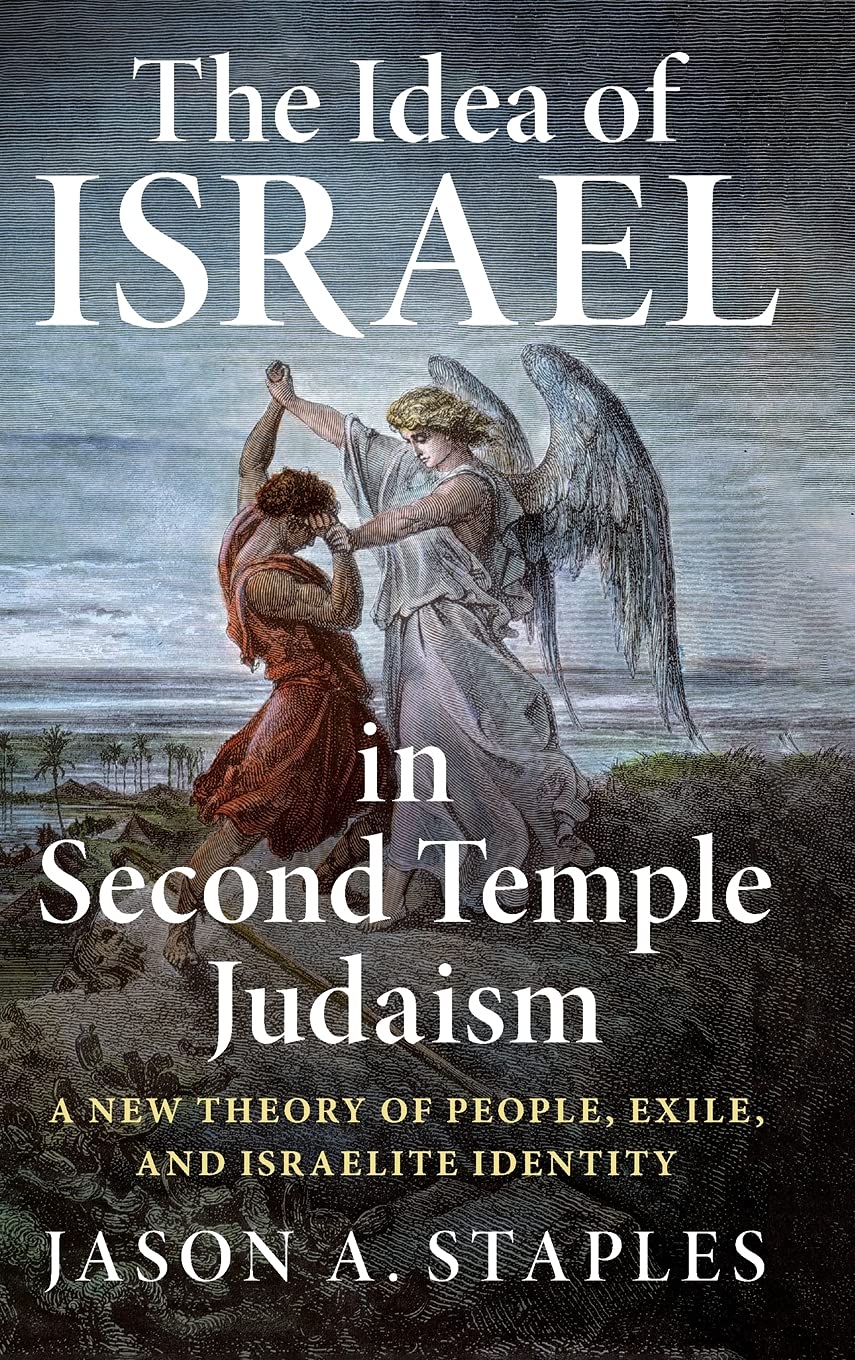
I first encountered Jason Staples's "new theory of ... Israelite identity"--to quote the sub-title of his 2021 monograph--years ago at SBL, and have kept an eye on his work ever since. When Scot McKnight named The Idea of Israel as the "best academic book" he "read this year," I decided not to wait until the paperback edition comes out.


Christopher Stroup's The Christians Who Became Jews is not the only book whose title and topic make me wish I had written it first. Since my research and publishing efforts have centered on ethnicity in ancient Judaism and, separately, Luke-Acts, I decided to take advantage of a Yale University Press sale and a trip to the United States to pick up a copy of this monograph that treats both at once. 


Also from Yale University Press, Lawrence Wills's recent Introduction to the Apocrypha promises to inform the course I teach on "Jewish Backgrounds to Early Christianity."

To round out my Yale University Press order, I picked up a copy of Brent Nongbri's much-discussed, God's Library: The Archaeology of the Earliest Christian Manuscripts, which is, fortunately, now out in paperback.

Attentive readers of titles (and subtitles) will notice a pattern here: "Jews and Anti-Judaism in the Gospel of John," "Jewish Books in Christian Bibles," "The Christians who Became Jews," "The Idea of Israel in Second Temple Judaism." In different ways all four books deal squarely with my own persistent scholarly preoccupation with early Judaism, the Jewish context of early Christianity, and the relationship between Jews and early Christians. I don't expect to agree fully with any of these books (who does?), but I do expect to learn much and to be stimulated to look at familiar texts with fresh eyes.

I suffer from a tendency to buy books faster than I read them, but these I hope to get to in 2022. Just perhaps--come spring--I may pull one or two of my own languishing projects off the shelf and make some headway on writing as well as reading in pandemic year 3.

In addition to picking up a book order, our trip the United States including a little snowshoeing:


Tuesday, October 19, 2021

Some News: Introducing Dr. & Dr. Miller

Four years ago the Miller family traveled to England so that t. could pursue a PhD in History at the University of Cambridge. We returned to Saskatchewan in 2019, in time to shelter in place through a pandemic, but the Cambridge journey--or this leg of the journey--only recently came to an end. 

In a way this is old news for us: t. successfully defended her thesis in August during a Zoom viva. But she only received official approval from the faculty of history last week, along with the examiners' comments and a note that she passed with "no corrections."

Short of attending commencement, which is not in the cards, this is as official as it's going to be. And this is as much authorization as I am going to get to publicly congratulate Dr. Miller on a job well done!


Tuesday, October 5, 2021

Old Testament Faculty Position at Briercrest College

I am happy to report that Briercrest College is looking to fill a faculty position in Old Testament: 

Briercrest College invites applications for a full-time faculty position in the field of Biblical Studies - Old Testament commencing August 1st, 2022. 

The successful candidate will be an enthusiastic teacher and researcher. Τhey will contribute to an established Biblical Studies Department in Briercrest's engaging intellectual and spiritual environment where the liberal arts, alongside biblical studies, stand at the core of all undergraduate degree programs. Candidates should possess a Ph.D. (although exceptional ABDs may be considered) and demonstrate potential for excellence in teaching, research, and service to the church. Experience teaching Biblical Hebrew using the communicative approach will be an asset.

More details about the position are here. 

Saturday, September 25, 2021

Vaccination Aphorisms

When Christians are unmoored from love it dishonours Love. 
When Christians are unmoored from truth it dishonours the Truth.
Notice that the aphorisms do not single out individuals for criticism. As Augustine observes in one of my favourite passages, those who are sincerely wrong—as we all are a lot of the time—are to be corrected, but those who knowingly spread falsehood are culpable. I would add that those who abet falsehood are also culpable. David French, I suspect, would agree. 

Christian leaders charged with speaking about the Truth must also speak truth as far as they are able. This does not mean anyone can or should comment on every matter of public interest (especially in areas outside their competence). Stamping out fires is a distraction from the Truth-speaker's and Truth-seeker's vocation. 

But posture matters. Part of the humility that comes with pursuit of truth and love for the Truth is acknowledgement of the limits of one's own knowledge and a posture of respect for those with expertise in fields other than one's own. 

And sometimes—say, in a national health crisis when evangelical Christians are among the most vaccine resistant—the truth is called for: Get vaccinated.


Saturday, September 11, 2021

Greek Alphabet Song (Modern Greek Pronunciation)

Thirteen years ago my friend, Luke Johnson, composed and recorded a Greek Alphabet song for my Greek students, using a Reconstructed Koine pronunciation. 

This summer Katy Turgeon, one of the teaching assistants in our second Immersive Greek Semester, recorded a cover of Luke's tune with the help of Geoff Dresser, Briercrest's Worship Arts professor. The reason for the new version is our switch from Reconstructed Koine to Modern Greek pronunciation in our Ancient Greek language classes, but Katy's version--and Geoff's guitar solo--are worth a listen regardless of which pronunciation system you prefer.  


If the play button doesn't work on the embedded file, click here for Katy's recording.

You can listen to Luke's original here.


Thursday, July 15, 2021

Romans Readings

I decided to switch up the reading requirements for this fall's modular course on Paul's letter to the Romans. I will still require Stephen Westerholm's Understanding Paul (Baker Academic, 2004), which remains a fine introduction to the worldview of Romans:


But instead of Leander Keck's much longer (385 pp.) commentary on Romans (Abingdon, 2005), I am assigning (1) Beverly Roberts Gaventa's short and wonderfully engaging, When in Romans: An Invitation to Linger with the Gospel According to Paul (Baker Academic, 2016):


(2) John Barclay's hot-off-the-press, Paul and the Power of Grace (Eerdmans, 2020):


(3) A longer selection of book chapters and journal articles by other Pauline scholars.

I still regard Keck's commentary as the best short commentary on Romans available—and my seminary students will still need to read it—but it is dense, and I am not sure my undergraduate students give themselves enough time to digest it. In different ways, Westerholm, Gaventa, and especially the chapters on Romans in Barclay will have to do as a shorter and more accessible pre-class discussion of Paul's argument.

Dropping Keck lets me assign a combination of recent and seminal journal articles and essays on parts of Romans, without adding (much!) to the overall reading load:

Dunn, James D. G. “The New Perspective on Paul.” Bulletin of the John Rylands University Library 65, no. 2 (1983): 95–122.

Eastman, Susan. “Double Participation and the Responsible Self in Romans 5-8.” Pages 93–110 in Apocalyptic Paul: Cosmos and Anthropos in Romans 5-8. Edited by Beverly Roberts Gaventa. Waco: Baylor University Press, 2013.

Gorman, Michael J. “‘Justified by Faith … Crucified with Christ’: Reconciliation with God through Participation in Christ.” Pages 111-131 in Reading Paul. Eugene, OR: Cascade Books, 2008.

Hays, Richard B. “Abraham as Father of Jews and Gentiles.” Pages 61–84 in The Conversion of the Imagination: Paul as Interpreter of Israel’s Scripture. Grand Rapids: Eerdmans, 2005.

Käsemann, Ernst. “‘The Righteousness of God’ in Paul.” Pages 168–82 in New Testament Questions of Today. Philadelphia: Fortress, 1969.

Linebaugh, Jonathan A. “Announcing the Human: Rethinking the Relationship between Wisdom of Solomon 13-15 and Romans 1.18-2.11.” New Testament Studies 57, no. 2 (2011): 214–37.

McCaulley, Esau. “Freedom Is No Fear: The New Testament and a Theology of Policing.” Pages 25–46 in Reading While Black: African American Biblical Interpretation as an Exercise in Hope. Downers Grove: IVP Academic, 2020.

Wright, Nicholas Thomas. “Christ, the Law and the People of God: The Problem of Romans 9-11.” Pages 231–57 in The Climax of the Covenant: Christ and the Law in Pauline Theology. Minneapolis: Fortress, 1991. (too long, unfortunately)

Zoccali, Christopher. “‘And so All Israel Will Be Saved’: Competing Interpretations of Romans 11.26 in Pauline Scholarship.” Journal for the Study of the New Testament 30, no. 3 (2008): 289–318.

The effect of assigning readings from a variety of perspectives will, I hope, increase student engagement as well as stimulate my own learning.

Here are the college and seminary versions of the syllabus for anyone who is interested:

For an assortment of other Romans-related posts, click here.