Showing posts with label Early Christianity. Show all posts

Friday, February 14, 2025

Gary Anderson on Hebrew as the Language of Jesus

Reviewing the endnotes to Gary Anderson’s impressive history of sin (!), I came across this gem on New Testament scholars, Modern Hebrew and the language of Jesus:

Mishnaic Hebrew, in its limited sense, refers to the Hebrew of the Mishnah itself, a relatively early rabbinic work [ca. 200 CE] …. But when we speak of the dialect of Mishnaic Hebrew, we are talking about the living Hebrew language of the first couple of centuries of the Common Era, in other words, the language of Jesus himself.”

“Scholars vary in their opinions as to how fluent Jesus was in the various languages with which he was familiar (Aramaic, Hebrew, and Greek). Most New Testament scholars assume that Aramaic was his mother tongue and that Hebrew was a secondary language. …. Part of the problem is that the best scholarship on the Hebrew of the late Second Temple period is being done at the Hebrew University and is written in modern Hebrew. Only a handful of New Testament scholars could follow this discussion, and I know of none who do. As a result, the case being made for Hebrew as a living language in the first and second centuries CE has gone unnoticed.” 

~ Gary A. Anderson, Sin: A History (New Haven, CT: Yale University Press, 2009), 95-6, 215 note 1 (emphasis added)

The book itself is a fascinating analysis of a shift from sin conceived as burden to sin conceived as debt, that ranges across the testaments, through rabbinic literature and Christian Syriac, concluding with a rousing defense of Anselm’s Cur Deus Homo? I wager that only a handful of Old Testament scholars could attempt such a feat.

Back to the topic of Hebrew as a living language during the Second Temple period: My posts on Jesus’ mother tongue from 15 years ago (!) are here:

Jesus’ Mother Tongue

Jesus' Mother Tongue Part 2: The Supposed Dominance of Aramaic in First Century Galilee

Thursday, January 6, 2022

A 2022 Reading List


Scot McKnight used to give himself a new fountain pen every Christmas. This year I did something similar with books.


I read a draft of Adele Reinhartz's Befriending the Beloved Disciple in Jerusalem in December 2000. My former teacher's sequel, Cast out of the Covenant, has been on my to-read list since it came out in 2018. Now that I have a copy of my own, I hope to get to it sooner rather than later. For Adele's reflections on her "Journey with John" and an overview of the book's argument, see this short essay


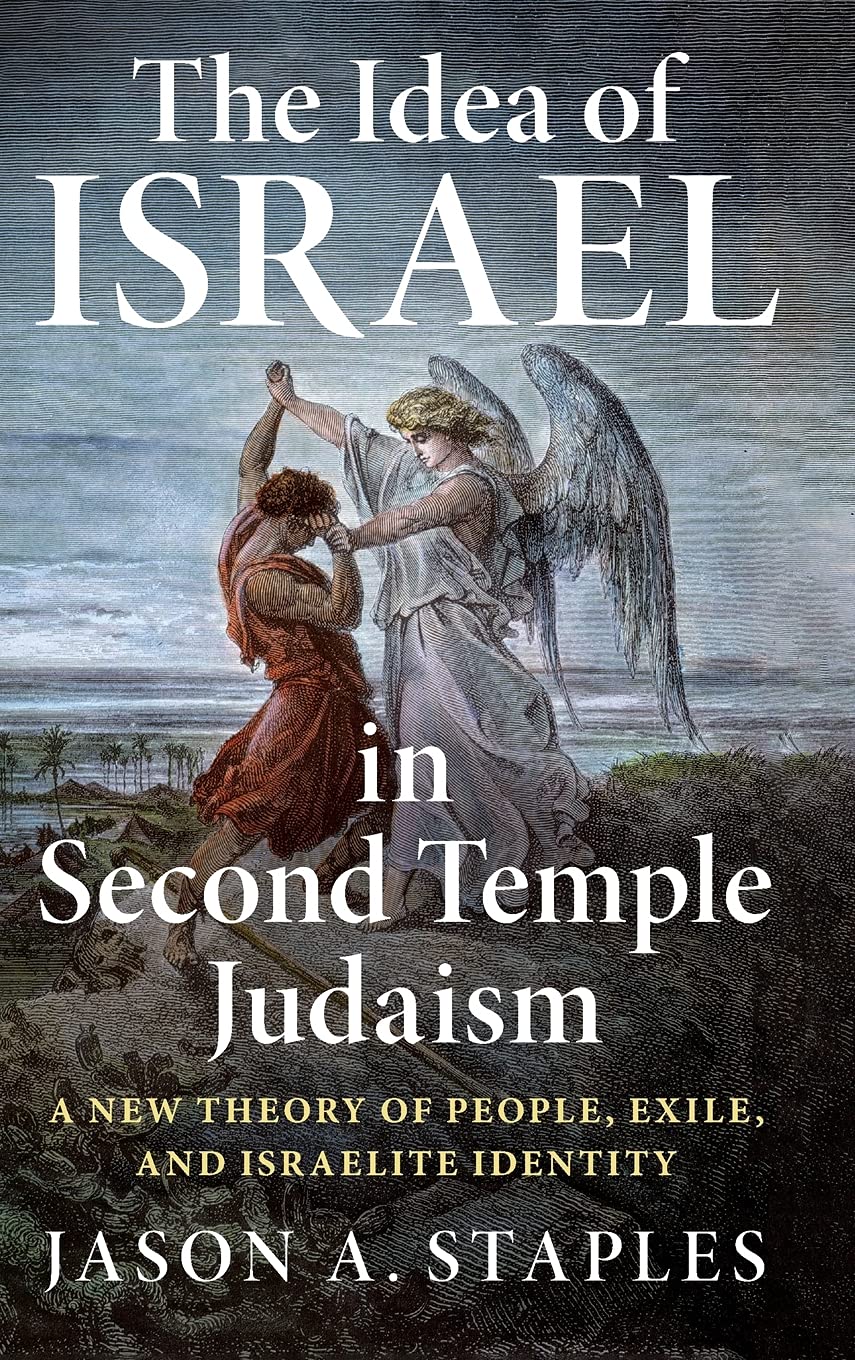
I first encountered Jason Staples's "new theory of ... Israelite identity"--to quote the sub-title of his 2021 monograph--years ago at SBL, and have kept an eye on his work ever since. When Scot McKnight named The Idea of Israel as the "best academic book" he "read this year," I decided not to wait until the paperback edition comes out.


Christopher Stroup's The Christians Who Became Jews is not the only book whose title and topic make me wish I had written it first. Since my research and publishing efforts have centered on ethnicity in ancient Judaism and, separately, Luke-Acts, I decided to take advantage of a Yale University Press sale and a trip to the United States to pick up a copy of this monograph that treats both at once. 


Also from Yale University Press, Lawrence Wills's recent Introduction to the Apocrypha promises to inform the course I teach on "Jewish Backgrounds to Early Christianity."

To round out my Yale University Press order, I picked up a copy of Brent Nongbri's much-discussed, God's Library: The Archaeology of the Earliest Christian Manuscripts, which is, fortunately, now out in paperback.

Attentive readers of titles (and subtitles) will notice a pattern here: "Jews and Anti-Judaism in the Gospel of John," "Jewish Books in Christian Bibles," "The Christians who Became Jews," "The Idea of Israel in Second Temple Judaism." In different ways all four books deal squarely with my own persistent scholarly preoccupation with early Judaism, the Jewish context of early Christianity, and the relationship between Jews and early Christians. I don't expect to agree fully with any of these books (who does?), but I do expect to learn much and to be stimulated to look at familiar texts with fresh eyes.

I suffer from a tendency to buy books faster than I read them, but these I hope to get to in 2022. Just perhaps--come spring--I may pull one or two of my own languishing projects off the shelf and make some headway on writing as well as reading in pandemic year 3.

In addition to picking up a book order, our trip the United States including a little snowshoeing:


Wednesday, December 26, 2018

First-Century Memories of the Maccabees Part 2: The Origins of Hanukkah

(This post is the second in a series on evidence for first-century CE memories of the Maccabean revolt. Part 1 is here.)

In a 1956 attempt to establish the existence of a Maccabean-inspired national resistance movement in the first century, William Farmer responded to the question, “Were the Maccabees Remembered?” by appealing to evidence for popular celebrations commemorating the Maccabean revolt:
“We rest the case for our thesis that the Maccabees were remembered by the Jews in Palestine during the first century A.D. on the fact that there were national holidays celebrated annually by the Jews in this period which commemorated certain great events from the time of the Maccabees.” [1]
The most important and most widely attested such festival was Hanukkah:
“No one questions the fact that the festival of Hanukkah was instituted in the time of the Maccabees to commemorate the rededication of the temple after it had been recovered and cleansed from the defiling hands of the Seleucids by the victorious Judas and his brothers.” [2] (133).
N.T. Wright, who wonders why Farmer’s book was “so long neglected,” goes further: Hanukkah was a “big annual festival” that “was enthusiastically observed in Jesus’ day.” [3] The festival’s popularity is important because it means “a far wider circle than simply the literate few would have known the story; the connection of revolt against the pagans, action in the Temple, and the establishment of a royal house was firmly impressed on the popular mind.” [4]

Because first-century Jews knew the story and had Maccabees on the mind, otherwise obscure similarities take on major significance. Wright endorses Farmer’s brilliant suggestion that Jesus’ triumphal entry and Temple cleansing were “Maccabean actions” that recalled Judas’s purification of the Temple in 164 BCE. [5]

Gerd Theissen argues in much the same way from the celebration of Hanukkah to a precise parallel between the Maccabean revolt and Jesus’ eschatological discourse in Mark 13: “The annual Feast of Dedication … kept alive memories of the Maccabean revolt. … Thanks to the Feast of Dedication, every Jew, whether educated in the law or not, knew (1) what the ‘desolating sacrilege’ was, and (2) that it had already, once before, been the occasion for flight to the mountains.” [6]

I hope to return to Theissen’s and Wright’s proposals in due course. First, let’s examine the evidence. What do we know about the size of the Hanukkah festival in the first century? Can we be confident it was so enthusiastically observed that Jesus’ triumphal entry would have reminded the Passover crowds of Judas’s purification of the temple 200 years earlier?

In this post, I begin with our two most important sources for the Maccabean revolt and the origins of Hanukkah.

Dating 1 and 2 Maccabees

1 Maccabees was written after 134 BCE and almost certainly before 63 BCE. We know that 1 Maccabees was composed during or after the reign of John Hyrcanus (134-104 BCE) because 1 Macc 16:24 mentions the annals of John Hyrcanus’s high priesthood. The book’s attempt to legitimate the Hasmonean dynasty through its story of Mattathias and his sons, combined with its positive attitude toward the Romans, secures 63 BCE as the terminus ante quem because that is when the Roman general Pompey brought Judaea under Roman control, ending almost a century of independent Hasmonean rule. [7]

Dating 2 Maccabees is more difficult. A letter attached to the beginning of 2 Maccabees fixes the terminus post quem of the book’s final form to 124 BCE. [8] Although some scholars have proposed dates as late as the mid-first-century CE for the book’s composition, a date before 63 BCE is most likely because (1) as in 1 Maccabees, 2 Maccabees views the Romans positively (see 2 Macc 4:11); (2) the author would have been unlikely to say that Jerusalem was still “in the possession of the Hebrews” (2 Macc 15:37) after 63 BCE. [9]

Hanukkah in 1 Maccabees

According to 1 Maccabees, there was no initial victory celebration when Judas entered the Temple along with his brothers and the entire Israelite army in 164 BCE:
“There they saw the sanctuary desolate, the altar profaned, and the gates burned. … Then they tore their clothes and mourned with great lamentation; they sprinkled themselves with ashes and fell face down on the ground” (1 Macc 4:38-40a NRSV).
After inspecting the desecrated Temple compound, Judas assigned priests to tear down the altar Antiochus had defiled, to build a new altar, and to rebuild the Temple and its furnishings (1 Macc 4:41-51). When this work was finished, the people fell on their faces again, but this time with joy instead of lamentation:
53 [T]hey rose and offered sacrifice, as the law directs, on the new altar of burnt offering that they had built. 54 At the very season and on the very day that the Gentiles had profaned it, it was dedicated with songs and harps and lutes and cymbals. 55 All the people fell on their faces and worshiped and blessed Heaven, who had prospered them. 56 So they celebrated the dedication of the altar for eight days, and joyfully offered burnt offerings; they offered a sacrifice of well-being and a thanksgiving offering. 57 They decorated the front of the temple with golden crowns and small shields; they restored the gates and the chambers for the priests, and fitted them with doors. 58 There was very great joy among the people, and the disgrace brought by the Gentiles was removed. 59 Then Judas and his brothers and all the assembly of Israel determined that every year at that season the days of dedication of the altar should be observed with joy and gladness for eight days, beginning with the twenty-fifth day of the month of Chislev. (1 Macc 4:53-59 NRSV)
Hanukkah in 2 Maccabees

2 Maccabees contains three descriptions of Hanukkah:

(1) In the form we have it, 2 Maccabees begins with two letters. The first was sent in 124 BCE to “the Jewish brothers in Egypt” (1:1-9). The letter appears to quote from an earlier letter sent in 143 BCE that describes a period of affliction that began in the years after Jason departed from the land, when the Jews in Judaea prayed, offered sacrifices, “lit the lamps and set out the loaves” (1:7-8). The letter concludes by requesting the addressees to “keep the days of Tabernacles in the month of Chislev” (1:9). Remarkably, the embedded letter from 143 BCE does not refer directly to Antiochus Epiphanes, but dates the beginning of affliction to the departure of Jason—one of the leading Jewish “Hellenizers”—an event that occurred during Antiochus’s reign (175-164 BCE), and that is described in 2 Macc 5. Hanukkah is not mentioned in the quotation from the 143 BCE letter either, although it may be implied in the reference to sacrifices (1:8), especially as the 124 BCE letter concludes by asking the Jews in Egypt to celebrate a festival during the month of Chislev. [10]

(2) A much longer second letter (1:10-2:18) of dubious authenticity counts Judas among its authors and claims to have been sent to “the Jews in Egypt,” presumably on the occasion of the first celebration of Hanukkah in 164 BCE. [11]

Unlike the first letter, this letter makes the connection between the rededication of the Temple and the celebration of Hanukkah explicit:
1:18 Since on the twenty-fifth day of Chislev we shall celebrate the purification of the temple, we thought it necessary to notify you, in order that you also may celebrate the festival of booths and the festival of the fire given when Nehemiah, who built the temple and the altar, offered sacrifices. … 2:16 Since, therefore, we are about to celebrate the purification, we write to you. Will you therefore please keep the days? 17 It is God who has saved all his people, and has returned the inheritance to all, and the kingship and the priesthood and the consecration, 18 as he promised through the law. We have hope in God that he will soon have mercy on us and will gather us from everywhere under heaven into his holy place, for he has rescued us from great evils and has purified the place.” (2 Macc 1:18, 2:16-17 NRSV)
(3) The longest description of the rededication of the Temple and its accompanying festival appears in the body of the book. As it is difficult to excerpt, I quote the passage in full:
1 Now Maccabeus and his followers, the Lord leading them on, recovered the temple and the city; 2 they tore down the altars that had been built in the public square by the foreigners, and also destroyed the sacred precincts. 3 They purified the sanctuary, and made another altar of sacrifice; then, striking fire out of flint, they offered sacrifices, after a lapse of two years, and they offered incense and lighted lamps and set out the bread of the Presence. 4 When they had done this, they fell prostrate and implored the Lord that they might never again fall into such misfortunes, but that, if they should ever sin, they might be disciplined by him with forbearance and not be handed over to blasphemous and barbarous nations. 5 It happened that on the same day on which the sanctuary had been profaned by the foreigners, the purification of the sanctuary took place, that is, on the twenty-fifth day of the same month, which was Chislev. 6 They celebrated it for eight days with rejoicing, in the manner of the festival of booths, remembering how not long before, during the festival of booths, they had been wandering in the mountains and caves like wild animals. 7 Therefore, carrying ivy-wreathed wands and beautiful branches and also fronds of palm, they offered hymns of thanksgiving to him who had given success to the purifying of his own holy place. 8 They decreed by public edict, ratified by vote, that the whole nation of the Jews should observe these days every year.” (2 Macc 10:1-8 NRSV)
The final form of 2 Maccabees, with its two appended letters urging the celebration of Hanukkah, shows that the festival was important to an author in the late 2nd or early 1st century BCE. But the very fact that letters had to be sent to Egypt repeatedly shows that, at least in the Diaspora, it was not universally observed at this time.

Evaluation

Our two earliest sources for the celebration of Hanukkah describe the origin of the festival, and confirm that it originated in connection with the rededication of the Temple in 164 BCE. But they are not actually evidence for first-century CE memories of the Maccabean revolt. For one thing, both books were almost certainly composed before the Roman invasion that brought independent Hasmonean rule to an end in 63 BCE. For another, the books themselves do not prove that the stories they tell about the Maccabees were well known in the first century, since, as I mentioned in the previous post, we have very little concrete evidence for the circulation of 1 and 2 Maccabees in the first century CE.

More on first-century evidence for the celebration of Hanukkah in a subsequent post.

Other Posts in This Series
Part 1: First-Century Memories of the Maccabees -- A Footnote with Footnotes
Part 3: First-Century Memories of the Maccabees Part 3: Hanukkah in the First Century
Part 4: Memories of the Maccabees in the Dead Sea Scrolls
Part 5: The Maccabean Revolt and the Success of Hasmonean Propaganda

Footnotes
[1] William Reuben Farmer, Maccabees, Zealots, and Josephus: An Inquiry into Jewish Nationalism in the Greco-Roman Period (Westport, CT: Greenwood Press, 1956), 132.
[2] Ibid., 133.
[3] Nicholas Thomas Wright, Jesus and the Victory of God (Minneapolis: Fortress, 1996), 582, 492, emphasis added.
[4] Ibid., 492.
[5] “Maccabean actions” is Wright’s phrase (Ibid., 493). For Farmer’s proposal, see William Reuben Farmer, “Palm Branches in John 12:13,” JTS 3.1 (1952): 62–66; Farmer, Maccabees, Zealots, and Josephus, vii–viii, 198–200.
[6] Gerd Theissen, The Gospels in Context: Social and Political History in the Synoptic Tradition, trans. Linda M. Maloney (Edinburgh: T&T Clark, 1992), 158 note 66, emphasis added.
[7] Uriel Rappaport, “Maccabees, First Book Of,” in The Eerdmans Dictionary of Early Judaism, ed. John J. Collins and Daniel C. Harlow (Grand Rapids: Eerdmans, 2010), 904, dates the book during John Hyrcanus’s reign (134-104 BCE). According to George W. E. Nickelsburg, Jewish Literature Between the Bible and the Mishnah: A Historical and Literary Introduction, 2nd ed. (Minneapolis: Fortress Press, 2005), 106, “a date between 104 and 63 BCE is probable.” Michael Tilly, 1 Makkabäer, HTKAT (Freiburg: Herder, 2015), 48, opts “für die Zeit vor oder kurz nach seinem Tod.”
[8] See 2 Macc 1:9 and the discussion in Robert Doran, 2 Maccabees: A Critical Commentary, Hermeneia (Minneapolis: Fortress, 2012), 33. For an alternative dating of the letter to 143/142 BCE see Daniel R. Schwartz, 2 Maccabees, CEJL (Berlin: de Gruyter, 2008), 11–15, 519–29.
[9] See Frank Shaw, “2 Maccabees,” in The T&T Clark Companion to the Septuagint, ed. James K. Aitken (London: Bloomsbury T & T Clark, 2015), 275–77. Doran, 2 Maccabees, 14–15, refuses to assign a date, but agrees with John R. Bartlett, The First and Second Books of the Maccabees (Cambridge: Cambridge University Press, 1973), 215, that the main body of “the book may belong almost anywhere in the last 150 years B.C.”
[10] My interpretation of the letter follows Doran, 2 Maccabees, 23–38, closely. Schwartz, 2 Maccabees, 11–15, 143, 519–29, argues that the letter should be dated to 143 BCE (following 2 Macc 1:7), and that the date in 1:9 should read “the 148th year” (=164 BCE) instead of “the 188th year” (=124 BCE). I find Doran’s response compelling (2 Maccabees, 28–33).
[11] Doran, 2 Maccabees, 62–63 concludes that the attribution to Judas is a forgery because the letter’s worldview seems to presuppose Judaea’s complete independence. According to Schwartz, 2 Maccabees, 144, “it cannot be excluded that it is based upon an original going back to Judas himself …. However, if there was such an authentic kernel, it grew.”

Sunday, December 16, 2018

First-Century Memories of the Maccabees -- A Footnote with Footnotes

This post began as an attempt to document an assertion I wanted to make about widespread memories of the Maccabean revolt in the late Second Temple period. When I did not find the succinct and authoritative discussion I was looking for, I decided I would need to compile the evidence myself. Many hours later, my survey, with all its caveats and qualifications, is too large for the footnote I had originally planned. I am transplanting it here to give it room to grow into a short essay—a footnote with footnotes—which will, I hope, help me more quickly bring this tangent to an end, while preserving what I found for my own and others’ future reference.

Everyone agrees that the Maccabean revolt was a watershed in Jewish history. In 167 BCE, when Antiochus IV Epiphanes outlawed the practice of the Jewish way of life—banning circumcision, ordering the destruction of copies of the Torah, setting up a pagan altar in the Jerusalem Temple, and forcing Jews to sacrifice to other gods—he set in motion a popular revolt led by Judas the Maccabee and his four brothers. The Temple was rededicated in 164 BCE. Twenty-two years later Judaea became an independent state for the first time since before the exile, and Judas’s brother Simon became the first ruler in a Hasmonean dynasty that governed for almost a century.

Joseph Sievers sums up the long-term consequences this way:
"It was the tenacity of the martyrs and the courage of Judas Maccabeus and his companions that saved monotheism for Judaism and thus for humanity …. The development of distinct Jewish groups, or Judaisms, in the late Second Temple period occurred partly in response to some of the later Hasmoneans. Thus the influence of the Hasmoneans reaches well beyond their own time" [1].
Like most scholarly discussions of the Hasmoneans and the Maccabean revolt, Sievers has little to say about what Jews in the later Second Temple period thought about the events leading up to the revolt. It is this question—about the revolt’s perceived impact rather than its historical effects—that I want to pursue here.

The changes that modern historians attribute to the Maccabean revolt were not necessarily grasped by those who lived a couple centuries downstream from these decisive events. It is, in fact, hard to imagine that Jews in the first century CE were aware of the extent to which their daily practices and beliefs owed their specific shape to a crisis in the second century BCE, and not, for instance, to the commands given to Moses on Mount Sinai.

So what did Jews in the first century think about the Maccabean revolt? How close to the surface of their consciousness was it? I begin with two ways of addressing the question that I find problematic.

(1) The Apocryphal Maccabees: Perhaps the answer to my question about Second Temple memories of the Maccabean revolt is so obvious it doesn’t need saying. Since we have easy access to our most important sources for the Maccabean revolt in the Apocrypha, it is easy to imagine that most Jews in the first century CE knew the stories 1 and 2 Maccabees preserve. In a recent essay Gerbern Oegema concludes that Paul, as someone with “a Jewish background and … a Jewish and Greek education,” would have been “familiar with the contents of 1 and 2 Maccabees” [2]. He also supposes that Paul’s Diaspora audience would have known the texts too because the “Septuagint”—including 1 and 2 Maccabees—was the “Bible” of the “Greek speaking churches founded and visited by Paul” [3].

In my view, such confidence about the scriptural status of 1 and 2 Maccabees is unwarranted. To be sure, allusions to and citations from 1 and 2 Maccabees in Christian writings as early as the late second century indicate that 1 and 2 Maccabees were viewed as divinely inspired Scripture by some Christian writers. It is possible, as Henry Swete proposed in 1900, that early Christian canon lists, which tend to exclude the Apocrypha, reflect a later attempt to align the Christian Old Testament with what had become the Hebrew canon, and that the great codices of the fourth and fifth century preserve an earlier more expansive view inherited from Greek-speaking Diaspora Jews who regarded 1 and 2 Maccabees and other apocryphal books as Scripture [4]. Nevertheless, our earliest canon lists begin with Origen in the early third century, while our earliest evidence for the inclusion of 1 and 2 Maccabees among other books from the Hebrew Bible comes from the fourth and fifth-century codices א and A. It is far from clear that 1 and 2 Maccabees or the other works now included in modern editions of the Septuagint were widely regarded as Scripture by Greek-speaking Jews and early Christians during the first century [5].

Concrete literary evidence for knowledge of either of these two quite different books—let alone both together—is scant before the end of the first-century CE. Josephus paraphrased much of 1 Maccabees, but appears not to have known 2 Maccabees [6]. 4 Maccabees reworks 2 Maccabees, Hebrews 11:35 refers to 2 Maccabees 7, but neither the author of 4 Maccabees nor the author of Hebrews seem to be aware of 1 Maccabees [7]. Even if a handful of other possible references to 1 or 2 Maccabees in Philo, 3 Maccabees, the Additions to Esther, and the New Testament is included [8], it will show only that some Jews knew these primary sources. We can hardly conclude on the basis of this slim evidence that educated Jewish readers in the Greco-Roman world would have known 1 or 2 Maccabees as a matter of course.

(2) Maccabees in the Air: Another approach identifies ideological parallels between those who resisted the Hellenistic reforms in the second century BCE, and ordinary Jews living two centuries later. In 1956 William Farmer defended the existence of a Maccabean-inspired “national resistance movement” in the first century on the basis of links he identified between the zeal of the Maccabees and the Zealots described in Josephus [9]. More recently Anthony Cummins has constructed a “Maccabean model of Judaism,” which he then presupposes as a background against which to interpret Paul [10]. Farmer and Cummins also discuss positive evidence, such as the celebration of Hanukkah, to support their claims that the Maccabean revolt was popular in the first century, so perhaps it is unfair for me to try to distinguish this hard evidence, which I will assess in a subsequent post, from ideological parallels, when they treat them both together. In the case of ideological parallels, however, I am inclined to assume that much of what is isolated as distinctively “Maccabean” was in fact common to first-century Jews in general, and that it had no necessary connection to the Maccabean revolt in the thinking of Jews themselves. Zeal for the law, to take one example, was not the preserve of the Maccabees alone, and the existence of such zeal need not have always evoked the Maccabean revolt.

In any case, I am looking for hard evidence. What else besides Hanukkah points to first-century memories of the Maccabean revolt? And what evidence is there for the celebration of Hanukkah anyway? More on this in the next post.

Other Posts in This Series
Part 2: First-Century Memories of the Maccabees Part 2: The Origins of Hanukkah
Part 3: First-Century Memories of the Maccabees Part 3: Hanukkah in the First Century
Part 4: Memories of the Maccabees in the Dead Sea Scrolls
Part 5: The Maccabean Revolt and the Success of Hasmonean Propaganda

Footnotes

[1] Joseph Sievers, in Dictionary of New Testament Background, ed. Craig A. Evans and Stanley E. Porter (Downers Grove: IVP Academic, 2000), 438-442, here 441.
[2] Gerbern S. Oegema, “1 and 2 Maccabees in Paul’s Letter to the Galatians,” in Die Makkabäer, ed. Friedrich Avemarie et al., WUNT I 382 (Tübingen: Mohr Siebeck, 2017), 345–60, here 345, 352.
[3] Gerbern S. Oegema, “Portrayals of Women in 1 and 2 Maccabees,” in Transformative Encounters: Jesus and Women Re-Viewed, ed. Ingrid R. Kitzberger, Biblical Interpretation Series 43 (Leiden: Brill, 2000), 245–64, here 263.
[4] Henry Barclay Swete, An Introduction to the Old Testament in Greek (Cambridge: Cambridge University Press, 1900), 219-226.
[5] For similar reservations about the use of fourth and fifth-century Christian evidence to determine first-century Jewish views about Scripture, see Roger Beckwith, The Old Testament Canon of the New Testament Church and Its Background in Early Judaism (Grand Rapids: Eerdmans, 1985), 383; Julio Trebolle, “Canon of the Old Testament,” New Interpreter’s Dictionary of the Bible 1:548–63, here 552.
[6] For Josephus’s lack of knowledge of 2 Maccabees, see Daniel R. Schwartz, 2 Maccabees, CEJL (Berlin: de Gruyter, 2008), 86–87; as well as Isaiah M. Gafni, “Josephus and 1 Maccabees,” in Josephus, the Bible, and History, ed. Louis H. Feldman and Gohei Hata (Detroit: Wayne State University Press, 1989), 130 note 39, responding to Jonathan A. Goldstein, I Maccabees: A New Translation, with Introduction and Commentary, AB (Garden City, NY: Doubleday, 1976), 56–57. For other analyses of Josephus’s use of 1 Maccabees, see Shaye J. D. Cohen, Josephus in Galilee and Rome: His Vita and Development as a Historian (Leiden: Brill, 1979), 44–47; Louis H. Feldman, “Josephus’ Portrayal of the Hasmoneans Compared with 1 Maccabees,” in Josephus and the History of the Greco-Roman World: Essays in Memory of Morton Smith, ed. Fausto Parente and Joseph Sievers (Leiden: Brill, 1994), 41–68; Étienne Nodet, “Joséphe et 1 Maccabées,” Revue Biblique 122.4 (2015): 507–39.
[7] On the use of 2 Maccabees in 4 Maccabees and Hebrews see Schwartz, 2 Maccabees, 85–90; Frank Shaw, “2 Maccabees,” in The T&T Clark Companion to the Septuagint, ed. James K. Aitken (London: Bloomsbury T & T Clark, 2015), 287–88. David A. deSilva, 4 Maccabees: Introduction and Commentary on the Greek Text in Codex Sinaiticus, Septuagint Commentary Series (Leiden: Brill, 2006), xxix–xxxi, makes no mention of 1 Maccabees in his discussion of the sources of 4 Maccabees. Craig R. Koester, The Epistle to the Hebrews: A New Translation with Introduction and Commentary, AB 36 (New York: Doubleday, 2001), 116, notes that Hebrews “used the deuterocanonical stories of the Maccabean martyrs (2 Macc 5-7; Heb 11:35-38) and perhaps the Wisdom of Solomon (Wis 7:25; Heb 1:3).”
[8] For the “influence” of 2 Maccabees on 3 Maccabees and the Additions to Esther, see Robert Doran, Temple Propaganda: The Purpose and Character of 2 Maccabees (Washington, D.C.: Catholic Biblical Association of America, 1981), 111–12; in his recent commentary, 2 Maccabees: A Critical Commentary, Hermeneia (Minneapolis: Fortress, 2012), 14, 17, Doran speaks more cautiously of “correspondences.” Schwartz, 2 Maccabees, 86–87 discusses and discounts the possibility that 3 Maccabees was influenced by 2 Maccabees and that the description of torture in Philo, Every Good Man is Free 89 drew on 2 Macc 7:4-5; 9:9. Michael Tilly, 1 Makkabäer, HTKAT (Freiburg: Herder, 2015), only cites Josephus among early Jewish writings before the end of the first century CE, and notes “Zwar finden sich keine direkten Zitate im Neuen Testament oder bei den Apostolischen Vätern” (52).
[9] William Reuben Farmer, Maccabees, Zealots, and Josephus: An Inquiry into Jewish Nationalism in the Greco-Roman Period (Westport, CT: Greenwood Press, 1956), see esp. pp. 189-191.
[10] Stephen Anthony Cummins, Paul and the Crucified Christ in Antioch: Maccabean Martyrdom and Galatians 1 and 2, SNTSMS 114 (Cambridge: Cambridge University Press, 2001).
Thursday, November 15, 2018

The Holy Kiss as Family Practice among Christian Brothers

Among the biblical imperatives almost universally ignored by modern western Christians is Paul’s repeated injunction to “greet one another with a holy kiss” (Rom 16:16; 1 Cor 16:20; 2 Cor 13:12; 1 Thess 5:26). In an effort to live up to its Truth Made Clear™ motto, the New Living Translation replaces the concrete kiss with the abstraction of “Christian love.” This attempt to retain a timeless meaning while discarding the cultural husk obscures the real—and really challenging—point of the command, which has less to do with the heartiness of the handshake than with the embodiment of family.

In the Bible we encounter kissing between rulers and subjects (2 Sam 15:5; Ps 2:12), between a host and his guest (Luke 7:45), and between close friends (1 Sam 20:41), but in both the Bible and Greco-Roman society kissing was most commonly practiced between relatives (see Song of Solomon 8:1). In its first-century context, then, the “holy kiss” was a transgressive act:
“In the early years of Christianity, followers of Jesus were noted for kissing each other (probably, though not necessarily, on the lips) and for making the exchange of such greetings a part of their public liturgy. Paul’s emphasis that this greeting was to be a ‘holy kiss’ (cf. 1 Pet. 5:14) makes clear that nothing erotic was implied. Still, the practice was a novel one. … [T]here does not appear to have been any precedent in Jewish or Greco-Roman society for kissing between men and women who were not either relatives … or lovers.” - Mark Allan Powell summarizing Michael Philip Penn*
When slaves and their owners, gentiles and Jews, and males and females in Paul’s churches kissed each other, they enacted family unity, demonstrating to themselves and others that they really were brothers and sisters in Christ, members of one body. If the goal of translation is to convey the—in this case shocking—effect of the original, NLT’s “Greet each other with Christian love” fails miserably. I am not proposing that churches today should add a literal “holy kiss” into their order of service, but they should probably have the chance to be exposed to what Paul actually said so that they can reflect on what an analogous contemporary practice might look like. (If you are like me, such reflection is unsettling.)

Alongside the kiss was the early Christian practice of addressing fellow believers as “brothers.” Unfortunately, readers of the NIV, NLT and other dynamic equivalence translations will sometimes miss the import of this speech act. I have no objection to replacing the Greek word for “brothers” with the gender neutral “brothers and sisters,” but when translators substitute the less cumbersome “believers,” the family connotations of the underlying Greek expression are lost—and these connotations are hugely significant both for the meaning of the term and its effect on those among whom it was used.

In the early Jewish book of Tobit, for example, marriage makes husband and wife “brother” and “sister” (7:12)—if, that is, marriage is kept in the family. Tobias addresses his new bride Sarah as “sister” (8:4) after he dutifully followed his father’s instruction to choose a wife from among his brothers, just like Abraham and the patriarchs (4:12; 6:16). In Tobit, the family ultimately includes all Israelites, who as descendants from Abraham are “brothers” (e.g., 1:3, 10, 16). The marriage between Sarah and her close relative, Tobias, is emblematic of a concern in the book to promote endogamy within the larger family of Israel and prohibit intermarriage with gentiles.

In 1 Maccabees, “brothers” frequently denotes those faithful Israelites who stood with Judas and his literal brothers (e.g., 1 Macc 2:40-41; 5:32). It is true that later in the book, Jonathan and the “assembly of the Jews” address the Spartans as “brothers,” but this exceptional usage proves the rule, for the Spartans explain in their reply that they had discovered that both Jews and Spartans were descendants of Abraham (1 Macc 12:21). (With Christopher Jones**, I take it that the assertion of kinship was believed to be genuine, not just a rhetorical device.)

Despite differences in where they draw the boundaries, Tobit and 1 Maccabees illustrate a wider Jewish pattern of usage drawn from the Hebrew Bible, which can use “brother” to refer to any descendant of Israel (e.g., Deut 17:15).

Much like giving a kiss, then, Christians in Paul’s churches who addressed each other as “brother” or “sister” were signaling that they were family, insiders as opposed to outsiders. (I should add that even though the new Christian family reflected in Paul’s letters crossed ethnic boundaries, it was just as exclusive in its own way as the Jewish pattern from which it was derived.)

In the next post, I want to explore how “brother” is used as a form of address in Acts. There is, I think, a consistent pattern that is intentional, but also rather puzzling.

Works Cited 
*Mark Allan Powell, Introducing the New Testament: A Historical, Literary, and Theological Survey (Grand Rapids: BakerAcademic, 2009), 379, summarizing Michael Philip Penn, Kissing Christians: Ritual and Community in the Late Ancient Church (Philadelphia: University of Pennsylvania Press, 2005).
**Christopher Prestige Jones, Kinship Diplomacy in the Ancient World (Cambridge: Harvard University Press, 1999).

Wednesday, January 4, 2017

Bruce Longenecker's Lost Letters of Pergamum

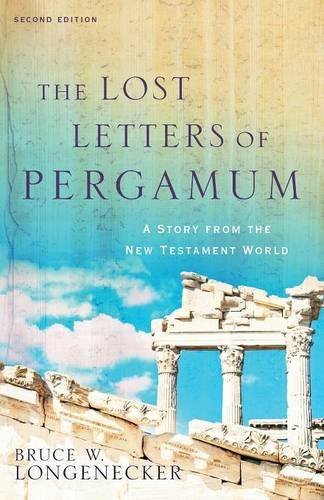
Bruce Longenecker made my job a little easier last semester, by writing a great little book that students enjoy reading. I assigned the second edition of Longenecker's Lost Letters of Pergamum (Baker Academic, 2016) as a textbook for "Introduction to the New Testament," and students loved it.

Perhaps Baker Academic will consider adding these student blurbs to the back of the third edition:
"Extremely interesting!"

"Loved this book, eye-opening, never read Luke the same."
"Really enjoying The Lost Letters of Pergamum book so far!" 

A few students apparently neglected to read the preface, which explains that the letters are fictional:
"The Lost Letters I found pretty cool how I'm able to read letters from a very old historical event."
"I am really enjoying Longenecker's book because it includes actual letters of Luke, Antipas, Calpurnius. It gives a glimpse at life in the New Testament times and is extremely interesting." 

But how often do you find a textbook that prompts this sort of student response?
"Longenecker is by far my favourite thing I've read this whole semester. I was interested from page one. It's the best." 

Based on student feedback I decided to switch out the other two very short introductions I had assigned, but Lost Letters is a keeper - It succeeds in conveying a lot of information about the first-century Roman world, it paints a compelling and attractive picture of early Christian community practices, and--did I mention?--students enjoy reading it.


Thursday, March 19, 2015

The Church Fathers on Paul's Wife

Yes, I also ask you loyal yokefellow (σύζυγος), “Help these women who struggled beside me in the Gospel." (Phil 4:3)

Commentaries on Philippians mention, as a matter of course, that Clement of Alexandria took the "loyal yokefellow" of Phil 4:3 as a reference to Paul's wife. To find out where Clement says this, you apparently have to go back to the 19th century (e.g., J.B. Lightfoot and Eadie), when NT scholars thought it was worth reading the church fathers. (BDAG also includes the references.) As usual, going ad fontes, repays the effort:

Clement of Alexandria (d. 215) discussed Paul's "yokefellow" in book 3 of his Stromateis, but--unless you read Latin--you can't find the passage in Schaff, the most widely-available English edition of the Ante-Nicene Fathers, because Clement's description of the sexual practices of heretics didn't pass T&T Clark's Victorian-era censors. Thanks to Henry Chadwick, there is a modern English translation, which has been made available online here. Here is the relevant psassage:

Even Paul did not hesitate in one letter to address his consort (σύζυγον). The only reason why he did not take her about with him was that it would have been an inconvenience for his ministry. Accordingly he says in a letter: 'Have we not a right to take about with us a wife that is a sister like the other apostles?' But the latter, in accordance with their particular ministry, devoted themselves to preaching without any distraction,and took their wives with them not as women with whom they had marriage relations, but as sisters, that they might be their fellow-ministers in dealing with housewives. It was through them that the Lord's teaching penetrated also the women's quarters without any scandal being aroused. We also know the directions about women deacons which are given by the noble Paul in his second letter to Timothy. Furthermore, the selfsame man cried aloud that "the kingdom of God does not consist in food and drink," not indeed in abstinence from wine and meat, "but in righteousness, peace, and joy in the Holy Spirit."
(The passage was not as clear as I expected until I checked the Greek and found that the word Chadwick translates as "consort" is the same word, σύζυγος, that is translated as "companion" or "yokefellow" in Phil 4:3.)

When we look at the context, we find that Clement refers to Paul's wife in order to argue--against the followers of Basilides, who rejected marriage altogether--that marriage (and sexual relations within marriage) is okay. Like the clean and unclean food of Romans 14, marriage, for Clement, is an adiaphora.

Clement's younger contemporary, Origen (d. 253/4), had rather different reasons for mentioning Paul's wife.Origen's commentary on Romans 1:1 seems to suggest that slavery to Christ excludes the possibility of sexual relations:
Paul, then, if certain traditions are true, was called while in possession of a wife, concerning whom he speaks when writing to the Philippians, “I ask you also, my loyal mate, help these women.” Since he had become free by mutual consent with her, he calls himself a slave of Christ. But if, as others think, he had no wife, nonetheless he who was free when he was called is yet a slave of Christ. In fact what does it mean to be a slave of Christ? It means that one is a slave of the Word of God, of wisdom, righteousness, truth, and of absolutely all the virtues which are identical with Christ himself. - Origen, Romans 1.1.3 (trans Schenk p. 62)
Origen returns to Paul's marital status in his commentary on Romans 4:

In order that we might remove such objections in a fitting way let us shift the explanation of [Abraham’s] dead body to say that Abraham was not dead with the infirmity of old age but in accordance with that power which the saints have at work, first of all, in themselves, and which they also admonish others to possess by saying, “Put to death your members which are earthly!” For I consider it to be absurd that we should fail to believe that this good which Paul possessed in himself—seeing that [Paul] would not command to others what he himself did not do this good which Paul possessed, I say, Abraham did not possess, so great a patriarch that the Apostle even calls him his own father. In [Abraham] as well, then, there was this mortification of the members. He was not enticed by luxury; he did not burn with lust like those of whom Paul says, “It is better to marry than to burn.” This same good was also in Sarah; and therefore it is written about her, “womanish things had ceased to function in Sarah.” For in her there was none of that feminine lasciviousness or the dissoluteness of incontinence, nor were either of them carried off unwillingly into the enjoyment of lustful desires. 4.6.7 (Schenk p. 271):
Here we learn that Abraham and Sarah couldn't have children because they had advanced to such a degree of godliness that they had lost all sexual desire. They had succeeded in putting their bodies to death, as Paul instructs the Romans to do in chapter 6. Paul, says Origen, would not have exhorted the Romans to such a state of sanctity, if he did not possess it himself.

Truly the world has changed

Thursday, August 4, 2011

Morton Smith on Forgery

"...This anachronism is one of the many traces of an unusually clumsy forger, who may have had some genuine text to expand, but who expanded it with palpable absurdities." - Morton Smith, Palestinian Parties and Politics That Shaped the Old Testament (New York: Columbia University Press, 1971), 199.

Smith is referring to an alleged anachronism in a letter recorded in 1 Macc 10.26-45, but his description of forgery will be of interest to those familiar with Stephen Carlson's, The Gospel Hoax (Waco: Baylor, 2005), and the debate about Smith's discovery (?) of the Secret Gospel of Mark.

Sunday, August 1, 2010

Jesus' Mother Tongue Part 2: The Supposed Dominance of Aramaic in First Century Galilee

My aim in this post is not to demonstrate that Hebrew rather than Aramaic was the dominant language in the first century or that Jesus taught in Hebrew rather than Aramaic, but to raise some questions about the nature of the evidence.

(1) As I mentioned in part 1, it is often claimed that the Greek words Hebrais and Hebraisti should be translated "Aramaic" instead of "Hebrew." In response I will simply quote from Ken Penner, whose argument I find persuasive:
In summary, all the anomalies to the otherwise consistent ancient distinction between Hebrew and Aramaic can be accounted for: First, John's Rabbouni can be considered a Hebrew word. Second, Josephus and Philo's Pascha and sabbata are taken directly from the Septuagint, and Asarta has a final alpha to aid pronunciation. Third, John's three place names called Hebraisti, namely Bethzatha, Gabbatha, and Golgotha should not be given much weight in the light [of] the resistance of proper names to translation. Thus all the apparently Aramaic words cited could easily have been used in Hebrew speech. Finally, Philo's claim that the Bible is written in chaldean is insubstantial, given that he probably knew neither Hebrew nor Aramaic. To refute the claim in the lexicon that Hebrais "refers to the Aramaic spoken at that time in Palestine," only one of the following three premises must be conceded. I have demonstrated the first two: First, Hebrais(ti) normally means Hebrew; second, Hebrais(ti) never certainly means Aramaic; and third, Hebrew was a spoken language in first century Palestine. This last premise has also now been generally conceded . . . (p. 10)
(2) Scholars who accept that both Aramaic and Hebrew were widely used often suggest that Aramaic was more common in Galilee, while Hebrew was more common in Jerusalem and its environs:
  • Chaim Rabin* concluded in 1976 that "while in Jerusalem mishnaic Hebrew was a home language and probably already also a literary language, and Aramaic a lingua franca, in Galilee Aramaic was a home language and mishnaic Hebrew the upper language of a diglossia" (1036).
  • Michael Wise** agrees, though he is less confident about the use of Hebrew: "The fact that the region [of Galilee] came under Jewish control only after some centuries of government by Aramaic and Greek-speaking rulers suggests that Hebrew was much less well known in Galilee than it would have been in Judea. . . . With the passage of time Aramaic became the most widely spoken language in Syria and Palestine, and, presumably, among the Jews, with the possible exception of the Jews of Judea" (437).
  • Mark Roberts refers to the "fact" that Aramaic was "the official language of Galilee": "It makes sense that residents of Nazareth spoke Aramaic, given the fact that Aramaic became the official language of Galilee from the sixth-century B.C. onward. Thus, it seems likely that ordinary residents of Galilee, including Nazareth, spoke Aramaic as their first language. This was the language of common discourse among Jesus' family and friends."
The problem with Roberts' assertion, in particular, is that Galilee came under Jewish/Judaean Hasmonean control in the second century BCE. Since there is strong evidence for Hasmonean preference for Hebrew, it is at least possible that Hebrew spread widely during this period among the Jews in Galilee. To be sure, this is an argument from silence. Wise** notes that written evidence for the use of Hebrew applies "only to Judea. . . . Similar evidence for Galilee is entirely lacking" (437). But Wise cites no epigraphic evidence that Aramaic was spoken in Galilee either. (There are inscriptions from late antiquity, but I know of no Galilaean Aramaic inscriptions dated to the Second Temple Period. I confess my ignorance: are there any? Scratch that: According to this article by Mark Chancey, there are perhaps two Galilaean Hebrew or Aramaic inscriptions from the Second Temple period. If there is little or no written evidence, both sides argue from silence--at least with respect to written evidence.

(3) Scholars now rightly avoid citing Rabbinic literature without further ado as evidence for first century usage. The reason is simple: Literature written after 200 CE must be examined first for what it says about the time in which it was composed (or compiled); it cannot be read as direct evidence for speech and practice hundreds of years earlier. It is worth noting, however, that the earliest Rabbinic literature (the Mishnah, the Tosefta) is preserved in Hebrew not Aramaic.

(4) As Wise** explains, the evidence from the Gospels about the language of Jesus is extraordinarily difficult to assess. In a bilingual context "Aramaic words might appear, for example, in the course of a conversation conducted mainly in Hebrew or vice versa; such phenomena are commonly observed in the speech of modern bilinguals" (442). Apart from the Aramaic command recorded in Mark 5:41,
"The other verbal sentences recorded as Jesus' direct speech . . . [Mark 7:34; Mark 15:34 and Matt 27:46] . . . are problematic as to language. . . . Thus it is impossible to be certain whether on these occasions Jesus spoke Hebrew or Aramaic. As a result, based on Mark 5:41 one can only say that Jesus certainly spoke Aramaic on occasion. This much was to be expected on the basis of our knowledge of the dominant language among the Jews of Galilee" (542).
I would merely add that "our knowledge of the dominant language among the Jews of Galilee" rests on inference; it seems not nearly as well-founded as is commonly supposed.

In the end I remain agnostic about Jesus' mother tongue. I assume Jesus was at least bilingual; he may well have taught in both languages. (I am not persuaded by arguments that Jesus taught in Greek.) I'd like to think he taught primarily in Hebrew, but see no way of knowing for sure. When I talk about Jesus' original language, I refer to "Hebrew/Aramaic" just to be safe.

Bibliography:


*Rabin, Chaim. “Hebrew and Aramaic in the First Century.” Pages 1007-1039 in The Jewish People in the First Century: Section One: Historical Geography, Political History, Social, cultural and Religious Life and Institutions. Edited by Shmuel Safrai and Menahem Stern. Philadelphia: Fortress, 1976. 
**Michael O. Wise, "Languages of Palestine." Pages 434-44 in The Dictionary of Jesus and the Gospels (IVP: 1992).
See also David Goodblatt, "Constructing Jewish Nationalism: The Hebrew Language." Pages 49-70 in Elements of Ancient Jewish Nationalism. New York: Cambridge University Press, 2006.  

Friday, July 30, 2010

Jesus' Mother Tongue

That Jesus' mother tongue was Aramaic, not Hebrew, is one of those "assured" results of modern scholarship that has filtered down into popular consciousness--assisted, no doubt, by the Aramaic script to Mel Gibson's Passion of the Christ as well as by modern English translations. BDAG, the standard Greek-English Lexicon of the New Testament, explains that although the noun ἑβραΐς (hebrais) means "the Hebrew language," it is used to "refer to the Aramaic spoken at that time in Palestine." The lexicon entry shows how firmly entrenched this view is in New Testament scholarship; it also contributes to its continued dominance. Among modern translations, the NIV, TNIV, NLT, NET, follow the lexicon's lead by translating ἑβραΐς by Aramaic instead of Hebrew when it appears in the New Testament (Acts 21:40; 22:2; 26:14; cf. the adjective, Ἑβραϊστί [hebraisti] in John 5:2; 19:13, 17, 20; 20:16; Rev 9:11; 16:16).

It may come as a surprise, then, to discover that scholars of post-exilic Hebrew and Aramaic agree that Hebrew continued as a spoken language until the 3rd century AD:
  • Moshe Bar-Asher*: "Research has further shown that Hebrew was spoken in Palestine until roughly 200 CE. The view is generally accepted that the Hebrew preserved in Tannaic literature reflects living speech current in various regions of Palestine" (568). "The theory was once proposed that MH had never been a living language, but an artificial creation, and that the Jews in the Tannaic period had spoken Aramaic exclusively. This view has now been universally abandoned" (586 n. 74). (See below for full bibliography.) 
  • Yohanan Breuer**: "Today . . .  everyone agree[s] that Hebrew speech survived in all walks of life at least until the end of the Tannaic period (beginning of the third century CE)" (598).
I suspect most pastors and more than a few scholars simply repeat what they learned when they were in school--namely, that the Jews of Jesus' day spoke Aramaic rather than Hebrew and therefore that Jesus taught in Aramaic. This view rests on the outdated scholarship of past giants such as Gustaf Dalman, who wrote before the great manuscript discoveries of the 20th century (the Dead Sea Scrolls, the Bar Kokhba letters).

The standard position among those who actually study the question has changed, however. As the quotations from Bar-Asher and Breuer show, scholars of the linguisitic setting of first century Palestine agree that both Hebrew and Aramaic were spoken languages. To be sure, there is debate about how common each language was. On one side, Joseph Fitzmyer*** concluded that Aramaic was the vernacular, and that even Greek was more common than Hebrew: "pockets of Palestinian Jews also used Hebrew, even though its use was not widespread" (46). As far as I can tell, most linguists of ancient Hebrew and Aramaic now give more prominence to Hebrew than Fitzmyer did in 1970, and the standard view is now that most Palestinian Jews in the first century--including Jesus--would have been bilingual in Aramaic and Hebrew, at least to some extent, and possibly trilingual in Aramaic, Hebrew and Greek.

This, of course, does not prove anything about Jesus' mother tongue or his normal language of instruction. The majority of scholars still seem to conclude that, as a Galilaean, Jesus' mother tongue was Aramaic and that he most likely taught primarily in Aramaic. This is the conclusion of Mark D. Roberts in a fine recent blog series (scroll down and begin reading at the bottom; most of the series is also collected here) as well as Michael O. Wise****, who concludes wisely: "In view of all the unproven assumptions and complexities involved with the question of Semitic sources behind the Gospels, it is no exaggeration to say that even after 150 years of scholarly effort, research is still at a very early stage" (444).

For my part, I am impressed with how little evidence there is for Aramaic dominance in Galilee, and I am convinced by my friend Ken Penner's excellent paper  (online here) that both ἑβραΐς (hebrais) and Ἑβραϊστί (hebraisti) should be translated "Hebrew" when they appear in the New Testament. But more on this in part 2.

_________

Bibliography:

*Moshe Bar-Asher, "Mishnaic Hebrew: An Introductory Survey," in The Literature of the Sages: Second Part: Midrash, and Targum; Liturgy, Poetry, Mysticism; Contracts, Inscriptions, Ancient Science and the Languages of Rabbinic Literature  (Fortress, 2007), 567-595.
**Yohanan Breuer, "The Aramaic of the Talmudic Period," in The Literature of the Sages: Second Part: Midrash, and Targum; Liturgy, Poetry, Mysticism; Contracts, Inscriptions, Ancient Science and the Languages of Rabbinic Literature  (Fortress, 2007),597-625.
***Joseph Fitzmyer, "The Languages of Palestine in the First Century A.D." Catholic Biblical Quarterly 32 (1970): 501-31, reprinted in A Wandering Aramaean (Scholars Press: 1979; Eerdmans: 1997), 29-56.
****Michael O. Wise, "Languages of Palestine." Pages 434-44 in The Dictionary of Jesus and the Gospels (IVP: 1992).

Other sources:

Rabin, Chaim. “Hebrew and Aramaic in the First Century.” Pages 1007-1039 in The Jewish People in the First Century: Section One: Historical Geography, Political History, Social, cultural and Religious Life and Institutions. Edited by Shmuel Safrai and Menahem Stern. Philadelphia: Fortress, 1976. 
I haven't yet read these two essays mentioned by Jeffrey Garcia: Shmuel Safrai, “Literary Languages in the Time of Jesus”; Hanan Eshel, “Use of the Hebrew Langauge in Economic Documents from the Judeaen Desert” in Jesus’ Last Week (eds. S. Notley, M. Turnage, and B. Becker; Leiden; Brill, 2006).

Monday, March 29, 2010

C.F.D. Moule on Incorporation in Christ

"Christianity is such that its 'theology and ethics' are, by their very nature, inseparable; for it is neither a merely intellectual statement of philosophy nor merely a system of rules for conduct: it is incorporation in Christ, which means faith and practice in one--pattern and power together; mind, will, and emotions working in co-operation" (113).

"Thus, Christian conduct is the result, not simply of the effort to be good, but of incorporation into the Body of Christ" (114).

"St Paul's meaning is evidently something like what Christ dramatically expressed by 'Take up your cross and follow me' (Mark viii. 34, etc.): that is, to follow Jesus means complete devotion, even to the extent of regarding oneself--one's own private desires and ambitions--as 'sentenced to death', or as in fact 'dead'. Yet there is a difference; for whereas Jesus, during his ministry and before his death and resurrection, could only summon disciples ot the effort to 'follow' in obedience, St Paul, called by the risen, heavenly Christ, has found, by incorporation in him, the transforming strength to achieve such devotion. The injunction νεκρώσατε--kill self-centredness--becomes progressively a possibility for those who are united by Baptism with the Body of Christ" (114-115).

Quotations from C.F.D. Moule, The Epistles of Paul the Apostle to the Colossians and to Philemon (Cambridge: 1962) on Colossians 3:5-17.

Wednesday, June 10, 2009

Israel Trip 2a (April 30) - Caesarea

(This is the second in a series of Israel tour posts; the first is here.)
Our first stop on our first day of touring was Caesarea, well-known as the city Herod the Great transformed from the fishing village of Strato's Tower into a major port. It is also the city where, according to Acts 10-11, Peter encountered the Gentile centurion Cornelius, and where Cornelius and his invited guests encountered the Holy Spirit. The group is standing on the stage of a much-restored Herodian theatre:
Looking north from the theatre compound, there is a nice overview of the ancient city. Off to the left of the next picture is the ruins of the "Palace of the Procurators"; the stepped seats on the right overlook a Herodian amphitheatre, large enough for chariot races. In the distance are the walls of the crusader city and, on the left, the remains of the ancient city's man-made harbour:

After Herod's son Archelaus was deposed in AD 6, Judaea was ruled directly by Roman prefects and procurators, who made their capital in Caesarea, and their headquarters, apparently, in this palace:
Jerome Murphy-O'Connor (243) speculates that it was here that the apostle Paul was imprisoned for two years (see Acts 23-26). Not a bad view for a prison!

On the northeastern end of the amphitheatre . . .
. . . "are four long vaulted warehouses of the C3 AD"(O'Connor 245), one of which was transformed into Israel's only Mithareum, a place of worship for devotees of the god Mithras:
The worship of Mithras was a mystery religion popular among the Roman army. Apparently important to the construction of this Mithraeum was a hole in the roof through which a ray of sunlight would strike the altar at noon on the summer solstice (June 21):

East of the amphitheatre and parallel with it is the Byzantine Cardo, or main street. According to O'Connor, "it is extremely probable that the Herodian Cardo followed the same line" (245). The smokestacks in the background of the next picture belong to a coal-burning electricity plant south of Caesarea. On clear days, the smokestacks can be seen from Jerusalem. The mosaics to the right of the pillars contain the only inscriptions in Israel (outside of churches) containing a passage from the New Testament. (See this blog post for more details on the inscriptions.)

The lawn in the photo below once formed part of Herod's amazing man-made "circular harbour enclosing enough space for large fleets to lie at anchor near shore" (A.J. 15.334). The white caps mark part of the harbour's northern edge, now submerged:
(There is an aerial photo and an artist's reconstruction here.)

Josephus says "that the solidity of [Herod's] masonry defied the sea, while its beauty was such as if no obstacle had existed" (War 1.411):
"[H]e had blocks of stone let down into twenty fathoms of water, most of them measuring fifty feet in length by nine in depth and ten in breadth, some being even larger. Upon the submarine foundation thus laid he constructed above the surface a mole two hundred feet broad; of which one hundred were built out to break the surge...while the remainder supported a stone wall encircling the harbour. From this wall arose, at intervals, massive towers..." (War 1.411-412).
The apostle Paul would have entered this harbour on his several voyages to Caesarea. When he did so, he couldn't miss the monumental temple to Rome and Augustus that Herod built in honour of his Roman patron overlooking the harbour.

In the end, Herod's decision to build a pagan temple containing "a colossal statue of the emperor, not inferior to the Olympian Zeus" (War 1.414) played a role in the conflict between Jews and Gentiles that culminated in the Jewish revolt (2.266), and the destruction of Herod's more famous temple to the God of Israel in Jerusalem.

(Roman aqueduct built in the first century CE)

Saturday, March 21, 2009

Dreaming of Spring: Reading Groups

Normally around this time of year I dream about traveling to some far away place, but since I get to go to Israel this spring, I've found myself dreaming about what I'll have time to do when I return. For instance, I'm looking forward to starting a reading group again this summer. Here are some ideas:
  • The Greek Testament of Abraham. A few of us started working through the Testament of Abraham in Greek last summer. The text is seriously funny, relatively easy Greek, and based on a familiar story--all in all, great practice.
  • The Rule of the Congregation (1QSa). I worked through this DSS in grad school. It would be good for me to do it again, and fun to work through with a few others who like reading unpointed Hebrew in their spare time.
  • The Apostolic Fathers. I read through the Didache in a Greek reading group several years ago now. I'd love to do more--maybe 1 Clement for starters?
  • Paleography 101. Who would not want to read from an ancient manuscript of the Greek New Testament? P46 anyone?
And no, it's not spring here yet. To be fair, I took these picture earlier this week, and it has been trying to thaw since then, but there is still plenty of snow around, and we will likely get more before this long winter is done.

Saturday, September 22, 2007

What's your plague?

Next time a stranger at a bus stop walks up to you and asks, "What's your sign?" consider taking a cue from the Byzantine chronicler, Cedrenus (see here and here), and steer the conversation in a more interesting direction by responding, "Leo. What's your plague?"

Here's why: In his short summary of the 10 plagues narrated in Exodus 7-12, Cedrenus adds a new element by sequencing the plagues with the months of the year:
June - Water turned to blood
July - Frogs
August - Lice (see LXX)
September - Dog flies (see LXX)
October - Destruction of cattle
November - Blistering abscesses
December - Hail
January - Locusts
February - Darkness for three days
March - The Firstborn
April-May - Gigantic Fish (just kidding). If you were born in April or May I guess you get off easy.
I don't know where Cedrenus got the idea of identifying the month on which each plague occurred. The summary passage in Cedrenus is listed as a parallel to the summary in Jubilees 48.5 by Denis, although Jubilees doesn't tie the plagues to specific months. Here's the Jubilees passage:
"And the LORD executed great vengeance upon them on account of Israel. And he smote them with [1] blood, and [2] frogs, and [3] lice, and [4] dog flies; and [6] evil boils which break out (as) blisters; [5] and their cattle with death; and [7] hailstones with which he destroyed everything which sprouted up for them; and with [8] locust who ate the remainder which was left from the hail; and with [9] darkness, and (with death of) the [10] firstborn of men, and cattle; and upon all of their gods the LORD took vengeance and he burned them with fire." (Jub. 48.5; Wintermute's trans. in OTP; numbers in brackets refer to the biblical plague order)
I wondered, since Jubilees explains that the plagues were God's judgment on the gods of Egypt, whether Cedrenus is also criticizing the Zodiac (but then what about the remaining two months?). But I think it is more likely that Cedrenus (or his source) worked backwards from the plague on the firstborn, now associated with the feast of Passover, as Passover sometimes begins toward the end of March. If you assume that each plague took a month to complete, Cedrenus's sequence works out.
(The pictures are from my fishing outing with D&D last weekend at Buffalo Pound. I caught nothing, but came back with two large Northern Pike, thanks to the generosity of D&D. The one pictured above was a whopping 39 inches long! Both fish were still flapping, gasping, and extremely slimy when I got home and summoned t. to help me figure out how to "clean" them. We are still recovering from the experience.)

Tuesday, August 7, 2007

Turkey Travelogue 6c - Priene (June 9)

The prize for "favorite Turkish ruins experience" goes to Priene:
  • A steady breeze and lots of pine trees reminded us of central Oregon and kept us cool on a very hot day.
  • There were very few other people at the site while we were there.
  • Thanks to some excellent town-planning in the first millennium BCE., we were able to get our bearings quickly and navigate the site easily...once we found out where the excavated area started. The city grid, with main streets running east to west, is still visible on Google Earth's remarkably clear satellite photo of the ruins:
  • The site is in an excellent state of preservation, and unlike Pergamum and Ephesus, the majority of the ruins reflect their Greek (rather than Roman) origin: "Apart from some minor alterations to the theatre and some of the other public buildings, the Hellenistic city [built in the 4th cent. BCE] was left untouched by the Romans....the modern visitor walks through the 2C BC" (Blue Guide, 232).
Like most other major Greco-Roman archaeological sites, Priene has its compliment of public buildings. These include a 5,000 person theatre (small by comparison with Ephesus and Pergamum):
A well-preserved Pyrtaneion:
The Pyrtaneion--I now know after seeing several examples and doing a little background reading--was the administrative center of the Greek city, "housing its communal hearth...eternal flame [dedicated to the hearth goddess, Hestia], and public dining-room where civic hospitality was offered" (OCD 1268).

Next to the Pyrtaneion is the Bouleterion or city council chamber:
Near these buildings is a Greek inscription:
(Curious about the Greek script? Interested in a transcription? See this post over at Evangelical Textual Criticism by Dirk Jongkind, who appears to have visited Priene shortly after we did.)

There were also several temples, the largest of which was the temple to Athena, now in some disarray:

The (reconstructed) pillars are still impressive, however. According to the Blue Guide, this temple "became the model for Ionic architecture":
But there are also signs of more ordinary life as you walk down the city streets...

...and gaze into the ruins of cookie-cutter, symmetrical houses, most of which were smaller than this large private dwelling:
The town plan was built around square "insulae" units, most of which contained four private houses. Here's the Blue Guide again:
These 3C and 4C BC houses have been compared with the 1C AD houses discovered at Pompeii and Herculaneum. they have many features in common. Both the Hellenistic and Roman builders used a design which proved itself effective all over the Mediterranean. Their houses were built to protect the occupants from the fierce heat of the summer sun and from the cold of winter.
The houses were also very small by modern standards; their close proximity to each other illustrate how different our modern Western conceptions of personal space are from those of the ancient world.

Assuming the first Christ-believers met in houses, perhaps we should also consider how very different church in the first century would have been from most Christians' experience of church today.

Click here for the Turkey Travelogue Index.