Showing posts with label Greco-Roman World. Show all posts

Tuesday, August 21, 2018

Mary Beard on Leadership and Power

Mary Beard's tiny book, Women and Power, should be required reading for anyone who reacts negatively to the word "feminism," or who wonders what all the fuss is about. As one would expect from a noted classicist and public intellectual, it is particularly helpful in tracing how classical ideas about gender continue to influence contemporary discourse, not least on Twitter. It is also a cracking good read (though a little crass).

What I want to reflect on here, however, is not so much gender as leadership. In her Afterword, Beard says that she would eventually "like to try to pull apart the very idea of 'leadership' (usually male) that is now assumed to be the key to successful institutions, from schools and universities to businesses and government" (p. 94).

Beard's initial attempt in the book itself is embedded in a passage that is difficult to excerpt:

"... But this is still treating power as something elite, coupled to public prestige, to the individual charisma of so-called 'leadership', and often, though not always, to a degree of celebrity. It is also treating power very narrowly, as an object of possession that only the few - mostly men - can own or wield .... On those terms, women as a gender - not as some individuals - are by definition excluded from it. You cannot easily fit women into a structure that is already coded as male; you have to change the structure. That means thinking about power differently. It means decoupling it from public prestige. It means thinking collaboratively, about the power of followers not just of leaders. It means, above all, thinking about power as an attribute or even a verb ('to power'), not as a possession. What I have in mind is the ability to be effective, to make a difference in the world, and the right to be taken seriously, together as much as individually. It is power in that sense that many women feel they don't have - and that they want." (pp. 86-87)

This is one example of how questions about gender can get at issues of wider relevance for people in general. Perhaps I'm mistaken, but when I hear "leadership" I think of the elite power "coupled to public prestige" and "individual charisma" "that is now assumed to be the key to successful institutions"--and I want to run the other way. To be sure, some people do need to be in senior leadership and management positions, people in those positions can exercise a great deal of influence, and it is important for such people to be trained. Bless them. Good leadership development will presumably stress service more than public prestige and personal charisma. But viewing everything in terms of leadership in the conventional sense can still exclude other people, and other ways of encouraging "the ability to be effective" and "to make a difference in the world."

Beard, Mary. Women & Power: A Manifesto. London: Profile Books, 2017.

Sunday, December 10, 2017

Highlights from the British Museum

I made it out to the British Museum with my daughter last weekend, enjoying our first London Tube ride along the way. S., along with a crowd of other people, was excited at the prospect of seeing the archaeological discovery that enabled scholars to decode Egyptian hieroglyphs:
The Rosetta Stone, British Museum,
After visiting Athens in 2013, I wanted to see the Elgin Marbles that used to adorn the Parthenon. (At the beginning of the 19th century, Lord Elgin received permission from the Ottoman government to take away "pieces of stone with old inscriptions or figures thereon." The priceless rock he carted off surely exceeded what the Sultan had in mind.)

The Egyptian exhibits were stunning, as one would expect:
Amenhotep III's left arm

But I was most surprised and astounded by the Assyrian artifacts. Here, for instance, is a Lamassu from Khorsabad that apparently goes back to the reign of Sargon II in the late 8th century BCE:

More exciting still is a series of wall panels depicting Sennacherib's siege of Lachish in 701 BCE:
Sennacherib's capture of Lachish is mentioned in Isaiah 36:1-2; it is also described first-hand in a series of letters inscribed on ostraca that were discovered when Lachish was excavated in the 1930's.

On a final dash through the second floor, I snapped pictures of various 1st-century Roman emperors for use in class:
The Emperor Augustus

If it were not for the incentive of seeing real mummies...

... we would have missed the Cyrus Cylinder, which describes Cyrus's policy of repatriating subject peoples to their homelands:


Admission is free, so it is churlish to complain that the museum is simply too large to take in on a single visit. The contents could easily be divided into a half-dozen world-class museums. 
I guess that means I'll need to go back.

Wednesday, January 4, 2017

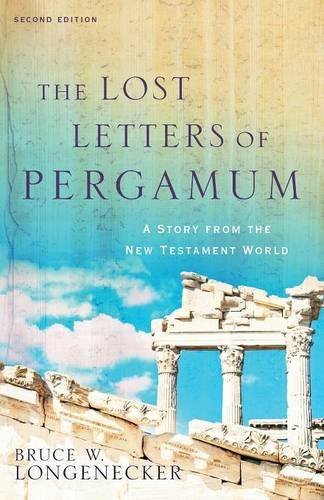
Bruce Longenecker's Lost Letters of Pergamum

Bruce Longenecker made my job a little easier last semester, by writing a great little book that students enjoy reading. I assigned the second edition of Longenecker's Lost Letters of Pergamum (Baker Academic, 2016) as a textbook for "Introduction to the New Testament," and students loved it.

Perhaps Baker Academic will consider adding these student blurbs to the back of the third edition:
"Extremely interesting!"

"Loved this book, eye-opening, never read Luke the same."
"Really enjoying The Lost Letters of Pergamum book so far!" 

A few students apparently neglected to read the preface, which explains that the letters are fictional:
"The Lost Letters I found pretty cool how I'm able to read letters from a very old historical event."
"I am really enjoying Longenecker's book because it includes actual letters of Luke, Antipas, Calpurnius. It gives a glimpse at life in the New Testament times and is extremely interesting." 

But how often do you find a textbook that prompts this sort of student response?
"Longenecker is by far my favourite thing I've read this whole semester. I was interested from page one. It's the best." 

Based on student feedback I decided to switch out the other two very short introductions I had assigned, but Lost Letters is a keeper - It succeeds in conveying a lot of information about the first-century Roman world, it paints a compelling and attractive picture of early Christian community practices, and--did I mention?--students enjoy reading it.


Sunday, March 23, 2014

An echo of Homer in Luke 11:21-22 (?)

Ambrosian Illiad
I make a point of reading through the Gospels each time I teach Briercrest's required first year course on the Gospels. This time through, I was struck by a passage in the assigned reading that we never talk about in class:

"When a fully-armed strong man guards his own estate, his belongings are in peace. But as soon as someone stronger than he attacks and conquers him, he takes away the armour in which he had trusted and distributes his plunder." (Luke 11:21-22; contrast Mark 3:27; Matt 12:29)


According to Howard Marshall, the battle imagery in Luke's version "has as its background the OT idea of God armed as a hero for battle against his enemies (Is. 59:16–18) and the Qumranic concept of the messianic war" (Luke, 478).

That may be so, but the description also reminds me of Homer--no doubt because one of the effects of crawling through the gory details of the Iliad at the rate of a few pages every week is that one thinks differently about ancient practices of warfare. Consider this passage, one of many that describe the same basic procedure:
Both fighters at one great stroke
chopped at each other--Pisander hacked the horn
of the horsehair-crested helmet right at its ridge
lunging as Menelaus hacked Pisander between the eyes,
the bridge of the nose, and bone cracked, blood sprayed
and both eyes dropped at his feet to mix in the dust--
he curled and crashed. Digging a heel in his chest
Menelaus stripped his gear and vaunted out in glory,
"So home you'll run from our racing ships, by god,
all as corpses--see, you death-defying Trojans?"
...                                                    So he cried
and staunch Atrides stripped the gear form the corpse
and heaving the bloody bronze to eager comrades
swung to attack again, frontline assault.
(Robert Fagles translation of the Illiad, book 13.705-714, 738-741)
To my mind, this passage (and others like it) illumines the armour-stripping imagery in Luke 11, but no commentary that I consulted mentions the practice. To be sure, in Homer one only strips weapons from a foe one has killed in battle, and most commentators appear to assume that the opponent in Luke 11 is not dead, but perhaps one shouldn't press the metaphor.

I don't know whether the warfare familiar to Luke's readers (or Jesus' audience) bore any resemblance to battle in Greek antiquity. One might suppose that the better-equipped Roman army would not pause to strip the armour from defeated foes after each kill. Do we then have an echo of Homer in Luke's Gospel?

Friday, October 18, 2013

Where was Romans written?

Where did Paul write the letter to the Romans? After visiting the Isthmus of Corinth last spring, the normal answer--Corinth, of course!--is not completely satisfying because some of the evidence that is taken as evidence for a Corinthian provenance points instead to Cenchreae. While commentators routinely note that Cenchreae was one of the ports of Corinth, the two cities were actually about 8 miles apart--a fair distance for someone walking on foot:


View Larger Map
Acts 20:3 says only that Paul and company spent three months in Greece before travelling on to Jerusalem. The main evidence in support of Corinth as opposed to Cenchreae or some other place in Greece is found in Romans 16:23 where Paul passes along greetings from "Gaius, the host of me and of the whole church" and "Erastus the steward (oiknomos) of the city."

  • In 1 Cor 1:14 Paul mentions baptizing a Gaius who belonged to the Corinthian church. Gaius was a common name, but it is reasonable to infer that the Gaius of Rom 16:23 and 1 Cor 1:14 are the same.
  • The Erastus of Rom 16:23 may be the same Erastus who is mentioned in a Latin inscription near the theatre in Corinth:
  • Photo by David M. Miller

For those who don't read Latin, the inscription states: "Erastus, commissioner for public works, laid this pavement at his own expense" (Cranfield 2.807). Here is a close up:
Erastus Inscription, Corinth (Photo by David M. Miller) 
Paul refers to Erastus as the steward or "treasurer" of "the city." If the city in question is Corinth, it points to Corinth as the place of writing because "the city" most naturally refers to the city where Paul is living.

However, Paul begins his chapter full of greetings with a mini-letter of commendation for "our sister, Phoebe, a deacon of the church that is in Cenchreae" (Rom 16:1). Since Paul describes Phoebe as his benefactor (16:2), we might imagine Paul receiving support from Phoebe while residing in Cenchreae, the east-facing port from which Paul would depart on his trip to Jerusalem. This, at least, is what Leander Keck assumes in his commentary on Romans (27, 30, 369, 380). (Keck also concludes that although Paul's host, Gaius, was baptized in Corinth, he lived in Cenchreae and hosted the church of Cenchreae in his house there.) Paul may have needed to be at some remove from the rowdy church in Corinth to hammer out the argument of Romans.

Since Paul instructs the churches at Rome to receive Phoebe and provide for her needs (16:2), it appears that Phoebe and Paul's epistle to Rome were going to travel together--Phoebe was responsible to take the letter to the church at Rome. Evidence from the Oxyrhynchus Papyri apparently indicates that the letter-bearer would also be the designated letter-reader and letter-explainer. According to Arland Hultgren, this makes Phoebe "the first exegete of the Letter to the Romans" (Hultgren 3; cf. Jewett 90; Keck 27). To do this well, Phoebe would most likely have interacted with Paul about the contents of the letter. What better location to do this than in Phoebe's house in Cenchreae?

So which is it--Corinth...
Corinth Bema (photo by David M. Miller)
...or Cenchreae?
Cenchreae (photo by David M. Miller)
In favour of Cenchreae is the nice pastoral setting and the fact that Paul is about to embark on a trip east to Jerusalem. If it was up to aesthetic preference, I would choose Cenchreae*, but the description of Erastus as the steward of "the city" tips the balance slightly in favour of Corinth (in my view). (Corinth has the added advantage of being easier for modern English-speakers to pronounce.)

*Update: Here's an additional argument from silence: Assuming that Luke knew where Paul stayed in Greece, the fact that he doesn't specify a precise location may indicate that Paul was in the less well-known Cenchreae instead of Corinth.

Bibliography:
Cranfield, C. E. B. A Critical and Exegetical Commentary on the Epistle to the Romans. 2 vols. Edinburgh: T&T Clark, 1975, 1979.

Hultgren, Arland J. Paul’s Letter to the Romans: A Commentary. Grand Rapids: Eerdmans, 2011.

Jewett, Robert. Romans: A Commentary. Hermeneia. Minneapolis: Fortress, 2007. 

Keck, Leander E. Romans. Nashville: Abingdon, 2005.

All photographs .

Wednesday, July 1, 2009

Israel Trip 2d (April 30) - Sepphoris (Zippori)

Update: See discussion of the mikveh "immersion pools" below.
Zippori (Sepphoris) is best known today for the "Mona Lisa of the Galilee," part of an amazingly detailed mosaic that once lined the floor of a triclinium dining room in a 3rd CE mansion:
At one end of the mosaic is the "Mona Lisa":
Near the other is the final scene from a drinking contest between Dionysus and Hercules:
Hercules lost.

The beautiful mosaic associated with the worship of Dionysus is intriguing because Zippori was at this time a center of Jewish religious life: Rabbi Judah the Prince moved the rabbinic Sanhedrin to Zippori at the end of the 2nd century, and the Mishnah was codified here around 200 CE.
(A miqveh immersion pool,* a sign of Jewish presence in Zippori)

"The city . . . was considered by Theodoret the church history to be entirely Jewish in the reign of Valens (364-78)" (Murphy-O'Connor 468). No doubt the city had a mixed Jewish and pagan population in the 3rd century (a 2nd CE Roman temple was recently discovered), but it is instructive to imagine the rabbis carry on their work in such a cosmopolitan setting.

*Update: That is, if the archaeologists are right in identifying the pools as immersion pools (miqva'ot). Consider Seth Schwartz in his excellent book, Imperialism and Jewish Society: 200 B.C.E. to 640 C.E. (Princeton University Press, 2001):
[O]ver twenty small bathtubs were discovered in a residential district of the city, which excavators have identified, with what justification is unclear, as miqva'ot. If this is correct, then the population of Sepphoris in approximately the third century was either radically diverse, consisting of a mixture of paganizers and the purity-obsessed or mind-bogglingly eclectic in their Jewish observance. While both options seem probable on other grounds, it is unclear why the bathtubs should not be considered simply bathtubs. (144)
Also interesting, giving the rabbinic prohibition of images, is the 5th century synagogue that we didn't take time to see: It has a colourful mosaic that contains the signs of the zodiac and depicts biblical figures such as Abraham, Isaac, and Aaron (see the pictures at the bottom of this page).

Sepphoris was made the capital of Galilee when the Romans took over in the first century BCE. It was destroyed by the Romans after a revolt in connection with Herod the Great's death (4 BCE). Herod Antipas, Herod the Great's son and successor in Galilee, rebuilt Sepphoris and made it his capital. Murphy-O'Connor speuclates that this "probably drew the artisan Joseph and his family to settle in nearby Nazareth (Matt. 2: 21-3); the project would provide work for many years" (468).

There is much more to see in Zippori--the national park pamphlet recommends 3-4 hours to view the whole 16 square kilometer site--but we were short on time, I was tired, and took few pictures.

If you want more, check out Bibleplaces.com for always excellent photos, a few of which are free to view; the Wikipedia article, and especially Biblewalks.com.

This is the 5th in a series on the 2009 Briercrest Israel Tour:
Israel Trip 1 (April 28-29) - Climate Change
Israel Trip 2a (April 30) - Caesarea
Israel Trip 2b (April 30) - Views from Mt. Carmel
Israel Trip 2c (April 30) - Megiddo

Monday, February 11, 2008

Colossians Remixed and Gender Hierarchy Part 2

I explained in the last post that Walsh and Keesmaat interpret Colossians over against a reconstructed first-century context in which the Roman empire and the imperial cult figure prominently. But although the the imperial cult was popular in Asia Minor during the first century,[1]
and Acts 17:7 suggests that Paul's opponents presented the Christian message as seditious, I think it is misleading to imagine an authoritarian regime in which any alternative lifestyle would be considered dangerous. To be sure, serious challenges to the social order, such as slave revolts, were forcibly repressed, but at least in the hinterland of the empire, considerable diversity was accepted.[2]

There were also other viable alternatives to the emperor cult—though they receive scant mention in Colossians Remixed. In Ephesus, according to Acts, the silversmiths concerned about the loss of their livelihood rioted on behalf of the great Artemis of the Ephesians.[3] In addition to the temple of Artemis and a temple the imperial cult, excavations at Ephesus have uncovered temples to Hestia and Serapis as well as a sanctuary of Zeus and “the Phyrgian mother goddess.”[4]

Another viable alternative to the emperor cult, supported by a large community in the Lycus valley, was Judaism.[5] What happens when we add first century Judaism to the mix? Walsh and Keesmaat note that the early Christian confession “Christ is Lord” was similar to the Jewish claim that there is no Lord but God,[6] but they do not consider the likely corollary that pagan responses to this Messianic Jewish sect would have been similar to pagan responses to Judaism, a religion that was permitted—if not well-liked—in the Roman world.[7] Even Josephus, who is often derided as a “Roman sympathizer” (204) if not an outright traitor, wrote to defend the superiority of the Jewish way of life—including the ideal of freedom from foreign domination which was shared by both the Maccabees and those who revolted against Rome.[8] We learn from Josephus that non-participation in the emperor cult was tolerated in some cases; to a certain extent resistance was too.

Walsh and Keesmaat find a challenge to empire in statements about Christ’s universal role in the creation and redemption of “all things” (98; cf. Col 1:15-20) as well as in Paul’s warnings against the “philosophy” mentioned in Colossians 2, but their imperialistic reading of the Colossian false teaching[9] overlooks the profoundly Jewish character of the “philosophy.” For example, in Col 2:11 Paul emphasizes that the Colossians were circumcised with a non-hand-made circumcision, verse 14 mentions “legal demands” (RSV; δόγμασιν; cf. Eph 2:11-18), verse 16 warns against those who would judge the believers with regard to observing the Sabbath, and the requirements in 2:21 point to Jewish purity regulations. Here conclusions about the nature of the false teaching become important: If Paul writes Colossians primarily to respond to the possibility that Christians in the Lycus valley might be led astray by attractive teaching in the synagogue down the street (Dunn), or by a “Hellenistic Jewish syncretism” (Lincoln), then it becomes much more difficult to view Colossians as directed primarily against an imperial worldview, however subversive the letter might be.

If you are not exhausted yet, see this post for more on Paul and imperialism.


[1] Cf. S. R. F. Price, “Rituals and Power,” in Paul and Empire: Religion and Power in Roman Imperial Society (ed. Richard A. Horsley; Harrisburg, PA: Trinity Press International, 1997), 48-9, 57-61.


[2] Cf. Tessa Rajak, “Was There a Roman Charter for the Jews?” in The Jewish Dialogue with Greece and Rome: Studies in Cultural and Social Interaction (ed. Tessa Rajak; Leiden: Brill, 2002), 301-2: “…the later Hellenistic polis may still have reserved the prizes of citizenship or political office for a select number, but it accommodated considerable diversity of population and did not demand conformity. And we know that, with the exception of overt participation in emperor worship, Jews could and did involve themselves in the life of their cities…”

[3] Acts 19:21-40. Note also that a ruler cult of sorts is applied to Herod Agrippa in Acts 12:20-25.

[4] Richard E. Oster Jr., “Ephesus,” ABD 2:544-5. According to Oster, the temple for Dea Roma and Divus Julius probably date from “shortly after Actium” (i.e. after 31 BCE). There was also a temple to Domitian (or possibly Vespasian) which “was apparently the first of several Neocorate temples of the imperial cult in Ephesus” including a temple to Hadrian (so Oster 544-545).

Not all cults would have been “subsumed under the imperial cult” as Walsh and Keesmaat imply (98). Cf. Price, “Rituals and Power,” 64; North, Roman Religion, 61.

[5] Cf. James D. G. Dunn, The Epistles to the Colossians and to Philemon (Grand Rapids: Eerdmans, 1996), 21-2.

[6] Walsh and Keesmaat, Colossians Remixed, 97. Cf. Alan F. Segal, “Response: Some Aspects of Conversion and Identity Formation in the Christian Community of Paul's Time,” in Paul and Politics: Ekklesia, Israel, Imperium, Interpretation (ed. Richard A. Horsley; Harrisburg, PA: Trinity Press International, 2000), 189; N. T. Wright, “Paul's Gospel and Caesar's Empire,” in Paul and Politics, 170: “The mainstream Jewish monotheistic critique of paganism, of all its idolatry and immorality, found in Paul’s day a more focused target and in Paul’s theology a sharper weapon.”

[7] Cf. Rajak, “Roman Charter,” 301-33.

[8] According to Josephus, both religious and political freedom are fundamentally good things that result from obedience to the laws established by Moses. Cf. Tessa Rajak, “The Against Apion and the Continuities in Josephus's Political Thought,” in Understanding Josephus: Seven Perspectives (ed. Steve Mason; Sheffield: Sheffield Academic Press, 1998), 242; Steve Mason, “'Should Any Wish to Enquire Further' (Ant. 1.25): The Aim and Audience of Josephus's Judean Antiquities/Life,” in Understanding Josephus: Seven Perspectives, 81, cf. 80-7.

[9] At first, Walsh and Keesmaat identify the philosophy as an internal threat distinct from the external pressures of the Roman empire (111), but after an initial discussion (105), the philosophy is treated consistently as an instance of empire. See especially the targum of Col 2:8-3:4 on pages 137-139.


Monday, December 17, 2007

Christmas Gift Idea

If you are still looking for that perfect gift for your classically-minded friend or family member, you might consider the wonderfully detailed Roman Empire Map produced by UNRV (United Nations of Roma Victrix):
(Click here for ordering information and a description with more pictures.)

My copy, now hanging above my desk at home, was a birthday present from t. this year. It makes a nice stand-in for the ten times more expensive Barrington Atlas...which is still on my "I'm dreaming" list.

Wednesday, October 24, 2007

Turkey Travelogue 11c - What does Istanbul have to do with Jerusalem?

From the Aya Sofya, we wandered downhill in the general direction of the Istanbul Archaeological Museum, hoping to find some cheap eats along the way. We eventually gave up, fortified ourselves with the remaining snacks in our backpacks, and ventured into the main museum building. Hungry and exhausted as we were from the previous night's journey, we still managed to stay until the staff asked us to leave.

The prize display in the museum is a collection of magnificent sarcophagi "excavated" from Sidon by the great Ottoman archaeologist and tomb raider, Osman Hamdi Bey. (I note that Hamdi Bey was by all accounts a model archaeologist of the 19th century variety, and that Sidon was part of the Ottoman empire at the time; his Western European contemporaries had the unfortunate habit of retrieving artifacts from outside their respective empires.) There are some excellent pictures of the Sidon sarcophagi, as well as artifacts in the rest of the museum here. Update (28 June 2009): There is a nice article about the "Alexander" sarcophagus here.

The bear (?) in this picture is part of a hunting scene on one of the less prominent sarcophagi:
Though there was still too much for us to absorb in one visit, large sections of the main building were undergoing needed renovations. This was a relief in a way, because it put limits on my compulsion to see everything. Still, I took a few pictures of items that seemed more relevant to my research interests. This is a fine statue of the emperor Hadrian:

And here's a bust of the emperor Tiberius:I was disappointed not to see signs that they were installing air-conditioners. Even with open windows the air was hot, humid and stuffy--especially on the third floor, where we noticed several displays related to Syria-Palestine...

Click here for the Turkey Travelogue Index.

Sunday, September 16, 2007

Turkey Travelogue 8d - Public Life in Ancient Aphrodisias

The Aphrodisiacs Aphrodisians were into water--and a good thing too, because the city was built in a low-lying area and was subject to flooding (at least after a 4th century earthquake).

The architects responsible for the distinctive agora capitalized on the ready supply of water by building the marketplace around a long oval pool now filled with green grass:
The Aphrodisians were also into bathing. We passed two massive bath complexes including the Theatre Baths:
...and the Baths of Hadrian:

They were also into worship. In 1979, archaeologists discovered a Sebasteion, dedicated to the worship of Aphrodite and the Emperor Augustus (and family), "dated to the first half of the 1C AD" (Blue Guide):(We weren't allowed in, but the sculptures are presumably in the museum anyway. You can see pictures of some of them here.)

Traditional polytheistic Greco-Roman religion appears to have lingered on in Aphrodisias well after the conversion of Constantine. In the 6th century CE, the temple of Aphrodite was converted into a Christian basilica:

And, of course, the Aphrodisians were into theatre:
The only hill in town is a man-made tell that rises behind the theatre, built up over centuries of human habitation. (Archaeologists have found human artifacts in the tell dated to ca. 5800 BCE.) Earthquakes in the 4th and 7th centuries crippled the city, now known as Stavropolis ('city of the cross'); its changing fortunes--and the weaker condition of the Byzantine empire--called for more utilitarian structures. After the second earthquake, the tell and the ruined theatre were transformed into a fortress.

What was left of the city fell to the Selçuk Turks in the 12th century; it was abandoned in the 13th.

Click here for the Turkey Travelogue Index.

Turkey Travelogue 8c - Finding Our Way in Aphrodisias

If you are looking for spectacular Roman ruins, Aphrodisias is a great place to visit. The Lonely Planet guide describes it as "one of Turkey's finest archaeological sites....Because Afrodisias is so isolated and so much of it still survives, here more than in most other places you can get a real sense of the grandeur and extent of the lost classical cities." (Troels Myrup on Iconoclasm rated Aphrodisias at #6 on his list of top ten archaeological sites on the Mediterranean.)

According to the 6th century Byzantine chronicler, Stephanus, Aphrodisias was first named "after Ninus, the legendary founder of the Assyrian Empire" (Blue Guide, 262). Ninus already featured in a post (here) on the Byzantine chronicler Cedrenus. I never expected him to come up again!

The city apparently began as a shrine to a mother-goddess (perhaps Ishtar), later identified with Aphrodite (hence the name Aphrodisias). The city's allegiance to Rome during unrest in Asia in the first century BCE paid off in subsequent and significant Roman support. The emperor Augustus granted the city independence from the province of Asia as an ally of Rome. "Under the empire Aphrodisias was an important intellectual and cultural centre. Its schools attracted students not only from Asia Minor but from other parts of the Roman Empire" (Blue Guide). I was especially interested in the Aphrodisian school of Architecture:
"Production on a large scale was facilitated by the existence of quarries of fine white marble two kilometres...away....Eclectic in style and highly proficient technically, the sculpture makes much use of polish and drill, and also of coloured marble for pictorial effect. Not only were the finished products widely exported, but Aphrodisian sculptors were much in demand in the cities of the eastern Mediterranean" (Oxford Classical Dictionary, 120; there are pictures and a fine discussion on the Iconoclasm blog here).
The Blue Guide assured us that "[m]ost of the finds are in a well-arranged museum at the site." Unfortunately, we learned that a major museum expansion project was underway, as a result of which the museum was closed. Fortunately, many fine sculptures, such as this sarcophagus, are scattered like lawn ornaments on the grounds around the museum:
(For a taste of the museum holdings see the pictures on Phil Harland's site here.)

A large number of inscriptions have also been discovered at Aphrodisias, including the following warning against littering: "Whoever throws rubbish here shall incur the curse of the 318 fathers [of the Council of Nicaea]" (Blue Guide). More important, perhaps (!), is a 3rd century inscription that has been at the center of a debate whether or not there existed a recognized group of Gentile worshipers of the God of Israel known as "god-fearers" (cf. Acts 10:2; 13:26; 17:4). The relevant part of the inscription reads as follows:
"God our help. (Givers to) the soup kitchen. Below (are) listed the (members) of the dekany [association] of the (students) of the law, also known as those who (fervently) praise God, (who) erected, for the relief of suffering in the community, at their personal expense, (this) memorial (building)" (Cambridge History of Judaism 3.1009).
Presumably the inscriptions are located in the museum as we didn't encounter them on our trek. Update: Aphrodisias in Late Antiquity is a great site dedicated to the inscriptions of Aphrodisias.

The Blue Guide advises to leave "at least three hours" for the ruins alone. With our driver, who gave us a generous 2.5 hours, waiting for us in the parking lot I felt rather too much pressure to see everything. Before we were done, we discovered a useful path designed for tourists (but not marked on the Blue Guide map) and realized that we should have followed it.

We ended up at the Martyrium (below) after trekking for 10-15 minutes through a plowed field around the outer edge of the site. (We thought we were following D&D along a short cut, but they apparently circled back to the tourist path.) Once we got to the Martyrium we had to stop and figure out what it was and how to get back to the main part of the site:
Notice the similarity with the Martyrium in Hierapolis.

Despite the detour, we still managed to see almost everything in Aphrodisias, and, thanks to a closed museum, we had time to stop for a picnic lunch near the Tetrapylon, which "appears to have marked the junction of a north-south street with, perhaps, a processional way to the temple" (Blue Guide):
Click here for the Turkey Travelogue Index.

Monday, August 27, 2007

Turkey Travelogue 7b - Hierapolis Highlights

The city of Hierapolis was most likely founded by the Seleucids during the 3rd century BCE, before being taken over by the Attalid kings of Pergamum (2nd century BCE), and then by Rome (129 BCE), and finally by the Selçuk Turks in the late 12th century CE. All the surviving ruins are Roman, perhaps because the original city was destroyed by the same earthquake that destroyed nearby Laodicea and (most likely) Colossae in 60 (or 64) CE. Hierapolis was home to Epictetus, a famous stoic philosopher; Papias, whose five volumes on the Interpretations of the Sayings of the Lord we all wish had survived, was bishop here in the early 2nd century.

The city had the usual assortment of monumental Roman buildings, including a 15,000 person theatre (our 5th) which is dated to the 2nd century CE:
(This theatre was nice because archaeologists left the stage pieces in place instead of moving them to nearby or faraway museums. It also affords a great view of the rest of the site and, on good days, of the Lycus river valley.)

There is also the 3rd CE remains of a temple to Apollo, the city's patron diety. The next picture is what we thought must be the temple after our experience viewing the massive temple of Apollo in Didyma:
After several minutes close inspection, we realized it was just a monumental fountain. The real temple seems rather small by comparison:We were especially interested in the temple because the Blue Guide reports that "During the excavation, work was impeded considerably by noxious gas which seeped from the foundations. It was found that this gas originated in the Plutonium...a sanctuary dedicated to Pluto, the god of the underworld." The poisonous gas emanating from the Plutonium was well-known in antiquity. In the late 2nd or early 3rd century the Roman historian, Dio Cassius, "tested its lethal properties on birds" and "remarked also on the apparent immunity enjoyed by eunuchs" (Blue Guide 277).

After what the guide books had to say, I imagined the Plutonium would be quite the tourist attraction, but the site is now overgrown with grass and is not exactly well-marked. The Lonely Guide comments that the gas "is still deadly poisonous. Before the grate was installed there were several fatalities among those with more curiosity than sense." Suitably warned, I took this picture using my camera's telephoto lens.
Another highlight of our trek through Hierapolis is the 5th CE Martyrium of St. Philip, up the hill to the north of the ruined city, whose octagonal design is much more striking in person than it is in the next picture:
The Chi-Rho in the top right corner of this blog was on one of the Martyrium's arches. Click on the next picture for a description in Turkish, Italian or English:
We didn't get a good picture of the Martyrium from below, so here is a picture of the view from the Martyrium itself:
Just before we left for Turkey I finished an article in the Journal of Jewish Studies by Philip Harland (available here) about what we can learn about the Jews of Hierapolis from the many inscriptions discovered in the city's extensive necropolis. Since we made it to Hierapolis, I thought it would be fun to find the tomb of Glykon featured in the article--a scavenger hunt, if you will. Unfortunately, I forgot to write down the description of the tomb's location and I was entirely unprepared for the sheer number of sarcophagi. Once you pass through the monumental arch of Domitian...
the city's north necropolis extends for another 2 km on both sides of the street. t. wisely decided to wait at the entrance to one of the tombs...
while I continued on my quest for Glykon or any other of the 23/360 published Jewish tomb inscriptions:
No luck. By the time we arrived back at the main part of the city the "excellent" museum had closed for the afternoon. Back in Canada I discovered the tomb is actually located by the Martyrium of St. Philip.

Click here for the Turkey Travelogue Index.

Sunday, August 12, 2007

Turkey Travelogue 6d - Didyma

Under construction for 500 years but never finished, the temple of Apollo at Didyma was a major oracular site that apparently rivaled Delphi in importance. The Blue Guide paints an idyllic picture:
The best time to visit the temple is just after sunset. Most of the tourists have departed by then and only a few silent figures linger among the giant columns. The walls, glimmering in the ghostly afterglow or pallid under a gibbous moon, are home to flocks of rooks which rise, circle then settle above the empty shrine. Only their harsh calls are heard. The oracle is silent.
We arrived in the mid-afternoon heat to find a ruined structure surrounded by tourist shops. My impression from reading the Lonely Planet guide was that the temple was located by the coast, but the sea was nowhere in sight. The visit was worth it, however, because Didyma is an excellent walk-around model of a typical Greek temple--typical, that is, in layout, but not in size:
Most ancient visitors would not have been invited inside, as we were. After washing in the sacred well, those who wished to consult the oracle would sacrifice on the altar before the temple entrance (see the circular area to the left of the next picture):
They would then ascend the stairs to the porch in front of the temple (pronaos) and put their queries to the priests:
From a gap in the wall, they could make out the open-air inner sanctuary (the adyton), which contained the naiskos, the smaller temple structure which held the statue of the god,...
...but they presumably would not have descended through the unusual tunnels on either side of the temple into the adyton itself:
The oracle could not always be 'in' because the prophetess, who served as the mouthpiece of the god, had to fast for three days before each oracular session. During this time of preparation she appears to have stayed within the adytum. After her three-day fast she would enter the naiskos (the rectangular foundations of which are visible toward the end of the sanctuary), sit suspended over the sacred spring on a piece of wood, dip either her foot or her dress into the water, and then provide answers to the questions given to her:
Her responses were then taken up the monumental staircase to the chresmographeion where the priests would convert them into hexameter verse and deliver them in writing to the waiting supplicants:
At least that is one common reconstruction (based primarily on the Oxford Classical Dictionary; see also this useful site). In reality, many details about the oracle's operation remain unclear.

Outside the temple are several inscriptions that mention prophets...
...and "good luck" (ΑΓΑΘΗ ΤΥΧΗ):
Didyma's luck ran out early in the 4th century AD, when the oracle advised "Diocletian to initiate his empire-wide persecution of the Christian church.... Constantine I closed the oracle, and executed the priests; it appears not to have functioned thereafter" (OCD, 467).

Click here for the Turkey Travelogue Index.