Showing posts with label New Testament. Show all posts

Friday, October 23, 2026

Revisiting the Lord’s Prayer in Hebrew

If Google Analytics is to be trusted, the most popular post on this blog is a 2010 comparison of three different Hebrew translations of the Lord’s Prayer in Matthew 6:9-13. Although New Testament scholars have been much more interested in reconstructing Jesus’ supposed Aramaic ipsissima verba,[1] 17,300+ views suggests that popular interest in a Hebrew Lord’s Prayer is lively enough.[2]

My concern here is not with what Jesus actually said or what language he said it in. I teach Ancient Hebrew as a living language, and I am on the lookout for comprehensible Hebrew texts in biblical or Second Temple idiom that I can use to help develop my own and my students’ fluency. To be sure, there are many excellent ancient Jewish prayers in Hebrew, but because it is known and used, the Lord’s Prayer is a good choice for my Christian students. In the absence of a Hebrew textus receptus the problem is deciding which translation to use.

My original post compared Delitzsch (1877), Salkinson-Ginsberg (1886) and the 1977 Bible Society of Israel. I recently stumbled upon two additional versions published by Christian Czerskier (1830 / rev. 1836) and Christian Hermann Friedrich Bialloblotzky (1833) while searching for Hebrew translations of the Anglican Book of Common Prayer. As both versions have the advantage of being farther removed from the changes that took place when Hebrew was adopted as the primary spoken language of Jews in the land of Israel, I thought I would update my translation comparison by adding in these two older and less well known versions.

I also intended to comment on the lack of attention to Hebrew versions of the Lord’s prayer. … But then I checked ATLA and discovered Jean Carmignac’s 1978 analysis of an astonishing 68 different Hebrew translations of the Lord’s prayer ranging from the 9th century to 1976.[3]

Carmignac explains that both the Czerskier and Bialloblotzky translations are derived from the 1814 translation by the London Society for Promoting Christianity amongst the Jews. Czerskier adopted the London Society’s 1833 revision (77 n. 116), while Bialloblotzky made one change to William Greenfield’s 1831 revision of the London Society’s 1814 translation. As I had settled on Bialloblotzky as the more-biblical sounding translation (to my ear), I was pleased to see the London Society’s translation included alongside Delitzsch in Carmignac’s shortlist of eight “that stand out above all the rest.”

Carmignac’s essay also defends his own translation on the basis of parallels in the Dead Sea Scrolls.

In the rest of this post, I compare Delitzsch (1877) [D] with Greenfield-Bialloblotzky (1831 / 1833) [B] and Carmignac (1969 / 1978) [C], adding notes mostly drawn from Carmignac (1978):

(D) Delitzsch (1877)(B) Bialloblotzky (1833)(C) Carmignac (1969)
אָבִינוּ שֶׁבַּשָׁמַיִם יִתְקַדַּשׁ שְׁמֶךָ תָּבֹּא מַלְכוּתֶךָ יֵעָשֶׂה רְצוֹנְךָאָבִינוּ אֲשֶׁר בַּשָּׁמַיִם יִתְקַדֵּשׁ שְׁמֶךָ תָּבֹא מַלְכוּתֶךָ יְהִי רְצוֹנְךָאָבִינוּ אֲשֶׁר בַּשָּׁמַיִם יִקָּדֵשׁ שִׁמְכָה תָּבוֹא מַלְכוּתְכָה יֵעָשֶׂה רְצוֹנְכָה
כַּאֲשֶׁר בַּשָׁמַיִם גַּם בָּאָרֶץכַּאֲשֶׁר בַּשָּׁמַיִם כֵּן גַּם בָּאָרֶץכַּאֲשֶׁר בְּשָׁמַיִם וְעַל אָרֶץ
אֶת־לֶחֶם חוּקֵּנוּ תֵּן־לָנוּ הַיּוֹםלֶחֶם חֻקֵּנוּ תֵּן לָנוּ הַיּוֹםלַחְמֵנוּ לְמָחָר תֵּן לָנוּ יוֹם יוֹם
וּמְחַל־לָנוּ עַל־חֹבוֹתֵינוּוּסְלַח לָנוּ אֶת־חֹבֹתֵינוּוְשָׂא לָנוּ נְשֵׂינוּ
כַּאֲשֶׁר מָחַלְנוּ גַּם־אֲנַחְנוּ לְחַיָּבֵינוּכַּאֲשֶׁר אֲנַחְנוּ סֹלְחִים לְבַעֲלֵי חוֹבֵינוּכַּאֲשֶׁר גַּם אֲנוּ נָשָׂאנוּ לְמַשֵּׂינוּ
וְאַל־תְּבִיאֵנוּ לִידֵי נִסָּיוֹןוְאַל תְּבִיאֵנוּ לְמַסָּהוְאַל תְּבִיאֵנוּ בְמַסָּה
כִּי אִם־תְּחַלְּצֵנוּ מִן־הָרָעכִּי אִם הַצִּילֵנוּ מִן הָרָעכִּי (אִם) הַצִּילֵנוּ מִן הָרָשָׁע
כִּי לְךָ הַמַּמְלָכָה וְהַגְּבוּרָה וְהַתִּפְאֶרֶת לְעוֹלְמֵי עוֹלָמִים אָמֵןכִּי לְךָ הַמַּמְלָכָה וְהַגְּבוּרָה וְהַתִּפְאֶרֶת לְעוֹלָמִים אָמֵן 

Our Father which art in heaven 
Πάτερ ἡμῶν ὁ ἐν τοῖς οὐρανοῖς
D: אָבִינוּ שֶׁבַּשָׁמַיִם 
B / C: אָבִינוּ אֲשֶׁר בַּשָּׁמַיִם

Although the shortened relative pronoun, שׁ, becomes common in Late Biblical Hebrew, Carmignac (p. 60) notes that the DSS prefer the more common Biblical Hebrew form אשׁר, and that אשׁר בשׁמים appears in the Ten Commandments (Exod 20:4; Deut 5:8) and at Qumran while שׁבשׁמים is first attested in Rabbinic literature.

Hallowed be thy name 
ἁγιασθήτω τὸ ὄνομά σου 
D: יִתְקַדַּשׁ שְׁמֶךָ
B: יִתְקַדֵּשׁ שְׁמֶךָ
C: יִקָּדֵשׁ שִׁמְכָה

After reviewing other translations, Carmignac felt “a strong inclination” to change his 1969 translation of ἁγιασθήτω from the Niphal (יִקָּדֵשׁ) (also in Greenfield’s revision) to the Hithpael (יִתְקַדֵּשׁ) form adopted by the majority of Hebrew translations, noting the use of the Hithpael form in the Jewish Qaddish prayer and in Qumran. Since the meaning of Niphal and Hithpael forms can overlap, the Hithpael (as in D and B) is to be preferred. (Carmignac’s שִׁמְכָה instead of שְׁמֶךָ simply follows Qumran orthography.)

Thy kingdom come
ἐλθέτω ἡ βασιλεία σου
D: תָּבֹּא מַלְכוּתֶךָ
B: תָּבֹא מַלְכוּתֶךָ
C: תָּבוֹא מַלְכוּתְכָה

Carmignac simply prefers the fuller Qumran orthography here and throughout the prayer. I assume the dagesh in Delitzsch’s תָּבֹּא is a mistake. Carmignac explains that the Late Biblical Hebrew מַלְכוּת refers to “the act of reigning,” while מַמְלָכָה means “realm.”

Thy will be done
γενηθήτω τὸ θέλημά σου
D: יֵעָשֶׂה רְצוֹנְךָ
B: יְהִי רְצוֹנְךָ
C: יֵעָשֶׂה רְצוֹנְכָה

The difference between the Niphal jussive יֵעָשֶׂה preferred by Delitzsch and Carmignac and the Qal jussive יְהִי adopted by Bialloblotzky is, according to Carmignac, between “to be accomplished” and “to become.”

In the Bible רָצוֹן is only combined with the verb היה when it is preceded by the preposition לְ (לְרָצוֹן) (Lev 22:20-21; Ps 19:15), while עשׂה is quite often collocated with רָצוֹן on its own in the sense of doing someone’s will (e.g., Ezra 10:11; Ps 40:9; 103:21; 143:10; multiple passages in the DSS; Avot. 2.4).

However, the DSS do combine היה and רָצוֹן in reference to God’s will (e.g., 1QS xi 18; 1QH ix 22, xviii 4; 4Q393, 4Q418). And in the Mishnah, יְהִי רָצוֹן does occur in connection with prayers for God’s will to be done (Ber. 9.3 [rendered by OAM as “May it be God’s will”]; Taan. 4.8; Avot. 4.8).

This leads to a bigger and more exegetically significant question: Does the prayer (primarily) invite human participation, in effect offering oneself up to the divine will and asking to be conformed in action to God’s will so that God’s will is done in the pray-er’s doing? Or does the prayer (primarily) invite God to do God’s eschatological will (as in Taan. 4.8; Avot. 4.8)? Here, I’m guessing יֵעָשֶׂה רְצוֹנְךָ is a better translation—in other words, the prayer’s emphasis is on human involvement in doing God’s will—but I still sort of prefer the 1814 London Society’s יְהִי רְצוֹנְךָ.

In earth, as it is in heaven
ὡς ἐν οὐρανῷ καὶ ἐπὶ γῆς
D: כַּאֲשֶׁר בַּשָׁמַיִם גַּם בָּאָרֶץ
B: כַּאֲשֶׁר בַּשָּׁמַיִם כֵּן גַּם בָּאָרֶץ
C: כַּאֲשֶׁר בְּשָׁמַיִם וְעַל אָרֶץ

Carmignac’s version attempts to preserve the difference between Greek prepositions. I prefer Greenfield-Bialloblotzky’s emphatic rendering of καί (see Deut 12:30 for the expression). Carmignac counts 25 different ways the phrase has been translated into Hebrew. Take your pick.

Give us this day our daily bread
τὸν ἄρτον ἡμῶν τὸν ἐπιούσιον δὸς ἡμῖν σήμερον
D: אֶת־לֶחֶם חוּקֵּנוּ תֵּן־לָנוּ הַיּוֹם
B: לֶחֶם חֻקֵּנוּ תֵּן לָנוּ הַיּוֹם
C: לַחְמֵנוּ לְמָחָר תֵּן לָנוּ יוֹם יוֹם

The Delitzsch and Greenfield-Bialloblotzky renderings, which differ only in the spelling of חֹק and the presence or absence of the direct object marker, draw on Prov 30:8 where לֶחֶם חֻקִּי refers to the speaker’s daily food allotment (NJPS / NIV: “my daily bread”). Carmignac’s לְמָחָר (“for tomorrow”) proposal seems closer to the meaning of ἐπιούσιον, but יוֹם יוֹם renders Luke’s καθ‘ ἡμέραν. For Matthew’s σήμερον, הַיּוֹם is to be preferred.

And forgive us our debts
καὶ ἄφες ἡμῖν τὰ ὀφειλήματα ἡμῶν
D: וּמְחַל־לָנוּ עַל־חֹבוֹתֵינוּ
B: וּסְלַח לָנוּ אֶת־חֹבֹתֵינוּ
C: וְשָׂא לָנוּ נְשֵׂינוּ

Delitzsch’s מחל means “forgive” in Rabbinic Hebrew, but not in the Hebrew Bible or in the DSS. (According to the DSS database in Accordance, 4Q267 is the only possible, but very fragmentary, exception.) Carmignac prefers the combination of נשׂא, which can mean forgive, and the cognate, נְשִׂי, which appears once in 2 Kings 4:7 in the sense of “debt.” I prefer Bialloblotzky’s use of סלח, a common verb with the primary meaning “to forgive.” A singular form of the noun חוֹב does occur once in Ezek 18:7 with the sense of guilt or debt; the feminine form חוֹבָה shows up in the Mishnah. I’m siding in favour of clear meaning over word-play. Again, take your pick.

As we forgive our debtors
ὡς καὶ ἡμεῖς ἀφήκαμεν [maj. text ἀφίεμεν] τοῖς ὀφειλέταις ἡμῶν
D: כַּאֲשֶׁר מָחַלְנוּ גַּם־אֲנַחְנוּ לְחַיָּבֵינוּ
B: כַּאֲשֶׁר אֲנַחְנוּ סֹלְחִים לְבַעֲלֵי חוֹבֵינוּ
C: כַּאֲשֶׁר גַּם אֲנוּ נָשָׂאנוּ לְמַשֵּׂינוּ

“Here we reach the maximum disagreement with fifty-eight divergent opinions” (p. 66). Delitzsch’s לְחַיָּבֵינוּ adopts the adjective חַיָּב, which appears once in Sirach 8:5 (according to DCH) as well as in the Mishnah.

Carmignac continues the word play on the root נשׂא by constructing a Hiphil participle with an otherwise unattested meaning of “debtor.” The London Society’s 1814 translation renders τοῖς ὀφειλέταις ἡμῶν as לחובינו, apparently reading a Qal participle from the verb חוב, which does not occur in the Hebrew Bible but does at Qumran and the Mishnah.

The Greenfield-Bialloblotzky revision seems mistakenly to conflate the London Society’s חוֹבֵינוּ (“our debtors”) with לבעלי חובותינו (“the masters of our debts”), a phrase borrowed from a Hebrew translation of Matthew completed ca. 1520-1530, which, in turn, draws on בַּעַל מַשֵּׁה in Deut 15:2, substituting the more common חובה for Deuteronomy’s משׁא (a hapax). According to Carmignac, “the mere length of this phrase makes [the] suggestion hardly possible” (see pp. 66, 30-31 for discussion).

In this case, I prefer the London Society’s reading: כַּאֲשֶׁר אֲנַחְנוּ סֹלְחִים לְחוֹבֵינוּ.

And lead us not into temptation
καὶ μὴ εἰσενέγκῃς ἡμᾶς εἰς πειρασμόν
D: וְאַל־תְּבִיאֵנוּ לִידֵי נִסָּיוֹן
B: וְאַל תְּבִיאֵנוּ לְמַסָּה
C: וְאַל תְּבִיאֵנוּ בְמַסָּה

As Carmignac notes, מַסָּה is better attested than נִסָּיוֹן. The difference between the prepositions בְּ and לְ in this context seem minimal, though the Hebrew Bible usually has בְּ in connection with the place.

But deliver us from evil
ἀλλὰ ῥῦσαι ἡμᾶς ἀπὸ τοῦ πονηροῦ
D: כִּי אִם־תְּחַלְּצֵנוּ מִן־הָרָע
B: כִּי אִם הַצִּילֵנוּ מִן הָרָע
C: כִּי (אִם) הַצִּילֵנוּ מִן הָרָשָׁע

Carmignac prefers רָשָׁע over רָע because at Qumran רָשָׁע has the sense of a wicked entity, but in the LXX πονηρός almost always translates רע not רשׁע.

For thine is the kingdom, and the power, and the glory, for ever. Amen.
Maj. text: Ὅτι σοῦ ἐστιν ἡ βασιλεία καὶ ἡ δύναμις καὶ ἡ δόξα εἰς τοὺς αἰῶνας. Ἀμήν.
D: כִּי לְךָ הַמַּמְלָכָה וְהַגְּבוּרָה וְהַתִּפְאֶרֶת לְעוֹלְמֵי עוֹלָמִים אָמֵן
B: כִּי לְךָ הַמַּמְלָכָה וְהַגְּבוּרָה וְהַתִּפְאֶרֶת לְעוֹלָמִים אָמֵן
C: No translation provided

This results in an eclectic text:

אָבִינוּ אֲשֶׁר בַּשָּׁמַיִם
יִתְקַדֵּשׁ שְׁמֶךָ
תָּבֹא מַלְכוּתֶךָ
יֵעָשֶׂה רְצוֹנְךָ or יְהִי רְצוֹנְךָ 
כַּאֲשֶׁר בַּשָּׁמַיִם כֵּן גַּם בָּאָרֶץ
לַחְמֵנוּ לְמָחָר תֵּן לָנוּ הַיּוֹם
וּסְלַח לָנוּ אֶת־חֹבֹתֵינוּ
כַּאֲשֶׁר אֲנַחְנוּ סֹלְחִים לְחוֹבֵינוּ
וְאַל תְּבִיאֵנוּ בְמַסָּה
כִּי אִם הַצִּילֵנוּ מִן הָרָע

One final note: The Hebrew version of the Lord's Prayer in the Pater Noster Chapel in Jerusalem pictured in the Wikimedia Commons photograph at the beginning of this post, reproduces a 1593 translation by Elias Hutter with a few minor changes (Carmignac 38).


  1. I say “supposed” because, as I have explained elsewhere, I do not assume Jesus taught—or prayed!—only in Aramaic. I note in passing that the Aramaic word for “father” is not the smoking gun it may appear to be. To be sure, the Aramaic word, “Abba,” used by Jesus (and other Jews) in addressing God as father, was adopted by the Greek-speaking early church (see Rom 8:15; Gal 4:6). But the use of “Abba” for father need not mean Jesus taught and prayed the “Lord’s Prayer” in Aramaic. After all, Hebrew-speaking Israelis today use “Abba” as a familial address. The word may originate as an Aramaic loanword, but it has been adopted into modern Hebrew. Let’s imagine for a moment that Second Temple Period Hebrew did the same.↩︎
  2. The next most popular post, on Martin Luther’s Preface to the Revelation of St. John (1522), rings in at 14,500 views. “Reconstructed Koine Greek Pronunciation” (8,510 views) and “Ancient Greek Picture Flashcards in Anki” (5,710 views) come in 3rd and 4th.↩︎
  3. Jean Carmignac, “Hebrew Translations of the Lord’s Prayer: An Historical Survey,” in Biblical and Near Eastern Studies: Essays in Honor of William Sanford LaSor, ed. Gary A. Tuttle (Grand Rapids: Eerdmans, 1978), 18–79. More recent attempts to reconstruct a Hebrew Lord’s prayer include Charles R. Day, “The Lord’s Prayer: A Hebrew Reconstruction Based on Hebrew Prayers Found in the Synagogue,” Conspectus 7 (2009): 22–31 and Alexander Ponomariov, “The Lord’s Prayer in a Wider Setting: A New Hebrew Reconstruction,” Journal of Northwest Semitic Languages 41.1 (2015): 71–100. Neither Day nor Ponomariov appear to have consulted Carmignac’s review of earlier translations. This is unfortunate, for, as Carmignac noted, “The value to any research project of having access to collections of previous efforts is precisely the help they afford in avoiding what is specious and ephemeral.” More helpful is David N. Bivin and Joshua N. Tilton’s massive 2011 essay, which can be found here: https://www.jerusalemperspective.com/769/. Eitan Berkowitz, “The Hebrew Translation of the Carolingian Lord’s Prayer: A Case Study in Using Linguistics to Understand History,” AJS Rev. 44.1 (2020): 23–47, offers a fresh analysis of the 9th century Hebrew version that survives in Latin transliteration. ↩︎

Tuesday, July 19, 2016

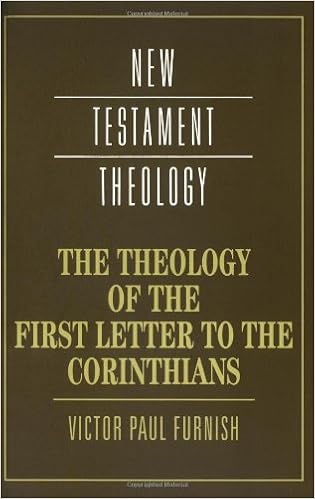
Victor Paul Furnish on 1 Corinthians 16:14

"'Let everything you do be done in love' .... One can imagine contexts in which this very general appeal would amount to little more than an encouragement to be kind to others. But here it is invested with the full weight of Paul's gospel as that comes to expression in 1 Corinthians. The love he has in view is the agape that is proper to God's own being, which both graces and claims the whole of creation and has been revealed in the saving power of the cross. In their belonging to the resurrected-crucified Christ, believers are formed into a community that lives from the cross and are called to be agents of God's love, both individually and corporately, within the particularities of their own time and place." - Victor Paul Furnish, The Theology of the First Letter to the Corinthians (Cambridge: Cambridge University Press, 1999), 121.

Thursday, June 30, 2016

Assessing Ernst Haenchen

Ernst Haenchen (1894-1975) is not exactly a household name, except in scholarship on Acts and John. When his contribution to the prestigious German KEK series first appeared in 1955, it quickly established itself as the standard critical commentary on Acts. When a revised edition was translated and added to the NTL series in 1971, W.D. Davies lauded it as "a great work of scholarship" and celebrated its appearance, at last, in English.

Jacob Jervell, whose very different 1998 German commentary on Acts replaced Haenchen's in the same series, described his predecessor's contribution as "the most comprehensive and important work of the critical German post-World War II research on Acts."*

(As an aside, Martin Rese describes how "From the end of the sixties until his death in 1975 Ernst Haenchen took me as one of his discussion-partners. He called me up nearly every day for at least an hour, and we talked about the problems of interpreting Luke-Acts and the gospel of John."** What would that have been like, I wonder?)

(As a second aside, I note with dismay that, according to this German Wikipedia entry, Haenchen was a member of the Nazi party during WWII: That decision may have secured him a promotion during the War, but it cost him his official position, at least, after it was over. Update: See Joseph Tyson's longer discussion of Haenchen here. Tyson does not mention Haenchen's membership in the National Socialist party.)

For my part, I share W. Ward Gasque's judgement that the commentary "is in every way a magnificently impressive piece of scholarship -- a treasury of bibliographical, philological, and exegetical detail. ... Even when one does not agree with the conclusions of the author ... he must confess that Haenchen has made him look at  the text and the problem raised by it from every possible angle" (A History of the Interpretation of the Acts of the Apostles [Hendrickson, 1989], 243).

To be sure, Gasque immediately went on to add:
"When all is said and done, however, it must be noted with a sense of disappointment that it is probable that Haenchen's great commentary will be regarded by future generations of scholars more as a historical phenomenon belonging to one era of the history of exegesis than as a lasting contribution to New Testament research. ... [W]hen the storm has subsided and New Testament critics are in a position to look back over the past two or three decades of research from the perspective of history they will, I think, be able to see that the commentary of Haenchen is as tendentious and ultimately as unhistorical as he thinks the author of the Book of Acts was." (Gasque, History, 244).

For better or worse, Gasque's prediction has not come true: Haenchen's commentary remains a classic, and the recent excellent critical commentary by Richard Pervo in the Hermeneia series stands very much in the same tradition. (See this post for my initial reflections on Pervo's commentary.)


*Jacob Jervell as translated and quoted in Martin Rese, "The Jews in Luke-Acts: Some Second Thoughts," in The Unity of Luke-Acts (J. Verheyden, ed.; Leuven: Peeters, 1999), 185-6.
**Martin Rese, "The Jews in Luke-Acts," 185.

Monday, March 16, 2015

Reflections on Paul's Wife by a 17th-Century Woman Interpreter of Scripture

These reflections by Lady Anne Halkett (1622-1699) are of interest not only for her views on Paul's marital status, but also for her reconstruction of the chronology of Paul's life:

And St. Paul says Marriage is honorable in all. And doubtless he was married himself as may be concluded from what he says in giving several admonitions, “I entreat thee also true Yokefellow, help those women which labored with me in the Gospel” (Phil 4:3). Others were called his fellow labourers, but only this his Yokefellow, by which is ordinarily, in common speech, called a wife. Which it seems the other Apostles had and the brothers of the Lord and Cephas. And where he treats of marriage in all sorts of persons, he says, “If thou marry, thou has not sinned” (1 Cor 7:28). But it is probable that his wife died at Philippi, while he was at Rome for that Epistle [Philippians] was dated from Rome where he was brought twice before Nero. And as the Lord stood by him the first time and delivered him out of the mouth of the Lion, so doubtless he was the second time (2 Tim 4:17), and came then to Philippi from whence these Epistles to the Corinthians was dated where in the former chapter cited he says to the unmarried and widows, “It is good for them if they abide even as I” (1 Cor 7:8). And whatever further he advises to any, married or unmarried, he doth it for their profit, and not to cast a snare upon them but for that which is comely that they may attend upon the Lord without distraction (1 Cor 7:35). - Anne Halkett (NLS 6501 pp. 11-12; spelling standardized)
Comments:
  • Lady Halkett's idea that the "Yokefellow" of Phil 4:3 is Paul's wife goes back as far as Clement of Alexandria, so she is not being original here. In this, I hasten to add, Halkett is no different from modern commentators who duly note the range of options without citing their sources. At least she provided reasons in support of her conclusions. How Halkett encountered Clement's view remains a mystery. 
  • According to Halkett, Paul was imprisoned in Rome and tried before Nero (twice!) between his second and third missionary journeys. I expect that Halkett would have dated the other "prison epistles" as well as Philippians to this Roman imprisonment. On his release from prison, Paul returned from Rome to Philippi where he wrote 1 and 2 Corinthians. This reconstruction is probably not original to Halkett either, but it is intriguing because it is so very different from modern scholarship, which puzzles over the provenance of Philippians--was it written from imprisonment in Ephesus, Caesarea or Rome?--but typically places Paul's imprisonment in Rome at the end of his three "missionary journeys." It is good to be reminded that our modern convention is not the only way to put the puzzle pieces together.
Beyond these two points, which interest me as a student of the New Testament, Halkett is of interest as a prolific 17th-century woman interpreter of Scripture. My own "Yokefellow", who is an expert on all things Halkett, informs me that about 5,000 pages of Halkett's religious meditations survive in manuscript. The excerpt I quoted comes from a meditation entitled, "Serious Reflections Concerning them that are Seduced," which was written in 1696, a few years before Lady Halkett's death.

Monday, December 29, 2014

Shaye Cohen on the value of pre-modern Christian exegesis

"Jewish and, to some extent, Christian scholarship has long recognized the continuing value of much of medieval Jewish exegesis for an understanding of the Hebrew Bible, and I do not understand why contemporary scholarship on the New Testament (excluding, of course, textual criticism) ignores practically all works that predate the nineteenth century." - Shaye Cohen, "Was Timothy Jewish?" in Shaye J. D. Cohen, The Beginnings of Jewishness: Boundaries, Varieties, Uncertainties (Berkeley, CA: University of California Press, 1999), 367 n. 9.

For the record, Cohen's answer to the question, "Was Timothy Jewish?" is no. 

Wednesday, January 4, 2012

The influence of E.P. Sanders

Mark Goodacre has described E. P. Sanders as "the greatest living New Testament Scholar" (here and here). Joshua Schwartz says something similar in his review of a festschrift in Sander's honour:
Most of us in academia hope to come up with a few new and original ideas that will impact upon scholars and scholarship. If we are lucky and this happens, we might remain in the eye of scholarship for a generation or two, but after that most of us and our work fade into various levels of academic oblivion. Only very few scholars produce work of such monumental importance that it becomes benchmarks not only for colleagues but for anyone wishing to study a particular field. Sanders has done this in not one or even two but in three centrally important areas of New Testament study: Judaism, Jesus, and Paul. Moreover, even if one does not study Christianity or Jesus, it is still impossible today to work on the Second Temple period without Sanders, and obviously this is the case regarding Jesus and Paul. This has been true for decades and will undoubtedly continue to be so for the coming ones. Few scholars have been able to bend, as it were, the not always pliant study of religious traditions and to form it into something new. Not all agree with him; his work has sometimes aroused opposition and criticism, but we cannot make do without it. The present volume is a fitting accolade for an outstanding scholar. - Joshua Schwartz, review of Fabian E. Udoh, Susannah Heschel, Mark A. Chancey, and Gregory Tatum, eds., Redefining First-Century Jewish and Christian Identities: Essays in Honor of Ed Parish Sanders (Notre Dame: University of Notre Dame Press, 2008) [http://www.bookreviews.org/pdf/7140_7760.pdf].
________________

I was about to announce that גֵּר־וְתוֹשָׁב is officially on ice until further notice, but then I came across a few unfinished posts in my draft folder that seemed worth saving. The above quote was one of them. 

Monday, June 6, 2011

The Riddle of the New Testament

I first encountered Sir Edwyn Hoskyns in Stephen Neill's fantastic history of The Interpretation of the New Testament, and have been intrigued by Hoskyns and Davey's The Riddle of the New Testament (3rd ed.; London: Faber & Faber, 1947) ever since reading Markus Bockmuehl's Seeing the Word. Neill calls it "a series of hammer blows, at what . . .was a widespread understanding of the gospels" (215). It is that, but it is also a series of hammer blows against theological liberalism, for, as Neill explains,  "[T]he most important thing of all about Hoskyns was that, like Karl Barth, he was a converted liberal" (213).

As one would expect from a book first published in 1931, parts of The Riddle of the New Testament are rather dated. I find the authors a little too confident in the results of historical criticism. However, it is worth your time at least as much as C.F.D. Moule's Birth of the New Testament, and it is an easier (and shorter) read. In many respects it seems far ahead of its time. It is also a model of clarity, forceful argument, and verve. The whole book is written around the riddle of the relationship between Jesus and the church:
"There is a riddle in the New Testament. And it is a riddle neither of literary criticism, nor of date and authorship, nor of the historicity of this or that episode. The riddle is a theological riddle, which is insoluble apart from the solution of an historical problem. What was the relation between Jesus of Nazareth and the primitive Christian church? That is the riddle. The New Testament documents, all of them, emerged from the primitive church. They reflected piety and encouraged faith. Was there, or was there not, a strict relationship between this rich piety and exuberant faith and the historical figure of Jesus of Nazareth? Did the life and death of Jesus of Nazareth control the life of the primitive church? or were his life and death submerged by a piety and faith wholly beyond his horizon? . . . The adequacy of the modern historical critical method is therefore finally tested by its success or failure in answering the problem of the Jesus of history. The authors of this book are confident that the critical method does survive this very severe test, and that it does disclose results, even assured results..." (12).
Hoskyn's and Davey's answer is, in a word, Yes. The life and death of Jesus controlled the life of the primitive church:
"No single strand in the evidence deprives Jesus of the conscious sense that he was bringing into being a new order and working out a purpose . . . . Nowhere in the New Testament are the writers imposing an interpretation upon a history. The history contains the purpose, and is indeed controlled by it. That is to say, the historian is dealing in the end with an historical figure fully conscious of a task which had to be done, and fully conscious also that the only future which mattered for men and women depended upon the completion of his task. The future order, which it was the purpose of Jesus to bring into being, depended upon what he said and did, and finally upon his death." (172)
I, for one, find their answer compelling.

Thursday, June 2, 2011

C.F.D. Moule on New Testament Ethics

"Strictly speaking, there are no 'cardinal' virtues in Christianity, for Christian character does not 'hinge' round the disciplined practice of virtue: it is a spontaneous growth, it is a crop of qualities springing from the seed of new life divinely sown . . .; or--more characteristically described--it is life in the new age, resulting from incorporation in the new humanity which is Christ . . . . Agape is not a virtue among other virtues so much as an impulse, divinely implanted: it is God's love for us in Christ, reflected and responded to. And what in other systems might be called virtues are the shape spontaneously taken by agape in the Christian community . . . . Therefore, although in fact many Christian qualities seem to coincide with those on the Stoic list, the difference is a radical one. The Stoic virtues are the proud struggle of the human spirit to conform to nature and to gain the mastery over weakness; the Christian virtues emerge after the recognition of sin and the confession of human helplessness: they are the result of committal to God and dependence upon him" (193-4).

"In the last analysis, it is questionable, indeed, whether a Christian ethical system, as such, can exist. Christianity is concerned with the transformation, in Christ, of personal relations. The code which provides a framework or scaffolding within which this operates must, strictly speaking, be a borrowed one, for Christianity, as such, does not offer a distinctive code or system of conduct" (274).

C.F.D. Moule, The Birth of the New Testament (3rd ed.; Harper & Row, 1982).

Tuesday, May 31, 2011

C.F.D. Moule on New Testament Eschatology and Football

"New Testament eschatology at its deepest level concentrates upon entering into, implementing, loyally expressing that which is already given, which is Christ: it does not say, 'How long will it be before the whistle blows for the end of the game?' but, 'Where ought I to be now, to receive the next pass?' In other words, the fact that the kick-off has taken place, that the game is on, and that we have a Captain who can lead us to victory, is all that matters." - C.F.D. Moule, The Birth of the New Testament (3rd ed.; Harper & Row, 1982), 148.

(Football = soccer, of course.)

Saturday, May 21, 2011

C.F.D. Moule on Evangelism and Worship

"[T]he Church lives by evangelism as fire by burning, and a non-evangelizing Church is dead or dying" (8)

"[W]orship, for a truly religious person, is the be all and end all of work; and . . . if worship and work are distinguished, that is only because of the frailty of human nature which cannot do more than one thing at a time. The necessary alternation between lifting up holy hands in prayer and swinging an axe in strong, dedicated hands for the glory of God is the human makeshift for that single, simultaneous, divine life in which work is worship and worship is the highest possible activity" (42-43).

Both quotations are from C.F.D. Moule, The Birth of the New Testament (Black's New Testament Commentaries) (3rd ed.; Harper & Row, 1982)--not the sort of book from which you would typically expect to find practical statements about church life.

Tuesday, December 28, 2010

On Hallowing God's Name

"The purpose of Israel's existence is to sanctify God's name, that is, to attest to His existence, to publicize His oneness, and to advertise His greatness, by worshipping Him and by keeping His laws. Their failure to do so has the opposite effect: His name is profaned, that is, His fame is diminished and His reputation tarnished." - Baruch J. Schwartz in The Jewish Study Bible (Oxford, 2004), 262.

The quotation suits the Lord's Prayer to a T, but Schwartz is commenting on Leviticus 22:31-33:
You shall faithfully observe My commandments: I am the LORD. You shall not profane My holy name, that I may be sanctified [= "hallowed"] in the midst of the Israelite people -- I the LORD who sanctify you, I who brought you out of the land of Egypt to be your God, I the LORD. (NJPS)

Saturday, October 16, 2010

Prophecy after the Prophets

I will be offering an upper level seminar at Briercrest College and Seminary next semester on early Christian prophecy within its early Jewish and Greco-Roman contexts. The course will be cross-listed in the college as BLST415 Advanced Studies in New Testament Literature, and in the seminary as BT829 New Testament Specialty: Prophecy after the Prophets.

The questions we will consider include the following:

  • What happened to prophecy between the Old and New Testaments? Did it cease only to be restored in the New Testament? Was it transformed or did it continue unchanged? What is the relationship between Old Testament prophecy and early Jewish apocalyptic literature (including the book of Revelation)?
  • Perceptions of past prophecy: How did early Jews and Christians interpret the written prophets? In what ways did respect for the “Prophets” as Scripture shape how early Jews and Christians viewed contemporary inspired experiences?
  • Future prophets: What role did prophets play in Jewish expectations of the future? How did early Jews and Christians understand Malachi’s prediction of the return of the prophet Elijah, and Deuteronomy’s prediction of a “prophet like Moses”?
  • Jesus the prophet: What sort of prophet was Jesus? How does the title “prophet” relate to the title “Messiah”?
  • Christian prophets in history: What role, if any, did Christian prophets play in the transmission of the Jesus tradition? What role did Christian male and female prophets play in Paul’s churches? How would Christian prophecy have been viewed in comparison with Greco-Roman conceptions of prophecy?
  • Christian prophets and theology: Are all Christians prophets? What is the relationship between prophecy and tongues? What are the characteristics of Christian prophets? How are prophets different from apostles? Is Christian prophecy different from Old Testament prophecy?
  • What happened to prophecy after the New Testament?
I will post the syllabus when it is complete. (My next major task is deciding on the readings--the single most important part of designing a successful seminar. Any recommendations?)

The course is currently scheduled on Friday's between 9:00 a.m. - 12:00 p.m., so you'll need to be in the Caronport area if you'd like to participate.

Monday, August 23, 2010

The Lord's Prayer in Hebrew

(Update:Hagop Karakashian informs me that he will be producing a tile with the Lord's Prayer in Hebrew in 2011.)

When I was in Jerusalem last year I wondered again why I could walk into shop after shop in the Old City and find identical "Armenian" "handpainted" ceramic plate renditions of the Lord's Prayer in Greek, Arabic and Syriac, but not Hebrew. So I made my way to the Karakashian Bros' Jerusalem Pottery shop--famous for its original, genuinely Armenian work--and asked the proprietor if he knew of any Hebrew versions of the Lord's Prayer on ceramic pottery. "No," he replied. But before I left he mentioned he would be interested in producing one--if I could provide the Hebrew text. I said I would email a Hebrew version on my return to Canada. Now more than a year later, it is time for me to keep my word.

The obvious answer to the question why no Hebrew versions of the Lord's Prayer are available for sale on ceramic tile is that most Hebrew speakers are not interested, and that the Lord's Prayer was preserved by Christians in Greek, Arabic and Syriac translation. Since Jesus is commonly thought to have taught exclusively in Aramaic, few scholars interested in the ipsissima verba of Jesus have tried to reconstruct a Hebrew version of the Lord's prayer. As I have already explained, my working assumption--based on recent scholarship as well as my experience growing up in Kenya, a country where bilingualism, at least, is the norm--is that Jesus could well have taught in Aramaic or Hebrew, and could probably converse in Greek. A Hebrew original of the Lord's prayer is not out of the question.

The problem is choosing the best Hebrew version. Because there is no centuries-old tradition of reciting the Lord's prayer in Hebrew, there is no standard liturgical version. The three Hebrew translations of the Lord's Prayer that I have consulted all differ, and I am, unfortunately, not qualified to arbitrate between them, much less to improve on them. Hence this post. Below the jump break, I present the English (KJV), Greek (NA27), and Hebrew versions of the Lord's prayer in parallel. I invite your feedback on which translation to recommend.

Tuesday, July 13, 2010

Paul and the Marginal Imperial Cult

A few years ago I expressed my reservations about recent attempts by N.T. Wright and others to read Paul against a pervasive imperial cult. I began to think I was wrong, however, because everyone else seemed to be jumping on the imperial band-wagon (often citing Simon Price's book, Rituals and Power: The Roman Imperial Cult in Asia Minor, which I have not read).

One of my main concerns was that much of the archaeological evidence for the imperial cult post-dates Paul. In a recent article, Colin Miller reviews the archaeological evidence in detail and has the same concern:
"[M]y aim in this article is to explore which of the cities in which Paul worked, in Paul's time, had some relation to the imperial cult, and what that relation was. Is it true that the emperor cult permeated life and helped make up the very fabric of reality in Paul's world? Is it true that in the time of Paul's mission the emperor cult held the empire together? Is it, more basically, true that "[i]n any city that Paul visited, evidence of emperor worship appears repeatedly in present excavations?" [quoting Crossan and Reed] I argue that all our evidence points to a negative answer to these questions. The archaeological evidence reveals that, in the cities Paul visited, in Paul's time, the emperor cult was marginal. In more than half of Paul's missionary cities there is no evidence of the imperial cult at all. In the others, I will show, the emperor was only one cult alongside many others." (Colin Miller, "The Imperial Cult in the Pauline Cities of Asia Minor and Greece," Catholic Biblical Quarterly 72.2 (April 2010): 314-332, here 316)
Looks like an important article!

Sunday, May 2, 2010

Free Audiobook of Dale Allison's The Historical Christ and the Theological Jesus

I was running out of reading material last week, so I took the subway down to Crux Books*, and picked up a copy of Dale C. Allison Jr.'s The Historical Christ and the Theological Jesus (Grand Rapids: Eerdmans, 2009). I soon realized I had already listened to an audio version narrated by Allison himself. In the introduction, Allison explains "I wrote this book in preparation for the Kenneth W. Clark lectures, which I delivered at Duke University in February of 2008." The lectures were recorded, and are still available online here.

The book is short, and worth reading (or listening to) twice. Allison is one of my favourite New Testament scholars. I like his bracing honesty; I resonate with his "doubt seeking understanding," though I prefer to doubt less--or less confidently--than he does; and I admire the depth and breadth of his knowledge: I recall Allison saying once that he learns more from reading outside the guild of biblical studies than he does within it--but when he writes on a subject within biblical studies you can be sure he has read virtually all there is to read on it. In a Christianity Today cover article announcing the "death of latest historical Jesus studies as we know them," Scot McKnight refers to Allison as "the most knowledgeable New Testament scholar in the United States" (page 4). In his blurb on the back of Allison's book, McKnight says: "In the last 125 years there have been five truly epochal thinkers who altered the course of Jesus researcH: Martin Kähler, Albert Schweitzer, Rudolf Bultmann, Ernst Käsemann--and the fifth one is Dale Allison." High praise, though I'm puzzled that E.P. Sanders didn't make the cut.

If you read Allison, you should also listen to Richard Hays's recent response to N.T. Wright, which raises similar questions about the uneasy relationship between history and theology, but which places rather more emphasis on theology than on history as it is conventionally understood. 

____
*In case you are wondering what I am doing in the land of subways and Crux Books, I have spent the last week in Toronto hanging out with my dad, and visiting my mom in the hospital. Thankfully, there has been time to read and listen to a few Wheaton conference podcasts in evenings, during the daytime when Mom naps, and while traveling to and fro. My current goal is to complete book #4 on Tuesday's return flight.

Sunday, April 25, 2010

The influence of E.P. Sanders

Mark Goodacre has described E.P. Sanders as "the greatest living New Testament scholar" (here and here).  Joshua Schwartz says something similar in his review of a festschrift in Sanders' honour:
Most of us in academia hope to come up with a few new and original ideas that will impact upon scholars and scholarship. If we are lucky and this happens, we might remain in the eye of scholarship for a generation or two, but after that most of us and our work fade into various levels of academic oblivion. Only very few scholars produce work of such monumental importance that it becomes benchmarks not only for colleagues but for anyone wishing to study a particular field. Sanders has done this in not one or even two but in three centrally important areas of New Testament study: Judaism, Jesus, and Paul. Moreover, even if one does not study Christianity or Jesus, it is still impossible today to work on the Second Temple period without Sanders, and obviously this is the case regarding Jesus and Paul. This has been true for decades and will undoubtedly continue to be so for the coming ones. Few scholars have been able to bend, as it were, the not always pliant study of religious traditions and to form it into something new. Not all agree with him; his work has sometimes aroused opposition and criticism, but we cannot make do without it. The present volume is a fitting accolade for an outstanding scholar. - Joshua Schwartz, Review of Fabian Udoh, ed., Redefining First-Century Jewish and Christian Identities: Essays in Honor of Ed Parish Sanders, Review of Biblical Literature [http://www.bookreviews.org/pdf/7140_7760.pdf] (2010).
____________________
I was getting ready to announce that גֵּר־וְתוֹשָׁב is on ice until further notice, when I ran across a few partial posts in my drafts folder that seemed worth completing. This is one of them.

Thursday, April 1, 2010

In defense of Pharisees

In a post a couple weeks ago on A Hermeneutics of the Golden Rule, I said:
"If we want to approach the Pharisees historically, as real people, we have to acknowledge that they would not have regarded themselves as hypocrites. "Loving" history will seek to recover a view of the Pharisees that made sense to them.'"
Here I want to respond in a little more detail to the widespread Christian assumption that the Pharisees of Jesus' day--if not most Jews--were hypocrites. I suspect many readers of the New Testament regard as typical the self-righteous Pharisee of Luke 18:9-14. And if Jesus selected a Pharisee to show-case the misguided posturing of those who "trusted in themselves that they were righteous" (Luke 18:9), and Paul accused his fellow Jews of "seeking to establish their own righteousness" (Rom 9:30), it is easy enough to view the Pharisee as the typical first century Jew, who--it turns out--goes home condemned by God.

This misreading of the parable of the Pharisee and the Tax Collector rests on a misunderstanding of the "righteous" as those whose behaviour is free from sin. If we want to situate the parable in a more realistic first-century context, we would do better to view it as an address by a Pharisee to fellow Pharisees, reminding them of truths on which they all agree. This goes too far, of course, since Jesus was not a Pharisee. Nevertheless, first-century Pharisees, like most first-century Jews, would have agreed with Jesus that it is those who confess their sins and acknowledge their unworthiness before a holy God who are "justified." In other words, in first century Judaism those who were "righteous" did not regard themselves as sinless. Consider the following examples from the Psalms of Solomon, a pseudonymous Jewish work dated to the first century BCE, and sometimes associated with the Pharisees:
3: 5 The righteous stumbles and proves the Lord right; He falls and watches for what God will do about him; 6 he looks to where his salvation comes from. The confidence of the righteous (comes) from God their savior; sin after sin does not visit the house of the righteous. 7 The righteous constantly searches his house, to remove his unintentional sins. 8 He atones for (sins of) ignorance by fasting and humbling his soul, and the Lord will cleanse every devout person and his house.

9:7 You bless the righteous, and do not accuse them for what they sinned. And your goodness is upon those that sin, when they repent.
The same viewpoint is expressed in the Hodayot (1QH) from the Dead Sea Scrolls, whose hymns are sometimes attributed to the "Teacher of Righteousness":
“I know that Thou hast marked the spirit of the just, and therefore I have chosen to keep my hands clean in accordance with [Thy] will: the soul of Thy servant [has loathed] every work of iniquity. And I know that man is not righteous except through thee...” (1QH; Vermes 257-8 [I'll add column and line references later]).

“[Thou art a merciful God] and rich in [favours], pardoning those who repent of their sin and visiting the iniquity of the wicked. [Thou delightest in] the free-will offering [of the righteous] but iniquity Thou hatest always” (1QH; Vermes 255).
No doubt there were hypocritical, self-righteous Pharisees in the first century just as there are hypocritical self-righteous Christians today. Jesus criticized them. Then, as now, the criticism hit home.  But the New Testament offers enough counter-evidence to demonstrate that not all Pharisees were hypocrites in the popular sense of someone who pretends to be something they are not. Paul, for example, gives no indication that his commitment to the "strictest sect of our religion" was a sham (see Phil 3:5); according to Acts 23:6-9 and 26:5 he remained a Pharisee even after becoming a follower of Jesus. Other obviously sincere Pharisees include Nicodemus (John 3) and Gamaliel (Acts 5:34).

I don't know how to generalize from individuals to entire groups, but evidence from several different sources points to the reputation of the Pharisees as a group for righteous living. The explanation that makes the best sense of the evidence is the charitable one: Most Pharisees regarded sincere piety as a positive good, and tried to live according to their ideals. In all fairness, trying to live according to one's ideals was what the Law required. Jesus required the same thing (see Matt 5:48).

I suspect the central issue in Jesus' polemic against the Pharisees was not their sincerity, but their rejection of his own claims about himself (see Luke 7:28-35; 12:54-56). According to the Gospels, being a "hypocrite" can mean sincerely placing one’s priorities in the wrong place, not being insincere.

The irony is that leaving the Pharisees as one-sided stick figures enables us as Jesus' contemporary followers to distance ourselves from the Pharisees and so avoid listening to the practical significance of Jesus' teaching.

Wednesday, February 3, 2010

1 Clement Greek Reading Group

If you live in Southern Saskatchewan and have a reading knowledge of Greek, you are invited to join a group of us who have begun reading through 1 Clement in Greek this semester.

We meet on Thursday's from 7:00-8:00 p.m. in my basement. (Contact me for the details if you need them.) This Thursday we will pick up at chapter 3--which means we are averaging a short chapter per week.

Here's a slightly modified excerpt from my introductory email:
I’d like to begin reading through 1 Clement, a letter usually attributed to Clement of Rome, one of the “Apostolic Fathers,” to the church in Corinth. 1 Clement is usually dated toward the end of the first century, which makes it one of the oldest surviving Christian texts outside of the New Testament. We will read about how some of the apostles died, experience how Clement, at least, interpreted the Old Testament as Christian scripture, and learn how the church developed at the tail-end of the NT era. How can that not be fun?

I suspect that parts of Clement’s letter will be more challenging Greek than what you have encountered so far, but that’s okay. There’s no requirement to prepare in advance (although you are welcome to do so), and I’ll have some lexical aids and English translations ready if we get stuck. The point is continued exposure to Koine Greek in a fun, low pressure context.

There are a few different editions of the Greek text available for free online. I recommend Lake’s version (http://www.ccel.org/ccel/lake/fathers2.ii.i.html) because the font is clear and the whole text displays at once. For more information on 1 Clement see http://www.earlychristianwritings.com/1clement.html and http://en.wikipedia.org/wiki/Epistles_of_Clement.
This is my first time through 1 Clement in Greek although I read the "Apostolic Fathers" in English a decade ago. I avoid preparing in advance partly because I don't have a lot of time, but mostly because the experience of diving into an unfamiliar text and discovering that one can make their way is both healthy and fun. It's the Greek geek's equivalent to stepping into a half-pipe or catching a wave.

Saturday, January 23, 2010

Strommata

Yesterday I skimmed through the 200+ blog posts that accumulated in my Blog reader over the last week, and highlighted a few links for subsequent, more detailed perusal.

The highlight is this excellent interview with Richard B. Hays.

Peter Enns's review of G.K. Beale's book-length response to Enns's book, Inspiration and Incarnation: Evangelicals and the Problem of the Old Testament, makes interesting reading. No surprise, Enns doesn't like the book. Here's his conclusion:
"Beale laments that the doctrine of inerrancy is eroding. In my opinion, the reason for this is not the insidious influence of a new breed of evangelical scholars, but the very thinking displayed in this book. If Erosion represents the kind of work necessary to defend the model of inerrancy Beale fancies, the erosion he fears may quickly become a landslide."

Thursday, January 7, 2010

Best Portland Area Christian Used Book Store

I am happy to dub Windows Booksellers the new best Christian used book store in Portland. Although Windows has been operating in Portland since 2002, I only found out about them on this visit when I began to look for an alternative to the now-defunct Pilgrim Discount. I came away with cheap copies of several classics:

Brown, Raymond E. New Testament Essays. Garden City: Doubleday, 1965.
Caird, G. B. The Gospel of St Luke. Harmondsworth: Penguin, 1963.
Davies, W. D. The Sermon on the Mount. Cambridge: Cambridge University Press, 1966.
Hengel, Martin. Property and Riches in the Early Church: Aspects of a Social History of Early Christianity. Philadelphia: Fortress, 1974.
Keck, Leander E. Mandate to Witness: Studies in the Book of Acts. Valley Forge: Judson Press, 1964.
Minear, Paul S. To Heal And To Reveal: The Prophetic Vocation according to Luke. New York: Seabury Press, 1976.

But I am especially excited about the following two by the late C.F.D. Moule:
Moule, C. F. D. The Epistles of Paul the Apostle to the Colossians and to Philemon. Cambridge: Cambridge University Press, 1962.
Moule, C. F. D. The Birth of the New Testament. 3rd ed. San Francisco: Harper & Row, 1982.

The first I plan to read as I teach Greek Exegesis this semester, the second I recall being mentioned in several Moule obituaries.

Windows Booksellers also has a very large store in Eugene, OR.