Showing posts with label Law. Show all posts

Thursday, September 20, 2018

Three or Four Views on the Law in Acts: Preliminary Taxonomies

Bonus marks if you can identify the location of the stairwell.
Note: This is part 2 in a series on the Law in Acts. Part 1 is here.

At the risk of caricature, I begin with two rough-and-ready ways of classifying the major options.

Taxonomy 1: The first typology plots Jewish-Christian Torah observance along a trajectory from least observant (option 1) to most observant (option 2c):

(1) Freedom from the law within Acts: The book of Acts tells the story of a progressive, divinely-orchestrated, abandonment of the law, in tandem with the spread of the gospel to all nations. Acts narrates the emergence of Christianity out of Judaism and the replacement of Israel by the church as the people of God.* This view is the starting point for many ordinary readers who conflate Acts with a conventional understanding of Paul, and who assume the New Testament is about Christianity not Judaism; it remains a common scholarly option as well. [*Supersessionism is a slippery term. Some scholars finesse “replacement” differently, while still holding that Luke presents a move away from the law among Paul and other right-thinking Jewish-Christians within Acts.]

(2) Law-observant Jewish Christians & law-free gentile Christians: A second broad approach grants (a) that the conversion of Cornelius in Acts 10-11 and the Jerusalem Council in Acts 15 are focused on a law-free mission to gentiles, and (b) that Luke depicts Jewish Christ-believers within Acts—including Paul—as obedient to the law. What this means for Luke’s understanding of the significance of the law in his own time remains debated:

(a) A Torah-observant past within Acts vs. a law-free post-70 present in Luke’s own day: Acts distinguishes between Jewish and gentile Christians, defending a law-free gentile Christianity but depicting Paul—and therefore all Jewish Christians—as fully Torah observant. However, between the story of Acts and the time of writing a major break between Judaism and Christianity occurred. In Luke’s own post-70 (gentile?) context, there is no longer a distinction between Jewish and gentile Christians, and the law is not considered binding on anyone in the church. Supporters of this view (2a) often regard Luke’s description of law-observant Jewish Christianity in Acts as an attempt to justify the claims of gentile Christianity to be the people of God and heirs of Israel’s ancient heritage. As a result, view 2a often resembles view 1.

(b) A Torah-observant past within Acts and a Torah-observant option in Luke’s own day (?): Luke knows of Torah-observant Jewish Christians among his contemporaries, and he thinks it is fine for them to continue to keep the law, but he doesn’t think it is necessary to do so.

(c) A Torah-observant past within Acts and in Luke’s own day: Acts makes it clear that both Jews and gentiles are saved by faith alone, but the author distinguishes between “a people from the nations” who are not required to observe the law, and God’s covenant with Israel at Mount Sinai, which, Luke assumed, remained in effect. Faithful Jewish believers in Jesus are thus expected to continue to keep the law. More clearly than view 2a, adherents of this view tend to deny that Luke depicts gentile believers as replacing Israel as the people of God. The “true Israel”—not a biblical term, but a sectarian concept—consists rather of Jewish believers in Jesus.

This taxonomy helps us see at a glance the difference between the two major approaches to the law in Acts. On the first approach, Acts can be made to correspond with conventional readings of Paul's letters. On the second approach (options 2a-c), Acts presents Paul as fully Torah-observant.

A problem with the taxonomy is that it combines questions about the story Luke tells--“Are Jewish Christians Torah observant in Acts?”--with speculative reconstructions of Luke’s own later church context--for example, “Were Jewish Christians in Luke's later church still Torah observant?”

Taxonomy 2: Before attempting to form conclusions about Luke's own church context, we should probably begin by trying to relate the story Luke tells about the law with another closely-related theme (or themes) in Acts. So here is a second taxonomy organized like a JoHari Window that combines Luke’s depiction of the law in Acts (the x-axis) with Luke’s depiction of Jewish Christianity within Acts (the y-axis):

  • The x-axis plots Jewish Christianity as described in Acts as either “Torah observant” or “Law-free.” 
  • The y-axis focuses on the significance of the story Luke tells, with “(gentile) church replaces Israel” at one end, and “Israel reduced to a Jewish sect” at the other. 
View 1 on the first typology belongs in the top right quadrant: According to this view, the church described in Acts claims to replace Israel as the people of God and has already abandoned the law.

Views 2a and 2b belong in the top left quadrant: Acts depicts Jewish Christians as fully Torah observant, but presents all believers in Jesus, both Jews and non-Jews, as part of a single new people of God. In the opening chapters of Acts, we see the development of a sectarian movement consisting only of Jews who claim to be experiencing the fulfillment of God's promises to Israel. As the sectarian assembly (or "church") expands to include non-Jews alongside Torah-observant Jews, non- or "trans-" ethnic Christianity begins to emerge out of Judaism and to replace ethnic Israel as the people of God.

View 2c belongs in the bottom right left [!] quadrant: According to this view, Luke not only distinguishes between Torah-observant Jewish believers (including Paul) and law-free gentile believers, he also continues to distinguish between a Jewish-Christian sectarian group that claims to be “Israel restored,” and a non-Jewish “people from the gentiles” who share in salvation, the Holy Spirit, and the other blessings brought by Jesus, but who are never fully merged with Jewish followers of Jesus and who are never described as Israel.

No doubt there are still other ways of organizing the scholarly options. Before pursuing these further I hope in the next few posts to begin to lay out the evidence that is so variously interpreted by modern readers of Acts.

Wednesday, September 19, 2018

Three or Four Views on the Law in Acts

Anyone who has followed this blog for a while will know that I keep returning to the puzzle of Luke’s attitude toward the law. In 2014, in what was at least the third post on some aspect of the topic, I concluded that leaving the puzzle unsolved would be better than forcing all the pieces to fit:
Rover as "sober second thought"
As I have tried to push for consistency, for an interpretation of Acts that makes sense of all the data, I have found myself offering readings of individual passages that, on sober second thought, seem unsustainable. After multiple attempts to walk away with a solution to the problem of Luke and the law, it dawned on me that allowing two readings of Luke's silences to sit side-by-side without deciding finally between them is better than a tour de force that forces all the evidence to fit instead of admitting honestly where the difficulties are. (Click here for the whole post; here and here for earlier posts; and here, here, and here, for subsequent posts.)
For better or worse, by the time the essay I was working on was complete, I had decided to try my hand at a tour de force. Although I did allow that Luke may have envisioned a change in the food laws to enable Jewish believers to eat whatever was set before them by baptized gentile believers, I argued not only that Luke depicts Jewish Christians in Acts as consistently Torah-observant, but that he also thought Jewish believers in his own day should continue to observe the law.

I am now far enough removed from the argument of that essay to want to subject it to “sober second thought.” I like to tell myself that when I am not completely convinced by what I am saying I am probably trying to get at something important. Difficult questions exist for a reason. If the answers were obvious, the questions would have been resolved already. Still, while I was confident enough to go into print with it, aspects of the argument have always troubled me.

For one thing, my conclusions seem to put the author of the Gospel of Luke and the book of Acts at odds with the apostle Paul. Try as I might, I have not been able to persuade myself that comments about the law in Paul’s letters are addressed only to non-Jews, as proponents of the “Paul within Judaism” perspective tend to argue. When in Romans 6:15 Paul declares “we are not under law but under grace,” I take it that he includes all believers in Jesus, both Jews and gentiles. Paul’s self-description as one who became “without the law to those without the law” (1 Cor 9:21) and who was “persuaded in the Lord Jesus that nothing is unclean in itself” (Rom 14:14) is difficult to square with the Paul of Acts who insists, “I have in no way committed an offense against the law of the Jews” (Acts 25:8 NRSV)—if, that is, Luke means that Paul maintained a fully Torah-observant lifestyle.

To be clear, Paul’s letters do not determine what Acts must mean or vice versa. The unity of Scripture is, in my view, a theological dictum, not a hermeneutical method that can be used to impose an artificial harmony on the text. Nevertheless, I admit that my inability to reconcile the Paul of Acts and the Paul of the letters results in a certain amount of uncomfortable dissonance.

More importantly, the difference between my reading of Acts and my reading of Paul’s letters raises historical questions about the setting and purpose of Acts. Where in the late first or early second century would you encounter a church composed of Torah-observant Jewish Christians and law-free gentile believers? Was Luke really so unaware of the kind of things Paul said about the law in his letters?

There are also niggling doubts about bits and pieces of Acts that could point in other directions. Was I explaining the text or explaining it away?

Apart from being more reluctant to draw conclusions from the narrative of Acts about law observance in Luke’s own later context, I haven’t changed my mind on any major point (yet). But I have decided that I want to re-evaluate the puzzle of Luke’s attitude toward the law along the more expansive lines of what I suggested back in 2014—not by defending one option, but by presenting the main alternatives as persuasively as I can, and evaluating the evidence as fairly as I can.

My plan in subsequent posts is to use this space to think through the evidence and the options in more detail. Feedback, corrections, and comments are welcome.

Other posts in this series:
Preliminary Taxonomies

Sunday, May 20, 2018

Wesley Hill, Modern Marcionism and Torah Ethics

In a recent column in First Things, Wesley Hill calls out Andy Stanley for stating that the gospel “is completely detached … from everything that came before,” that Christians “are not accountable to the Ten Commandments,” and that “The Old Testament was not the go-to source regarding any behavior for the church.”

From Hill’s perspective, Stanley’s comments amount to a new Christian Marcionism not by denying the inspiration of the Old Testament, but by declaring that it has been superseded by the New Testament, and by implying that the Old Testament is irrelevant for Christian ethics.

To Stanley’s claim that the “apostolic decree” in Acts 15 “was a general call to avoid immoral behavior[,] but not immoral behavior as defined by the Old Testament,” Hill responds:
“New Testament scholars such as Markus Bockmuehl have demonstrated that the rules for Gentile converts outlined in Acts 15 themselves go back to the Old Testament’s guidelines for Gentile sojourners in Israel.” 
To be fair, some of the quotations from Andy Stanley’s sermon remind me of things I tell my students: It is true that Paul seldom refers directly to the Old Testament when he gives ethical instruction. You won't find the apostle trying to persuade his audience to agree with him by appealing to the authority of the Law of Moses as a legal code. And if Christians are "not under law, but under grace," then that law must include the Ten Commandments as well. Stanley is on to something.

I also agree with Stanley that the way the prohibitions in the apostolic decree are authorized is significant. In an essay on “Torah Ethics in Acts,” I wrote:
“Despite the absence of chapter and verse references, Luke’s readers would have connected the prohibitions against things defiled by idols, blood, what is strangled and sexual immorality (15:20) to the Torah. … Nevertheless, the four requirements of the decree are not authorized by Moses. While they are connected to the law of Moses (15:21), James formulates the terms of the decree as his judgement (15:19). In the letter the “apostles and elders” send to the Gentiles, the requirements are authorized by the Holy Spirit and the Jerusalem apostles and elders, not Moses (15:28, cf. 16:4).” (p. 85)
But Paul’s insistence that believers are free from the law, and the fact that the apostles and elders in Acts 15 do not appeal directly to the law when they issue ethical requirements does not mean that the Torah was no longer viewed as a divinely-inspired guide for human behaviour. Surely it was. In Torah Ethics and Early Christian Identity (Grand Rapids: Eerdmans, 2016), Susan Wendel and I asked contributors to consider not if, but how the Law of Moses continued to inform Christian ethical thinking even for those who, like Paul, did not think Torah observance was essential for salvation.


Hill's column demonstrates that the answer to this question can have important practical consequences.

In my essay on Acts, I concluded,
“[A]lthough Luke did not think that Gentile Christ-believers encounter the Torah in the context of God’s covenant with Israel, he presumably took for granted that the law—and controversy stories about the law in Luke’s Gospel—remains authoritative and relevant for Gentile Christ-believers when it is read as prophecy and applied by analogy.” (p. 91) (For what it means to read law as prophecy, you will need to read the essay itself.)

In Luke's writings, the Mosaic law continues to function authoritatively, but it is not the go-to source for Christian ethics--that honour goes to Jesus:
“The law in Luke’s writings plays a supporting role behind Luke’s overwhelming interest in Jesus. While Luke does not think they conflict, it is the example of Jesus, much more than the demands of Torah, that serves as the primary paradigm for the main characters in Acts, and hence for Luke’s Gentile readers.” (p. 91)
In this context, I would want to stress the absence of conflict. As Hill puts it, "One cannot pit Paul's sexual ethics against the Ten Commandments, from which they stemmed."

Sources:
Wesley Hill,  "Andy Stanley's Modern Marcionism," First Things (5.11.18)
Miller, David M. “Reading Law as Prophecy: Torah Ethics in Acts.” Pages 75–91 in Torah Ethics and Early Christian Identity. Edited by Susan J. Wendel and David M. Miller. Grand Rapids: Eerdmans, 2016.

Wendel, Susan J., and David M. Miller, eds. Torah Ethics and Early Christian Identity. Grand Rapids: Eerdmans, 2016.


Wednesday, June 29, 2016

Ernst Haenchen on the Purpose of Acts

The introduction to Ernst Haenchen's classic commentary on Acts contains no separate section on the purpose of Acts, but it is clear enough from his discussion that he thinks Acts was written (1) to reassure Christians (a) about the continuation of the Christian story after the death and resurrection of Jesus (i.e., to respond to the delay of the parousia) and (b) about the salvation-historical continuity of Gentile Christianity with the story of Israel (i.e., to demonstrate the legitimacy of the law-free Gentile mission). In addition to reassuring Christians about these two theological issues, Acts was also written to address a political problem. In the face of criticism by Jews, Luke wrote (2) to convince Romans that Gentile Christianity should be tolerated as a religio licita, just as Judaism was:
Luke's narrative suggests "a problem-free, victorious progress on the part of the Christian mission. But in reality Luke the historian is wrestling, from the first page to the last, with the problem of the mission to the Gentiles without the law. His entire presentation is influenced by this. It is a problem with two aspects: a theological and a political. By forsaking observance of the Jewish law Christianity parts company with Judaism; does this not break the continuity of the history of salvation? That is the theological aspect. But in cutting adrift from Judaism Christianity also loses the toleration which the Jewish religion enjoys. Denounced by the Jews as hostile to the state, it becomes the object of suspicion to Rome. That is the political aspect. Acts takes both constantly into account" (100).
Luke's answer to the theological question about salvation-historical continuity also responds to the political problem:
"As a religion of the resurrection, Christianity was in the direct line of succession to Judaism. And one cannot ... expect the Roman State to trouble itself with theological niceties alien to its concern. On the other hand Christianity does not imply any transgression of Roman laws. Consequently the intelligent representatives of Rome always took a benevolent view of the Christian mission" (102).
According to Haenchen, Luke conveys the continuity between Christianity and Judaism (a) by emphasizing that the extension of the Gospel to Gentiles was divinely initiated and (b) by depicting Paul and the apostles--those who first carried the Gospel to Gentiles--as completely law-observant. Haenchen declares that "Luke knows no break in Paul's attitude to the law" (625). Paul's trial narrative, with its stress on Paul's innocence, illustrates this.

But Jewish Christianity was no longer a factor in Luke's Gentile church, and there were no longer any actual positive connections with non-Christian Jews when Luke was writing. In Acts, Jewish Christians (represented by the apostles, the Seven and Paul, etc.) play a symbolic role in witnessing to Jesus and securing the transition to a Gentile Church. This means both that Jewish Christianity has transitioned to Gentile Christianity and that "Christianity was in the direct line of succession to Judaism" (102).

Haenchen seems to suppose that after the destruction of Jerusalem by the Romans, any Jewish Christianity that still existed survived as an inconsequential Christian sect: "Jewish Christians after 70 had become unimportant, and the Gentile Christians were not Paulinists who had to contend with Judaizers for recognition. Luke no longer hoped for the conversion of the Jews" (693).

According to Haenchen, then, Acts depicts Jewish-Christianity as Torah observant, but because Jewish Christianity had, for all intents and purposes, passed from the scene, the church of Luke's day still represents a movement away from Judaism and the law. Although Luke claims continuity with Judaism, the evidence for that continuity lies in the past. Paul, according to Luke, may have been innocent of the charges against him, but the church of Luke's day was not. Luke's Jewish contemporaries were, in fact, right to accuse Christians of opposition to the Torah, Temple and the Jewish people (Acts 21:28). "For Luke the Jews are 'written off'" (128).

This is the third (or fourth) post in a series on the purpose of Acts. The earlier posts in this series, which also link to some of my reflections on the topic from previous years, are here:
Jewish Christianity in Acts: In Search of a Sitz im Leben
Part 1: Reflections on Hermeneutics and the Purpose of Acts
Part 2: The Purpose of Acts: Some Alternatives

Thursday, June 9, 2016

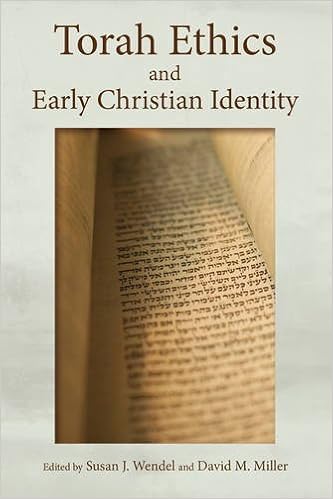
Torah Ethics and Early Christian Identity

I am happy to announce the release (in July) of Torah Ethics and Early Christian Identity (Grand Rapids: Eerdmans, 2016), edited by my friend and colleague, Susan Wendel, and yours truly.

The book is dedicated to our Doktorvater, Stephen Westerholm, whose interest in matters of Torah and ethics is long-standing.

The volume explores a question that is sometimes overlooked in the larger academic discussion about the role of the law in early Christianity: How did the Torah continue to serve as a positive reference point for Christians regardless of whether or not they thought Torah observance remained essential?

For those who care about such things, it should be clear from the roster of contributors that the essays do not hew to a particular "old" or "new" perspective:


TORAH ETHICS IN EARLY JUDAISM

Anders Runesson, "Entering a Synagogue with Paul: First-Century Torah Observance"

John W. Martens, "The Meaning and Function of the Law in Philo and Josephus"

TORAH ETHICS AND THE NEW TESTAMENT
 
Wesley G. Olmstead, "Jesus, the Eschatological Perfection of Torah, and the imitatio Dei in Matthew"

S. A. Cummins, "Torah, Jesus, and the Kingdom of God in the Gospel of Mark"

David M. Miller, "Reading Law as Prophecy: Torah Ethics in Acts"

Adele Reinhartz, "Reproach and Revelation: Ethics in John 11:1–44"

Scot McKnight, "The Law of the Laws: James, Wisdom, and the Law"

Beverly Roberts Gaventa, "Questions about Nomos, Answers about Christos: Romans 10:4 in Context"

Terence L. Donaldson, "Paul, Abraham’s Gentile 'Offspring,' and the Torah"

Richard B. Hays, "The Conversion of the Imagination: Scripture and Eschatology in 1 Corinthians"

BEYOND THE NEW TESTAMENT

Susan J. Wendel, "Torah Obedience and Early Christian Ethical Practices in Justin Martyr"

Peter Widdicombe, "The Law, God, and the Logos: Clement and the Alexandrian Tradition"

Stephen Westerholm, "Canonical Paul and the Law"

You can pre-order your copy today from the Eerdmans website (for $35; listed as shipping July 26) or from Amazon (for $25.52; listed as shipping July 7).

Sunday, August 30, 2015

Could ancient Jews eat with Gentiles without violating the law?

Peter's vision by Domenico Fetti, via Wikimedia Commons

Could ancient Jews eat with Gentiles without violating the law?

It is safe to say that most readers of the New Testament (and many New Testament scholars) assume the answer is no. After all, (1) in Acts, when Peter returns from visiting Cornelius he is criticized for staying with uncircumcized men and "eating with them" (Acts 11:3). (2) In Galatians, Paul equates eating with Gentiles to living "like a Gentile (ethnikôs) and not like a Jew (ioudaikôs)" (Gal 2:12-14). These two passages seem parallel. (3) Since Peter responds to his critics by telling a story about clean and unclean food that concludes with the declaration, “what God has cleansed, do not regard as defiled” (11:9), readers of Acts routinely conclude that, from Luke's perspective at least, accepting Gentiles into the church meant doing away with the food laws.

I am not so sure. For one thing, Luke never explicitly draws the conclusion from Peter's vision or his encounter with Cornelius that the food laws were set aside. To the contrary, in the latter chapters of Acts Paul insists on his own continued fidelity to the Jewish way of life: Paul participates in temple worship to show that he “guards the law” (21:24); he also denies that he has done anything against the law (25:8) or his people’s ancestral customs (28:17).

Outside the New Testament, passages that emphasize the strictness with which some Jews observed the food laws also demonstrate that it was possible to "keep Kosher" in Gentile contexts: (1) Daniel and friends refuse the king's food and wine, requesting a diet of vegetables and water, but it was still the king's vegetables and water that they ate (Dan 1:8, 12). (2) Josephus describes a group of priests imprisoned in Rome who survived on a diet of figs and almonds out of piety toward God (Life 14). Martin Goodman concludes: "For pious Jews to eat with non-Jews, sharing a convivial table, was possible, but difficult" (Rome and Jerusalem 119).

Moreover, the food laws were interpreted differently by different Jews:
"It is important to remember that--notwithstanding many wide areas of absolute conformity--evolving Jewish law, even within the normative Orthodox wing alone, has never been monolithic. As a result, it is usual for all popular guides to the practice of kashruth (including cookbooks) to contain strong disclaimers and exhortations to the reader to consult local competent rabbinic authority at all times." - Gene Schram, "Meal customs (Jewish)" Anchor Bible Dictionary 4.649.
If this is true for Orthodox Judaism today, how much more may we suppose that there was room for variety in the first century?

E.P. Sanders explains that in addition to the avoidance of pork, food sacrificed to idols and food containing blood posed "potential problems" for observant Jews. "There are possible problems with other foods, especially the main liquids, oil and wine. A libation to a pagan deity might have been offered from wine before it was sold; oil also might have an idolatrous connection." Aside from these restrictions, Gentile food could be fair game, although "some Jews were generally unwilling to eat pagan food, even when there might be no legal objection to it." On the other hand, Sanders suggests that Paul was not the only first-century Jew who advised eating whatever was set before them without asking questions of conscience: "In 1 Cor. 10.27, Paul advises Christians not to ask about the source of food when in someone else's house, and it is most likely that in the Diaspora some Jewish families followed the same practice" (E.P. Sanders, Judaism: Practice and Belief: 63 BCE – 66 CE. [Philadelphia: Trinity Press International, 1992], 216).

To this evidence, we may add a passage from the Mishnah about Gentile wine and its use in idolatrous libations, which takes for granted that Jews could in some contexts eat with Gentiles:
"If an Israelite was eating with a gentile at a table, and he put flagons [of wine] on the table and flagons [of wine] on the side-table, and left the other there and went out, what is on the table is forbidden and what is on the side-table is permitted..." (Avodah Zarah 5.5).
However we understand NT passages such as Acts 10-11 and Galatians 2, we need to set aside once and for all the idea that Jews believed eating with Gentiles meant violating the law. That simplistic assumption rests on a failure to engage early Jewish sources--and a failure of historical imagination.

Saturday, July 4, 2015

The Maccabean Revolt and Reverse Polemic in Acts, and other summer projects

As usual when I forecast a blog post on a particular topic, nothing materializes (like rain this year in Saskatchewan). My excuse this time is that I needed to write the paper, not about it, and shortly after posting about the Maccabean revolt in Acts back at the beginning of May, I took the paper in a slightly different direction so that the question I meant to ask no longer seemed as pressing. For what it is worth, here is what I concluded when I presented the paper at the Canadian Society of Biblical Studies at the end of May:

Connections in Acts to the initial events leading up to the Maccabean revolt are more extensive than is generally recognized, and these challenge the view that Acts narrates a transition from Judaism to Gentile Christianity. The parallels between Acts and 1-2 Maccabees fall into two contrasting patterns. On the one hand, Jewish opponents of the Gentile mission appeal to the Maccabean revolt to paint the practices of Jewish Christ-believers as a threat to Jewish identity, just as the “renegades” had been during the reign of Antiochus Epiphanes. On the other hand, Luke reverses the polemic and asserts that it is the Jewish leadership in Judaea, as well as other hostile Jews, who resemble Antiochus and the “renegades,” and that Jewish Christ-believers, by contrast, correspond to the faithful Israelites who endured Antiochus’s persecution. Faithfulness, for Luke, now requires faith in Jesus. But the law remains important. Instead of triumphantly moving beyond Judaism and the law, Luke employs “reverse polemic” to try to show that the messianic claims of Jesus and the Gentile mission championed in Acts need not undermine the law or threaten the Jewish identity of Jesus’ Jewish followers.
When I got back from Ottawa, I intended to spend my remaining summer research time revising this and one other paper. I turned to the other paper first...and it promptly fell apart in my hands. I didn't want to leave the pieces scattered all over the floor, but picking them up and puzzling over where I think they now belong has required delving into an area (Greco-Roman political thought) in which I can claim no expertise, and has taken longer than I hoped. But that's how it goes. At times like these, I try to remind myself to breathe, relax, and enjoy the privilege of being able to study and learn new things. They say that quality can't be rushed.

In other news, it did rain today. When I went outside this evening, I found the remains of a robin's nest washed down the downspout on our garage, which just goes to show that even in a drought you shouldn't put your egg basket in a rain gutter.

Thursday, May 7, 2015

The Maccabean Revolt and the Ambiguous Identity of Gentile Christ-Believers in Acts

My major priority right now is finishing a draft of an essay that I am to present at the Canadian Society of Biblical Studies in Ottawa at the end of the month. I am posting a (lightly revised) version of the abstract I submitted in January because I hope to comment more on questions related to the paper in a bit:
In this paper I will argue that Luke draws on the familiar storyline of the Maccabean revolt both to present criticism of Paul and to respond to it. The claim that Paul, like the Hellenizers of the Maccabean era, defiled the temple, and taught against the law and the people (Acts 21:28) treats Paul’s Gentile mission as a threat to Jewish identity. Luke responds by reversing the Maccabean “script”: Instead of collapsing a distinction between Jews and Gentiles, Luke maintains that the charges against Paul confuse Paul’s instructions to Gentiles with his instructions to law-observant Jews, and suggests that it is not Christ-believing Jews, but Paul’s Jewish opponents who violate the law and are thereby responsible for the temple’s demise.
It is not coincidence that my paper deals with some of the same issues I was working through last year (here, here, here, here, and here).

Tuesday, November 25, 2014

Reading Law as Prophecy: Torah Ethics in Acts

A public service announcement for sojourners in Southern Saskatchewan:

This year's Briercrest College and Seminary Colloquium series kicks off on Friday, November 28th, just before the start of Briercrest's Christmas Festival. (Why not come for an academic paper, and stay for the music? ...Or vice versa.) 

I am up first this year. My paper is entitled "Reading Law as Prophecy: Torah Ethics in Acts." Here is the abstract:
The author of Acts distinguishes between Jewish Christians, who remain oriented to the law, and Gentile Christians, who are not subject to the law. Luke draws on the law’s demands as well as its predictions to present Torah-observant Jewish Christians as faithful Israel, and to demonstrate that salvation extends to Gentiles apart from the law without violating the law. Although Acts does not directly articulate a Torah ethic for Gentiles, Luke probably assumed that Torah should guide Gentiles ethically in the same way that he applied the predictions and demands of biblical prophecy by analogy to audiences not directly addressed by the prophets.
Please join us on Friday, November 28, in room 144 @ 12:30 PM if you can make it out. 

Monday, August 11, 2014

The Law and Faith in Luke-Acts: An Exercise in Stating the Obvious

Any time you study a particular topic you run the risk of skewing its significance. What is central to your thinking must be central to the author you are studying, right? In my study of Luke's understanding of the law of Moses, it has been helpful to step back far enough to notice that although law is important to the narrative argument of Acts, it pales in significance to faith. Consider the following evidence about Jewish Christ-believers and the law:

The early Jewish Jesus movement can be designated as "all those who believe" (Acts 2:44), the "multitude of those who believed" (4:32) or simply as "believers" (5:14). Jewish priests who respond become "obedient to the faith" (6:7), not the law.  Both Jews and Gentiles who join the community are commanded to believe (16:31; cf. 10:43; 19:4; 20:21). By contrast, no passage in Acts enjoins Torah observance on Jews.

Law and faith need not be opposed, as they are in Paul, but this should be clear enough: In Acts faith is a positive requirement for all Christ-believers, while references to the Torah-observance of Jewish Christians are primarily descriptive.

Saturday, August 2, 2014

Reading Luke's Silences about Jewish-Christian law observance part 2

Some readers of Acts conclude from Luke's general silence about such things as Sabbath observance and the food laws that Jewish believers were no longer required to keep the laws that distinguished Jews from non-Jews. After all, Paul on trial in Jerusalem claims to believe the law and the prophets (24:14); he does not explicitly say that he observes every jot and tittle. For these readers, the Lukan Paul's silence about Sabbath observance is deafening. When Paul claims not to have violated the law (25:8), we understand him to add under his breath, "...as I interpret it."

Other readers conclude from hints early on in Acts (and in Luke's Gospel!) that Jewish "Christ-believers" are presented as Torah observant. For these readers, Luke's silence about explicit violations of the law confirms not only that Jewish-Christians do keep the law, but that they must. According to Acts, salvation is by faith, of course (Acts 15:11), but just as Gentile Christ-believers are required to keep the terms of the apostolic decree, so Jewish Christians are required to live under the terms of the Mosaic covenant.

When do we conclude a silence is significant? When do we assume Luke expected his readers to take for granted what he did not say?

Two (rather obvious) suggestions: (1) we can be more confident about the function of the law in the story Luke does tell. Silences are secondary. (2) Luke's comments and silences need to be controlled by our understanding of the narrative. A strong case for a particular reconstruction can be made if we can explain how it ties into another of Luke's themes or into the narrative argument of Acts--or both.

Even so, there remains a degree of guesswork, of gap-filling and ambiguity. And at times we must leave gaps unfilled, concluding that Luke simply does not speak to the question. For example:

  • References to the "apostolic decree" in Acts 16:4 and 21:25 indicate that Luke believed the prohibitions against blood and the meat of strangled animals apply to all Gentile Christians everywhere. What would Luke have said about a Gentile believer who continued to indulge in non-Kosher rare steak and the meat of strangled animals?
  • A variation on the same scenario: Imagine an apostate or non-observant Jew who becomes a follower of Jesus. Would Luke's church instruct him to keep the law as well as believe in Jesus?

Obviously, scenarios that Luke does not address can still be useful to think with. They have the potential to shed light on Luke's historical context and his reasons for writing.

Friday, August 1, 2014

Reading Luke's silences about Jewish-Christian law observance

Rover as "sober second thought"
In a previous post I suggested that our unexamined assumptions about the meaning of "salvation" make it more difficult for us to grasp what Luke says about the law. Here I want to consider another reason why the topic of the law in Luke-Acts is so complicated: Every attempt to comprehend what Luke says about the law must account for what he does not say as well as what he does say, and Luke's silences can be read in several different ways.

As I have tried to push for consistency, for an interpretation of Acts that makes sense of all the data, I have found myself offering readings of individual passages that, on sober second thought, seem unsustainable. After multiple attempts to walk away with a solution to the problem of Luke and the law, it dawned on me that  allowing two readings of Luke's silences to sit side-by-side without deciding finally between them is better than a tour de force that forces all the evidence to fit instead of admitting honestly where the difficulties are.

This does not mean that Luke is inconsistent, only that the sense he makes--or the sense that at this point I can make of him--lies somewhere else.

Wednesday, July 23, 2014

The law and salvation in Luke-Acts

In Luke's Gospel Jesus tells an expert in the law to do what the law says if he wants to inherit eternal life (Luke 10:25). But in Acts Peter declares, "through the grace of the Lord Jesus we believe to be saved" (Acts 15:11). Explaining the relationship between these two apparently conflicting statements about works and faith is only one of the puzzles that make grasping what Luke says about the law so challenging.
I have begun to wonder if part of the difficulty is our assumption that we know what salvation is. What if, for Luke, salvation is a new sectarian thing that qualifies law, not a result of the law itself? In other words, what if "salvation" in the Christian sense only became a live issue for the sectarian group made up of Jesus' followers?
If so, it would be anachronistic to suggest that salvation in the sense that Luke uses it would have been legitimately connected to Torah by Second Temple Jews. In Luke, as for Paul, then, there would be a move from solution to plight, and it wouldn't be the law's fault that it can't--and wasn't expected to--deal with the new problem(s) to which "salvation" is the answer.

In any case, reducing the Christian value of the law to a via media or to a concern for its sociological effects (e.g., to legitimate Christianity in Roman eyes by linking it to ancient Jewish tradition), seems to underplay its continued significance for Acts. It is as if "salvation" is such a big thing, that we can't appreciate any subsidiary and on-going role for the law.

(For earlier thoughts on salvation in Luke-Acts see this post, and follow the links back.)

Photo credits: Big Four Ice Caves, Washington (more links here and here). Don't worry, we didn't go inside.