Tuesday, May 23, 2023

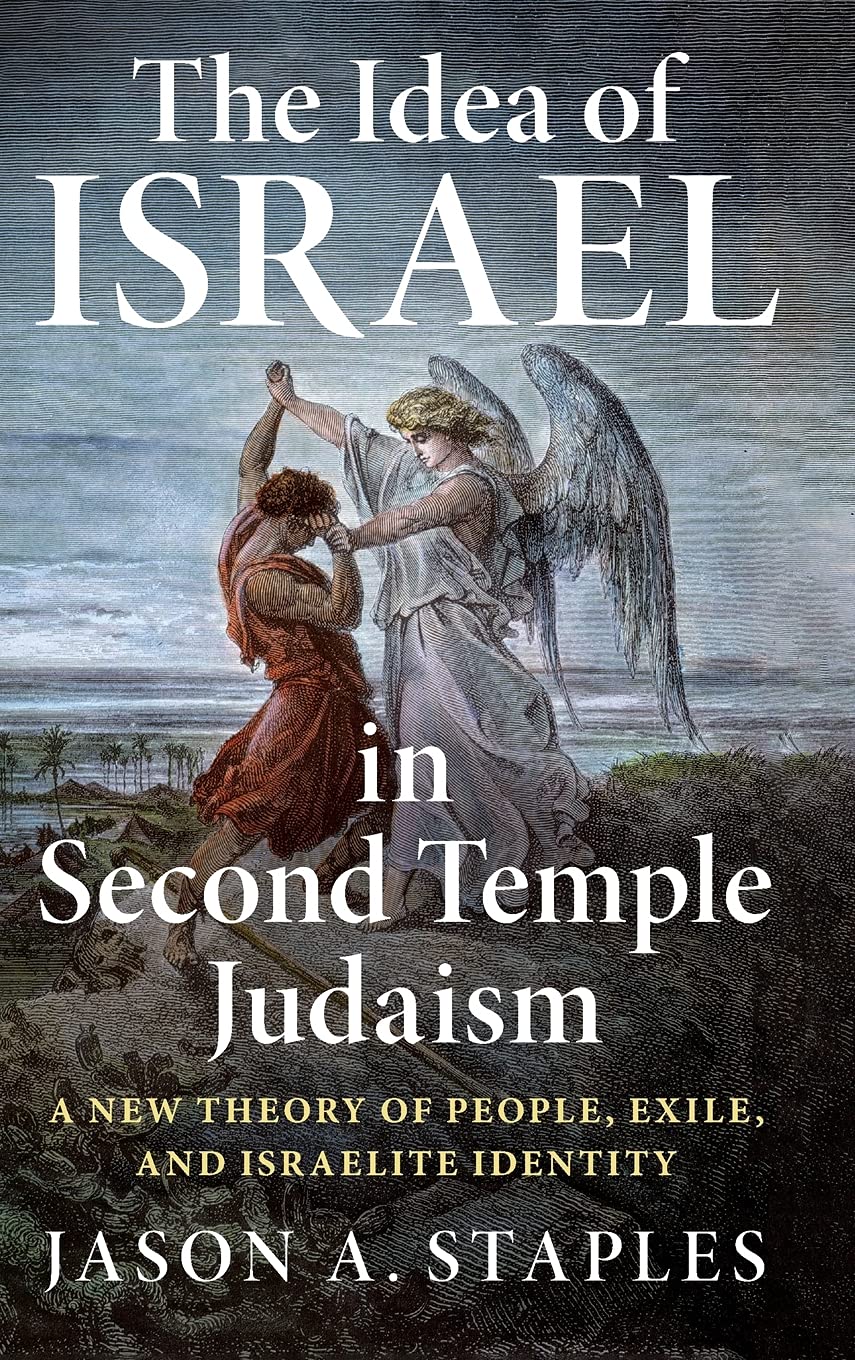
Josephus and Jewish Ethnonyms: Evaluating Jason Staples's Idea of Israel in Second Temple Judaism

I'm on to present a paper at the Canadian Society of Biblical Studies annual meeting at Congress in Toronto next Monday. I put the abstract together in January on a hunch, in the hopes that a deadline would force me to finish a book I wanted to read, and prime the writing pump. Since I didn't make nearly as much progress as I wanted over the semester, it also made a gauntlet of a winter-spring that much more demanding. Right now, however, I'm grateful because at least in a few moments over the last intense week of research and writing, the chance to concentrate on a single intellectual puzzle long enough to make headway has felt strangely like a mental vacation. 

The abstract is not quite what I would say now that I have a more-or-less complete rough draft in hand, but it is close enough to what the paper is still trying to do that I will post it here in case anyone is interested:

In The Idea of Israel in Second Temple Judaism (CUP, 2021), Jason Staples argues that instead of being mutually interchangeable terms for the same group, “Israel” referred to the “tribes of the biblical northern kingdom” or to “the twelve-tribe covenantal people,” while Ioudaios (and cognates) designated a “subset” of this larger group associated with the southern tribes and the biblical kingdom of Judah. This paper will test Staples’s proposal against the evidence in Josephus. I will consider Josephus’s explanation for his own shift in terminology within the narrative context of the Antiquities; reevaluate the dueling claims of Ioudaioi and Samaritans in Antiquities books 9 and 11; and examine the labels Josephus uses to designate both those who returned from exile and those who remained “beyond the Euphrates.” We will see that within Josephus Ioudaios could still serve as a label for the people as a whole, including descendants of the northern tribes.

I may have more to say once the draft is revised and the paper is presented.

Saturday, March 18, 2023

Briercrest's Fall 2023 Ancient Greek Semester

I am pleased to report that we will be running our third immersive Greek semester this coming fall on the Briercrest College & Seminary campus. As I wrote last time,

Our intensive series of five three credit-hour courses is designed to take students from the Greek alphabet to a reading knowledge of ancient Greek, including the Koiné Greek of the New Testament. In our immersive classroom context on the Briercrest College & Seminary campus, students have the opportunity to learn ancient Greek in ancient Greek, as they would any modern language. Because it is geared to the way people naturally learn languages, an active communicative approach to learning Greek leads to deeper and longer-lasting learning than the conventional grammar-translation approach used in most North American academic settings; it also appeals to a wider range of learning styles (and is more fun!) 

As far as I know, our immersive, semester-long approach to teaching Ancient Greek in Ancient Greek is unique in North America. (For more detail, see this post and follow the links.)

Our Immersive Greek Semesters run every second year. Almost four years after the first iteration, we have begun to see the payoff:

  • There's the graduating student who took Greek Semester 1.0 in the fall of 2019, who tells me she still regularly reads her Greek New Testament.

  • Six students from Greek Semester 2.0 (fall 2021) elected to read through the Greek text of Acts last semester as part of their course requirements in my English-Bible Acts class. I sat down with each student twice during the semester to have a conversation in Ancient Greek about selected passages from Acts. None of us would claim fluency, but I was uniformly impressed at how much they understood from the text of Acts and how well they could make themselves understood in Greek.

  • I am currently sitting in on my colleague Wes Olmstead's Greek VII course, partly to see how he runs advanced classes, and partly because I wanted to read the extrabiblical texts he assigned. So far this semester, the seven students in the class have read Galatians, they are about halfway through Matthew's Gospel, we recently finished Plato's Apology--a text I had never read before in Greek--and we have started on Melito of Sardis's 2nd century Easter homily, Peri Pascha, a text I'm afraid I was totally unfamiliar with. Need I mention that the class is taught in Greek? 

In short, it's working. Care to join us? 

Friday, January 20, 2023

A 2022 "Reading" (and Listening) Retrospective


A modest discovery—prompted initially by the need to squeeze in as much Hebrew listening as I could—paid "reading" dividends last year: I realized that even a five minute commute is enough to make real headway in an audiobook or podcast, especially when the commute is multiplied by four and the playback speed is turned up to 1.5. When you add in the time it takes to put on and take off boots, toque, and jacket to prevent frostbite during our Saskatchewan winters, the amount of "reading" doubles. 

Thanks to multiple daily mini-commutes, a couple longer road trips, household chores, and a decent set of Bluetooth earbuds, almost one third of the books I "read" in 2022 were audiobooks. For the glass-half-empty folks out there, the fact that nine out of thirty books "read" in 2022 were audiobooks means that I only completed a paltry twenty-one conventional books. Ten of the thirty were completed in December, which says something about the reading I was not doing the rest of the year. Twelve of the thirty were published in the last three years—surely a record. Aside from textbooks, I only made it through one monograph that can be said to be directly related to (one of) my primary research interests. On the other hand, the other reading was rich, rewarding, and often refreshing. Listening too: In addition to audiobooks and Greek and Hebrew audio, I (finally) subscribed to the excellent Onscript and Biblingo podcasts. 

Without further ado, here is a lightly annotated list in reading sequence, with links to blog posts:

Shelley, Mary Wollstonecraft. Frankenstein. New York: Dover, 1818. 
Bolt, Robert. A Man for All Seasons: A Play in Two Acts. London: Samuel French, 1960. [Followed a viewing of the Academy Award-winning movie, when trucking convoys were in the news.]
Bauckham, Richard. Jesus: A Very Short Introduction. New York: Oxford University Press, 2011. [A textbook, re-read for at least the 3rd and 4th times]
Barr, Beth Allison. The Making of Biblical Womanhood. Brazos, 2021. [The first audio book of the year, followed in succession by Kirsten Kobes du Mez (see below)]
Bradbury, Ray. Fahrenheit 451. New York: Simon and Schuster, 1967. [Last read during high school]
Keefer, Kyle. The New Testament as Literature: A Very Short Introduction. Oxford: Oxford University Press, 2008. [A textbook, re-read for at least the 3rd and 4th times]
Zimmermann, Jens. Hermeneutics: A Very Short Introduction. Oxford: Oxford University Press, 2015. [I expect to use this as a textbook the next time I teach undergraduate hermeneutics.]
Longenecker, Bruce W. The Lost Letters of Pergamum: A Story from the New Testament World. 2d ed. Grand Rapids: Baker Academic, 2016. [A textbook; read multiple times previously]
Brown, Peter. The World of Late Antiquity: AD 150-750. New York: Norton, 1989. [Read aloud to the family; a classic I should have read years ago.]
Frank, Anne. Anne Frank: The Diary of a Young Girl. Garden City, NT: Doubleday, 1952. [Maybe it was the play rather than the diary that I read 30+ years ago.]
Nayeri, Daniel. Everything Sad Is Untrue. Montclair, New Jersey: Levine Querido, 2020. [See this post for my recommendation.]
Du Mez, Kristin Kobes. Jesus and John Wayne: How White Evangelicals Corrupted a Faith and Fractured a Nation. Liveright, 2020. [Audiobook]
Dinesen, Isak. Out of Africa and Shadows on the Grass. New York: Vintage, 1989. [Audiobook; see this post for my recommendation.]
Stanley, Christopher D. A Rooster for Asklepios: A Slave’s Story, Book 1. 3rd edition. NFB Publishing, 2020. [A fun historical novel written by a NT scholar; especially enjoyable if you have spent time in the historical sites in Turkey where the story is set.]
Stroup, Christopher. The Christians Who Became Jews: Acts of the Apostles and Ethnicity in the Roman City. Yale University Press, 2020. [A reminder not to trust dust jacket blurbs.]
Buechner, Frederick. The Alphabet of Grace. New York: Seabury Press, 1970. [I gradually realized I had read it before; still good the second time]
Jennings, Willie James. After Whiteness: An Education in Belonging. Eerdmans, 2020. [influenced this post; recommended]
Buechner, Frederick. Telling the Truth: The Gospel as Tragedy, Comedy, and Fairy Tale. New York: HarperCollins, 1977. [First read almost 30 years ago as a homiletics textbook; re-read aloud to the family.]
Holland, Tom. Dominion: How the Christian Revolution Remade the World. Basic Books, 2021. [Audiobook]
Kuhn, Thomas S., and Ian Hacking. The Structure of Scientific Revolutions: 50th Anniversary Edition. 4th edition. Chicago: University of Chicago Press, 2012. [Audiobook; a classic I've been thinking about (without reading it) for 25 years]
Jipp, Joshua W. Reading Acts. Cascade Companions. Eugene, OR: Cascade Books, 2018. [Textbook; re-read multiple times]
Skinner, Matthew L. Intrusive God, Disruptive Gospel: Encountering the Divine in the Book of Acts. Grand Rapids: Brazos Press, 2015. [Textbook; read for the first time but will probably do so again]
Birkett, Kirsten. Living Without Fear: Using The Psalms To End Your Worry And Anxiety. Self-published, 2022. [Recommended by my former colleague, Eric Ortlund; read aloud]
Rowling, J. K. The Christmas Pig. New York: Scholastic Inc., 2021.
Johnson, Luke Timothy. The Mind in Another Place: My Life as a Scholar. Grand Rapids: Eerdmans, 2022. [Audiobook; thought-provoking enough to generate several blog posts (herehere, and here)]
Plass, Adrian. The Horizontal Epistles of Andromeda Veal. London: Marshall Pickering, 1988. [Re-read]
Strawn, Brent A. Lies My Preacher Told Me: An Honest Look at the Old Testament. Louisville, Kentucky: Westminster John Knox Press, 2021. [Audiobook; "read" while crossing the Rockies on Dec 26]
O’Donovan, Oliver. Resurrection and Moral Order: An Outline for Evangelical Ethics. 2d ed. Grand Rapids: Eerdmans, 1994. [The book I'm most proud of finishing this year (see here and here for why)] 
Marsh, Charles. Evangelical Anxiety: A Memoir. San Francisco: HarperOne, 2022. [Audiobook. The tagline could be, 'Of course, I needed Jesus; I also needed therapy.' James K. A. Smith calls it "a bold, beautiful memoir, at once transgressive and faithful," which seems about right, though one should underscore transgressive. This is Marsh unfiltered. Not rated for a general audience.]
Hill, Wesley. Washed and Waiting: Reflections on Christian Faithfulness and Homosexuality. Grand Rapids: Zondervan, 2010. [Audiobook; "read" while crossing the Rockies on my way back to Saskatchewan on Dec 31]

The first and only book I've completed so far in 2023 is a re-read of Adrian Plass's hilarious The Theatrical Tapes of Leonard Thynn, surely an auspicious start to the year. I'm also slowly digesting Jason Staples's Idea of Israel in Second Temple Judaism, about which I hope to say more in due course.
Thursday, December 29, 2022

Luke Timothy Johnson Shoots the Moon

In the final two chapters of his memoir, Luke Timothy Johnson describes what it takes to be an excellent (and productive) scholar, someone with the requisite raw-material—intelligence, rapid reading fluency, memory—who is increasingly characterized by the intellectual virtues of curiosity, respect for evidence, mastery, wide and critical reading, imagination, clarity and cogency, and by the moral virtues of courage, ambition, discipline, persistence, detachment, contentment, and (surprisingly) multitasking. 

Mastery for mature scholars of "New Testament and Christian origins" begins with "comprehensive knowledge of the content and rhetorical character of each OT and NT writing" as well as "a firsthand grasp of all the critical questions concerning those compositions." Mastery also entails "appropriate interaction with all of Greco- Roman literature, Jewish literature, and early Christian literature at least to the time of Constantine":

"The mature scholar ought to be as comfortable with the Sentences of Sextus as with the Sentences of Pseudo-Phocylides, with the Pirqe Avot and the Avot of Rabbi Nathan as with the Sifre on Deuteronomy, with the varieties of Jewish mysticism as with the hermetic literature, with Epictetus as with Plutarch, with the Didache as with Dionysius the Areopagite."

Nor is it sufficient to know the text themselves. The evidence that a scholar must respect includes "the entire history of interpretation."

Among the moral virtues, ambition—"not in the competitive sense of seeking to outdo others but in the sense of desiring excellence"—is "the 'motor' that pushes the scholar to significant accomplishment."

Also essential is contentment, the "freedom from a scholarly possessiveness manifested by obsessiveness, compulsiveness, and perfectionism":

"[I]f my identity and worth are not to be identified with my scholarship, then what I research and write can freely and generously be shared with others. As in other areas of life, so in scholarship: liberality and even prodigality reveal a freedom that is the opposite of a cramped perfectionism driven by anxiety, that only with great reluctance shares with others what I have discovered or crafted."

Few contemporary New Testament scholars can match Johnson's scholarly productivity. His autobiography makes it clear that his was no charmed ivory-tower existence: he wrote 35 books and 75 scholarly articles while being actively involved in university life and supporting family through significant personal adversity. Although Johnson peppers his account of the scholarly virtues with examples from his own life, he is at pains to insist that the final two chapters are not a self-portrait but an ideal to which he aspired in his "long career as a scholar." Besides, his abilities and the opportunities that came his way are in fact gifts from God.

For those with ears to hear, the memoir as a whole can serve as motivation for those just starting out, or a kick in the pants for academics mid-career.

Still, I came away with a few questions:

  • First, what if the pursuit of scholarly excellence conflicts with the ultimate goal—the goal Johnson identifies as his own—of becoming a saint? For ordinary mortals who don't possess Johnson's natural ability and rigorous training, and who perhaps lack his ambition, enormous industry and audacity, life may be more of a zero sum game where energy expended in scholarly production comes at the expense of other important things—one's family, for instance. At the very least, there is a temptation to cheat, to sacrifice those other important things instead of making room for both.
  • Second, there are other competing models of life before God and of scholarship that emphasize the virtue of moderation. (See, for example, the slow work movement, and its application to the academy in Berg and Seeber's The Slow Professor.) Is the only option for real scholars such enormous effort? Perhaps.
  • Third, middle-aged me questions Johnson's definition of scholarship as "an intellectual life that is both focused and productive" because productivity tends to be defined in terms of scholarly publications. Is productivity in this sense really the mark of a scholar? To be fair, Johnson does not simply equate the two:

"By productive, I mean that such learning gained by the mind is communicated to others, or is applied to the solution of other problems, with an eye to eventual communication, through teaching, writing, or other medium."

Insofar as productivity is reduced to publication (by Johnson's readers if not by Johnson himself) I suspect infection by the diseased bureaucratic drive to quantify everything.

To be sure, "[w]hen personal goals are insignificant, accomplishments will fall even shorter." Point taken. But most of those who aim high—even those who publish extensively—do not in fact succeed at producing anything that more than a few people read, as Johnson admits. What is the point of it all anyway? The vast majority of people have their most lasting impact not through what they write but through personal contact over time.

Questions aside, the story is interesting and well-told, and there is much to learn from, and to be challenged by, Johnson's example. Highly recommended! (If you listen to the audiobook, as I did, you get the added bonus of hearing Johnson narrate the book himself.)

Note: 

Tuesday, December 13, 2022

Luke Timothy Johnson on Not Wasting Time

"My first and most persistent goal in life was to become a saint .... In my own stumbling and clumsy fashion, I find that I truly do seek the face of God. Scholarship, like all other human endeavors, has always seemed to me secondary to the serious business of becoming a certain kind of person; scholarship is a game that can be played, and must be played, seriously and intently, with the scholar never forgetting that it is only a game, whose stakes are not ultimate." 

"Sowing seeds by scattering them in every direction means much waste, and yes, the sower seldom actually sees whether any of the sown seed yields a crop. But I would not trade the hours I spent in preparing and presenting all this array of words for any other task I might have been assigned. As I gladly learned, so gladly did I teach."

"As for properly scholarly writing and publication, I am acutely aware how few minds I have changed or improved. I know, in fact, that some of my views are regarded by many other scholars as wrongheaded or eccentric. But I am also aware that I never stinted in the effort to make a difference in how important issues are understood. I know that I have employed the gifts God has given me—a modest intelligence, a wealth of energy, a passion for truth and beauty—as fully as time and circumstances have allowed. I have never wasted time, and I have never allowed circumstances to be an excuse for less than full effort. I have pursued truth as I have seen it. With that realization, I must be content." 

- Luke Timothy Johnson, The Mind in Another Place: My Life as a Scholar (Grand Rapids: Eerdmans, 2022), 31, 267.

Luke Timothy Johnson has been a formative influence and sparing partner in my thinking about Luke-Acts for years, I'm a sucker for academic biographies anyhow, so no surprise that I find Johnson's memoir stimulating in all sorts of ways. Challenging too. Highly recommended for anyone interested in biblical scholarship (or biblical scholars) even if you disagree, as I do, with Johnson on various points.

Sunday, August 28, 2022

Oliver O'Donovan on the Corruption of Academic Authority

"The only authority that a particular person or thing may derive from the truth is a didactic authority which is self-effacing and points beyond itself. ... That is why our attachments of loyalty to individual wise men or particular books of wisdom are more problematic than our loyalties to favourite works of art, men of power or cultural traditions. Of course, such attachments may be delightful and enriching, as, for example, when we retain our reverence and affection for an inspiring teacher; but when that happens other elements have entered into his claim upon us which must not be confused with the claim of truth itself. When a wise man or a tradition of thought comes to be thought beyond reach of critical question, he or it is dishonoured. The translucent didactic authority to which it could once lay claim in the service of the truth has been replaced by an authority that is immediate and opaque. This changeling may be the authority of tradition, or it may be the authority of strength .... But either way the fundamental stance of the thinker vis à vis the truth, critical and open to criticism, will be betrayed by the seduction of the wrong kind of authority." - Oliver O'Donovan, Resurrection and Moral Order (Grand Rapids: Eerdmans, 1986), 126


Saturday, August 27, 2022

On Academic Ambition: A Summer Miscellany

“My first and most persistent goal in life was to become a saint.” So writes Luke Timothy Johnson in his academic autobiography, which I have, so far, only read about. In this interview with Nijay Gupta, Johnson reflects on how this goal shaped his work as a scholar:

“First, I have always considered only one thing essential — to become (or better, to allow God to make one) a certain kind of person. Everything else I have considered as secondary and non-essential. The judgment of other humans is trivial compared to the absolute judgment of God. Such a conviction enables one to speak boldly and without fear. 
“Second, I have considered scholarship as a serious enterprise, but one without ultimate importance. It is, indeed, a game that, like all games, must be played seriously if it is to be played well. But it is played best when it is played with the freedom that authentic faith gives and is not erected into an idolatrous project.

“Third, if scholarship is non-ultimate, then an academic career is even more nugatory. The academy should be regarded as a social arrangement whose importance is measured solely by the way it serves the ends for which it was designed. Do students learn? Do teachers grow in knowledge? Is the church and society made better by these processes? To the degree that “the academy” becomes absolute and self-serving, to that degree it has lost its way.” (Read the whole interview here.)

Johnson, a Roman Catholic New Testament scholar, is surely riffing off of Thomas Merton:

“There’s a wonderful moment in Thomas Merton’s The Seven-Storey Mountain when Merton — a new convert to Catholicism — is whining and vacillating about what he should be: a teacher, a priest, a writer, a monk, something else altogether maybe, a labor activist or a farm laborer. And his friend Robert Lax tells him that what he should want to be is a saint.” - Alan Jacobs

Academics who fail to get their ambitions straight all too easily end up with the apotheosis of scholarly vices that C.S. Lewis described as hell:

“We must picture Hell as a state where everyone is perpetually concerned about his own dignity and advancement, where everyone has a grievance, and where everyone lives the deadly serious passions of envy, self-importance, and resentment.” - C.S. Lewis, Preface to The Screwtape Letters (HT: Sean Davidson

I suspect C.S. Lewis’s picture of hell is part of what Willie James Jennings has in mind when he argues in After Whiteness that western theological education tends to form students into white, male plantation owners—those who seek control, possession, and mastery, and who know how to get it. “Whiteness,” Jennings says in this OnScript interview, is

“A way of being in the world and a way of seeing the world at the same time, a way of organizing, shaping, and envisioning the world. And whiteness is having the power to realize that vision. Whiteness is imagining the world from an imperial position of thinking and making. And whiteness has been presented as an aspiration for all those who have seen the possibilities of a world after the rise of colonialism—a world in which things can be changed, people can be owned, land can be owned. ... A white self-sufficient man ... embodies what I call three demonically derived virtues: control, possession and mastery. And that man has been imagined as the one who would build the world.” Willie James Jennings –– After Whiteness | OnScript

So which will it be—white male plantation owner or saint?