Sunday, February 21, 2010

Bible Arcing

One of the most helpful ways of tracing the flow of thought in biblical passages is now a whole lot easier thanks to BibleArc.com.

"Arcing" is valuable because it forces you to think about and articulate your understanding of the relationship between each unit of thought in a passage. When you are finished, you can see at a glance the major emphases of the passage, and how the various parts fit together.

Sometimes arcing exposes new interpretive possibilities and unexplored exegetical issues:
In John 3:16, for example, the issue is the relationship between οὕτως (translated 'so' by the ESV) and ὥστε ('that') in 16a and b. Before arcing the verse I assumed that ὥστε functions as it often does to indicate result: The result of God's great love was to give his only son. But this leaves the οὕτως at the beginning of the verse unexplained. Rather than indicating a quantity ("so great love"), the word οὕτως normally means "thus" or "in this way." After puzzling over my arcing diagram and looking at the related syntactical pattern in 3:14-15, I concluded that the ὥστε ('that') clause in 16b indicates the manner in which God loved the world rather than the quantity of his love. 16c-d go on to state the purpose of this loving gift.

The one major drawback of arcing is that it was time consuming to write out the text, draw, erase, and redraw each arc by hand. All that has changed with the arcing tool provided by BibleArc.com.  The tool automatically inserts the Greek or Hebrew text or translation of your choice, and dividing a passage into units of thought and drawing and erasing arcs is the work of a mouse click or two. Now instead of spending time writing out a passage you can concentrate on the work of analysis.

I was taught arcing in 1993 by Bruce Fisk. When I went on to TEDS for my MA, I was introduced to it again by D.A. Carson. When I began teaching Greek Exegesis, I created a replica to replace the tattered hand-out I had been using (download it here).

The method apparently originated with Daniel P. Fuller, professor emeritus of hermeneutics at Fuller Seminary, and son of the seminary's founder, Charles Fuller. Fuller's student, Thomas Schreiner, introduced the methodology in Interpreting the Pauline Epistles (Baker, 1990). It has been championed more recently by another of Fuller's students, John Piper. (See the video on the home page of BibleArc.com.)

Friday, February 19, 2010

From Resurrection to New Creation


Fellow blogger Michael W. Pahl's new book, From Resurrection to New Creation: A First Journey in Christian Theology (Eugene, OR: Cascade, 2010), arrived in the mail this morning.

The back cover includes blurbs by Michael J. Gorman, Scot McKnight, Daniel Kirk, and David M. Miller. Here's what the latter had to say:
"A splendid little book that explores the essentials of Christian theology in a fresh, lively, and insightful manner. By beginning with the resurrection, Pahl is able to make a point about both the center of Christian theology and how to do theology in a way that takes seriously the New testament's historical context. Highly recommended!"


The book makes for good and insightful reading in its own right--it is a splendid little book. Because it is a little book, it will be especially well-suited in church contexts (if churches teach about God these days) or in entry level college courses.

Wednesday, February 17, 2010

Greek Apostolic Fathers Online

Do a search for 'Greek Apostolic Fathers Online' and you will be directed to a blog entry by Stephen Carlson that directs you to the CCEL website, which claims to present Kirsopp Lake's public domain edition. Alan Humm's jewishchristianlit.com points to the same thing.

Unfortunately, it has become apparent in our 1 Clement Greek Reading Group that the CCEL text of 1 Clement, at least, is riddled with errors, including egregious misspellings and the omission of large verse sections.

Here are some alternatives (1 Clement only):

(1) Saint Clement of Rome (dabar.org; HT: earlychristianwritings.com) (only 1 chapter at a time)
(2) Κλήμεντος Προς Κορινθίους Α (only chapters 1-22)
(3) Rico's Apostolic Father's Lookup (only 1 chapter at a time...why is that??)
(4) early church texts (links to Rico's Lookup; only displays one chapter at a time)

Option 2 will work fine until we pass chapter 22. The restriction to one chapter viewing in options 1, 3-4 is annoying. Why is it that no one seems to make the whole text available at once?

Update:  (5) At DocumentaCatholicaOmnia, the whole text of 1 Clement can be downloaded as a PDF, and copied from there as unicode text. The best option yet! HT: Ken Penner.

Monday, February 15, 2010

Three Year Blogiversary

"Every act of writing, and all the more so the arrogation of credit for what one has written, is a sign of hubris." - Shaye J. D. Cohen, From the Maccabees to the Mishnah (WJK, 2006), 190

One might add in good Qal wahomer fashion, if this is true for writing in general, how much more for the writing of blogs?

Oddly enough, several of my earliest posts--quotations, mostly, that I had been collecting until I thought I had something to say--were about this very thing. On my very first entry 3 years ago today, I posted the lyrics to T-Bone Burnett's "Trap Door," the fourth post quotes from Mike Yaconelli on ego addiction, and the second, an excerpt from Martin Luther's commentary on Genesis 15, offers a solution.

Thursday, February 11, 2010

Barth on Grace and Disturbance of Soul

"Grace is the incomprehensible fact that God is well pleased with a man, and that a man can rejoice in God....grace means bearing witness to the faithfulness of God which a man has encountered in Christ, and which, when it is encountered and recognized, requires a corresponding fidelity towards God" (31).

"He who is under grace can no more adjust himself comfortably to sin than the sinner can toy with grace as with an alternative human possibility" (217).

"To the man under grace, righteousness is not a possibility, but a necessity; not a disposition subject to change, but the inexorable meaning of life; not a condition possessing varying degrees of healthiness, but the condition by which existence is itself determined; not that which he possesses, but that which possesses him" (220).

"If we are able to endure life apart from this possibility [of obedience]; if we are content with something less; if we trim and adjust grace so that it dovetails in with other possibilities;--grace is not grace. If we are able to escape from that naturally Christian--Medieval!--disturbance of soul; if all that is in us does not stretch out towards a sanctified life prepared for and open to the righteousness of God; if we do not long for a life running so nigh to the righteousness of God that it would break visibly through in our members, in our mortal body;--grace is not grace" (223).

Quotations from Karl Barth, The Epistle to the Romans(Oxford: 1968).

Tuesday, February 9, 2010

Top 50 Biblical History Blogs

Update: I removed the links to the list and to "Linda" after reading Todd Bolen's eye-opening post about how "Top 50" Lists Work.

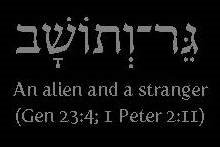
This just in: גֵּר־וְתוֹשָׁב has been included as #1 in a list of Top 50 Biblical History Blogs. How nice. I should note, however, that the list is organized alphabetically (by English name).
And one small correction: While I did my Ph.D. at McMaster University, I teach at Briercrest College and Seminary. Fine institutions, both. Still, thanks for the mention, Linda!

And, if this is your first time here, may I recommend the following sampling from the גֵּר־וְתוֹשָׁב past?

Paul and the End of the World
(Dec 8, 2009)
Pastor or Scholar? (Nov 6, 2009)
Retrospective Multivalence in Romans 2 (Sept 22, 2009)
History, Criticism and Christian Conviction - Part 2 (July 16, 2009)
Why I don't believe in "timeless truth" or "eternal principles" (Jan 27, 2008)
What's in a Name? On Jews and Judeans (Dec 21, 2007)
Turkey Travelogue (Nov 13, 2007)

As a Driven Leaf - The Ending

This is the last in a series of three posts with excerpts from Milton Steinberg's brilliant novel, As a Driven Leaf. (See here and here for the first two.) In the end, Elisha confesses to his former student, Rabbi Meir, that his quest was "vanity and a striving after wind:
Do you remember, Meir, that epigram quoted in the name of Rabbi Johanan ben Zaccai: "There is no truth unless there be a faith on which it may rest"? Ironically enough the only sure principle I have achieved is this which I have known almost all my life. And it is so. For all truth rests ultimately on some act of faith, geometry on axioms, the sciences on the assumptions of the objective existence and orderliness of the world of nature. In every realm one must lay down postulates or he shall have nothing at all. So with morality and religion. Faith and reason are not antagonists. On the contrary, salvation is through the commingling of the two, the former to establish first premises, the latter to purify them of confusion and to draw the fulness of their implications. It is not certainty which one acquires so, only plausibility, but that is the best we can hope for. (473)
The book celebrates the value of Jewish tradition, but also laments a social context that made no room for questions or for those who asked them:
That is the fantastic intolerable paradox of my life, that I have gone questing for what I possessed initially--a belief to invest my days with dignity and meaning, a pattern of behavior through which man might most articulately express his devotion to his fellows. In a sense it has all been a long arduous journey in a circle, whereby I have returned to my point of departure. And yet I may not enter. For those who live there insist, at least in our generation, on the total acceptance without reservation of their revealed religion. And I cannot surrender the liberty of my mind to any authority. Free reason, my son, is a heady wine. It has failed to sustain my heart, but having drunk of it, I can never be content with a less fiery draught. (474)
The book concludes with Rabbi Meir weeping on his master's grave:
Thunder rolled in the misty vault of the heavens. From the cemetery down the hill, from the grave at his feet and from out dead yesterdays ghosts came stealing. And he wept not alone for his master, but for himself as well, for a woman who rarely smiled, for sweet children who slept near by, for a people crushed and persecuted, for all the sons of men, their aches of the body and soul, and their dreams that die. (477)